Overview
- Cosmic voids are vast underdense regions of space spanning 20–300 megaparsecs in diameter, occupying roughly 60% of the volume of the universe and forming the dominant structural component of the cosmic web alongside filaments, walls, and galaxy clusters.
- First identified in the late 1970s through galaxy redshift surveys — most famously the Boötes void discovered in 1981 — voids arise naturally from the gravitational evolution of primordial density fluctuations, as matter drains out of underdense patches and accumulates along surrounding filaments and walls.
- Voids have emerged as powerful cosmological laboratories: their shapes test the expansion history of the universe through the Alcock–Paczyński effect, their imprint on the cosmic microwave background probes dark energy via the integrated Sachs–Wolfe effect, and their abundance function constrains both the matter density and the nature of gravity on the largest scales.
Definition and basic properties
Cosmic voids are the largest coherent structures in the universe: enormous, roughly spherical regions of space where the density of galaxies and matter falls well below the cosmic mean. Typical voids span 20–50 megaparsecs (Mpc) in diameter, though the largest known examples exceed 300 Mpc.4 Together, voids occupy an estimated 60% or more of the total volume of the present-day universe, making them the dominant component of the cosmic web by volume.5 The interior density of a mature void typically lies at 10–20% of the cosmic mean density, though the very centres of large voids can approach near-complete emptiness.4

Discovery and early observations
The existence of large underdense regions in the galaxy distribution was first demonstrated observationally by Stephen Gregory and Laird Thompson in 1978, who identified a conspicuous gap in the galaxy distribution between the Coma cluster and the Abell 1367 cluster.1 This work provided the first quantitative evidence that galaxies are not distributed uniformly on large scales but instead congregate in filaments and sheets separated by vast empty regions.
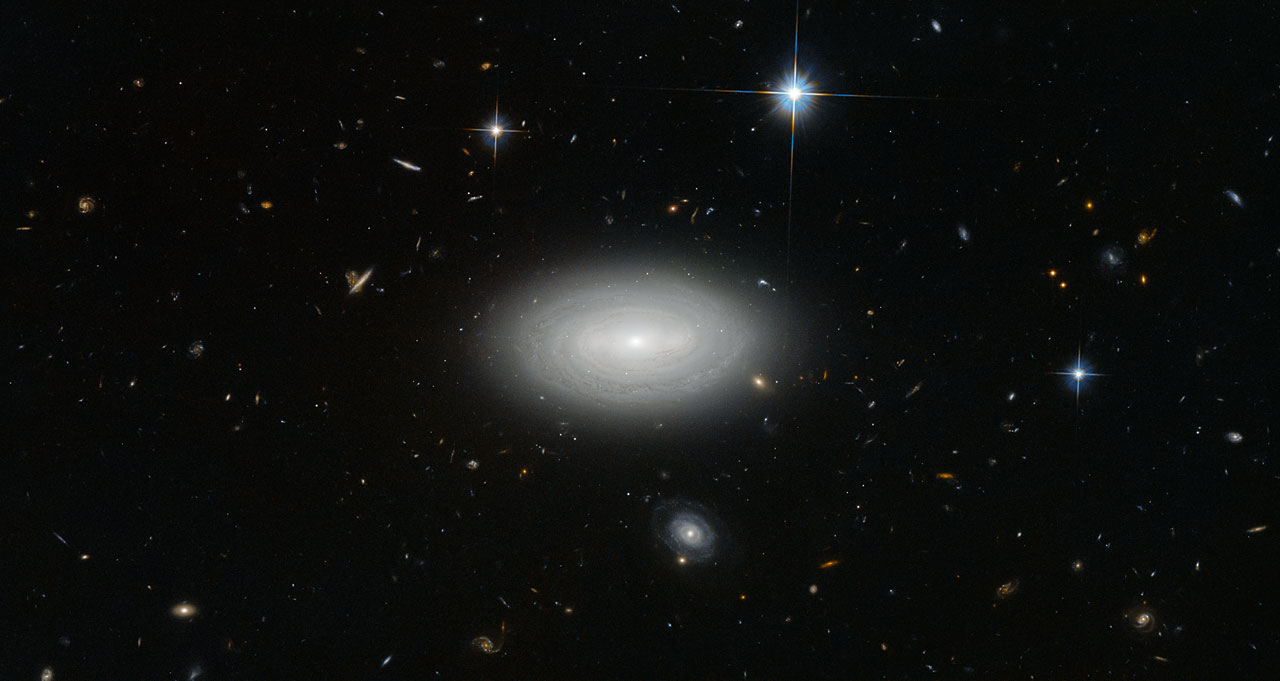
The discovery that captured wide attention came in 1981, when Robert Kirshner, Augustus Oemler, Paul Schechter, and Stephen Shectman reported a startling void in the constellation Boötes. This void, roughly 100 Mpc across, contained almost no galaxies in a volume of approximately one million cubic megaparsecs — an emptiness far more extreme than expected from random fluctuations in a uniform galaxy distribution.2 The Boötes void remains one of the largest and most thoroughly studied individual voids.
The true extent of the void network became apparent with the pioneering redshift surveys of the 1980s. The “slice of the universe” produced by Valerie de Lapparent, Margaret Geller, and John Huchra in 1986 revealed that galaxies are arrayed on the surfaces of bubble-like structures, with voids filling the interiors.3 This landmark result established the frothy, soap-bubble-like topology of the cosmic web and demonstrated that voids are not rare anomalies but a fundamental and pervasive feature of cosmic structure.
Formation and evolution
Cosmic voids form through the gravitational amplification of primordial underdensities — regions where the matter density was slightly below average in the very early universe. These initial density deficits, seeded by quantum fluctuations during cosmic inflation and imprinted in the cosmic microwave background, evolve under gravity in a manner that is the inverse of structure formation in overdense regions.4, 8
As the universe expands, matter within an underdense patch experiences less gravitational deceleration than the cosmic average. Material flows outward from the void interior toward the surrounding higher-density regions, causing the void to become progressively emptier over time. This evacuation process is self-reinforcing: as the void empties, the density contrast with its surroundings increases, which further accelerates the outflow of matter. The result is a characteristic void density profile with a nearly uniform low-density interior surrounded by a sharp ridge of compressed material at the boundary — the void wall.4
Ravi Sheth and Rien van de Weygaert formalized this evolutionary picture in 2004 using an excursion set framework, identifying two key processes that govern the void hierarchy. In the “void-in-void” process, a small void embedded within a larger underdensity is effectively absorbed as the larger void expands, erasing the smaller structure. In the “void-in-cloud” process, a small void located within or near a collapsing overdensity is crushed out of existence as the surrounding region collapses to form a filament, wall, or cluster.8 These two mechanisms together determine the size distribution of voids: small voids are systematically eliminated through merging or compression, producing the characteristic population of large, well-defined voids observed today.
Void galaxies
Though sparse, voids are not devoid of galaxies. The galaxies that do reside within voids differ systematically from their counterparts in denser environments, making them valuable probes of how environment shapes galaxy evolution. Studies using the Sloan Digital Sky Survey (SDSS) have shown that void galaxies tend to be bluer, less massive, and more actively star-forming than galaxies in walls or filaments at the same luminosity.12
Void galaxies also exhibit later morphological types on average: spirals and irregular galaxies are overrepresented relative to ellipticals.12 This pattern is consistent with the expectation that galaxies in low-density environments undergo fewer mergers and tidal interactions, processes that drive morphological transformation toward early-type systems. In effect, void galaxies evolve more slowly and retain more of their primordial characteristics, offering a window into galaxy evolution in the absence of strong environmental effects.5, 12
P. James E. Peebles highlighted the “void phenomenon” in 2001, noting that voids appear sharper and emptier than predicted by cold dark matter simulations of the time. The near-absence of even faint dwarf galaxies within void interiors posed a challenge for models of galaxy formation, as dark matter halos should still exist in moderate numbers within voids.5 Subsequent work has partially resolved this tension by invoking the suppression of gas accretion and star formation in low-mass halos through the ultraviolet background radiation after reionization, which renders many void halos dark or nearly invisible.
Void catalogs and identification methods
Constructing a catalog of cosmic voids from galaxy survey data requires a precise definition of what constitutes a void and an algorithm to identify them. Several void-finding methods have been developed, broadly falling into two categories: geometric approaches that identify underdense regions in the galaxy density field, and topological approaches that trace the boundaries of voids as watershed basins in the density landscape.4, 6
The ZOBOV (Zones Bordering On Voidness) algorithm, which applies a watershed transform to a Voronoi tessellation of the galaxy distribution, has been widely adopted. Danny Pan and collaborators applied this technique to the SDSS Data Release 7 to produce one of the most comprehensive public void catalogs, identifying over 1,000 voids with effective radii ranging from roughly 5 to 40 Mpc.6 These catalogs have become a standard resource for void cosmology studies, enabling statistical analyses of void properties, stacking of void signals, and cross-correlation with other cosmological observables.
The Dark Energy Survey has extended void identification to photometric galaxy samples, demonstrating that voids can be reliably found even without spectroscopic redshifts, although with somewhat degraded radial precision. Void catalogs from DES have been used for gravitational lensing analyses, establishing the feasibility of void lensing as a complementary probe of the mass distribution within and around voids.7
Voids as cosmological probes
Cosmic voids have emerged as powerful tools for precision cosmology, complementing traditional probes based on galaxy clustering, supernovae, and the CMB. Their utility derives from several properties: they are the most underdense environments in the universe, their dynamics are simpler and more linear than overdense regions, and their shapes and abundance are sensitive to the underlying cosmological parameters.13, 14
The Alcock–Paczyński test
Because cosmic voids are, on average, spherical when measured in physical coordinates, any apparent elongation or compression in their stacked shapes as measured in redshift space provides a direct test of the assumed cosmological model. This is the Alcock–Paczyński (AP) effect: the ratio of the radial to transverse dimensions of a statistically isotropic object depends on the product of the Hubble parameter and the angular diameter distance, which in turn depends on the expansion history and the density of dark energy.10 Guilhem Lavaux and Benjamin Wandelt demonstrated in 2012 that stacked SDSS voids provide competitive AP constraints, with the advantage that voids are less affected by the nonlinear peculiar velocities that complicate the AP test applied to galaxy clustering.10
The integrated Sachs–Wolfe effect
As photons from the CMB traverse a cosmic void, they experience a net energy change due to the time-varying gravitational potential of the expanding void. In a matter-dominated universe, the gravitational potential remains constant and the energy gained falling into a void is exactly cancelled by the energy lost climbing out. However, in a universe where dark energy dominates the expansion — as in the present epoch — the void potential decays while the photon transits, resulting in a net cooling of the CMB photon. This is the integrated Sachs–Wolfe (ISW) effect, and it produces faint cold spots in the CMB at the locations of foreground voids.9
Ben Granett, Mark Neyrinck, and István Szapudi reported in 2008 the detection of this signal by stacking CMB patches centered on the largest voids and superclusters identified in the SDSS, finding a combined ISW signal at approximately 4σ significance.9 The detected amplitude, however, was larger than expected from Lambda-CDM predictions, a tension that remains a subject of active investigation and has motivated explorations of modified gravity theories.14
Void abundance
The number density of voids as a function of their size — the void abundance function — is sensitive to the matter density parameter Ωm, the amplitude of density fluctuations σ8, and the equation of state of dark energy. Elise Jennings, Yin Li, and Wayne Hu showed in 2013 that the excursion set prediction for void abundance, calibrated against N-body simulations, can be used as a precision cosmological probe, with constraining power comparable to the cluster mass function but with different systematic uncertainties.15 Because void abundance is governed by the linear or quasi-linear regime of structure formation, it is less sensitive to the complex baryonic physics that complicates cluster-based constraints.13, 15
The Eridanus supervoid and the CMB cold spot
One of the most intriguing connections between voids and the CMB involves the so-called CMB Cold Spot, a region in the southern sky in the direction of the constellation Eridanus where the CMB temperature is anomalously low. The Cold Spot, roughly 10 degrees across, stands out as one of the most statistically unusual features in the CMB and has resisted straightforward explanation within standard inflationary cosmology.
In 2015, István Szapudi and collaborators reported the discovery of a large supervoid aligned with the Cold Spot, centered at a redshift of approximately z = 0.22 and spanning some 200–300 Mpc in diameter. This Eridanus supervoid is one of the largest individual voids ever identified.11 The alignment raised the possibility that the Cold Spot is at least partially caused by the ISW effect of this supervoid, as CMB photons traversing the decaying gravitational potential of such a large underdensity would emerge slightly cooler.
However, quantitative analyses have shown that the ISW contribution from a void of this size and depth accounts for only a fraction — perhaps 20–40% — of the observed Cold Spot temperature decrement, leaving the full explanation unresolved.11 Proposed alternatives include a primordial origin related to unusual initial conditions, a statistical fluctuation, or contributions from cosmic textures. The Eridanus supervoid and the Cold Spot remain active areas of research at the intersection of void science and CMB cosmology.
Voids and modified gravity
Cosmic voids provide a uniquely sensitive environment for testing theories of gravity beyond general relativity. In many modified gravity models — including f(R) gravity and certain scalar-tensor theories — the so-called fifth force is screened in high-density regions through nonlinear mechanisms such as the chameleon or Vainshtein screening. Voids, being the lowest-density environments in the universe, are precisely where these screening mechanisms are weakest and modified gravity effects are most pronounced.14
This makes void properties — their density profiles, expansion rates, lensing signals, and abundance — particularly effective discriminators between general relativity and its alternatives. Simulations of f(R) gravity predict measurably different void profiles compared to GR, with voids tending to be emptier and more sharply bounded in modified gravity scenarios.13, 14 The combination of void lensing from surveys like the Dark Energy Survey and Euclid with ISW and AP measurements promises to deliver some of the tightest constraints on deviations from general relativity on cosmological scales.7, 14
Future prospects
The next generation of galaxy surveys is poised to transform void cosmology from a niche pursuit into a mainstream pillar of precision cosmology. The Dark Energy Spectroscopic Instrument (DESI), which began its five-year survey in 2021, will map tens of millions of galaxies and quasars across an unprecedented volume, enabling the identification of hundreds of thousands of voids with precisely measured redshifts.14 The Euclid space telescope, launched in 2023, will combine deep imaging for void lensing with spectroscopic redshifts for void identification, providing simultaneous access to multiple void-based cosmological tests.
These datasets will allow void abundance, the AP test, ISW stacking, and void lensing to be applied jointly, breaking degeneracies between cosmological parameters that limit any single probe. Void statistics are also expected to improve constraints on the neutrino mass sum, since massive neutrinos suppress the growth of structure in a scale-dependent manner that leaves a distinctive imprint on the void size distribution.14 As Alice Pisani and collaborators have argued, voids represent a novel and largely untapped reservoir of cosmological information, one whose systematic exploitation is only beginning.13, 14
References
A public void catalog from the SDSS DR7 Galaxy Redshift Surveys based on the watershed void finder
Detection of the ISW and SZ effects from the CMB–large-scale structure cross-correlations