Overview
- The universe’s matter is organized on scales of tens to hundreds of megaparsecs into a vast network of filaments, walls, and voids — the cosmic web — first revealed by galaxy redshift surveys in the 1980s and now mapped across billions of light-years by the 2dFGRS and the Sloan Digital Sky Survey.
- The cosmic web forms because gravity amplifies tiny quantum density fluctuations from the early universe, imprinted in the cosmic microwave background, into the filamentary scaffolding seen today; dark matter, revealed in N-body simulations like Millennium and IllustrisTNG, provides the structural skeleton that baryonic matter subsequently follows.
- Most of the ordinary matter in the universe does not reside in galaxies but in a diffuse warm-hot intergalactic medium threading the filaments, detectable through quasar absorption spectra and the thermal Sunyaev-Zel’dovich effect, confirming the large-scale structure predictions of Lambda-CDM cosmology.
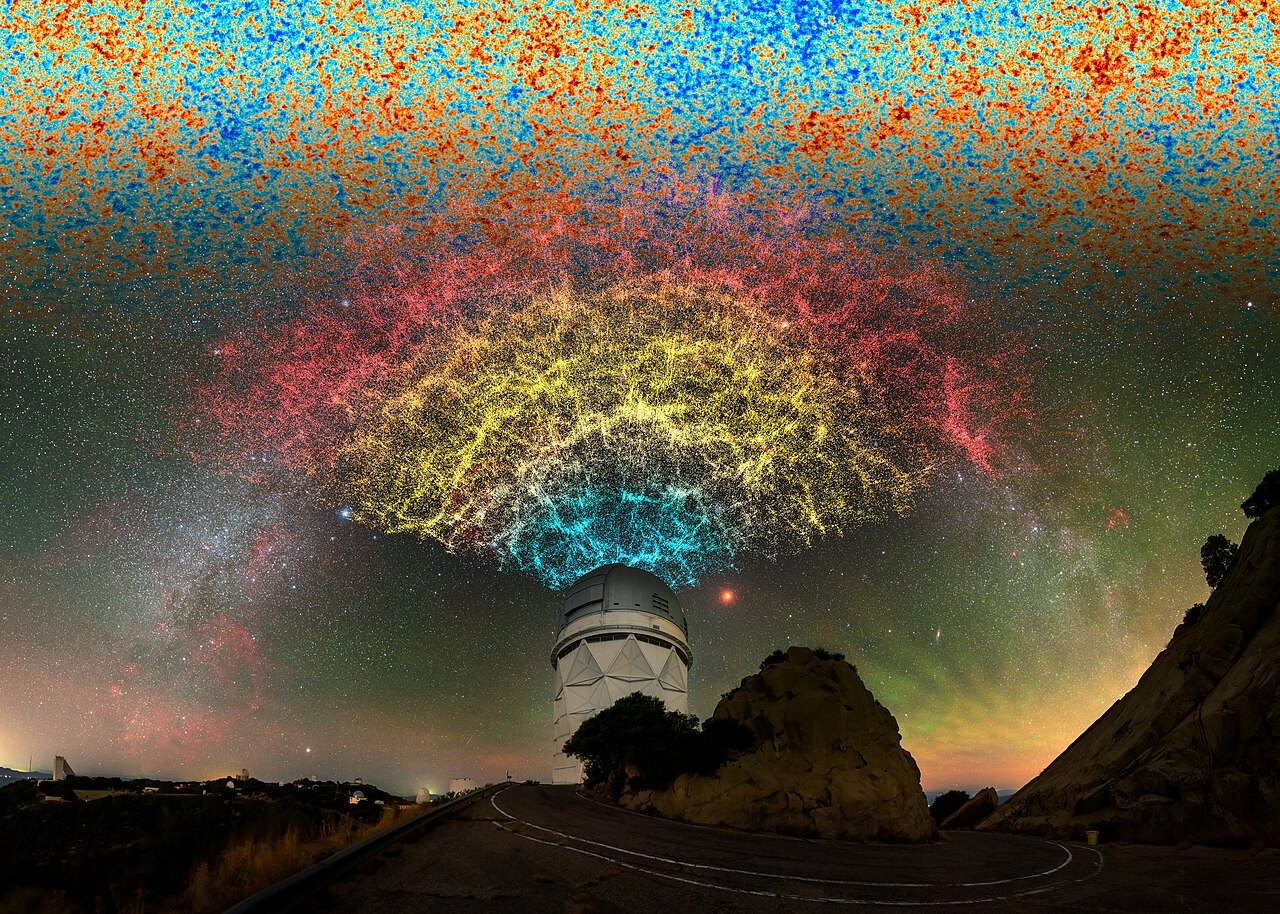
The universe, on its largest scales, is neither smooth nor random. Matter is gathered into an intricate, three-dimensional lattice of filaments, walls, and nodes separated by vast near-empty voids — a structure astronomers call the cosmic web. Galaxy clusters mark the densest intersections of this lattice; long filaments of galaxies and gas bridge them across hundreds of millions of light-years; and the interiors of the voids that occupy most of the universe’s volume are almost devoid of bright galaxies. This architecture, spanning scales from a few megaparsecs to the observable horizon, is the largest coherent structure known to exist and constitutes one of the most vivid predictions of the standard model of cosmology, Lambda-CDM — a universe composed of cold dark matter, ordinary baryonic matter, and a cosmological constant driving accelerating expansion.4, 10
.jpg)
The cosmic web is not merely a descriptive label for a pattern in galaxy maps. It is a quantitative prediction of gravitational physics operating on density fluctuations that were present in the universe fractions of a second after the Big Bang and are still visible today as temperature anisotropies in the cosmic microwave background. Understanding the cosmic web means tracing the gravitational amplification of primordial perturbations across 13.8 billion years, from the quantum seeds embedded in the inflaton field to the hundreds-of-megaparsec structures observable in modern redshift surveys.10, 18
Discovery: the redshift surveys that revealed the web
The first clues that galaxies were not distributed at random came from wide-field photographic surveys in the mid-twentieth century, which revealed that bright galaxies congregate in clusters and superclusters. But a two-dimensional sky map cannot reveal the three-dimensional distribution of matter. Only by measuring the redshift of each galaxy — its recession velocity, which by Hubble’s law encodes its approximate distance — could astronomers build the volumetric maps needed to see the cosmic web. The programme of systematically collecting galaxy redshifts in defined patches of sky, known as a redshift survey, transformed extragalactic astronomy in the 1980s and 1990s.
The Harvard-Smithsonian Center for Astrophysics (CfA) Redshift Survey, begun in the late 1970s and substantially extended through the 1980s, provided the first clear glimpse of the web. John Huchra, Margaret Geller, and their collaborators systematically measured redshifts for all galaxies brighter than a given apparent magnitude in a strip of sky. The first CfA survey, published in 1983, covered over 2,000 galaxies and revealed pronounced clustering.20 But it was the 1986 paper by Valérie de Lapparent, Geller, and Huchra — A Slice of the Universe — that made the large-scale pattern undeniable. Their redshift map of a thin wedge of sky showed galaxies arranged in curved sheets and filaments surrounding large, nearly empty regions. Galaxies appeared to trace the surfaces of bubble-like voids, with clusters at the intersections of the bubbles.1 The map was startling to many astronomers who had expected a more uniform distribution, and it set the agenda for large-scale structure research for decades.
The 2dF Galaxy Redshift Survey (2dFGRS), completed in the early 2000s by an Anglo-Australian collaboration using the Two-degree Field spectrograph at the Anglo-Australian Telescope, extended the programme to nearly 250,000 galaxies across two large strips of sky. The 2dFGRS confirmed and quantified the web at far greater statistical power, enabling measurements of the galaxy power spectrum, the matter density of the universe, and the rate of structure growth.2, 21 The Sloan Digital Sky Survey (SDSS), which began collecting data in 2000 using a dedicated 2.5-metre telescope at Apache Point Observatory, pushed further still: over its successive data releases it mapped more than three million galaxy spectra across roughly a quarter of the sky, providing the most detailed and statistically complete three-dimensional map of the nearby universe yet constructed.3 SDSS maps made the three-component anatomy of the cosmic web — filaments, walls, and voids — visually spectacular at scales up to several hundred megaparsecs, and they enabled the first robust detection of baryon acoustic oscillations in the galaxy distribution in 2005.24
Anatomy of the cosmic web
The cosmic web has three principal structural elements. Galaxy clusters — the most massive gravitationally bound objects in the universe, with total masses between 1014 and 1015 solar masses — occupy the densest nodes where multiple filaments intersect. Hundreds to thousands of galaxies are concentrated in these regions, embedded in vast dark matter halos and a hot, X-ray-emitting intracluster medium. Filaments are elongated overdense structures that connect clusters; they typically span tens to hundreds of megaparsecs in length and contain a significant fraction of all galaxies, arranged along the filament axis by the gravitational collapse of matter toward the filament spine. Voids are the underdense interiors — roughly spherical or ellipsoidal regions, typically 20 to 100 megaparsecs in diameter, where galaxy counts fall well below the cosmic mean.4, 9
Several individual structures deserve mention as landmarks in the cosmic web. The Sloan Great Wall, identified in SDSS data by Gott and colleagues in 2005, is one of the largest known structures in the observable universe: a sheet of galaxies approximately 420 megaparsecs (roughly 1.37 billion light-years) long, located at redshift z ≈ 0.08.8 It is a wall-like concentration of galaxy clusters rather than a single gravitationally bound object. The Boötes Void, discovered in 1981 and subsequently confirmed as one of the largest known voids, is an approximately spherical underdense region in the direction of the constellation Boötes, spanning roughly 330 megaparsecs (about 1 billion light-years) in diameter at redshift z ≈ 0.05.9 The interior of the Boötes Void is not completely empty — a small number of galaxies have been found within it — but its galaxy density is far below the cosmic average.
At a more local scale, the Laniakea Supercluster, defined by R. Brent Tully and colleagues in 2014 using peculiar velocity flows rather than galaxy number counts, encompasses approximately 100,000 galaxies across a volume roughly 160 megaparsecs in diameter. The Milky Way lies near the outskirts of Laniakea, within a subsidiary structure called the Local Group, which is itself part of the Virgo Supercluster. Tully and colleagues showed that the entire Laniakea volume is gravitationally coherent in the sense that all galaxies within it are moving, on large scales, toward the region of greatest gravitational attraction, known as the Great Attractor.7 The definition of Laniakea as a supercluster based on gravitational basins rather than galaxy density was a conceptual advance that highlighted how structures in the cosmic web are better understood dynamically than statistically.
Formation: gravitational instability and the Zel’dovich approximation
The cosmic web did not exist at the Big Bang. In the very early universe, matter was nearly uniformly distributed, with density fluctuations at the level of only one part in 100,000, as revealed by the temperature anisotropies of the cosmic microwave background first mapped precisely by the COBE satellite in 1992 and subsequently characterized with extraordinary detail by the WMAP and Planck missions.10 These tiny fluctuations are the seeds of all structure: over 13.8 billion years of gravitational amplification, they grew into the galaxies, clusters, and filaments of the present universe.
The theoretical framework for how this amplification proceeds was pioneered by Yakov Zel’dovich in 1970 in what is now known as the Zel’dovich approximation. Zel’dovich showed analytically that gravitational collapse of a slightly overdense region is generically non-spherical: matter first collapses along one axis, forming a sheet called a pancake, then along a second axis to form a filament, and finally along the third axis to form a point-like cluster. This sequence of collapses from three-dimensional overdensities naturally produces the filamentary and sheet-like geometry of the cosmic web without requiring any special initial conditions beyond a generic spectrum of density perturbations.19 The Zel’dovich approximation is a first-order Lagrangian perturbation theory valid until shell crossing, and it remains a conceptually powerful description of how the web forms even in the era of detailed N-body simulations.
The full nonlinear evolution of the cosmic web requires numerical simulation. The Millennium Simulation, published by Volker Springel and the Virgo Consortium in 2005, was a landmark N-body simulation following the gravitational evolution of 10 billion dark matter particles in a volume 500 megaparsecs on a side from redshift z = 127 to the present. It produced a synthetic universe strikingly similar in its large-scale structure to the SDSS galaxy maps, with the same hierarchy of filaments, sheets, and voids, and demonstrated that cold dark matter gravitational dynamics alone suffices to produce the observed cosmic web.5 Subsequent hydrodynamic simulations, most notably the IllustrisTNG project, added baryonic physics — gas cooling, star formation, stellar feedback, supermassive black hole growth and feedback — and showed that while baryons modify the small-scale structure of halos, the large-scale web morphology is dominated by dark matter gravity and is robust to the details of galaxy formation physics.6, 16
Dark matter as the structural skeleton
The cosmic web is, in the first instance, a structure of dark matter. Because dark matter interacts only gravitationally and is approximately six times more abundant than baryonic matter by mass, it dominates the gravitational potential of the universe on all scales above individual stellar masses. In N-body simulations, the dark matter forms a continuous, filamentary network — the dark matter skeleton — into which baryonic matter subsequently falls and concentrates. Galaxies and galaxy clusters trace the dark matter distribution, but they do not define it: the filaments between clusters are largely dark, containing far more mass in diffuse dark matter than in luminous galaxies.5, 16
The correspondence between the dark matter web revealed in simulations and the galaxy web revealed in redshift surveys is one of the most important quantitative confirmations of the cold dark matter model. The statistics of the galaxy distribution — the two-point correlation function, the power spectrum, the void size distribution, the topology of the density field — all match the predictions of Lambda-CDM simulations calibrated to the observed matter density and amplitude of primordial fluctuations measured by the CMB.10, 21 Discrepancies between simulations and observations, particularly on small scales (the missing satellites problem, the cusp-core problem), are active research areas but do not challenge the overall concordance on cosmic-web scales.16
Direct evidence for dark matter filaments connecting galaxy clusters comes from gravitational lensing. Because dark matter deflects light from background galaxies, the projected mass distribution of a filament can in principle be recovered from the weak-lensing shear signal even in the absence of any visible tracer. Jörg Dietrich and colleagues reported in 2012 the detection of a dark matter filament between the galaxy clusters Abell 222 and Abell 223 using weak gravitational lensing, with a significance of 4.1-sigma, providing the first direct mass measurement of an inter-cluster filament and confirming that the mass between clusters is dominated by dark matter rather than galaxies or gas.17
The intergalactic medium and the Lyman-alpha forest
Between the galaxies and clusters of the cosmic web lies a vast reservoir of diffuse gas: the intergalactic medium (IGM). This gas, which contains the majority of the ordinary baryonic matter in the universe, is distributed in a filamentary pattern that traces the dark matter web. At low densities, far from clusters and filaments, the IGM is cool (temperatures of 104 kelvin or less) and composed primarily of neutral and singly ionized hydrogen. In the denser filaments, the gas is shock-heated to temperatures of 105 to 107 kelvin, forming the warm-hot intergalactic medium. In the hottest cluster cores it reaches 108 kelvin and above.11, 22
The primary observational probe of the IGM is the Lyman-alpha forest: the pattern of absorption lines seen in the spectra of distant quasars. Hydrogen atoms in the IGM absorb ultraviolet photons at a rest wavelength of 121.6 nanometres (the Lyman-alpha transition). As the quasar’s light travels toward us, it is redshifted, and each intervening cloud of neutral hydrogen absorbs at the Lyman-alpha wavelength appropriate to its redshift, imprinting a forest of absorption lines onto the quasar spectrum. This technique was first described by Roger Lynds in 1971 and subsequently developed into a quantitative tool for mapping the three-dimensional distribution of intergalactic gas.12 The Lyman-alpha forest encodes the matter power spectrum of the IGM and has been used to constrain the thermal history of the universe after reionization, the mass of the neutrino, and the properties of dark energy, making quasar spectra one of the most information-rich datasets in observational cosmology.11
Modern three-dimensional analyses of the Lyman-alpha forest, using dense grids of quasar sightlines from SDSS and its successor surveys, have made it possible to reconstruct the three-dimensional gas density field of the IGM on scales of tens of megaparsecs. These reconstructions reveal the filamentary structure of the web in the gas distribution as clearly as galaxy redshift surveys do in the galaxy distribution, and they extend the mapping of large-scale structure to redshifts z ∼ 2 to 3, when the web was actively assembling and the structures were less evolved than they are today.11
The warm-hot intergalactic medium and the missing baryons
A long-standing problem in cosmology, sometimes called the missing baryons problem, concerns the census of ordinary matter in the low-redshift universe. The total baryon density inferred from Big Bang nucleosynthesis and confirmed by CMB measurements amounts to approximately 5 percent of the universe’s total energy density, equivalent to a present-day baryon density parameter Ωb ≈ 0.048.10 Yet at redshifts below about 2, the baryons accounted for in galaxies, galaxy clusters (in the form of stars and intracluster medium), and cold intergalactic gas amount to considerably less than this total. The shortfall is substantial: roughly half of all baryons in the present universe are unaccounted for in direct observations of luminous or X-ray-emitting material.15, 22
Hydrodynamic simulations of the cosmic web predicted, beginning in the late 1990s, that the missing baryons reside in the warm-hot intergalactic medium (WHIM): gas at temperatures between 105 and 107 kelvin that has been shock-heated as it falls into the gravitational potential wells of filaments during structure formation. At these temperatures, the gas is too cool to emit strongly in X-rays but too hot and too ionized to produce strong Lyman-alpha absorption. It is predominantly detected through the ultraviolet and soft X-ray absorption lines of highly ionized oxygen (O VI, O VII) and neon against the spectra of background quasars and blazars.22 Enzo and GADGET-based simulations by Davé and colleagues in 1999 predicted that the WHIM contains approximately 30 to 40 percent of all baryons at z = 0 and that it is distributed preferentially in the filaments of the cosmic web.22
Observational confirmation of the WHIM in filaments has been challenging but is now well established. Dominique Eckert and colleagues reported in 2015 the detection of warm gas emission from a filamentary structure connecting galaxy clusters in the Coma supercluster, using XMM-Newton X-ray data combined with Planck SZ observations.13 Direct imaging of a WHIM filament between the clusters Abell 3391 and Abell 3395 was reported using eROSITA data in 2021, providing the clearest X-ray image of inter-cluster WHIM to that point. Statistical measurements stacking the thermal Sunyaev-Zel’dovich signal from Planck along the axes connecting pairs of galaxy clusters in the SDSS provided further evidence for thermally pressurized gas in filaments, with de Graaff and colleagues obtaining a 5-sigma detection of the inter-cluster gas signal in 2019.14 Together, these observations support the conclusion that the WHIM in filaments accounts for much of the previously missing baryon budget, broadly consistent with simulations.15
Direct detection of filaments: lensing and the SZ effect
Detecting the matter in cosmic-web filaments is technically difficult because filaments are far less dense than galaxy clusters and span enormous volumes. Two observational techniques have proven most powerful for directly probing filament matter: weak gravitational lensing and the thermal Sunyaev-Zel’dovich effect.
Weak gravitational lensing maps the projected mass distribution by measuring the coherent distortions (shear) in the shapes of background galaxies induced by foreground mass concentrations. Because lensing responds to all mass regardless of physical state or luminosity, it can in principle detect dark matter filaments even where no galaxies or hot gas are observed. The detection by Dietrich and colleagues of a filament between Abell 222 and Abell 223 demonstrated this capability.17 More recently, Jause and colleagues (2019) stacked weak-lensing measurements along the axes between pairs of clusters identified in the KiDS survey and detected the average filament shear signal at high significance, enabling statistical constraints on filament mass and width that match simulations.23
The thermal Sunyaev-Zel’dovich effect (tSZ), which distorts the spectrum of the CMB in directions where hot electrons are present, provides a complementary probe sensitive to the integrated thermal pressure of the gas rather than to its mass. Stacking analyses using Planck and the Atacama Cosmology Telescope have detected the tSZ signal in filaments between galaxy clusters at increasing significance over the past decade. The method exploits the fact that the tSZ signal is redshift-independent: a filament at z = 0.5 produces the same signal per unit thermal energy as one at z = 0.1, enabling efficient stacking across large cosmological volumes. These measurements constrain the gas temperature and pressure in filaments, revealing that the inter-cluster gas is indeed in the warm-hot regime predicted by simulations and that its contribution to the total baryon budget is consistent with solving the missing baryons problem.14
The cosmic web as a confirmation of Lambda-CDM
The cosmic web occupies a central place in the validation of the standard cosmological model. Lambda-CDM makes specific, quantitative predictions for the statistical properties of large-scale structure: the galaxy two-point correlation function, the shape and amplitude of the matter power spectrum, the void size distribution, the mass function of dark matter halos, and the topology of the density field. All of these statistics, as measured by the CfA survey, the 2dFGRS, the SDSS, and subsequent surveys, are consistent with Lambda-CDM predictions computed from the cosmological parameters independently determined from the CMB.10, 21
The detection of baryon acoustic oscillations in the galaxy power spectrum — a preferred clustering scale of approximately 150 megaparsecs imprinted by acoustic waves in the pre-recombination plasma and preserved as a feature in the galaxy distribution — provides an independent ruler for measuring the expansion history of the universe. The SDSS detection of this BAO peak in the large-scale correlation function of luminous red galaxies, reported by Eisenstein and colleagues in 2005, was a triumph of precision cosmology that simultaneously confirmed the large-scale structure predictions of Lambda-CDM and provided tight constraints on the dark energy equation of state.24
The agreement between the observed cosmic web and simulation is not perfect on all scales. On scales below a few megaparsecs, tensions exist between the number of observed satellite galaxies around the Milky Way and predictions from pure dark matter simulations, and between the observed central density profiles of dwarf galaxies and the cuspy NFW profiles predicted by N-body simulations. These small-scale challenges may reflect incomplete baryonic physics in simulations, the influence of warm or self-interacting dark matter, or both. On the scales of filaments, walls, and voids — tens to hundreds of megaparsecs — the concordance between observation and Lambda-CDM prediction is compelling and has been stable for three decades of increasingly precise surveys.16, 10
Future surveys promise to sharpen these tests dramatically. The Dark Energy Spectroscopic Instrument (DESI), the Vera C. Rubin Observatory, and the Euclid satellite are mapping tens of millions to hundreds of millions of galaxies with spectroscopic or photometric redshifts, extending the cosmic web map to higher redshifts and smaller angular scales. The Square Kilometre Array will map neutral hydrogen in filaments via the 21-centimetre emission line. eROSITA is conducting an all-sky X-ray survey that will detect WHIM filaments and the hot gas component of the web across the entire sky. Each of these datasets will provide new tests of Lambda-CDM’s predictions for the growth of structure, the baryon distribution, and the influence of dark energy on the evolution of the cosmic web across cosmic time.16
References
- de Lapparent, V., Geller, M. J. & Huchra, J. P. (1986). A slice of the universe. The Astrophysical Journal Letters 302: L1–L5. doi:10.1086/184625
- Colless, M. et al. (2001). The 2dF Galaxy Redshift Survey: spectra and redshifts. Monthly Notices of the Royal Astronomical Society 328: 1039–1063. doi:10.1046/j.1365-8711.2001.04902.x
- York, D. G. et al. (2000). The Sloan Digital Sky Survey: technical summary. The Astronomical Journal 120: 1579–1587. doi:10.1086/301513
- Bond, J. R., Kofman, L. & Pogosyan, D. (1996). How filaments of galaxies are woven into the cosmic web. Nature 380: 603–606. doi:10.1038/380603a0
- Springel, V. et al. (2005). Simulations of the formation, evolution and clustering of galaxies and quasars. Nature 435: 629–636. doi:10.1038/nature03597
- Pillepich, A. et al. (2018). First results from the IllustrisTNG simulations: the stellar mass content of groups and clusters of galaxies. Monthly Notices of the Royal Astronomical Society 475: 648–675. doi:10.1093/mnras/stx3112
- Tully, R. B. et al. (2014). The Laniakea supercluster of galaxies. Nature 513: 71–73. doi:10.1038/nature13674
- Gott, J. R. et al. (2005). A map of the universe. The Astrophysical Journal 624: 463–484. doi:10.1086/428890
- Peebles, P. J. E. (2001). The void phenomenon. The Astrophysical Journal 557: 495–504. doi:10.1086/322254
- Planck Collaboration (2020). Planck 2018 results. VI. Cosmological parameters. Astronomy & Astrophysics 641: A6. doi:10.1051/0004-6361/201833910
- Meiksin, A. A. (2009). The intergalactic medium. Reviews of Modern Physics 81: 1405–1469. doi:10.1103/RevModPhys.81.1405
- Lynds, R. (1971). The Lyman-alpha forest in the spectra of quasistellar objects. The Astrophysical Journal Letters 164: L73–L78. doi:10.1086/180695
- Eckert, D. et al. (2015). Evidence of warm hot intergalactic medium in the Coma filament. Nature 528: 105–107. doi:10.1038/nature16058
- de Graaff, A. et al. (2019). Detection of warm-hot intergalactic medium filaments with X-ray and Sunyaev-Zel’dovich observations. Astronomy & Astrophysics 624: A48. doi:10.1051/0004-6361/201730795
- Fukugita, M. & Peebles, P. J. E. (2004). The missing baryons II: effects of the warm-hot intergalactic medium. The Astrophysical Journal 616: 643–668. doi:10.1086/425155
- Vogelsberger, M. et al. (2020). Cosmological simulations of galaxy formation. Nature Reviews Physics 2: 42–66. doi:10.1038/s42254-019-0127-2
- Dietrich, J. P. et al. (2012). Weak gravitational lensing detection of a filament connecting two clusters of galaxies. Nature 487: 202–204. doi:10.1038/nature11224
- Peebles, P. J. E. (1980). The Large-Scale Structure of the Universe. Princeton University Press. Princeton University Press
- Zeldovich, Ya. B. (1970). Gravitational instability: an approximate theory for large density perturbations. Astronomy & Astrophysics 5: 84–89. ADS
- Huchra, J. P. et al. (1983). The CfA redshift survey: data for the NGP+30 zone. The Astrophysical Journal Supplement Series 52: 89–119. doi:10.1086/190860
- Peacock, J. A. et al. (2001). A measurement of the cosmological mass density from clustering in the 2dF Galaxy Redshift Survey. Nature 410: 169–173. doi:10.1038/35065528
- Davé, R. et al. (1999). The warm-hot intergalactic medium I: characterization of the WHIM predicted by LCDM. The Astrophysical Journal 511: 521–545. doi:10.1086/307612
- Jauzé, A. et al. (2019). A filament of dark matter between two clusters of galaxies. Astronomy & Astrophysics 621: A3. doi:10.1051/0004-6361/201833664
- Eisenstein, D. J. et al. (2005). Detection of baryon acoustic oscillations in the distribution of galaxies. The Astrophysical Journal 633: 560–574. doi:10.1086/466512
References
First results from the IllustrisTNG simulations: the stellar mass content of groups and clusters of galaxies
Detection of warm-hot intergalactic medium filaments with X-ray and Sunyaev-Zel’dovich observations
Weak gravitational lensing detection of a filament connecting two clusters of galaxies
A measurement of the cosmological mass density from clustering in the 2dF Galaxy Redshift Survey