Overview
- The discovery of planets orbiting other stars transformed astronomy beginning in 1992 with the detection of pulsar planets and in 1995 with the radial velocity identification of 51 Pegasi b, the first exoplanet found around a Sun-like star, for which Michel Mayor and Didier Queloz received the 2019 Nobel Prize in Physics.
- Multiple complementary techniques including radial velocity spectroscopy, transit photometry, direct imaging, gravitational microlensing, and astrometry have collectively confirmed more than 5,700 exoplanets as of late 2024, revealing that planets are ubiquitous in the Milky Way and that planetary systems are remarkably diverse.
- The Kepler space telescope demonstrated that small planets between Earth and Neptune in size are the most common type in the galaxy, while the James Webb Space Telescope has begun characterizing exoplanet atmospheres through transmission spectroscopy, detecting molecules such as carbon dioxide and water vapour in the atmospheres of distant worlds.
The detection of planets orbiting stars beyond our own Sun stands as one of the most transformative achievements in the history of astronomy. For centuries the existence of other worlds was a matter of philosophical speculation, but beginning in the early 1990s a succession of increasingly powerful observational techniques made it possible to identify, confirm, and characterize planets around distant stars. The first confirmed exoplanets were found in 1992 orbiting a millisecond pulsar, a rapidly spinning neutron star remnant — a discovery as unexpected as it was profound.1 Three years later, the detection of a Jupiter-mass companion to the Sun-like star 51 Pegasi inaugurated the era of exoplanet science in earnest, revealing a type of planet — a gas giant in a scorchingly close orbit — that had no analogue in our own Solar System.2 In the three decades since, multiple complementary detection methods have confirmed more than 5,700 exoplanets, fundamentally reshaping our understanding of how planetary systems form, evolve, and distribute themselves across the galaxy.21
Each detection technique is sensitive to different combinations of planetary mass, radius, orbital period, and distance from the host star, and no single method can survey the full parameter space of possible planets. The radial velocity method measures the gravitational tug of a planet on its star; the transit method detects the slight dimming of starlight when a planet passes in front of its host; direct imaging captures photons from the planet itself; gravitational microlensing exploits the bending of light by intervening masses; and astrometry tracks the positional wobble of a star on the sky. Together, these approaches have revealed a galaxy teeming with planets of every conceivable size and orbital configuration, from scorching hot Jupiters whipping around their stars in mere days to frigid super-Earths in the outer reaches of their systems.5, 12
The first exoplanet discoveries
The first confirmed detection of planets outside the Solar System came from an entirely unexpected source. In 1992, the Polish astronomer Aleksander Wolszczan and the Canadian astronomer Dale Frail announced the discovery of two planetary-mass bodies orbiting PSR B1257+12, a millisecond pulsar located approximately 2,300 light-years from Earth in the constellation Virgo. Using the 305-metre Arecibo radio telescope in Puerto Rico, they detected minute but precisely periodic variations in the arrival times of the pulsar's radio pulses, consistent with the gravitational influence of at least two planets with minimum masses of approximately 3.4 and 2.8 Earth masses orbiting at distances of 0.36 and 0.47 astronomical units respectively.1 A follow-up study in 1994 confirmed these planets through the detection of predicted gravitational perturbations between them, and identified a third, smaller body in the system with a mass comparable to that of the Moon.18
Although the pulsar planets demonstrated that planet formation is possible even in the extreme aftermath of a supernova, the astronomical community was eager to know whether planets existed around ordinary main-sequence stars. The answer came on 6 October 1995, when Michel Mayor and Didier Queloz of the Geneva Observatory announced the detection of a Jupiter-mass companion orbiting the Sun-like star 51 Pegasi, approximately 50 light-years away in the constellation Pegasus.2 Using the ELODIE spectrograph at the Observatoire de Haute-Provence in southern France, they measured periodic Doppler shifts in the star's spectral lines corresponding to a radial velocity semi-amplitude of roughly 59 metres per second and an orbital period of just 4.23 days. The implied orbital distance of approximately 0.05 astronomical units — well inside the orbit of Mercury — placed a gas giant in a region where standard theories of planetary formation said no such object should exist.2 The discovery of 51 Pegasi b, informally nicknamed Dimidium, was rapidly confirmed by the American astronomers Geoffrey Marcy and R. Paul Butler, and Mayor and Queloz were awarded one half of the 2019 Nobel Prize in Physics for their groundbreaking work.22
The radial velocity method
The radial velocity technique, also called the Doppler wobble method, was the dominant exoplanet detection strategy for the first decade of the field and remains one of the most productive approaches. The method exploits the fact that a planet does not simply orbit its host star; rather, both the star and the planet orbit their common centre of mass. As the star moves alternately toward and away from the observer, the wavelengths of its spectral absorption lines are periodically blue-shifted and red-shifted by an amount proportional to the line-of-sight component of its orbital velocity. By measuring these tiny spectral shifts with high-resolution echelle spectrographs, astronomers can infer the presence, orbital period, eccentricity, and minimum mass of an unseen companion.2, 12
The technique yields only a lower bound on the planet's mass because the inclination of the orbit relative to the line of sight is generally unknown: the measured radial velocity amplitude scales as the true mass multiplied by the sine of the orbital inclination. A system viewed face-on (inclination near zero degrees) would produce almost no radial velocity signal regardless of the planet's mass, while an edge-on orbit (inclination near ninety degrees) would yield the full signal. For a randomly oriented sample of orbits, the statistical expectation is that the true mass is on average about 27 percent larger than the minimum mass derived from the radial velocity data alone.12
The precision of radial velocity measurements has improved dramatically since the discovery of 51 Pegasi b. The ELODIE spectrograph that detected the first hot Jupiter achieved a radial velocity precision of roughly 13 metres per second.2 Its successor, the HARPS (High Accuracy Radial velocity Planet Searcher) spectrograph, installed on the European Southern Observatory's 3.6-metre telescope at La Silla in Chile in 2003, achieved long-term precision below 1 metre per second, enabling the detection of Neptune-mass and even super-Earth-mass planets.19 More recent instruments such as ESPRESSO on the Very Large Telescope have pushed precision toward the sub-metre-per-second regime required to detect the roughly 9-centimetre-per-second signal that an Earth-mass planet in a one-year orbit would induce on a Sun-like star.12 As of 2024, the radial velocity method has contributed more than 1,000 confirmed exoplanet discoveries.21
The transit method
The transit method detects exoplanets by measuring the periodic dimming of a star's light when a planet passes directly between the star and the observer. During such a transit, the planet blocks a small fraction of the star's disc, producing a characteristic dip in the observed brightness whose depth is proportional to the square of the ratio of the planet's radius to the star's radius. A Jupiter-sized planet transiting a Sun-like star produces a brightness dip of approximately 1 percent, while an Earth-sized planet produces a dip of only about 0.008 percent, or 84 parts per million.4, 5
The first exoplanet transit was observed in 1999 when David Charbonneau and colleagues detected the passage of the previously known radial velocity planet HD 209458b across the disc of its host star. The photometric light curve revealed not only the transit depth — yielding a planetary radius of approximately 1.27 Jupiter radii — but also the effects of stellar limb darkening, demonstrating the remarkable information content of high-precision transit photometry.3 The transit method has the unique advantage of providing the planet's physical radius directly, and when combined with a radial velocity mass measurement, it yields the planet's bulk density, a fundamental constraint on its internal composition.
The method's power was fully realised with the launch of dedicated space-based photometric missions. NASA's Kepler space telescope, launched in March 2009, continuously monitored approximately 156,000 stars in a single field in the constellations Cygnus and Lyra for four years with photometric precision sufficient to detect Earth-sized transits. Kepler revolutionised the field, discovering more than 2,600 confirmed exoplanets and an additional catalogue of several thousand candidates, the vast majority of which are statistically likely to be genuine planets.4, 5 The Transiting Exoplanet Survey Satellite (TESS), launched in April 2018, extended the transit survey to nearly the entire sky by monitoring bright, nearby stars across 26 overlapping sectors. TESS was designed to identify planets amenable to atmospheric characterisation with subsequent observations, and by early 2026 it had identified more than 7,800 candidate exoplanets, of which over 700 had been confirmed.8
A major limitation of the transit method is its geometric bias: transits are visible only when the planet's orbital plane is oriented nearly edge-on to the observer's line of sight. For a planet in a one-year orbit around a Sun-like star, the probability of a geometrically favourable alignment is only about 0.5 percent. This means that the method surveys a large number of stars to find a relatively small number of transiting systems, and the observed population must be corrected for this geometric selection effect to derive true occurrence rates.5, 6 An additional complication is the contamination of transit surveys by astrophysical false positives — scenarios such as eclipsing binary stars, background eclipsing binaries blended with the target star, or hierarchical triple systems that can mimic the photometric signature of a planetary transit. Detailed statistical analyses of the Kepler data have established that the global false positive rate is approximately 9.4 percent, though the rate varies with planet size.6
Direct imaging
Direct imaging aims to spatially resolve the light of a planet from the overwhelming glare of its host star, an extraordinary technical challenge given that a Sun-like star outshines a Jupiter-like planet by a factor of roughly one billion in visible light and approximately one million in the thermal infrared. To achieve the necessary contrast, astronomers employ coronagraphs — optical devices that block the central starlight — in combination with adaptive optics systems that correct for atmospheric turbulence, and sophisticated image-processing techniques such as angular differential imaging that exploit the rotation of the field of view to distinguish genuine companions from residual optical artefacts.9
.jpg)
.jpg)
The landmark result for direct imaging came in 2008, when Christian Marois and colleagues used the Keck and Gemini telescopes in Hawaii to obtain images of three giant planets orbiting the young, nearby star HR 8799, located approximately 129 light-years away. Multi-epoch observations confirmed counter-clockwise orbital motion for all three companions, and the low luminosities of the planets, combined with the estimated age of the system (approximately 30 million years), implied masses of roughly 5 to 13 Jupiter masses at projected separations of 24, 38, and 68 astronomical units.9 A fourth planet, HR 8799 e, was subsequently discovered at a closer separation of approximately 15 astronomical units, making the HR 8799 system the first multi-planet system to be directly imaged. The same year, a separate team imaged a planetary companion to the star Fomalhaut, though the nature of that object remains debated.
Direct imaging is inherently sensitive to young, massive, widely separated planets that are still radiating the heat of their formation, and it therefore probes a parameter space largely inaccessible to the radial velocity and transit techniques, which favour close-in planets. As of 2024, approximately 50 exoplanets have been discovered by direct imaging, a small fraction of the total census but one that includes some of the most thoroughly characterised individual objects.21 Future space missions equipped with advanced coronagraphs, including NASA's planned Habitable Worlds Observatory, aim to image Earth-like planets around nearby Sun-like stars for the first time.
Gravitational microlensing
Gravitational microlensing offers a fundamentally different approach to exoplanet detection, one that does not rely on detecting photons from either the planet or its host star. Instead, the method exploits the gravitational bending of light predicted by general relativity. When a foreground star (the lens) passes close to the line of sight to a more distant background star (the source), the gravitational field of the lens magnifies the source's light, producing a characteristic smooth, symmetric brightening event that typically lasts weeks to months. If the lens star hosts a planet, the planet's own gravitational field can produce an additional, brief deviation in the light curve — a sharp spike or dip lasting hours to days — that reveals the planet's mass ratio and projected separation relative to the Einstein ring of the lens.10
Microlensing is uniquely sensitive to planets at and beyond the snow line of their host stars (typically 1 to 5 astronomical units for solar-type stars), where the planet's projected separation is comparable to the Einstein ring radius of the lens. It can also detect free-floating planets — rogue worlds not bound to any star — through the short-duration, symmetric microlensing events they produce. Two major ground-based surveys, the Optical Gravitational Lensing Experiment (OGLE), based in Chile, and Microlensing Observations in Astrophysics (MOA), based in New Zealand, have monitored tens of millions of stars in the dense stellar fields of the Galactic bulge, collectively discovering more than 200 exoplanets by microlensing as of 2024.10, 21
The principal limitation of microlensing is that the events are one-time, non-repeating occurrences: because the geometric alignment between the source and the lens is fleeting, there is generally no opportunity to observe the same system again. This makes detailed follow-up characterisation difficult, although mass and distance estimates for the lens star and planet can sometimes be refined by measuring second-order effects such as finite-source effects, parallax, or the relative proper motion of the source and lens.10 The Nancy Grace Roman Space Telescope, scheduled for launch in the mid-2020s, will conduct a large-scale microlensing survey from space with greatly improved photometric precision and cadence, and is expected to discover thousands of additional exoplanets including a significant population of Earth-mass worlds in wide orbits.10
Astrometry
The astrometric method detects exoplanets by measuring the positional wobble of a host star on the plane of the sky as it orbits the common centre of mass with its planetary companion. In principle, astrometry is complementary to the radial velocity technique: while radial velocity measures the line-of-sight component of the stellar motion, astrometry measures the two-dimensional motion projected on the sky, and the combination of both provides the full three-dimensional orbit, including the orbital inclination and thus the true planetary mass rather than merely a lower bound.11
In practice, the astrometric signal of an exoplanet is extraordinarily small. A Jupiter-mass planet in a five-year orbit around a Sun-like star at a distance of 10 parsecs induces an astrometric wobble of approximately 500 microarcseconds, and an Earth-mass planet in the same configuration would produce a signal of only about 0.3 microarcseconds. Achieving such precision from the ground is prohibitively difficult due to atmospheric effects, and even early space-based astrometric missions lacked sufficient accuracy. The European Space Agency's Gaia mission, launched in 2013, is the first facility with the astrometric precision to detect a significant population of exoplanets. Over its multi-year survey, Gaia is expected to discover tens of thousands of giant planets at intermediate orbital separations around nearby stars, particularly those too far from their host stars for the transit method and too widely separated for current radial velocity surveys to have detected them efficiently.11
Simulations by Perryman and colleagues predicted that the nominal five-year Gaia mission would discover approximately 21,000 giant planets with masses between 1 and 15 Jupiter masses out to distances of roughly 500 parsecs, with the number rising to approximately 70,000 for a ten-year extended mission.11 The release of the full Gaia astrometric catalogue is anticipated to substantially expand the known exoplanet census in the coming years, particularly for long-period giant planets that are poorly sampled by other techniques.
The Kepler revolution and planet occurrence rates
No single instrument has contributed more to the understanding of exoplanet demographics than the Kepler space telescope. During its primary mission from 2009 to 2013 and the subsequent K2 extended mission, Kepler monitored the brightness of more than 200,000 stars with photometric precision of roughly 20 parts per million over six-hour integration periods, enabling the detection of Earth-sized and even sub-Earth-sized transiting planets.4, 5
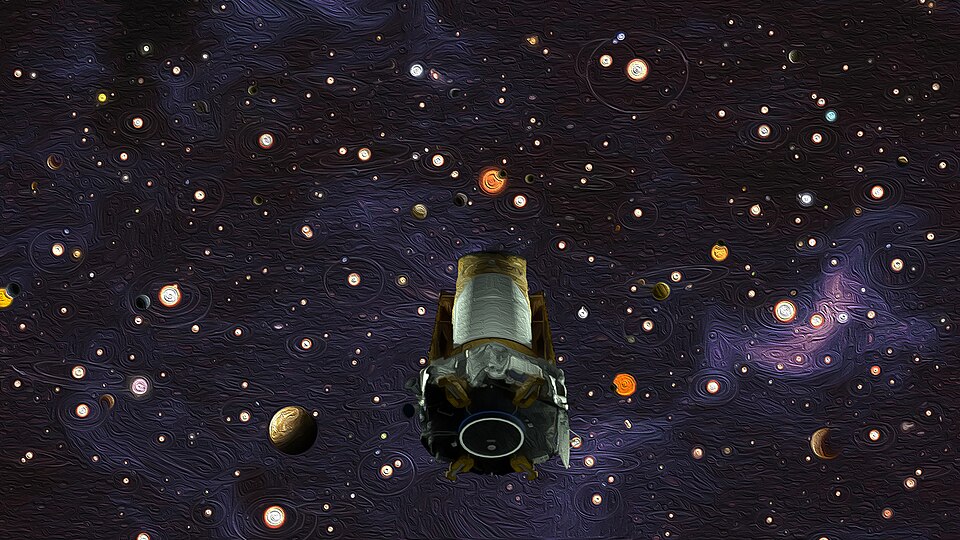

The most profound result from Kepler was the quantification of planet occurrence rates During its primary mission from 2009 to 2013 and the subsequent K2 extended mission, Kepler monitored the brightness of more than 200,000 stars with photometric precision of roughly 20 parts per million over six-hour integration periods, enabling the detection of Earth-sized and even sub-Earth-sized transiting planets.4, 5 The resulting dataset yielded more than 2,600 confirmed exoplanets and approximately 2,000 additional candidates that remain statistically likely to be genuine, establishing the most comprehensive inventory of planets around a well-defined stellar sample ever assembled.5
The most profound result from Kepler was the quantification of planet occurrence rates as a function of size and orbital period. Detailed statistical analyses that accounted for the survey's detection efficiency, the geometric transit probability, and the false positive contamination rate demonstrated that small planets are far more common than large ones. Approximately 85 percent of the planets discovered by Kepler have radii smaller than Neptune (less than about 4 Earth radii), in stark contrast to the early radial velocity surveys, which had predominantly discovered giant planets simply because those were the easiest to detect.5, 6 Fressin and colleagues estimated that 16.5 percent of Sun-like stars host at least one Earth-sized planet (0.8 to 1.25 Earth radii) with an orbital period shorter than 85 days.6 Petigura, Howard, and Marcy extended these occurrence rate calculations to longer orbital periods and concluded that approximately 22 percent of Sun-like stars harbour an Earth-sized planet in the habitable zone, the region around a star where surface liquid water could persist.7 These findings established one of the central conclusions of modern astronomy: planets are not rare; they are ubiquitous, and the galaxy contains billions of potentially Earth-like worlds.
Exoplanet discoveries by detection method (as of late 2024)21
| Detection method | Confirmed planets | Primary sensitivity | Key facilities |
|---|---|---|---|
| Transit photometry | ~4,300 | Short-period planets of all sizes | Kepler, TESS, CoRoT |
| Radial velocity | ~1,100 | Massive planets at short to moderate periods | HARPS, Keck/HIRES, ESPRESSO |
| Gravitational microlensing | ~230 | Planets near the snow line; free-floating planets | OGLE, MOA |
| Direct imaging | ~50 | Young, massive planets at wide separations | Keck, Gemini, VLT, JWST |
| Astrometry | ~3 | Long-period giant planets (major expansion expected from Gaia) | Gaia |
Hot Jupiters and the migration problem
The discovery of 51 Pegasi b immediately posed a fundamental challenge to theories of planetary formation. In the standard core-accretion model, giant planets form beyond the snow line — the distance from a young star where temperatures are low enough for volatile ices to condense — at orbital distances of roughly 3 to 5 astronomical units in a solar-type system. At such distances, the solid core of a nascent giant planet can accrete a sufficiently massive envelope of hydrogen and helium gas. The existence of a Jupiter-mass planet at 0.05 astronomical units from its star, where temperatures exceed 1,000 kelvin, was therefore deeply puzzling.2, 13
The resolution, proposed by Douglas Lin, Peter Bodenheimer, and Derek Richardson within a year of the discovery of 51 Pegasi b, invoked orbital migration: the planet formed at a conventional distance beyond the snow line and subsequently migrated inward through gravitational interactions with the protoplanetary gas disc.14 In this disc migration scenario, a massive planet embedded in a gas disc excites density waves that carry angular momentum, causing the planet to spiral inward through the disc over timescales of roughly one million years. Migration ceases when the inner disc is cleared, when the disc dissipates, or when tidal interactions with the host star halt the planet's inward drift.13, 14
A competing class of models invokes high-eccentricity tidal migration, in which gravitational interactions with other planets or with a distant stellar companion excite the planet's eccentricity to extreme values, bringing its closest approach to the star near enough for tidal dissipation to circularise the orbit and strand the planet in a short-period configuration.13 Observational tests to distinguish between these mechanisms include measuring the orbital obliquity (the angle between the planet's orbital axis and the star's spin axis), the eccentricity distribution of hot Jupiters, and the presence or absence of additional companions in the system. The current consensus is that both disc migration and high-eccentricity migration contribute to the hot Jupiter population, but that no single mechanism satisfactorily explains all observed properties.13, 20
Despite their outsized role in the history of exoplanet science, hot Jupiters are intrinsically rare. Occurrence rate studies from both radial velocity surveys and Kepler transit data indicate that only approximately 0.5 to 1.0 percent of Sun-like stars host a hot Jupiter, compared with approximately 10 percent that host a giant planet at any orbital period.12, 13 Their prominence in early surveys was a consequence of observational selection bias: massive, close-in planets produce the largest radial velocity signals and the deepest, most frequent transits, and were therefore the easiest to find with the instruments available at the time.
Super-Earths and sub-Neptunes
One of the most consequential revelations from the Kepler mission was the discovery that the most common type of planet in the galaxy — planets with radii between approximately 1 and 4 Earth radii, variously classified as super-Earths or sub-Neptunes depending on their size and inferred composition — has no counterpart in our own Solar System. The Solar System's terrestrial planets are all smaller than Earth (or only marginally larger in the case of Earth itself), and its ice giants, Uranus and Neptune, are substantially larger at roughly 4 Earth radii. The size range between these two classes is conspicuously empty in our system but densely populated in the Kepler sample.5, 6, 12
Kepler data revealed a striking feature in the radius distribution of small planets: a deficit of planets with radii between approximately 1.5 and 2.0 Earth radii, known as the radius valley or Fulton gap after Benjamin Fulton, who characterised it in 2017. The gap appears to separate two distinct populations: smaller, predominantly rocky super-Earths below the gap and larger sub-Neptunes above it that retain substantial hydrogen-helium envelopes. The leading interpretation is that the gap is sculpted by atmospheric mass loss: planets born with thin gaseous envelopes can lose them entirely through photoevaporation driven by high-energy stellar radiation or through cooling-driven mass loss from the planet's own internal heat, leaving behind a bare rocky core, while planets born with more massive envelopes retain enough gas to remain inflated above the gap.12
The prevalence of super-Earths and sub-Neptunes has profound implications for planet formation theory. Their abundance suggests that the formation of intermediate-mass planets with modest volatile envelopes is a natural and efficient outcome of the core-accretion process, and that our own Solar System, which lacks such planets, may be atypical rather than representative of the galactic norm.5, 7
Fraction of Sun-like stars hosting at least one planet by size category6, 7
The habitable zone concept
The habitable zone (HZ) of a star is conventionally defined as the range of orbital distances at which a rocky planet with a suitable atmosphere could sustain liquid water on its surface. The concept was formalised in a seminal 1993 paper by James Kasting, Daniel Whitmire, and Ray Reynolds, who used one-dimensional climate models to calculate the inner and outer boundaries of the habitable zone for main-sequence stars of various spectral types.15 The inner boundary is set by the onset of a runaway greenhouse effect, in which rising surface temperatures increase atmospheric water vapour to the point that all surface water evaporates and is eventually lost to space through photodissociation. For the Sun, this inner edge lies at approximately 0.95 astronomical units. The outer boundary is determined by the maximum greenhouse warming achievable by a carbon dioxide atmosphere before CO2 condensation at high pressures limits additional warming, placing the outer edge at approximately 1.67 astronomical units for the Sun.15
The habitable zone is not a fixed property of a star but evolves over time as the star's luminosity changes. Main-sequence stars brighten gradually over their lifetimes — the Sun is approximately 30 percent more luminous today than it was 4.5 billion years ago — and the habitable zone correspondingly migrates outward. For lower-mass M-dwarf stars, which are dimmer and cooler than the Sun, the habitable zone lies much closer to the star, at orbital distances where tidal locking (in which the planet always presents the same face to the star) is likely. Whether tidally locked planets can maintain habitable climates remains an active area of theoretical investigation.15
The convergence of habitable zone theory with Kepler occurrence rate data has yielded one of the most compelling estimates in modern astrophysics. If approximately 22 percent of Sun-like stars host an Earth-sized planet in the habitable zone, as estimated by Petigura, Howard, and Marcy, then the nearest such planet is statistically likely to be within 12 light-years of the Sun, well within reach of future space-based telescopes designed for direct imaging and atmospheric characterisation.7 For the cooler, more numerous M-dwarf stars, the occurrence rate of habitable-zone terrestrial planets may be even higher, suggesting that potentially habitable worlds are extraordinarily common throughout the galaxy.12
Atmospheric characterisation with JWST
Detecting an exoplanet is only the first step; understanding its nature requires characterising its atmosphere. The primary technique for atmospheric study is transmission spectroscopy, which exploits the fact that during a transit, a small fraction of the host star's light passes through the thin annulus of the planet's atmosphere. Different atmospheric molecules absorb light at characteristic wavelengths, producing spectral features that are superimposed on the transit depth as a function of wavelength. By comparing the transit depth across a broad spectral range, astronomers can identify the chemical species present in the atmosphere and constrain its temperature structure, cloud properties, and composition.16, 17
The Hubble and Spitzer space telescopes pioneered transmission spectroscopy and detected sodium, potassium, and water vapour in the atmospheres of several hot Jupiters. However, the transformative step came with the launch of the James Webb Space Telescope (JWST) in December 2021. JWST's large 6.5-metre primary mirror, its suite of infrared instruments covering wavelengths from 0.6 to 28 micrometres, and its position at the Sun-Earth Lagrange point L2, where thermal stability is exceptional, provide an unprecedented combination of sensitivity, spectral coverage, and precision for exoplanet atmospheric studies.16
.png)
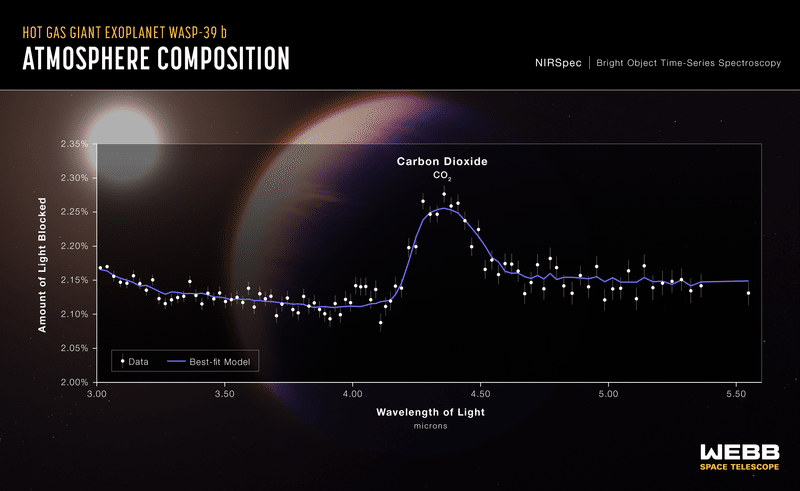
Among JWST's first exoplanet results was the Early Release Science programme targeting WASP-39b, a hot Saturn-mass planet (approximately 0.28 Jupiter masses) with a bloated radius of approximately 1.27 Jupiter radii orbiting its host star every 4.05 days. Observations with the NIRSpec instrument in its PRISM mode yielded a broadband transmission spectrum spanning 0.5 to 5.5 micrometres that robustly detected water vapour (H2O) at 33 standard deviations of significance, carbon dioxide (CO2) at 28 standard deviations, carbon monoxide (CO) at 7 standard deviations, and sodium (Na) at 19 standard deviations.16 Complementary observations with the NIRSpec G395H mode identified sulfur dioxide (SO2) in the atmosphere, a photochemically produced molecule whose detection demonstrated JWST's ability to probe atmospheric chemistry beyond simple thermochemical equilibrium.17 The derived atmospheric metallicity of WASP-39b is roughly ten times the solar value, providing constraints on the planet's formation history and the amount of heavy-element enrichment it experienced during accretion.16
JWST has since observed the atmospheres of a growing number of exoplanets, including rocky terrestrial worlds in the TRAPPIST-1 system. The telescope's ability to characterise the atmospheric composition of potentially habitable planets represents one of the most significant frontiers in contemporary astrophysics, moving the field from merely cataloguing other worlds to understanding their environmental conditions and, ultimately, their potential to support life.16, 17
The current census and future prospects
As of late 2024, the NASA Exoplanet Archive catalogues more than 5,700 confirmed exoplanets orbiting more than 4,300 distinct host stars, with several thousand additional candidates awaiting confirmation.21 The transit method dominates the census with approximately 4,300 confirmed detections, followed by radial velocity with approximately 1,100, gravitational microlensing with approximately 230, direct imaging with approximately 50, and astrometry with a handful of confirmed discoveries.21 These numbers continue to grow rapidly, driven by ongoing observations from TESS, continued analysis of the Kepler dataset, and ground-based radial velocity surveys.
The diversity of the known exoplanet population is staggering. The catalogue includes ultrahot Jupiters with dayside temperatures exceeding 4,000 kelvin, circumbinary planets orbiting both stars in a binary system, planets in tightly packed multi-planet systems where six or more worlds orbit within a fraction of an astronomical unit, and rogue planets drifting through interstellar space without a host star. This diversity has fundamentally challenged the long-held assumption, based solely on our own Solar System, that planetary systems should consist of small rocky planets close in, gas giants farther out, and ice giants in the outer reaches.12, 13
Several major facilities and missions planned for the coming decade promise to extend the exoplanet census still further and to deepen our understanding of individual worlds. The Nancy Grace Roman Space Telescope will conduct a microlensing survey expected to discover thousands of planets in wide orbits, including Earth-mass worlds. The European Space Agency's PLATO mission, planned for launch in 2026, will search for transiting terrestrial planets in the habitable zones of solar-type stars with the photometric precision needed to detect Earth-Sun analogues. Ground-based extremely large telescopes with apertures of 25 to 39 metres will combine direct imaging with high-resolution spectroscopy to characterise the atmospheres of temperate rocky exoplanets from the ground. And JWST will continue to observe transmission and emission spectra of an expanding sample of exoplanets across the mass spectrum, from hot Jupiters to potentially habitable super-Earths, steadily building the empirical foundation needed to assess whether any of the billions of worlds in our galaxy might harbour conditions suitable for life.8, 11