Overview
- Stars and gas at the outer edges of spiral galaxies orbit at nearly the same speed as those near the center — a flat rotation curve that directly contradicts the Keplerian decline expected from visible matter alone and implies vast reservoirs of unseen mass extending far beyond the optical disk.
- Vera Rubin and Kent Ford’s systematic spectroscopic surveys of the 1970s turned isolated anomalies into an inescapable pattern across dozens of galaxies, establishing flat rotation curves as the primary dynamical evidence for dark matter.
- Alternative explanations such as Modified Newtonian Dynamics (MOND) account for galactic curves but fail for galaxy clusters and the cosmic microwave background, while the Bullet Cluster independently confirms that gravitational mass is spatially offset from visible matter.
When astronomers in the early twentieth century turned their spectrographs toward nearby galaxies, they expected to find something familiar: a rotation pattern resembling that of the solar system, where planets closer to the Sun travel faster and those farther away move more slowly. This expectation was not arbitrary. It followed directly from Newton’s law of gravitation and Kepler’s third law — if mass is concentrated at the center, orbital velocity should fall off with distance from that center in a predictable, mathematically precise way. What they found instead reshaped cosmology. Stars at the outer edges of galaxies orbit just as fast as those deep within, tracing out flat curves that cannot be explained by the luminous matter astronomers can see. The resolution to this discrepancy — that galaxies are embedded in enormous halos of invisible mass — is now among the most robustly supported conclusions in all of astrophysics.
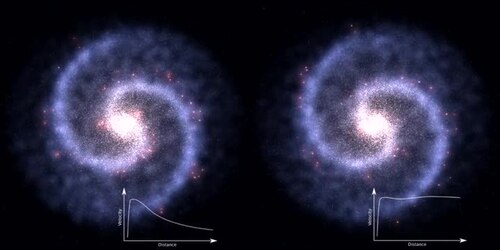
The Keplerian expectation
The solar system provides a clear illustration of what gravitational dynamics predict for a mass-concentrated system. Mercury, closest to the Sun, orbits at roughly 48 kilometers per second. Earth travels at approximately 30 kilometers per second. Neptune, at thirty times Earth’s distance from the Sun, moves at just 5 kilometers per second. This systematic decline — orbital velocity falling as the inverse square root of distance from the central mass — follows directly from equating gravitational force with centripetal acceleration: v = √(GM/r), where G is the gravitational constant, M is the mass enclosed within radius r, and v is the orbital velocity. When M is constant (all mass concentrated centrally) and r increases, v must decline — a so-called Keplerian falloff.
For a spiral galaxy, the expectation was similar in outline. A galaxy has a luminous bulge at its center, a disk of stars and gas, and then a relatively empty periphery. Astronomers understood that the mass distribution would be more extended than in the solar system, so the falloff would not begin immediately at the galactic center — orbital velocities should rise through the inner disk as more and more mass falls within the orbital radius, reach a peak somewhere in the mid-disk, and then decline in the outer regions where the enclosed mass levels off and the disk becomes optically sparse. The observable implication was clear: stars and gas clouds in the outer reaches of a galaxy should orbit measurably more slowly than those at intermediate radii. Detecting this decline and using it to weigh galaxies was a primary goal of observational spectroscopy through the mid-twentieth century.1
Rubin, Ford, and the flat curves
The first systematic attack on the rotation of Andromeda — the nearest large spiral galaxy, roughly 2.5 million light-years from the Milky Way — came in the 1970 paper by Vera Rubin and Kent Ford at the Carnegie Institution of Washington. Using a highly sensitive image-tube spectrograph of Ford’s own design, they measured Doppler shifts in ionized hydrogen emission lines at 67 positions across the face of M31, tracing the rotation curve out to roughly 24 kiloparsecs from the galactic center. Their data showed no sign of the expected Keplerian decline. Orbital velocities in the outer regions of Andromeda remained approximately flat, plateauing near 225 kilometers per second rather than falling toward lower values.1
The 1970 paper was received cautiously. Andromeda could plausibly be a special case; the data did not yet extend to the most distant gas clouds; and the possibility of systematic error in early Doppler measurements was difficult to fully exclude. Rubin, Ford, and Norbert Thonnard responded with a systematic campaign. Their 1978 paper presented optical rotation curves for ten high-luminosity spiral galaxies of varying morphological type (Sa through Sc), chosen specifically to test whether flat curves were an isolated anomaly or a general feature of spiral galaxy dynamics. In every case, the rotation curves were flat or even rising at the largest measured radii.2 A 1980 follow-up extended the sample to 21 Sc-type spirals spanning an enormous range of sizes — from galaxies only a few kiloparsecs across to UGC 2885, one of the largest known spirals at 122 kiloparsecs in radius — and found the same result throughout.3 Flat rotation curves were not an anomaly. They were a universal feature of spiral galaxies.
Independent confirmation arrived from radio astronomy. Albert Bosma’s 1981 study used 21-centimeter emission from neutral atomic hydrogen to trace rotation curves in 25 spiral galaxies out to radii far beyond what optical spectroscopy could reach. Stars and ionized gas become too sparse to detect optically in the outer disk and halo, but neutral hydrogen — mapped through the 21-cm hyperfine transition line — extends to two or three times the optical radius of a typical spiral. Bosma found that rotation curves remained flat at these extreme distances, implying that the missing mass was distributed through an extended halo rather than concentrated in the disk.11 The 21-cm technique has since become the standard tool for measuring galactic rotation at large radii, with modern surveys extending curves well beyond 50 kiloparsecs in many systems.5
The mass discrepancy
Translating a flat rotation curve into a mass estimate is straightforward. If v(r) is constant at large r, the enclosed mass must grow as M(r) ∝ r — linearly with radius. But when astronomers add up all the visible mass in a galaxy (stars, inferred from their luminosities; gas, measured directly from emission lines), they consistently find far too little to account for the observed velocities. The classic case study is NGC 3198, a well-studied Sc spiral whose rotation curve was measured to 30 kiloparsecs by van Albada and collaborators in 1985. They found that the visible disk alone could not reproduce the flat curve even under maximally generous mass-to-light assumptions; a spherical dark halo extending well beyond the visible disk, with a mass-to-light ratio far exceeding any stellar population, was required.4
The magnitude of the discrepancy is substantial. Across a typical spiral galaxy, visible matter — stars and gas that emit, absorb, or scatter electromagnetic radiation — accounts for only roughly 15–20% of the total gravitational mass implied by the rotation curve.9 The remaining 80–85% must reside in some form that does not interact with photons at detectable levels. This is the mass-to-light discrepancy, and its magnitude increases with galactic radius: the outer parts of galaxies are the most mass-deficient in luminous terms, exactly the opposite of what one would expect if the missing matter were simply low-luminosity stars or gas clouds too faint to detect in survey data.
The shape of the discrepancy also carries information. Persic, Salucci, and Stel showed in 1996 that spiral galaxies of different luminosities exhibit a systematic family of rotation curves — brighter galaxies show a more pronounced peak before flattening, while fainter galaxies have curves that rise more steeply and flatten at lower absolute velocities — but all converge to flat profiles at large radii, and all require dark halos whose mass fractions scale inversely with luminosity.18 This systematic behavior strongly argues against simple observational errors and points toward a universal physical mechanism.
The dark matter halo explanation
The standard explanation for flat rotation curves posits that every spiral galaxy is embedded in a roughly spherical dark matter halo extending far beyond the optical disk. As a star or gas cloud orbits in the disk, it feels the gravitational pull not only of the luminous stars and gas near it but also of the vast surrounding halo. Because the halo mass grows approximately linearly with radius in the regions probed by rotation curves, the enclosed mass within any given orbital radius increases in proportion to that radius, exactly canceling the r−1/2 decline that Keplerian dynamics would otherwise produce, and yielding the observed flat velocity profile.4
The leading particle physics candidate for the halo constituent is the weakly interacting massive particle (WIMP), a class of hypothetical particles that interact with ordinary matter only through gravity and the weak nuclear force, making them invisible to electromagnetic telescopes while still gravitationally significant in aggregate. Other candidates include axions and sterile neutrinos. Despite extensive direct-detection experiments, no definitive laboratory signal has been found for any of these particles as of 2026 — a subject explored in detail in the companion article on dark matter detection experiments.9
Numerical simulations of cosmic structure formation using cold dark matter (CDM) — dark matter particles that moved slowly relative to the speed of light in the early universe — naturally reproduce halos with density profiles that flatten rotation curves. The Navarro–Frenk–White (NFW) profile, derived from N-body simulations, predicts a density that falls as r−1 near the center and r−3 at large radii, producing rotation curves consistent with observations across a wide range of galaxy masses.17 The success of these simulations in matching the observed rotation curve family across galaxy types constitutes a major quantitative success of the cold dark matter model, complementing the evidence from the cosmic microwave background and large-scale structure.
The Tully–Fisher relation
One of the most consequential empirical byproducts of rotation curve surveys is the Tully–Fisher relation, published by R. Brent Tully and J. Richard Fisher in 1977. They noticed that the maximum rotational velocity of a spiral galaxy — the flat portion of its rotation curve — correlates tightly with the galaxy’s total luminosity: faster-rotating galaxies are intrinsically brighter.10 Because the rotation velocity is observable through Doppler measurements of the 21-cm line or optical emission lines, and because it is independent of the galaxy’s distance from Earth, the Tully–Fisher relation provides a way to infer absolute luminosity from a kinematic measurement, and thus to calculate distance from the apparent brightness. It has become one of the most widely used rungs in the cosmic distance ladder, calibrated against Cepheid variables in nearby galaxies and applied to infer distances of tens of megaparsecs.
The existence of the Tully–Fisher relation is itself a constraint on dark matter models. It implies that the total rotational velocity — which includes the dark halo’s contribution — tracks the baryonic mass closely, suggesting a tight coupling between visible and dark matter in the assembly of spiral galaxies. This coupling is not trivially predicted by simple dark-matter-only models and has motivated ongoing work on galaxy formation physics, including the role of stellar feedback in redistributing baryons and modifying halo density profiles.15
A modern refinement, the baryonic Tully–Fisher relation, extends the original result by including the mass of neutral gas (traced by the 21-cm line) alongside stellar mass. When total baryonic mass replaces stellar luminosity, the relation tightens considerably and extends to very low-mass, gas-dominated dwarf galaxies that fall off the original luminosity-based relation. This improved scaling law, covering more than four decades in baryonic mass, provides a stringent test for theories of galaxy formation and has been used to argue both for and against various dark matter and modified gravity models.16
Modified Newtonian Dynamics and its limits
Not all physicists accepted the dark matter halo as the only possible explanation for flat rotation curves. In 1983, Mordehai Milgrom proposed a radical alternative: that Newton’s second law requires modification at extremely low accelerations. In Modified Newtonian Dynamics (MOND), the effective gravitational acceleration experienced by a test particle does not simply equal GM/r2 at all distances. Instead, when the Newtonian acceleration falls below a critical threshold a0 ≈ 1.2 × 10⁻¹⁰ m s−2, the actual acceleration becomes √(aNewt × a0), which produces a flat rotation curve asymptotically for any finite central mass without invoking dark matter at all.6, 7
MOND’s remarkable success at the galactic scale is not in dispute. It reproduces the rotation curves of individual spiral galaxies with impressive accuracy across a wide range of galaxy types and luminosities, using only the visible mass distribution as input, with the single free parameter a0 fixed globally.12 The baryonic Tully–Fisher relation emerges naturally from MOND as a consequence of the modified dynamics rather than as an empirical coincidence requiring a special relationship between dark and visible matter. The radial acceleration relation — a tight observed correlation between the total centripetal acceleration in galaxy disks and the acceleration predicted from baryonic mass alone — was highlighted in 2016 as strong empirical support for MOND-like phenomenology, though its interpretation remains debated.16
However, MOND faces severe difficulties when applied beyond individual galaxies. In galaxy clusters, the observed mass discrepancy is roughly a factor of five to ten — even larger than in individual galaxies — and MOND cannot fully account for it using only visible baryons. Clusters require residual dark matter even under MOND, typically invoked as massive sterile neutrinos, which undermines the theory’s conceptual parsimony.13 More fundamentally, the detailed pattern of acoustic oscillations in the cosmic microwave background power spectrum — which encodes the ratio of dark matter to baryonic matter at the epoch of recombination, more than 13 billion years ago — matches cold dark matter cosmology with high precision and cannot be reproduced by MOND without introducing an effective dark matter component. The CMB evidence predates galaxy formation and is therefore immune to the galaxy-scale arguments that motivated MOND in the first place.9
The Bullet Cluster: gravitational lensing as independent confirmation
The most direct visual evidence that mass is not merely proportional to visible matter comes from the Bullet Cluster (1E 0657–558), a system of two galaxy clusters caught in the aftermath of a high-velocity collision approximately 150 million years ago. The collision is visible in X-ray images from the Chandra Observatory as a distorted, bullet-shaped plume of hot gas: when the two clusters passed through each other, their diffuse intracluster gas — which accounts for the majority of their baryonic mass — collided and was decelerated by ram pressure, while the individual galaxies and any collisionless dark matter passed through relatively unimpeded.
Clowe and collaborators used weak gravitational lensing to map the total mass distribution of the Bullet Cluster in 2006. The result was unambiguous: the gravitational mass (as revealed by the lensing distortion of background galaxy shapes) is spatially offset from the X-ray gas by roughly 25 arcseconds — an angular separation corresponding to about 200 kiloparsecs at the cluster’s distance. The mass peaks coincide with the positions of the two galaxy populations, not with the gas. Because the gas is the dominant baryonic component and because MOND (or any other modified gravity theory based on local baryonic mass) would predict the gravitational field to track the gas, this spatial offset constitutes a direct empirical proof that the gravitational mass is carried by a component that is collisionless and therefore physically distinct from ordinary baryonic matter.8
The Bullet Cluster does not, by itself, prove that dark matter is made of any particular particle. It demonstrates that the dominant gravitational mass in galaxy clusters is spatially separable from visible matter under dynamical stress — behavior consistent with a collisionless fluid of weakly interacting particles and difficult to reconcile with modified gravity theories that tie gravitational effects directly to baryonic mass distributions.13
Connection to the broader dark matter evidence
Galactic rotation curves are the most historically prominent evidence for dark matter, but they represent one strand in a multi-threaded observational case. The cosmic microwave background, as measured by the Planck satellite, determines the relative density of dark matter and ordinary baryonic matter through the pattern of temperature fluctuations imprinted at recombination. The third acoustic peak in the CMB power spectrum is particularly diagnostic: its amplitude relative to the second peak requires a cold dark matter component comprising approximately 26.8% of the total energy density of the universe, a quantity entirely independent of rotation curve arguments.9
Baryon acoustic oscillations — the fossilized imprint of sound waves in the early universe, now visible as a characteristic clustering scale in the distribution of galaxies across hundreds of millions of light-years — require dark matter to provide the gravitational potential wells that seeded the observed large-scale structure. Without dark matter, baryons alone cannot form structures fast enough to match the galaxy distributions seen in surveys like the Sloan Digital Sky Survey.19
N-body simulations using cold dark matter cosmology reproduce the observed web of galaxy filaments, voids, and clusters with remarkable fidelity when dark matter halos are included. The Millennium Simulation, run by Springel and collaborators in 2005, showed that a ΛCDM cosmology naturally produces the cosmic web of structure seen in surveys of millions of galaxies without any tuning beyond the Planck-constrained cosmological parameters.14 Galactic rotation curves, in this framework, are the local, small-scale manifestation of the same dark matter scaffolding that shapes the largest structures in the observable universe.
The cumulative force of these independent lines of evidence — rotation curves, weak lensing, the CMB, baryon acoustic oscillations, large-scale structure simulations, and the Bullet Cluster — each derived by different methods, at different scales, and at different epochs in cosmic history, constitutes the scientific basis for treating dark matter as a real component of the universe rather than a placeholder for ignorance. What remains unknown is the physical identity of the dark matter particle or particles, a question driving one of the most ambitious experimental programs in contemporary physics.
References
Extended rotation curves of high-luminosity spiral galaxies. IV. Systematic dynamical properties, sa–sc galaxies
Rotational properties of 21 Sc galaxies with a large range of luminosities and radii, from NGC 4605 (R = 4 kpc) to UGC 2885 (R = 122 kpc)
The Millennium Simulation: the large-scale structure of the universe in a standard cold dark matter cosmology
The mass discrepancy–acceleration relation: disk mass and the dark matter distribution
Dark matter halos in the standard cosmological model: results from the Bolshoi simulation
Baryon acoustic oscillations in the Sloan Digital Sky Survey data release 5 galaxy sample