Overview
- Gravitational waves are ripples in the fabric of spacetime generated by accelerating masses, predicted by Albert Einstein in 1916 as a consequence of general relativity and first directly detected on September 14, 2015, by the twin LIGO interferometers observing the merger of two black holes 1.3 billion light-years away.
- The Hulse–Taylor binary pulsar, discovered in 1974, provided the first indirect evidence for gravitational waves by demonstrating that its orbital period decays at exactly the rate predicted by general relativity’s quadrupole formula—a result matching theory to within 0.2 percent and earning the 1993 Nobel Prize in Physics.
- By the end of the third observing run in 2020, 90 gravitational-wave events had been cataloged from merging black holes, neutron stars, and mixed binaries, while future detectors including the space-based LISA mission (planned for 2035) and pulsar timing arrays promise to open entirely new frequency windows on the gravitational-wave universe.
Gravitational waves are ripples in the curvature of spacetime that propagate outward from their source at the speed of light, carrying energy and information about the most violent events in the universe. They are produced whenever massive objects accelerate—most powerfully during the inspiral and merger of compact binaries such as black holes and neutron stars, but also during supernova explosions, the rapid rotation of deformed neutron stars, and potentially during the earliest moments of cosmic inflation.22 Albert Einstein predicted their existence in 1916 as a direct consequence of general relativity, his geometric theory of gravitation in which mass and energy curve the fabric of spacetime and that curvature dictates how objects move.1 For nearly a century, gravitational waves remained a theoretical prediction—too feeble to detect with any existing technology. Their first direct observation on September 14, 2015, by the Laser Interferometer Gravitational-Wave Observatory (LIGO) opened an entirely new window on the cosmos, inaugurating the era of gravitational-wave astronomy.8
Unlike electromagnetic radiation, which is produced by the acceleration of charged particles and can be absorbed, scattered, or blocked by intervening matter, gravitational waves interact so weakly with matter that they pass through stars, gas clouds, and galaxies essentially unimpeded.22 This transparency makes them uniquely powerful probes of phenomena that are invisible or opaque to telescopes operating at any wavelength of light, including the interiors of supernovae, the moments before and during black hole formation, and conditions in the first fraction of a second after the Big Bang.22
Theoretical foundations
Einstein's general theory of relativity, published in November 1915, replaced Newton's conception of gravity as an instantaneous force acting at a distance with a description of gravity as the curvature of a four-dimensional spacetime manifold caused by the presence of mass and energy. In June 1916, Einstein published a follow-up paper in which he derived the linearized field equations of general relativity and showed that they admitted wave-like solutions—perturbations of the spacetime metric that propagate at the speed of light, analogous to electromagnetic waves propagating through the electromagnetic field.1 He identified three types of gravitational waves (longitudinal–longitudinal, transverse–longitudinal, and transverse–transverse) and concluded that gravitational radiation must propagate at the speed of light, but he also noted that the effect was so small as to be of no practical consequence.1
Einstein's 1916 analysis contained errors, which he corrected in a second paper published in January 1918 titled “Über Gravitationswellen.”2 In this paper, Einstein derived the quadrupole formula, which remains the foundational result for calculating gravitational-wave emission. The formula states that gravitational radiation is produced by the time-varying quadrupole moment of a mass distribution—not by its monopole (total mass) or dipole (center-of-mass motion), both of which are conserved. This is a fundamental difference from electromagnetism, where the leading radiation term is dipole.2, 21 The quadrupole requirement means that a perfectly spherical explosion or a uniformly rotating sphere produces no gravitational waves; asymmetric motion is required.
Gravitational waves have two independent polarization states, conventionally labeled “plus” (+) and “cross” (×), each of which stretches and compresses space in perpendicular directions transverse to the wave's direction of travel.22 The amplitude of a gravitational wave is characterized by the dimensionless strain h, defined as the fractional change in the distance between two freely falling test masses. For astrophysical sources, typical strains at Earth are extraordinarily small: the signal from GW150914, the first detected event, had a peak strain of approximately 10−21, meaning that a 4-kilometer baseline changed length by roughly 4 × 10⁻¹⁸ meters—less than one-thousandth the diameter of a proton.8
Indirect evidence: the binary pulsar
For decades after Einstein's prediction, the existence of gravitational waves remained contested even among theorists. A famous debate at the 1957 Chapel Hill conference, in which Felix Pirani and Richard Feynman argued that gravitational waves must carry real energy capable of heating a detector, helped settle the question theoretically.23 The first observational evidence, however, came from an entirely different direction: the discovery of a binary pulsar.
In 1974, Russell Hulse and Joseph Taylor, working at the Arecibo Observatory in Puerto Rico, discovered PSR B1913+16, a pulsar in a tight 7.75-hour orbit with another neutron star.4 Because pulsars emit extremely regular radio pulses, the orbital parameters of the binary system could be measured with extraordinary precision over time. By 1982, Taylor and Joel Weisberg had accumulated enough timing data to demonstrate that the orbital period of the system was decreasing at a rate of approximately 76 microseconds per year—exactly the amount predicted by general relativity for energy loss through gravitational-wave emission.5
Over the following three decades, continued monitoring of PSR B1913+16 confirmed that the observed orbital decay matches the prediction from Einstein's quadrupole formula to within 0.2 percent.6 This agreement provided compelling, though indirect, evidence that gravitational waves exist and carry energy away from their source exactly as general relativity predicts. Hulse and Taylor were awarded the 1993 Nobel Prize in Physics for this discovery.
Observed vs. predicted orbital decay of PSR B1913+166
Detection technology
The challenge of detecting gravitational waves is fundamentally one of measurement precision. A typical astrophysical signal changes the distance between two points separated by several kilometers by less than 10−18 meters, a displacement smaller than the diameter of a proton by roughly three orders of magnitude.8
.jpg)
The concept of using laser interferometry to detect gravitational waves was laid out in detail by Rainer Weiss in a 1972 technical report at MIT. Achieving this sensitivity required decades of technological development across multiple fields, including laser physics, optics, seismic isolation, thermal noise reduction, and quantum measurement theory.
The concept of using laser interferometry to detect gravitational waves was laid out in detail by Rainer Weiss in a 1972 technical report at MIT.3 Weiss described a Michelson-type interferometer with kilometer-scale arms and systematically analyzed all the fundamental noise sources that would limit its sensitivity, including seismic vibration, thermal motion of mirror surfaces, laser frequency and amplitude noise, and radiation pressure shot noise. This report served as the foundational blueprint for what would eventually become LIGO.
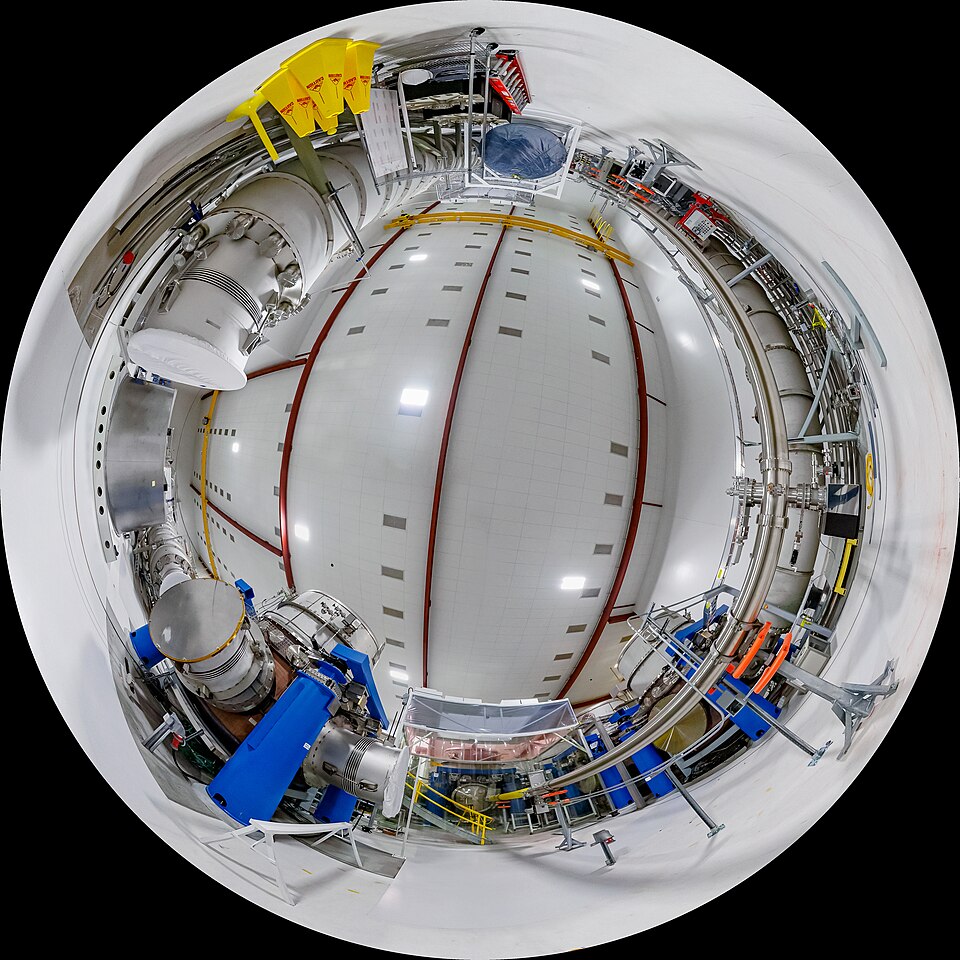
LIGO consists of two identical L-shaped interferometers, one in Hanford, Washington, and the other in Livingston, Louisiana, separated by 3,002 kilometers. Each interferometer has two perpendicular arms, each 4 kilometers long.7 A laser beam is split at a beam splitter and sent down both arms simultaneously. At the end of each arm, the beam reflects off a mirror and returns. When no gravitational wave is present, the two beams recombine destructively at the beam splitter, producing a dark fringe at the photodetector. A passing gravitational wave stretches one arm while compressing the other, shifting the interference pattern and producing a measurable signal at the photodetector.7
To amplify the tiny displacement signal, each arm contains a Fabry–Pérot optical cavity: an additional mirror near the beam splitter creates a resonant cavity in which the laser light bounces back and forth approximately 300 times before exiting, effectively increasing the optical path length from 4 kilometers to roughly 1,200 kilometers.7 Advanced LIGO, the upgraded version that achieved the first detection, incorporated numerous additional improvements over the initial LIGO design, including higher laser power (200 watts), heavier fused-silica test masses (40 kilograms each), monolithic silica fiber suspensions to reduce thermal noise, and active seismic isolation systems. These upgrades improved the strain sensitivity by approximately a factor of ten compared to initial LIGO, extending the detector's reach to a volume of space roughly 1,000 times larger.7
The first direct detection
On September 14, 2015, at 09:50:45 UTC, both LIGO detectors simultaneously recorded a transient gravitational-wave signal designated GW150914. The signal swept upward in frequency from 35 Hz to 250 Hz over approximately 0.2 seconds, with a peak gravitational-wave strain of 1.0 × 10−21.8


The waveform matched with extraordinary precision the predictions of general relativity for the inspiral, merger, and ringdown of two black holes with masses of approximately 36 and 29 solar masses, coalescing to form a single black hole of about 62 solar masses at a distance of approximately 1.3 billion light-years.8, 20 The waveform matched with extraordinary precision the predictions of general relativity for the inspiral, merger, and ringdown of two black holes with masses of approximately 36 and 29 solar masses, coalescing to form a single black hole of about 62 solar masses at a distance of approximately 1.3 billion light-years.8, 20
The difference between the two detected masses and the final remnant mass—roughly 3 solar masses—was radiated away as gravitational-wave energy in a fraction of a second, corresponding to a peak luminosity of approximately 3.6 × 1056 ergs per second, or roughly 200 solar masses per second converted to gravitational radiation. For a brief instant, GW150914 was more luminous than all the stars in the observable universe combined.20
The detection was confirmed with a combined signal-to-noise ratio of 24, and the false-alarm probability was estimated at less than one event per 203,000 years of coincident observation, establishing the detection at greater than 5.1 sigma significance.8 Detailed analyses showed that the observed waveform was fully consistent with the predictions of general relativity across all stages of the coalescence, placing the strongest constraints yet on deviations from Einstein's theory in the strong-field, high-velocity regime.19
A second binary black hole merger, GW151226, was detected on December 26, 2015, involving lower-mass black holes of approximately 14 and 8 solar masses.9 Rainer Weiss, Kip Thorne, and Barry Barish were awarded the 2017 Nobel Prize in Physics for decisive contributions to the LIGO detector and the observation of gravitational waves.
Multimessenger astronomy
The detection of gravitational waves from binary black hole mergers demonstrated the power of gravitational-wave astronomy, but black hole mergers produce no electromagnetic radiation and therefore cannot be studied with conventional telescopes. The breakthrough into multimessenger astronomy came on August 17, 2017, with the detection of GW170817, the first observed gravitational-wave signal from the inspiral of two neutron stars.11
GW170817 was detected by both LIGO interferometers and, for the first time, by the Virgo detector in Italy, enabling triangulation of the source's sky position to a region of approximately 28 square degrees.10, 11 Just 1.7 seconds after the merger, the Fermi Gamma-ray Space Telescope and the INTEGRAL satellite detected a short gamma-ray burst, GRB 170817A, from the same region of sky.12 This near-simultaneous detection confirmed a long-standing hypothesis that at least some short gamma-ray bursts originate from neutron star mergers. Within hours, optical telescopes identified the electromagnetic counterpart—a kilonova—in the galaxy NGC 4993, approximately 130 million light-years away. Over the following weeks and months, approximately 70 observatories across the electromagnetic spectrum, from radio to X-ray, observed the afterglow of the merger.12
GW170817 also enabled the first measurement of the Hubble constant using gravitational waves as a “standard siren.” The concept, proposed by Bernard Schutz in 1986, exploits the fact that the gravitational-wave signal directly encodes the luminosity distance to the source without requiring any calibration against a cosmic distance ladder.14 By combining the gravitational-wave distance measurement with the recession velocity of NGC 4993 inferred from its redshift, the LIGO–Virgo collaboration determined the Hubble constant to be 70.0+12.0−8.0 km s−1 Mpc−1, consistent with both the Planck CMB-derived value and the local distance-ladder measurements.13
The growing catalog of events
Following the first detection, the rate of gravitational-wave observations has grown rapidly with each successive observing run as detector sensitivity has improved. The first gravitational-wave transient catalog, GWTC-1, published in 2019, contained 11 confident detections from the first and second observing runs (O1 and O2), including 10 binary black hole mergers and the single binary neutron star event GW170817.15 The third observing run (O3), conducted between April 2019 and March 2020, dramatically expanded the catalog: GWTC-3, published in 2023, brought the total to 90 candidate events across all three runs, including the first confident detections of neutron star–black hole binaries.16
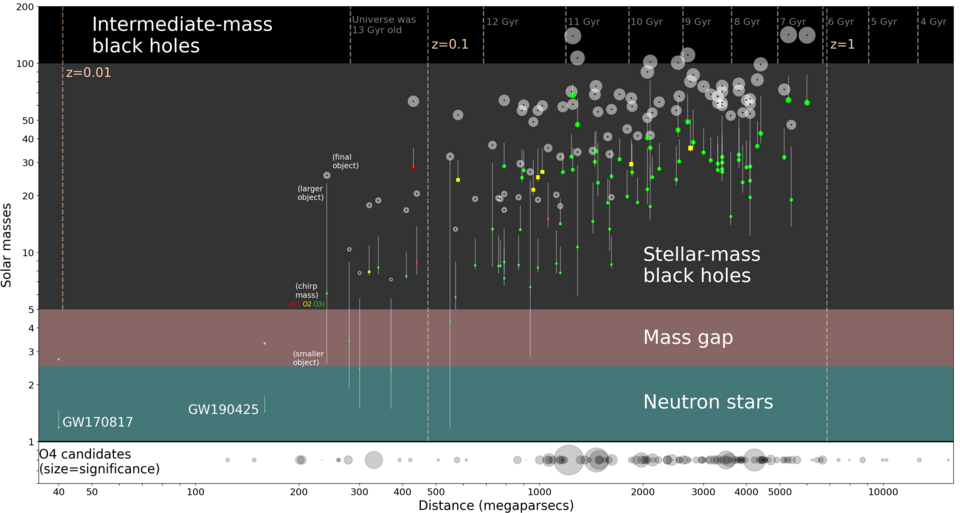

The fourth observing run (O4), which began in May 2023 with further improvements to detector sensitivity and the addition of the KAGRA detector in Japan, is expected to substantially expand the catalog as increased sensitivity extends the detectable volume of space.7
Gravitational-wave observing runs and cumulative detections (O1–O3)15, 16
| Observing run | Dates | Detectors | Events (cumulative) |
|---|---|---|---|
| O1 | Sep 2015 – Jan 2016 | LIGO Hanford, LIGO Livingston | 3 |
| O2 | Nov 2016 – Aug 2017 | LIGO H, LIGO L, Virgo (Aug 2017) | 11 |
| O3 | Apr 2019 – Mar 2020 | LIGO H, LIGO L, Virgo | 90 |
The growing catalog has enabled statistical studies of the population of compact binary systems. The mass distribution of merging black holes reveals structure that was not anticipated, including a possible excess of black holes near 35 solar masses and a dearth in the range predicted by pair-instability supernova theory (the “upper mass gap” between roughly 50 and 120 solar masses), although several events have challenged the boundaries of this gap.16 The spin measurements of merging black holes constrain their formation channels, distinguishing between isolated binary evolution in galactic fields and dynamical assembly in dense stellar environments such as globular clusters.16
Tests of general relativity
Every gravitational-wave detection provides a test of general relativity in the strong-field, dynamical regime—a domain inaccessible to solar-system experiments, pulsar timing, or any other observational technique. The waveform of a compact binary coalescence encodes the predictions of general relativity across three distinct phases: the inspiral, during which the two objects orbit each other with gradually increasing frequency and amplitude; the merger, when the objects plunge together; and the ringdown, during which the newly formed remnant settles into a stationary black hole by emitting damped gravitational waves at characteristic quasinormal mode frequencies.19
For GW150914, the LIGO–Virgo collaboration performed a battery of tests comparing the observed signal to the predictions of general relativity. These included checking the consistency between the inspiral and merger-ringdown portions of the signal, searching for deviations in the post-Newtonian coefficients that govern the inspiral waveform, constraining the mass of the graviton (which general relativity predicts to be exactly zero, implying that gravitational waves travel at exactly the speed of light), and testing the no-hair theorem by checking whether the ringdown frequencies match those predicted for a Kerr black hole of the inferred mass and spin.19 All tests were consistent with general relativity, with no statistically significant deviations detected.
The near-simultaneous arrival of gravitational waves and gamma rays from GW170817 placed an extraordinarily tight constraint on the speed of gravitational waves relative to the speed of light. The 1.7-second delay between the gravitational-wave and gamma-ray signals, over a travel distance of approximately 130 million light-years, constrains the fractional difference between the two speeds to be less than a few parts in 1015.11, 12 This single measurement ruled out a wide class of alternative theories of gravity that predict gravitational waves traveling at speeds different from light.
The nanohertz regime: pulsar timing arrays
Ground-based interferometers like LIGO and Virgo are sensitive to gravitational waves in the frequency range of roughly 10 to several thousand hertz, corresponding to the final seconds of compact binary mergers. At the opposite end of the frequency spectrum, pulsar timing arrays (PTAs) probe gravitational waves with periods of years to decades—the nanohertz regime—by monitoring the arrival times of radio pulses from an array of millisecond pulsars distributed across the Milky Way.17
A passing gravitational wave stretches and compresses the spacetime between Earth and each pulsar, inducing correlated shifts in pulse arrival times across the array. The distinctive spatial correlation pattern expected from an isotropic gravitational-wave background was predicted by Ronald Hellings and George Downs in 1983 and is known as the Hellings–Downs curve. In June 2023, four independent pulsar timing array collaborations—NANOGrav (North America), the European Pulsar Timing Array, the Parkes Pulsar Timing Array (Australia), and the Indian Pulsar Timing Array—simultaneously announced compelling evidence for a gravitational-wave background at nanohertz frequencies.17
NANOGrav's 15-year dataset, based on precise timing of 68 millisecond pulsars, revealed the characteristic Hellings–Downs inter-pulsar correlations at a significance level of approximately 3.5 to 4 sigma.17 The most likely source of this background is the superposition of gravitational waves from the cosmic population of supermassive black hole binaries—pairs of black holes with masses of millions to billions of solar masses that form when galaxies merge, slowly spiraling toward each other over millions of years. Alternative sources, including cosmic strings, phase transitions in the early universe, and inflationary gravitational waves, remain under investigation but are considered less likely explanations for the observed signal characteristics.17
Future detectors and open questions
The next major frontier in gravitational-wave astronomy is the millihertz frequency band, which lies between the nanohertz regime probed by pulsar timing arrays and the audio-frequency band accessible to ground-based interferometers. The Laser Interferometer Space Antenna (LISA), a European Space Agency mission adopted in January 2024 and planned for launch around 2035, will deploy three spacecraft in a triangular formation with arm lengths of 2.5 million kilometers in a heliocentric orbit trailing Earth.18 LISA will detect gravitational waves from merging supermassive black hole binaries at cosmological distances, from thousands of compact binary systems in the Milky Way, and potentially from exotic sources such as extreme mass-ratio inspirals—stellar-mass compact objects spiraling into supermassive black holes—which would map the spacetime geometry of black holes with exquisite precision.18
On the ground, plans are advancing for third-generation detectors that would dramatically surpass the sensitivity of Advanced LIGO and Virgo. The Einstein Telescope, a proposed European underground detector with 10-kilometer arms arranged in a triangular configuration, and Cosmic Explorer, a proposed American detector with 40-kilometer arms, would extend the observable volume of the universe by a factor of roughly 1,000 compared to current facilities, enabling the detection of binary black hole mergers out to the epoch when the first stars and galaxies formed.22
Gravitational-wave astronomy has already transformed our understanding of the universe in its first decade. It has confirmed the existence of stellar-mass black hole binaries, measured the properties of dozens of black holes that are invisible to electromagnetic telescopes, demonstrated that neutron star mergers produce short gamma-ray bursts and forge heavy elements through rapid neutron capture, provided an independent measurement of the cosmic expansion rate, and subjected general relativity to its most stringent tests in the strong-field regime.8, 11, 13, 19 With each new observing run bringing hundreds of additional detections, and with LISA, pulsar timing arrays, and third-generation ground-based detectors on the horizon, the gravitational-wave spectrum is poised to become as rich and informative as the electromagnetic spectrum that has served astronomy for four centuries.
References
A new test of general relativity: gravitational radiation and the binary pulsar PSR 1913+16
GW151226: observation of gravitational waves from a 22-solar-mass binary black hole coalescence
GW170814: a three-detector observation of gravitational waves from a binary-black-hole coalescence
GWTC-1: a gravitational-wave transient catalog of compact binary mergers observed by LIGO and Virgo during the first and second observing runs
GWTC-3: compact binary coalescences observed by LIGO and Virgo during the second part of the third observing run
Gravitational radiation from post-Newtonian sources and inspiralling compact binaries