Overview
- X-ray binaries are binary star systems in which a compact object—a neutron star or black hole—accretes matter from a companion star, releasing gravitational potential energy as X-ray radiation with luminosities up to 1038 erg per second; the first such source, Scorpius X-1, was discovered in 1962 by Riccardo Giacconi's team, a finding that launched X-ray astronomy and earned Giacconi the 2002 Nobel Prize in Physics.
- The two principal classes—high-mass X-ray binaries (HMXBs), powered by stellar winds from O/B-type companions, and low-mass X-ray binaries (LMXBs), fueled by Roche lobe overflow from late-type stars—comprise more than 300 catalogued Galactic systems, with approximately 114 HMXBs and 187 LMXBs identified by the mid-2000s.
- Black hole X-ray binaries exhibit dramatic spectral state transitions between a hard state dominated by a hot corona and a soft state dominated by thermal disk emission, and many launch relativistic jets reaching apparent superluminal velocities—earning the designation microquasars—making them essential laboratories for studying accretion physics, general relativity, and jet formation on human-observable timescales.
An X-ray binary is a binary star system in which a compact object—either a neutron star or a stellar-mass black hole—accretes matter from a companion star, converting gravitational potential energy into electromagnetic radiation that peaks in the X-ray band. These systems are among the most luminous X-ray sources in the sky, with typical luminosities ranging from 1034 to 1038 erg per second, and they serve as natural laboratories for studying the physics of accretion, strong-field gravity, ultra-dense matter, and relativistic jet formation.5, 6
The discovery of the first extrasolar X-ray source in 1962 inaugurated X-ray astronomy as a discipline and revealed that the universe is pervaded by violent, high-energy processes invisible to optical telescopes.1 In the six decades since, more than 300 X-ray binaries have been catalogued in the Milky Way alone, divided into high-mass and low-mass systems according to the nature of the donor star.10, 11 X-ray binaries containing black holes have provided the most compelling dynamical evidence for the existence of stellar-mass black holes, while those containing neutron stars have yielded precision measurements of neutron star masses and radii that constrain the equation of state of matter at supranuclear densities.5, 18
Discovery and early history
X-ray astronomy began on 18 June 1962, when an Aerobee 150 sounding rocket launched from White Sands, New Mexico, carried Geiger counters above the atmosphere and detected an unexpectedly intense X-ray source in the constellation Scorpius. The six-minute suborbital flight, led by Riccardo Giacconi, Herbert Gursky, Frank Paolini, and Bruno Rossi, revealed what would be designated Scorpius X-1—the brightest persistent extrasolar X-ray source in the sky. The X-ray luminosity of Sco X-1 exceeded the Sun's total luminosity by a factor of roughly 100 and its X-ray output by a factor of approximately 108, immediately indicating a physical mechanism far more energetic than ordinary stellar radiation.1
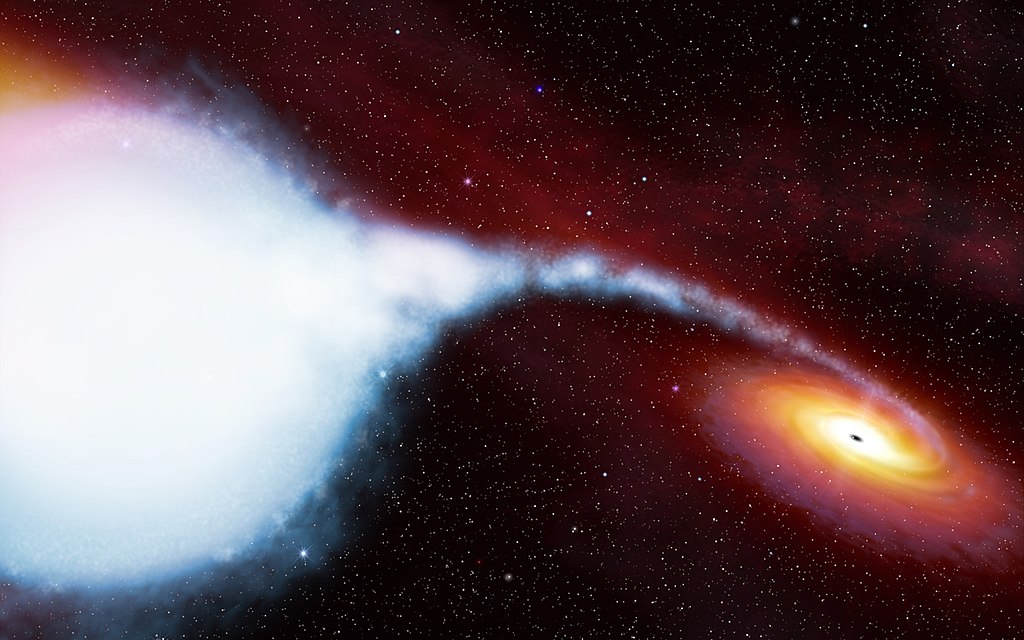

The nature of this mechanism became clear over the following decade. Theoretical work by Shakura and Sunyaev in 1973 established the foundational model of accretion disk physics, describing how matter spiralling inward through a geometrically thin, optically thick disk around a compact object converts gravitational energy into thermal radiation with extraordinary efficiency.4 In this framework, matter falling from a companion star forms a disk around the compact object, and viscous friction within the disk heats the gas to temperatures of millions to tens of millions of kelvins, producing copious X-ray emission. The innermost regions of the disk, closest to the compact object, reach the highest temperatures and dominate the X-ray output. The Shakura-Sunyaev disk model, with more than 8,000 citations, remains the most widely used theoretical framework for understanding accretion in X-ray binaries and active galactic nuclei alike.4
A pivotal moment came in 1972, when two independent teams established that the X-ray source Cygnus X-1 is a binary system containing an invisible companion far too massive to be a neutron star. Louise Webster and Paul Murdin at the Royal Greenwich Observatory, and Charles Thomas Bolton at the University of Toronto, each measured the radial velocity curve of the blue supergiant HDE 226868 and derived a mass function implying a compact companion of at least several solar masses.2, 3 Since the maximum mass of a neutron star is approximately 2 to 3 solar masses, the companion in Cygnus X-1 was identified as the first strong black hole candidate—a designation that has since been confirmed by increasingly refined mass measurements placing the black hole at approximately 21 solar masses.2, 3, 5 Giacconi was awarded the 2002 Nobel Prize in Physics for his pioneering contributions to X-ray astronomy, including the discovery of Sco X-1.1
Classification: high-mass and low-mass systems
X-ray binaries are divided into two broad classes based on the mass of the donor star that supplies material to the compact object. This classification reflects fundamental differences in the mass-transfer mechanism, evolutionary history, and observational properties of the systems.9, 10, 11
High-mass X-ray binaries (HMXBs) contain a compact object—usually a neutron star, occasionally a black hole—accreting from a massive companion star, typically an O- or B-type star with a mass above roughly 8 solar masses. The fourth edition of the Liu, van Paradijs, and van den Heuvel catalogue lists 114 HMXBs in the Galaxy.10 HMXBs subdivide further into two principal types. Supergiant X-ray binaries (SgXBs) contain evolved blue supergiant companions whose powerful stellar winds provide a continuous supply of matter to the compact object; the neutron star orbits within this wind, accreting directly from it without the need for Roche lobe overflow. These systems tend to be persistent X-ray sources with luminosities of 1036 to 1038 erg per second.16 Be/X-ray binaries (BeXBs) form the numerically dominant subclass, comprising roughly two-thirds of all known HMXBs. In these systems, the compact object—invariably a neutron star—orbits a rapidly rotating Be star that is surrounded by a circumstellar decretion disk of ejected gas. X-ray outbursts occur when the neutron star passes through or near this disk, typically at periastron in an eccentric orbit, producing transient flares that can reach luminosities of 1037 erg per second or more.13
Low-mass X-ray binaries (LMXBs) contain a compact object accreting from a companion star of roughly 1 solar mass or less—typically a late-type main-sequence star, a subgiant, or a white dwarf. The fourth edition of the LMXB catalogue lists 187 such systems in the Galaxy, the Large Magellanic Cloud, and the Small Magellanic Cloud.11 In contrast to HMXBs, mass transfer in LMXBs proceeds via Roche lobe overflow: the donor star fills its Roche lobe—the teardrop-shaped gravitational equipotential surface surrounding it—and matter streams through the inner Lagrangian point onto an accretion disk around the compact object.9, 17 LMXBs are typically old systems with ages of billions of years, consistent with their concentration toward the Galactic centre and in globular clusters. Many LMXBs are transient: they spend most of their time in a quiescent state at very low luminosity, punctuated by bright outbursts lasting weeks to months during which the X-ray luminosity increases by factors of 103 to 106.17
Known Galactic X-ray binary populations10, 11, 12
Accretion physics and the disk
Accretion onto a compact object is the most efficient sustained energy-release mechanism known in astrophysics. A particle falling from infinity onto the surface of a neutron star releases roughly 20 percent of its rest-mass energy as radiation, while accretion onto a non-rotating black hole can release up to approximately 6 percent (rising to 42 percent for a maximally spinning Kerr black hole). By comparison, nuclear fusion in the core of a star converts less than 1 percent of rest-mass energy into radiation.4, 6
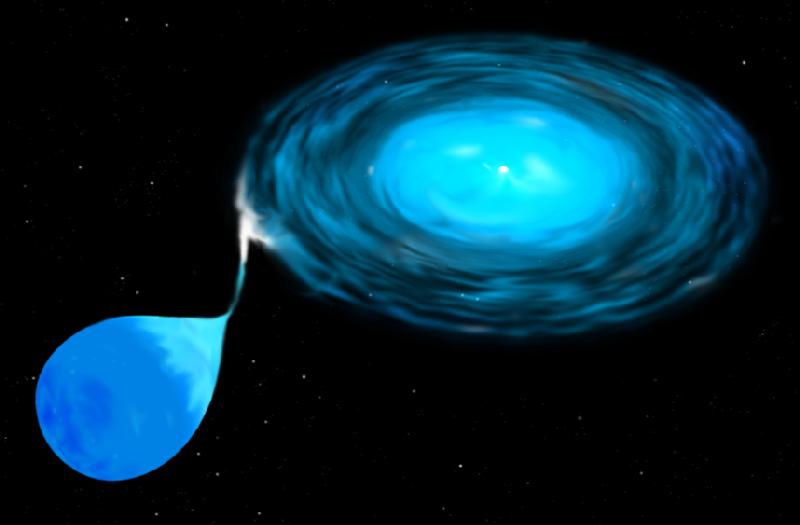

In the standard Shakura-Sunyaev thin-disk model, the accreting material forms a geometrically thin, optically thick disk in which gas orbits the compact object on nearly circular Keplerian trajectories. Viscous stresses—now understood to arise primarily from magnetohydrodynamic turbulence driven by the magnetorotational instability—transport angular momentum outward through the disk, allowing matter to spiral gradually inward. As it does so, gravitational energy is converted into thermal energy, heating the gas to progressively higher temperatures at smaller radii. The resulting spectrum is a superposition of blackbody emission from annuli at different temperatures, producing a characteristic multicolour disk spectrum that peaks in the soft X-ray band at temperatures of roughly 0.5 to 1.5 keV for black hole systems and up to 2 to 3 keV for neutron star systems.4, 6
In addition to the thermal disk, X-ray binaries exhibit a hard X-ray component extending to energies of hundreds of keV. This emission is attributed to a corona—a region of hot, optically thin electrons with temperatures of roughly 109 kelvins (approximately 100 keV)—that Comptonises soft photons from the disk, upscattering them to higher energies through inverse Compton scattering. The geometry and location of the corona remain subjects of active investigation; proposed configurations include a hot inner flow that replaces the inner disk, a patchy atmosphere above the disk, and the base of a relativistic jet.6, 15
For neutron star X-ray binaries, accretion has the additional consequence of spinning up the neutron star through the transfer of angular momentum. Over timescales of hundreds of millions of years, this recycling process can accelerate the neutron star to millisecond spin periods, producing accreting millisecond X-ray pulsars (AMXPs). These objects represent the evolutionary link between LMXBs and the isolated millisecond radio pulsars observed after accretion ceases. The first AMXP, SAX J1808.4−3658, was discovered in 1998 with a spin period of 2.49 milliseconds, and more than 20 are now known.14, 19
Spectral states and state transitions
Black hole X-ray binaries do not maintain a constant X-ray spectrum; instead, they undergo dramatic transitions between distinct spectral states that reflect changes in the geometry and physics of the accretion flow. The two canonical states are the hard state and the soft state, with intermediate and transitional states observed during the evolution between them.5, 6
In the hard state, which typically prevails at low to moderate luminosities, the X-ray spectrum is dominated by a power-law component with a photon index of approximately 1.5 to 2.0, extending to several hundred keV before cutting off. This emission arises from inverse Compton scattering in the hot corona. The standard interpretation is that the optically thick disk is truncated—its inner edge recedes to radii of tens to hundreds of gravitational radii from the compact object—and is replaced inward by a hot, geometrically thick, optically thin accretion flow (often described as an advection-dominated accretion flow, or ADAF). The hard state is invariably accompanied by a steady, compact, partially self-absorbed radio jet.5, 6, 7
In the soft state, observed at higher luminosities, the X-ray spectrum is dominated by thermal emission from the accretion disk, peaking at approximately 1 keV, with a steep, weak power-law tail. In this state the disk extends inward to or near the innermost stable circular orbit (ISCO)—the smallest stable orbit allowed by general relativity, located at 6 gravitational radii for a non-spinning black hole and approaching 1 gravitational radius for a maximally spinning one. The corona is greatly diminished or absent, and the compact radio jet is quenched.5, 6, 7
The transitions between hard and soft states trace a characteristic q-shaped hysteresis pattern in the hardness-intensity diagram: as the luminosity rises during an outburst, the source remains in the hard state to higher luminosities than the level at which it transitions back during the decline. The hard-to-soft transition is frequently accompanied by the ejection of bright, discrete, relativistic plasma blobs detectable as transient radio flares, while the steady compact jet switches off. Fender, Belloni, and Gallo proposed a unified model in which the jet properties are fundamentally linked to the spectral state: a steady, compact jet in the hard state, discrete ejections during the transition, and jet suppression in the soft state.7
Relativistic jets and microquasars
Some X-ray binaries launch powerful, collimated, bipolar outflows of relativistic plasma—relativistic jets—from the innermost regions of the accretion flow.
These jets are directly analogous to the much larger jets produced by active galactic nuclei (AGN), a resemblance that led Mirabel and Rodríguez to coin the term microquasars to describe X-ray binaries exhibiting relativistic jet activity.8
The landmark observation came in 1994, when Mirabel and Rodríguez used the Very Large Array (VLA) radio telescope to detect apparently superluminal radio-emitting plasma ejections from the black hole X-ray binary GRS 1915+105. Two-sided jets were observed to separate at an apparent velocity exceeding the speed of light—the first detection of superluminal motion within the Milky Way. The effect is a geometric illusion produced when plasma moving at a large fraction of the speed of light (in this case, approximately 0.92c) is directed close to the observer's line of sight, causing the approaching component to appear to travel faster than light due to photon travel-time effects.8
The microquasar analogy is more than superficial. The accretion disk–jet coupling observed in X-ray binaries mirrors the relationships seen in AGN, but on timescales of days to months rather than millennia to millions of years. This makes microquasars invaluable for studying the physics of jet formation and propagation, because an observer can watch an entire outburst cycle—from jet ignition through full development to quenching—within a single observing campaign. The fundamental plane of black hole activity, a correlation linking X-ray luminosity, radio luminosity, and black hole mass that spans from stellar-mass to supermassive black holes, provides quantitative evidence that the same accretion-jet physics operates across more than eight orders of magnitude in black hole mass.7, 5
Jets in the hard state are compact and steady, producing a flat or slightly inverted radio spectrum characteristic of partially self-absorbed synchrotron emission from a conical, continuous outflow. Their bulk Lorentz factors are moderate, typically 1.5 to 5. During state transitions, the jets become discrete and ballistic, with Lorentz factors reaching 2 to 10 or more, producing optically thin radio flares as the ejected plasma expands and shocks the surrounding medium.7
Quasi-periodic oscillations
The X-ray emission from accreting compact objects in X-ray binaries frequently exhibits quasi-periodic oscillations (QPOs)—narrow peaks in the power density spectrum of the X-ray light curve that indicate the presence of a characteristic timescale in the accretion flow without being strictly periodic. QPOs are observed across a wide range of frequencies, from millihertz to kilohertz, and are among the most powerful probes of the dynamics of matter in the immediate vicinity of neutron stars and black holes.20
In neutron star LMXBs, the most dramatic QPOs occur at kilohertz frequencies (kHz QPOs), typically appearing as a pair of peaks at frequencies between roughly 300 and 1,200 Hz. These frequencies correspond to orbital periods of matter only a few kilometres above the neutron star surface, placing the emitting region at or near the ISCO. The kHz QPOs were discovered in 1996 with NASA's Rossi X-ray Timing Explorer (RXTE) and have since been detected in more than 30 neutron star LMXBs. Their frequencies increase with accretion rate, and the separation between the twin peaks is approximately constant for a given source, often close to the neutron star spin frequency or half thereof—suggesting a beat-frequency mechanism involving the orbital motion and stellar rotation.20, 18
In black hole X-ray binaries, low-frequency QPOs (LFQPOs) at 0.1 to 30 Hz are ubiquitous in the hard and intermediate states. They are classified into three types—A, B, and C—on the basis of their coherence, amplitude, and the noise continuum on which they sit. Type-C QPOs, the most common, have been explained by models invoking Lense-Thirring precession of the hot inner flow: frame-dragging near a spinning black hole causes the inner accretion flow to precess, modulating the X-ray flux at the precession frequency. This model predicts that the QPO frequency should increase as the inner flow contracts during a state transition, which matches the observed behaviour.20 High-frequency QPOs (HFQPOs) at 40 to 450 Hz have been detected in a handful of black hole binaries, often appearing as a pair with a 3:2 frequency ratio. These frequencies are in the range expected for orbital or epicyclic motions near the ISCO of a stellar-mass black hole, making them potential probes of strong-field general relativity and black hole spin.5, 20
Formation and evolution
The formation of an X-ray binary requires that a binary star system survive the supernova explosion that creates the compact object—a highly selective process that destroys the majority of progenitor systems through the combination of mass loss and natal kicks imparted to the newborn neutron star or black hole.9
For HMXBs, the evolutionary pathway begins with a massive binary in which the primary star (initially the more massive component) evolves first, transferring mass to its companion through Roche lobe overflow or common-envelope evolution before exploding as a core-collapse supernova. If the system survives this explosion, the result is a neutron star or black hole in orbit around the still-massive secondary. The secondary's evolution then determines the HMXB subtype: if it is an OB supergiant with a strong stellar wind, the system appears as a supergiant X-ray binary; if it is a rapidly rotating Be star with a circumstellar disk, the result is a Be/X-ray binary.9, 13, 16 HMXBs are therefore young systems, with lifetimes limited by the nuclear evolution of the massive companion—typically a few million to a few tens of millions of years. They are found preferentially in the Galactic disk, tracing regions of recent star formation.10
LMXBs follow a different evolutionary path. They can form through the evolution of primordial binaries in which the initially more massive star produces a neutron star or black hole via supernova, while the low-mass companion begins mass transfer only after expanding off the main sequence billions of years later. A second formation channel, dominant in globular clusters, involves dynamical capture: the high stellar densities in cluster cores enable neutron stars to acquire companions through tidal capture or exchange interactions. This explains the dramatic overabundance of LMXBs in globular clusters relative to the field—approximately 100 times higher per unit stellar mass.9, 17
The long-term evolution of LMXBs is driven by angular momentum loss from the binary orbit, which sustains mass transfer. For systems with orbital periods above roughly 3 hours, the dominant mechanism is magnetic braking—the loss of angular momentum through the interaction between the companion star's magnetic field and its stellar wind. Below 3 hours, gravitational wave emission becomes the primary driver, causing the orbit to shrink gradually over gigayears. This evolutionary framework explains the observed period gap between approximately 2 and 3 hours in the orbital period distribution of cataclysmic variables and is relevant to understanding the population of ultracompact X-ray binaries with periods below roughly 80 minutes.9, 17
Black hole mass measurements
X-ray binaries provide the primary method for measuring the masses of stellar-mass black holes. The technique relies on dynamical mass determination: by measuring the radial velocity curve of the companion star from its Doppler-shifted absorption lines, astronomers derive the mass function—a lower limit on the compact object's mass that depends on the orbital period, the velocity semi-amplitude, and the inclination of the orbit. When the mass function exceeds approximately 3 solar masses, the compact object exceeds the maximum mass of a neutron star and is identified as a black hole.5, 12
The BlackCAT catalogue compiled by Corral-Santana and colleagues lists 59 black hole transients discovered in the Galaxy since 1966, of which 18 have been dynamically confirmed through radial velocity measurements of the donor star. The confirmed black holes have masses ranging from approximately 5 to 21 solar masses, with a concentration around 7 to 10 solar masses. Population synthesis models suggest that the total Galactic population of black hole X-ray transients is approximately 1,300, the vast majority remaining undetected in quiescence.12
Selected dynamically confirmed black hole X-ray binaries5, 12
| System | Year discovered | BH mass (M⊙) | Orbital period |
|---|---|---|---|
| Cygnus X-1 | 1964 | ~21 | 5.6 days |
| A0620−00 | 1975 | ~6.6 | 7.75 hr |
| GRS 1915+105 | 1992 | ~12 | 33.5 days |
| V404 Cygni | 1989 | ~9 | 6.47 days |
| XTE J1118+480 | 2000 | ~7.5 | 4.08 hr |
Beyond dynamical measurements, X-ray spectroscopy offers complementary constraints on black hole properties. The profile of the broad, relativistically distorted iron Kα fluorescence line at 6.4 keV, produced by X-ray irradiation of the inner accretion disk, encodes information about the disk inclination and the location of the ISCO, which in turn depends on the black hole spin. Spectral fitting of this line and the associated reflection spectrum has yielded spin estimates for more than a dozen black holes, with several (including Cygnus X-1 and GRS 1915+105) showing evidence for near-maximal spin.5, 6
Recent advances and future prospects
The study of X-ray binaries has entered a new era with the deployment of instruments capable of probing previously inaccessible physical parameters. NASA's Imaging X-ray Polarimetry Explorer (IXPE), launched in December 2021, has provided the first spatially resolved X-ray polarimetry measurements of accreting black holes and neutron stars. In 2022, IXPE observed Cygnus X-1 in the hard state and measured a polarization degree of 4.01 ± 0.20 percent at 2 to 8 keV, with the polarization angle aligned with the radio jet axis. This result demonstrated that the hot X-ray-emitting corona is extended in a plane perpendicular to the jet—favouring a disk-like or sandwich corona geometry over a compact, lamppost-like geometry concentrated on the jet axis—and provided the first direct observational constraint linking the geometry of the corona to the orientation of the jet.15
The Neutron Star Interior Composition Explorer (NICER), operating aboard the International Space Station since 2017, continues to deliver precision measurements of neutron star masses and radii through X-ray pulse profile modelling of accreting and rotation-powered millisecond pulsars. These measurements constrain the equation of state of ultra-dense matter, complementing the information obtained from gravitational-wave observations of neutron star mergers.18, 14
Looking forward, next-generation X-ray observatories such as the Advanced Telescope for High Energy Astrophysics (Athena), planned by the European Space Agency for launch in the late 2030s, will combine large collecting area with high spectral resolution, enabling time-resolved spectroscopy of the inner accretion flow on dynamical timescales of milliseconds. Such observations will map the geometry of the accretion disk and corona in real time during state transitions and QPO cycles, directly testing theoretical models of accretion physics and jet formation. The continued expansion of multi-wavelength monitoring—combining X-ray, optical, infrared, and radio observations with gravitational-wave data—promises to resolve longstanding questions about the disk-jet connection, the nature of the corona, and the role of black hole spin in powering relativistic outflows.15, 16, 20
References
Polarized x-rays constrain the disk-jet geometry in the black hole x-ray binary Cygnus X-1
Advances in Understanding High-Mass X-ray Binaries with INTEGRAL and Future Directions
A review of quasi-periodic oscillations from black hole X-ray binaries: Observation and theory