Overview
- Charles Darwin's On the Origin of Species, published on 24 November 1859, established the theory of evolution by natural selection as the central organizing framework of biology, arguing from evidence drawn from biogeography, paleontology, embryology, and morphological homology that all species descend from common ancestors through gradual modification.
- The theory was developed over more than twenty years of painstaking observation and reasoning, catalyzed by Darwin's voyage on HMS Beagle, his reading of Malthus on population, and ultimately prompted to publication by Alfred Russel Wallace's independent discovery of the same mechanism in 1858.
- Although Darwin acknowledged serious difficulties with his theory, including the problem of blending inheritance and gaps in the fossil record, the twentieth-century Modern Synthesis united natural selection with Mendelian genetics and vindicated the core of his argument, making the Origin one of the most consequential scientific works ever published.
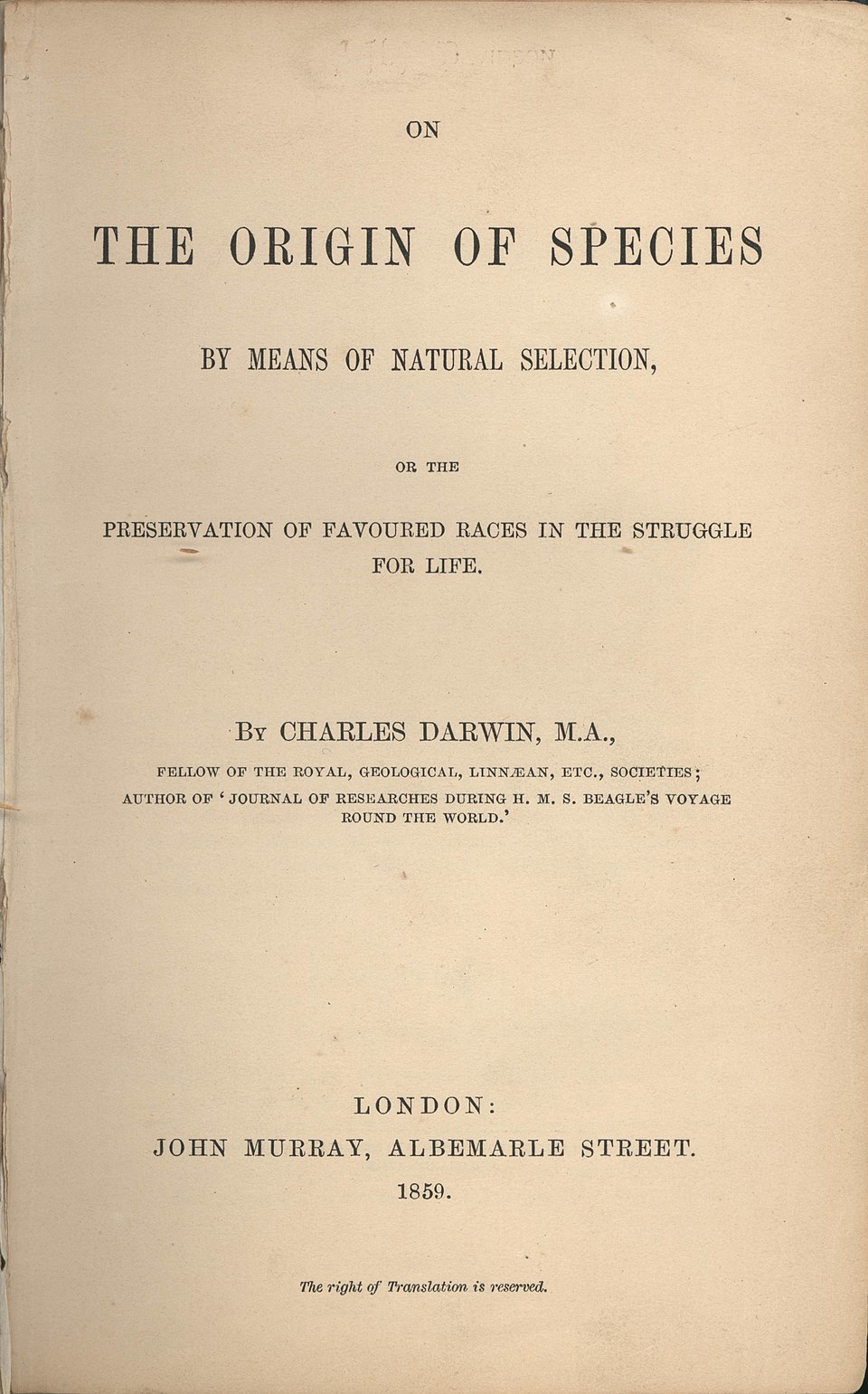
On the Origin of Species by Means of Natural Selection, or the Preservation of Favoured Races in the Struggle for Life, published by John Murray in London on 24 November 1859, is the foundational text of modern evolutionary biology.1 In it, Charles Darwin marshalled two decades of evidence and reasoning to argue that species are not fixed creations but the products of gradual modification through a process he called natural selection: the differential survival and reproduction of individuals bearing heritable variations that are better suited to their environments.1, 4 The book transformed the life sciences, replacing the prevailing framework of natural theology — in which the adaptation of organisms was attributed to divine design — with a mechanistic, testable explanation grounded in observable natural processes. Darwin himself described the work as "one long argument," and its publication is widely regarded as one of the pivotal events in the history of science.1, 5
The first edition of 1,250 copies sold out on the day of publication, and the book went through six editions in Darwin's lifetime, each incorporating revisions, responses to critics, and additional evidence.9 More than a century and a half later, the central thesis of the Origin — that all life shares common ancestry and that natural selection is the primary mechanism of adaptive evolution — remains the organizing principle of biology.13, 17
The intellectual background
Darwin did not work in an intellectual vacuum. The early nineteenth century saw vigorous debate over the fixity of species, the age of the Earth, and the relationship between organisms and their environments. The dominant framework in British natural history was natural theology, exemplified by William Paley's Natural Theology (1802), which argued that the intricate adaptation of organisms to their ways of life was evidence of intelligent design by a Creator — just as the complexity of a watch implies a watchmaker.4, 16 Darwin read Paley as an undergraduate at Cambridge and later acknowledged the power of the argument, even as he came to replace it with a naturalistic alternative.2
On the European continent, the French naturalist Jean-Baptiste Lamarck had proposed in his Philosophie Zoologique (1809) that species change over time through the inheritance of acquired characteristics — the idea that organisms could pass on traits developed during their lifetimes in response to environmental pressures. Although Lamarck's proposed mechanism was ultimately rejected, his insistence that species were mutable rather than fixed was an important intellectual precedent.5, 16 In geology, Charles Lyell's Principles of Geology (1830–1833) championed uniformitarianism, the principle that the geological processes observable in the present — erosion, sedimentation, volcanic activity — are the same processes that shaped the Earth in the past, operating over immense spans of time. Darwin took the first volume of Lyell's Principles aboard HMS Beagle and later described it as having profoundly influenced his thinking by providing the vast temporal framework that gradual biological change would require.2, 18
Anonymously published in 1844, Robert Chambers's Vestiges of the Natural History of Creation had proposed a progressive, law-governed development of life from simple to complex forms, and although the scientific establishment savaged its speculative reasoning and factual errors, the book demonstrated enormous public appetite for evolutionary ideas and warned Darwin of the reception his own theory might face.4, 16 These intellectual currents — natural theology, Lamarckism, uniformitarian geology, and the popular ferment around transmutation — formed the backdrop against which Darwin developed his radically new explanation for the diversity of life.
The voyage of HMS Beagle
The event that set Darwin on the path to the Origin was his appointment as gentleman naturalist aboard HMS Beagle, a Royal Navy survey vessel that circumnavigated the globe between December 1831 and October 1836 under the command of Captain Robert FitzRoy.2 The voyage took Darwin through the Cape Verde Islands, along the coasts of South America, to the Galápagos archipelago, across the Pacific to New Zealand and Australia, and home via the Indian Ocean and the Cape of Good Hope. Over nearly five years, Darwin collected thousands of specimens, made extensive geological observations, and filled notebooks with the raw material that would occupy his scientific career for decades.2, 18
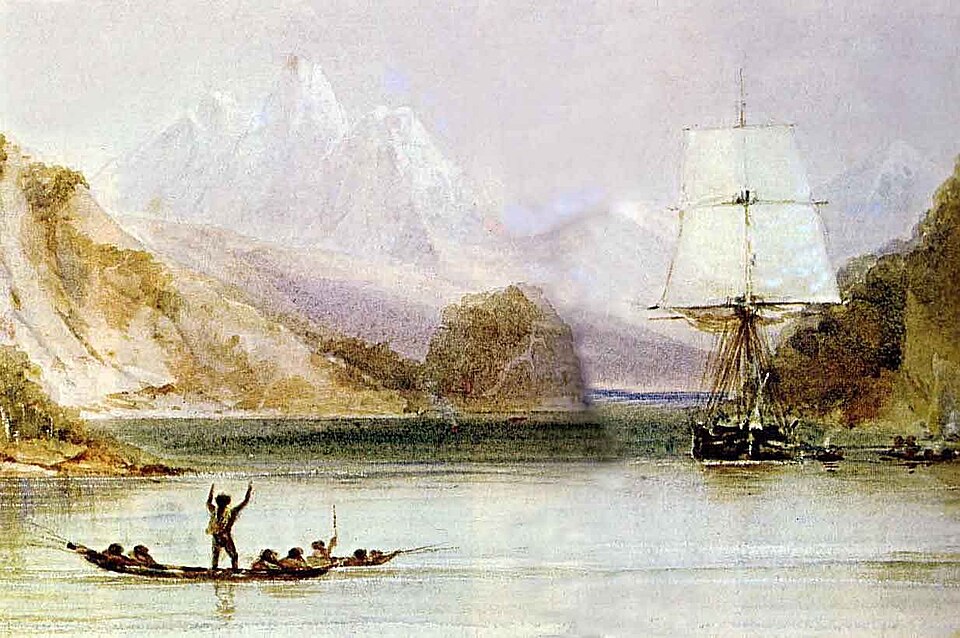

Three categories of observation proved especially formative. First, in the Pampean formations of Argentina, Darwin discovered fossil remains of giant extinct mammals — including ground sloths (Megatherium), armadillo-like glyptodonts, and the horse-like Macrauchenia — that bore unmistakable structural resemblances to the living mammals of the same continent. The extinct glyptodonts, for example, were covered in bony armour strikingly similar to that of living armadillos, suggesting a genealogical relationship between the fossil and living forms rather than independent creation.1, 2 Second, as Darwin traveled southward along the South American coast, he noticed that closely allied species replaced one another geographically, a pattern of biogeographic continuity difficult to explain if each species had been separately created for its particular station.1, 2
Third, and most famously, Darwin observed the distinctive fauna of the Galápagos Islands. He initially failed to label many of his bird specimens by island, an oversight he later regretted, but upon his return to England the ornithologist John Gould examined the collection and reported in January 1837 that what Darwin had assumed to be a miscellaneous assortment of blackbirds, grosbeaks, and finches were in fact a closely related group of thirteen species, all unique to the archipelago.6 The Galápagos mockingbirds, which Darwin had more carefully labelled by island, proved even more striking: Gould confirmed that specimens from different islands represented distinct species rather than mere varieties, yet all closely resembled mainland South American mockingbirds.2, 6 The implication was that the island species had descended from a common mainland ancestor and diverged in isolation — a pattern of descent with modification.
Development of the theory
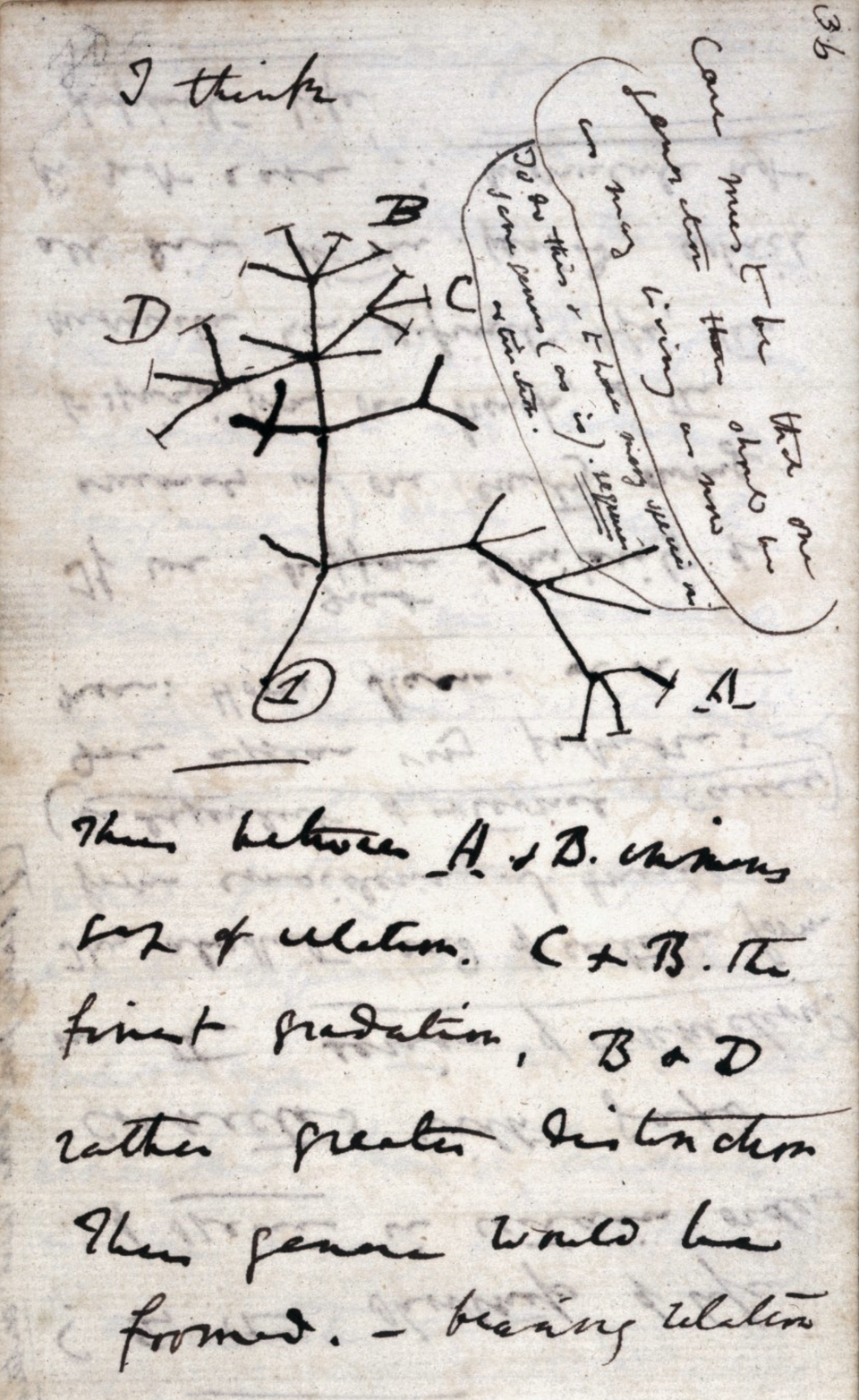
Darwin opened his first notebook on the "transmutation of species" in July 1837, shortly after Gould's identifications had crystallised the significance of the Beagle collections.2, 7 Over the next fifteen months, he filled a series of notebooks (designated B through E by scholars) with speculations on heredity, variation, species change, and the branching pattern of descent. In Notebook B, he drew his famous "I think" diagram: a simple tree of branching lines representing the divergence of species from common ancestors, the earliest known sketch of an evolutionary tree of life.7

The decisive intellectual breakthrough came on 28 September 1838, when Darwin, as he recorded in his autobiography, read Thomas Malthus's Essay on the Principle of Population (1798) "for amusement." Malthus had argued that human populations tend to grow geometrically while food supplies increase only arithmetically, so that population growth is inevitably checked by famine, disease, and competition. Darwin immediately grasped the implication for the natural world: since all species produce far more offspring than can survive, there must be a constant "struggle for existence," and any heritable variation that confers even a slight advantage in that struggle will tend to be preserved and accumulated over generations.1, 2, 15 This was the principle of natural selection.
Darwin did not rush to publish. He wrote a brief 35-page pencil sketch of his theory in 1842 and expanded it into a 230-page essay in 1844, neither of which he published.7, 21 Instead, he embarked on an eight-year taxonomic study of barnacles (1846–1854), establishing his credentials as a meticulous systematist before venturing so controversial a theory. Beginning in 1856, encouraged by Lyell, Darwin started writing what he intended to be a comprehensive treatise, provisionally titled Natural Selection, which he estimated would run to several volumes.7 He was still working on this "big book" when, in June 1858, he received a letter that upended his plans.
Wallace and the impetus to publish
On 18 June 1858, Darwin received a manuscript from Alfred Russel Wallace, a young naturalist then conducting fieldwork in the Malay Archipelago. Wallace's paper, "On the Tendency of Varieties to Depart Indefinitely from the Original Type," outlined a theory of species change through natural selection that was, in its essential logic, strikingly similar to Darwin's own.8, 20 Darwin was stunned, writing to Lyell: "your words have come true with a vengeance — that I should be forestalled."3
The crisis was resolved by the intervention of Lyell and the botanist Joseph Dalton Hooker, two of Darwin's closest scientific confidants, who had long known of his unpublished theory. They arranged for a joint presentation of Wallace's paper alongside extracts from Darwin's unpublished 1844 essay and an 1857 letter to the American botanist Asa Gray summarizing his views. The joint papers were read before the Linnean Society of London on 1 July 1858 and published in the Society's journal on 20 August of that year.8, 20 The presentation attracted little immediate notice, but it established Darwin's priority and galvanized him to abandon the comprehensive treatise and write what he described as an "abstract" of his larger work. Composed at extraordinary speed between July 1858 and March 1859, that abstract became On the Origin of Species.3, 9
The structure and argument of the Origin
The Origin is organised as a sustained cumulative argument across fourteen chapters. Darwin began with what his readers knew best: the artificial selection practised by plant and animal breeders. Chapter I, "Variation Under Domestication," documented the extraordinary range of forms that breeders had produced in pigeons, cattle, dogs, and crop plants by selecting individuals with desired traits over many generations — the process now known as artificial selection.1 This was a deliberate rhetorical strategy: if human breeders could produce such dramatic changes in a few centuries, Darwin asked, what might nature accomplish over millions of years?

Chapter II, "Variation Under Nature," established that wild populations are not uniform but exhibit continuous heritable variation in virtually every measurable trait. Chapter III, "Struggle for Existence," drew on the Malthusian insight that all species produce more offspring than can survive, creating intense competition for resources. In Chapter IV, "Natural Selection," Darwin brought these threads together: given heritable variation, a struggle for existence, and the differential survival and reproduction of individuals bearing advantageous variants, species would inevitably change over time in the direction of greater adaptation to their environments.1, 4
Chapter IV also introduced two concepts central to Darwin's vision. The principle of divergence of character proposed that natural selection would tend to favour the most divergent varieties within a species, because organisms differing most from their competitors could exploit the widest range of ecological niches. Over time, this divergence would produce the branching, tree-like pattern of relationships among species. Darwin illustrated this principle with the only figure in the entire book: a branching diagram showing hypothetical lineages diverging from a common ancestor, splitting and re-splitting over geological time, with many branches going extinct.1, 5 This tree of life metaphor replaced the traditional image of a linear scale of nature (scala naturae) with a fundamentally new conception of the history of life as a branching, contingent process.
The remaining chapters addressed potential objections (Chapters VI–IX), presented supporting evidence from the geological record, biogeography, morphology, and embryology (Chapters X–XIII), and concluded with a summary and a celebrated closing passage evoking "grandeur in this view of life."1
Chapter structure of On the Origin of Species (1st edition, 1859)1, 9
| Chapter | Title | Core argument |
|---|---|---|
| I | Variation under domestication | Artificial selection demonstrates that heritable variation can be accumulated to produce dramatic change |
| II | Variation under nature | Wild species exhibit abundant heritable variation, the raw material for natural selection |
| III | Struggle for existence | Geometric population growth ensures intense competition for survival and reproduction |
| IV | Natural selection | Favourable variations are preserved; divergence of character produces the tree-like pattern of life |
| V | Laws of variation | Environmental and developmental factors produce the variation on which selection acts |
| VI | Difficulties on theory | Addresses absence of transitional forms, organs of extreme perfection, and instinct |
| VII | Instinct | Complex behaviours such as hive-building in bees can evolve by gradual selection |
| VIII | Hybridism | Sterility of hybrids is a byproduct of divergence, not a designed barrier |
| IX | On the imperfection of the geological record | Gaps in the fossil record reflect incomplete preservation, not absence of transitional forms |
| X | On the geological succession of organic beings | Fossil patterns — gradual appearance, extinction, and resemblance to living forms — support descent |
| XI–XII | Geographical distribution | Biogeographic patterns are explained by migration and subsequent modification, not separate creation |
| XIII | Mutual affinities; morphology; embryology; rudimentary organs | Homologous structures, embryonic resemblances, and vestigial organs all point to common descent |
| XIV | Recapitulation and conclusion | "There is grandeur in this view of life" — summary of the entire argument |
The evidence Darwin marshalled
One of the most striking features of the Origin is the breadth and depth of its evidentiary base. Darwin drew on four principal lines of evidence, each independently pointing toward descent with modification.
Biogeography. Darwin devoted two full chapters to the geographic distribution of organisms. He argued that the distribution of species could not be explained by the idea that each was created in its present location: why should oceanic islands harbour species closely resembling those on the nearest mainland, rather than those on other islands with similar climates? Why should the Galápagos have finches and mockingbirds allied to South American species, rather than to African ones? The patterns made sense only if island species had descended from mainland colonists and diverged in isolation.1, 2
Paleontology. The fossil record, despite its acknowledged imperfections, revealed patterns consistent with Darwin's theory. Extinct species often resembled the living inhabitants of the same region (as with the South American glyptodonts and armadillos), geological strata showed a progressive succession of forms over time, and the further back one looked in the record, the more different the organisms appeared from their modern counterparts.1, 18 Darwin was candid about the incompleteness of the fossil record, devoting an entire chapter to explaining why transitional forms were rarely preserved, but he argued that the general pattern of the record was precisely what his theory predicted.
Morphological homology. Darwin pointed to the remarkable structural similarities among the forelimbs of vertebrates: the same bones are present in the human arm, the whale's flipper, the bat's wing, and the horse's leg, despite their vastly different functions. Under the hypothesis of special creation, there was no reason why a designer should use the same skeletal plan for such different purposes; under the hypothesis of common descent, these homologous structures were inherited from a shared ancestor and modified for different uses.1, 5
Embryology. Darwin observed that the embryos of very different vertebrates — fish, reptiles, birds, and mammals — resemble one another far more closely than do the adults, a pattern he interpreted as evidence that these organisms share a common developmental heritage inherited from a remote ancestor. Vestigial structures, such as the rudimentary hind-limb bones in some snakes and the functionless eyes of cave-dwelling animals, provided further evidence: they were intelligible as remnants of structures that were functional in ancestors but have been reduced by natural selection or disuse in descendants.1
Reception of the Origin
The publication of the Origin ignited immediate and intense debate. The first edition of 1,250 copies was offered to booksellers at John Murray's autumn trade sale on 22 November 1859, and all available copies were taken up; a second edition of 3,000 copies followed on 7 January 1860.3, 9 Reviews were polarised. The anatomist Richard Owen, who had once collaborated with Darwin, wrote an anonymous and hostile review in the Edinburgh Review, while the comparative anatomist Thomas Henry Huxley — who dubbed himself "Darwin's Bulldog" — wrote enthusiastic notices in The Times and elsewhere, declaring that he was "sharpening up my claws and beak in readiness."3, 4
The most famous confrontation occurred at the British Association for the Advancement of Science meeting in Oxford on 30 June 1860, where Huxley clashed with Samuel Wilberforce, the Bishop of Oxford, in what became known as the "Huxley-Wilberforce debate." No verbatim transcript survives, and subsequent accounts have been embellished by partisans on both sides, but the episode became a powerful symbol of the perceived conflict between evolutionary science and religious authority.3, 4 In reality, the scientific reception of the Origin was more nuanced. Many scientists accepted common descent relatively quickly but remained sceptical of natural selection as the primary mechanism of change, a position that persisted well into the twentieth century.4, 5
Darwin's cause was advanced by a network of able supporters. Joseph Dalton Hooker, director of the Royal Botanic Gardens at Kew, provided critical botanical evidence for evolution in his Introductory Essay to the Flora Tasmaniae (1859), becoming the first prominent scientist to publicly endorse the theory.3 In the United States, the Harvard botanist Asa Gray became Darwin's foremost American advocate, defending the theory while also arguing that natural selection was not incompatible with religious belief in design — a position Darwin appreciated as tactically useful, though he personally found it unconvincing.22 The geologist Charles Lyell, despite deep personal reservations about the implications for human uniqueness, eventually gave qualified public support in his Antiquity of Man (1863).3
Criticisms and limitations Darwin acknowledged
Darwin was his own most perceptive critic, and the Origin is remarkably forthright about the difficulties facing the theory. He devoted Chapter VI, "Difficulties on Theory," to potential objections, and addressed the incompleteness of the fossil record at length in Chapter IX. Two problems proved particularly serious.
The first was the problem of blending inheritance. In the prevailing understanding of heredity in the 1860s, offspring were thought to be a blend of their parents' characteristics, much as mixing two colours of paint produces an intermediate shade. The Scottish engineer Fleeming Jenkin pointed out in an influential 1867 review that under blending inheritance, any new favourable variation arising in a single individual would be diluted by half in each subsequent generation through mating with unmodified individuals, and would effectively be "swamped" before selection could act on it.14, 19 Darwin acknowledged the force of this argument, writing to Wallace in 1869 that "Fleeming Jenkin's arguments have convinced me," and in later editions of the Origin he placed greater emphasis on the importance of individual differences — small, continuously distributed variations present in many members of a population — rather than on large, sudden "sports."14 The problem was not resolved until the rediscovery of Gregor Mendel's particulate theory of inheritance at the turn of the twentieth century, which showed that hereditary factors do not blend but are transmitted as discrete units (genes) that can be passed intact from generation to generation.10, 14
The second major difficulty was the imperfection of the geological record. If species had evolved gradually through the accumulation of small differences, the fossil record should preserve abundant intermediate or transitional forms connecting ancestral species to their descendants. In Darwin's time, such intermediates were extremely rare. Darwin argued that the rarity of transitional fossils was a consequence of the extreme incompleteness of the geological record: fossilisation is a rare event, and the geological deposits that happen to be preserved and accessible represent only a tiny fraction of the history of life.1 Subsequent discoveries have vindicated this argument far beyond what Darwin could have hoped. The fossil record now includes spectacular transitional sequences documenting the evolution of whales from terrestrial mammals, birds from theropod dinosaurs, tetrapods from lobe-finned fish, and numerous other major transitions, although the record remains incomplete by its very nature.17
The modern vindication through genetics
The resolution of the blending-inheritance problem and the full vindication of Darwin's theory came through the integration of natural selection with Mendelian genetics in the early twentieth century, a process known as the Modern Synthesis. The mathematical foundations were laid by three population geneticists working largely independently. Ronald A. Fisher, in The Genetical Theory of Natural Selection (1930), demonstrated that Mendelian inheritance was not only compatible with Darwinian selection but actually required by it: he showed mathematically that natural selection acting on the small, continuously distributed genetic variation present in populations could produce precisely the patterns of adaptive change Darwin had described.10 J. B. S. Haldane, in a series of papers collected in The Causes of Evolution (1932), provided further mathematical models of selection, mutation, and migration in populations. Sewall Wright developed the concept of genetic drift and the "adaptive landscape" metaphor for visualising the relationship between genotype and fitness.5, 16
These mathematical results were translated into biology accessible to naturalists and systematists by Theodosius Dobzhansky's Genetics and the Origin of Species (1937), which demonstrated through studies of natural populations of Drosophila fruit flies that the genetic variation, geographic differentiation, and reproductive isolation observed in the wild were exactly what Mendelian genetics and natural selection predicted.11 Ernst Mayr's Systematics and the Origin of Species (1942) contributed the biological species concept — defining species as populations of interbreeding organisms reproductively isolated from other such populations — and showed how geographic isolation leads to speciation, providing the mechanism for the branching pattern Darwin had described.12 Julian Huxley, grandson of Thomas Henry Huxley, coined the term "Modern Synthesis" in his 1942 book Evolution: The Modern Synthesis, which surveyed the convergence of genetics, systematics, paleontology, and ecology into a unified evolutionary framework.23
The discovery of the structure of DNA by Watson and Crick in 1953, followed by the elucidation of the genetic code and the mechanisms of mutation and gene regulation in subsequent decades, provided the molecular foundation for the variation and heredity that Darwin had observed but could not explain. Molecular biology confirmed that all living organisms share the same genetic code and the same basic molecular machinery for replication and protein synthesis, providing the most powerful evidence yet for universal common descent.17
The lasting scientific impact
The Origin of Species did not merely introduce a new theory; it reoriented the entire enterprise of biology. Before Darwin, the study of living organisms was largely descriptive and classificatory, organised around the assumption that species were fixed types created according to a divine plan. After Darwin, biology became an explicitly historical science, concerned with the processes by which the diversity of life arose and with the genealogical relationships among organisms.5, 13 As Theodosius Dobzhansky declared in a landmark 1973 essay, "Nothing in biology makes sense except in the light of evolution."13
The theory of natural selection provided a unifying framework that connected previously disparate fields. Biogeography, paleontology, comparative anatomy, embryology, and later genetics and molecular biology all found their explanatory coherence within the Darwinian framework.17 The Origin also established the methodological standards for evolutionary research: the insistence on testable mechanisms, the use of converging lines of evidence from independent disciplines, and the willingness to identify and confront difficulties with one's own theory. Darwin's candour about the problems facing natural selection — blending inheritance, gaps in the fossil record, the origin of complex organs — was not a weakness but a model of scientific integrity that set the template for subsequent work.1, 4
The book went through six editions between 1859 and 1872, with Darwin continually revising the text in response to criticism and new evidence. The second edition (1860) incorporated minor corrections and responded to religious objections. The third edition (1861) added a historical sketch acknowledging predecessors. The fifth edition (1869) introduced Herbert Spencer's phrase "survival of the fittest" as a synonym for natural selection, a concession Darwin later regretted because it invited misinterpretation. The sixth and final edition (1872) dropped "On" from the title and was the most heavily revised, incorporating responses to critics including Jenkin and the physicist William Thomson (Lord Kelvin), who had argued that the Earth was too young for evolution to have occurred — an objection made moot by the subsequent discovery of radioactivity and the revision of the Earth's age to approximately 4.54 billion years.1, 3, 9
More than 160 years after its publication, the Origin of Species remains in print and continues to be read both as a scientific text and as a work of English prose of exceptional clarity and persuasive power. Its central argument — that the diversity of life is the product of descent with modification through natural selection — has been confirmed and extended by every subsequent advance in biology, from Mendelian genetics to genomics, and stands as one of the most thoroughly substantiated theories in all of science.13, 17
References
Darwin's Other Books: 'Red' and 'Transmutation' Notebooks, 'Sketch,' 'Essay,' and Natural Selection
On the Tendency of Species to form Varieties; and on the Perpetuation of Varieties and Species by Natural Means of Selection
Darwin, Malthus, Süssmilch, and Euler: The ultimate origin of the motivation for the theory of natural selection