Overview
- Developmental constraints are biases in the production of phenotypic variation: development does not generate all conceivable forms with equal probability, and some morphologies are far more readily produced than others, channelling and limiting the trajectories available to natural selection.
- The deeply conserved Hox gene toolkit, shared across virtually all bilaterally symmetric animals, explains recurring features of body plan organisation — including the five-digit tetrapod limb and the segment-based insect body — and why certain radical novelties, such as six-limbed vertebrates or wheeled organisms, have never evolved.
- Constraints and evolvability are not opposites: Kirschner and Gerhart’s theory of facilitated variation shows that the same conserved developmental systems that limit some directions of change actively enable rapid, coordinated adaptation in others, making constraints essential to the success of evolutionary tinkering.
Evolution does not explore all possible forms of life with equal probability. If the universe of conceivable body plans were sampled randomly, we would expect to find vertebrates with six limbs, animals that roll on wheels, and insects built on a fundamentally different segmentation logic from the one they have used for half a billion years. None of these things exist. The explanation lies not solely in natural selection — which eliminates forms after they arise — but in the prior question of what forms development is even capable of generating. Developmental constraints are biases in the production of phenotypic variation: the architecture of embryonic development makes some morphologies far more probable than others, and some effectively impossible, regardless of whether they would be adaptive.2 Understanding constraints means understanding why evolution is, as François Jacob put it in 1977, a tinkerer that works with available materials rather than an engineer designing from scratch.1

What developmental constraints are
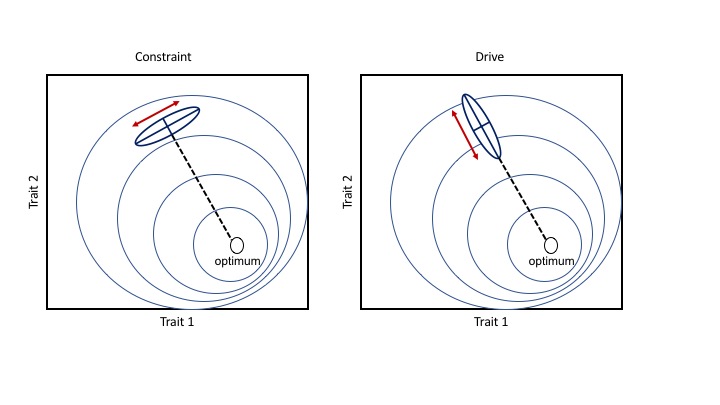
The formal concept was introduced into evolutionary biology by John Maynard Smith and colleagues in a landmark 1985 review, which defined a developmental constraint as “a bias on the production of variant phenotypes or a limitation on phenotypic variability caused by the structure, character, composition, or dynamics of the developmental system.”2 This definition distinguishes two related phenomena. A constraint as limitation is the absolute absence of certain variants — a gap in the morphospace that development simply cannot reach. A constraint as bias is the unequal probability of generating different variants: some directions of phenotypic change are much more easily produced than others, so mutation and development tend to push populations along certain trajectories even in the absence of directional selection.
The distinction matters enormously for evolutionary theory. Selection can only act on variation that development supplies. If certain variants are never produced, selection cannot favour them no matter how beneficial they would be. If certain variants are produced far more readily than others, the phenotypic outcomes of evolution will be biased toward those variants even when selection is weak. Developmental constraints therefore partially determine the direction of evolution independent of the adaptive landscape — they shape what evolutionary biologists call evolvability: the capacity of a lineage to generate heritable phenotypic variation.16 This is the deep connection between evo-devo and macroevolution: the developmental system is not a passive medium through which selection acts, but an active participant that channels and filters the raw material selection receives.9, 10
Types of constraints
Physical and structural constraints arise from the laws of physics and the material properties of biological tissues. Body size provides the clearest example. Bone strength scales with cross-sectional area (proportional to length squared), while body weight scales with volume (proportional to length cubed). As an animal grows larger, its bones must become disproportionately thick to bear the increased load — a relationship Galileo recognised in 1638 and that J. B. S. Haldane formalised in his famous 1926 essay “On Being the Right Size.”12 By the time an animal reaches the mass of a large sauropod dinosaur or an extant elephant, bone dimensions approach the mechanical limits of mineralised tissue. The largest reliable estimates for terrestrial sauropod mass cluster around 70–80 tonnes, with theoretical upper limits around 90–120 tonnes; building a stable, load-bearing terrestrial skeleton much beyond this range appears to be physically precluded regardless of selection pressure.11 Similar scaling relationships constrain respiratory, circulatory, and thermal physiology across body size regimes, creating a tightly interconnected web of physical limits on what morphologies are viable.
Phylogenetic constraints reflect the legacy of ancestral developmental architecture that is shared by all members of a clade. All living tetrapods — amphibians, reptiles, birds, and mammals — possess five or fewer digits on each limb. Polydactyly occasionally produces extra digits in individual animals, but no tetrapod lineage has ever stably evolved more than five as a fixed trait. This is not because six or seven digits would be mechanically inferior in all contexts, but because the developmental system that generates digits, inherited from the earliest tetrapod ancestor more than 375 million years ago, is strongly biased toward producing five or fewer.7, 8 The fossil record of early tetrapods shows that some had seven or eight digits, but this diversity was eliminated early, and subsequent tetrapod evolution has operated entirely within the five-digit ceiling.7 The constraint is phylogenetic in the sense that it is an ancestral character of the clade, not a universal physical law.
Developmental-mechanistic constraints arise from the internal logic of developmental processes themselves. Insect body segmentation provides a canonical example. Insects produce their body segments through a hierarchical cascade of transcription factor activity: gap genes, pair-rule genes, and segment-polarity genes subdivide the embryo into progressively finer positional domains during early development. Individual segments can be profoundly modified by changes in Hox gene expression — thoracic segments can develop legs, abdominal segments can develop wings in mutants, and the identities of entire tagmata can be shifted.18 But the segmentation mechanism itself, the fundamental process of dividing the body into a series of repeated units, has not changed since the origin of arthropods. Mutations that disrupt the segmentation cascade are lethal, not merely disadvantageous. The mechanism is canalized: it is essentially invariant across arthropod diversity not because selection continuously favours it over alternatives, but because development no longer generates heritable variation in the mechanism itself.2, 9
The Hox gene toolkit and body plan conservation
The most striking molecular demonstration of developmental constraint comes from the Hox genes, a family of transcription factors that specify positional identity along the anterior-posterior axis of virtually all bilaterally symmetric animals. In Drosophila, the eight Hox genes of the Antennapedia and Bithorax complexes are arranged in chromosomal order corresponding to their expression domains in the embryo: genes at one end of the cluster are expressed anteriorly, and genes at the other end posteriorly — a property called spatial colinearity. When William McGinnis and colleagues used Drosophila Hox probes to screen libraries from other organisms in 1984, they found the same homeodomain sequences conserved in organisms ranging from beetles to frogs to humans.6 Subsequent work confirmed that Hox genes are present in all bilaterian animals, arranged in homologous clusters, performing homologous functions.5
This conservation is extraordinary given that vertebrates and insects last shared a common ancestor more than 550 million years ago. The Hox toolkit has been copied, modified, and deployed in countless variations, but its fundamental architecture — anterior genes specify head and neck identity, posterior genes specify trunk identity — has not changed. Vertebrates have expanded the ancestral bilaterian set to four Hox clusters through genome duplications, enabling greater complexity, but the logic of Hox function is the same.5, 18 This conservation is the molecular face of phylogenetic constraint: the Hox system is so deeply integrated into the regulatory networks that control body plan development that changes to its fundamental architecture are lethal. Natural selection has not eliminated alternative body-plan control systems because development does not generate animals that lack functional Hox genes — such animals die before birth. The Hox toolkit is conserved not because it is optimal, but because the developmental system has become dependent on it in a way that makes alternatives inaccessible.19
The same logic explains why there are no six-limbed vertebrates. All tetrapod limbs are patterned by the same developmental toolkit involving Hox genes of the HoxA and HoxD clusters, sonic hedgehog signalling, and fibroblast growth factor cascades emanating from the apical ectodermal ridge.13 This limb-development programme was established in the common ancestor of tetrapods and has been modified to produce wings, flippers, hands, and hooves, but not to produce additional pairs of limbs. Insects and other arthropods develop limbs on multiple body segments using a completely different developmental programme: the expression of appendage-promoting Hox genes in thoracic versus abdominal segments determines where legs form. Vertebrates lack this segmental appendage-induction system. A mutation that redirected the vertebrate limb programme to an additional body segment would require coordinated changes in multiple regulatory elements that jointly define where the lateral plate mesoderm thickens to form a limb bud — a degree of coordinated change that development effectively never generates as a single heritable variant.13
Why wheels, propellers, and other human inventions have not evolved
Richard Dawkins and others have noted that the wheel — arguably the most useful machine humans have invented — does not appear in the body plans of any multicellular organism. Bacterial flagella rotate, and are sometimes cited as a biological exception, but the flagellar motor operates at the microscopic scale where viscosity dominates over inertia, and the flagellum is not a load-bearing wheel connected by an axle to a rigid body: it is a nanoscale molecular machine that functions by an entirely different mechanical principle from a wheel supporting a vehicle’s weight against gravity.1
The absence of wheels in macroscopic animals is a developmental constraint problem. A wheel requires a freely rotating component connected to a stationary axle by a lubricated bearing. Biology can build rotating molecular motors, but scaling this to a macroscopic load-bearing joint that is both mechanically decoupled from the body and supplied with blood, nerves, and nutrients by vessels that cannot twist indefinitely is a developmental impossibility. Vascular supply, neural innervation, and the growth processes that produce appendages all require continuous physical connection between a structure and the body. Any appendage that rotated freely relative to the body would tear away the blood vessels and nerves that sustain it. The constraint here is not a simple bias but a genuine limitation: no developmental process currently known can produce a macroscopic rotating joint with uninterrupted axle separation from the body while maintaining continuous vascular and neural supply. Jacob’s insight was that evolution, unlike engineering, cannot discard a partly-built structure and start again; it must always work from what already exists.1
Distinguishing constraints from selection
A methodological challenge in evolutionary biology is separating the absence of a trait due to developmental constraint from its absence due to natural selection against it. The phylogenetic comparative method offers the most powerful approach. If a trait is genuinely developmentally constrained, it should be absent across an entire clade regardless of the ecological context of its members; if it is absent due to selection, it should be absent in ecological contexts where it would be disadvantageous but present in contexts where it would be favoured, or it should arise in domestication experiments where artificial selection overrides natural selection.2
Pere Alberch’s work on salamander digit reduction provides a clear example of how constraints leave distinctive fingerprints in the fossil record and among living taxa. When salamander lineages independently reduce digit number, they do not lose digits in random order: fore limbs consistently lose digit I first, and hind limbs consistently lose digit V first, regardless of the lineage or ecological context.16 This non-random pattern reveals that the developmental system does not generate all possible digit-loss phenotypes with equal probability. Selection could not explain the consistent order unless there were something specifically disadvantageous about losing digits in other orders in every independent lineage. The regularity indicates instead that development produces some variants (loss of peripheral digits) more readily than others (loss of central digits), a bias that channels phylogenetic change along predictable trajectories irrespective of selection.16
Stephen Jay Gould emphasised that constraints can have macroevolutionary consequences distinct from natural selection: they determine not just which variants are favoured, but which variants exist to be favoured.17 This is the key conceptual distinction. Selection is a filter; constraints determine the composition of what enters the filter. A lineage that cannot generate variation in a certain dimension cannot respond to selection in that dimension, no matter how strong. Conversely, a lineage that readily generates certain types of variation will tend to evolve in those directions even when selection is weak or neutral, simply because the developmental bias keeps introducing variants in those directions.2, 17
Facilitated variation: constraints as enablers
A powerful reframing of the constraint concept comes from Marc Kirschner and John Gerhart’s theory of facilitated variation, developed in a 2001 paper and elaborated in their 2005 book The Plausibility of Life.3, 4 Their central argument is that the conserved developmental toolkit, precisely because it is deeply modular and composed of reusable signalling systems, makes large-scale phenotypic change accessible to small genetic changes. Far from being merely a source of limits, developmental architecture actively facilitates the production of complex adaptive variation.
The key concept is weak regulatory linkage: the components of developmental systems — signalling pathways, transcription factor networks, cytoskeletal elements — are connected to each other by regulatory relationships that can be modified by changes in a small number of cis-regulatory elements, without disrupting the core functions of the components themselves. The Wnt, Hedgehog, BMP, and FGF signalling cascades, for example, are each deployed repeatedly in different developmental contexts across the body. A mutation that changes where or when a ligand is expressed can redirect an entire downstream signalling programme to a new context, producing a major morphological change from a simple regulatory alteration.3, 4
Kirschner and Gerhart argue that this architecture explains why evolution has been able to generate the observed diversity of animal body plans from a conserved genetic toolkit: the toolkit is not a constraint in the limiting sense but a library of pre-tested, reliable developmental modules that can be assembled and reassembled by regulatory change. The constraint lies in the modules themselves, which are reused rather than replaced; the facilitation lies in the ease with which their deployment can be modified. This connects directly to the evo-devo finding that morphological evolution proceeds predominantly through changes in cis-regulatory elements rather than protein-coding sequences: altering the regulatory wiring of conserved modules produces heritable phenotypic diversity without disrupting the modules’ core biochemical functions.4, 18
Anatomical signatures of historical constraint
Two of the most discussed examples of developmental and historical constraint in vertebrate anatomy are the recurrent laryngeal nerve and the inverted vertebrate retina. Both are frequently cited as evidence that evolution is a tinkerer working within historical constraints rather than an engineer optimising from first principles — precisely the lesson Jacob drew in 1977.1
The recurrent laryngeal nerve is a branch of the vagus nerve (cranial nerve X) that innervates the larynx. In humans, instead of running directly from the brainstem to the larynx — a distance of a few centimetres — it descends into the chest, loops under the aortic arch, and ascends back to the larynx, adding roughly 15 centimetres of unnecessary path length. In the giraffe, this detour extends the nerve to nearly five metres. The detour is a historical constraint: in the common ancestor of all jawed vertebrates, the vagus nerve passed posterior to the sixth aortic arch, which supplied the gills. Over evolutionary time, the aortic arches were remodelled as the pharyngeal gill arches became the jaw, hyoid, and laryngeal skeleton of tetrapods, and the heart descended into the thorax. The nerve, unable to pass through solid tissue, was dragged along as these structures migrated, producing an anatomically absurd route that only makes sense as the product of incremental modification of an ancestral arrangement rather than fresh design.14 The nerve now connects to the aortic arch by connective tissue, confirming the historical explanation; see also the discussion in vestigial structures.
The vertebrate eye presents a related case. The photoreceptors of the vertebrate retina point away from the incoming light — toward the back of the eye — and their axons must pass across the front of the retina before exiting through the optic disc, creating the blind spot. This “inverted” retinal arrangement has no optical advantage and creates a genuine functional cost. Cephalopod molluscs, which evolved the camera eye independently, have a “correct” retina in which photoreceptors face toward the light and there is no blind spot.15 The inversion in vertebrates is not the result of selection for the inverted arrangement but of developmental history: the vertebrate retina develops from the optic cup, which is an outgrowth of the neural tube, and the photoreceptors are arranged along the inner wall of this cup with their light-sensitive ends pointing inward toward the future vitreous cavity. This developmental origin — from neural tissue that was oriented inward during the formation of the neural tube — constrains the architecture of all vertebrate eyes. No vertebrate lineage has reversed the retinal inversion, not because it would be disadvantageous, but because the developmental process that generates the eye does not produce inverted-retina variants in vertebrate tissue.15
Jacob’s tinkerer and the limits of evolutionary engineering
François Jacob’s 1977 essay “Evolution and Tinkering” remains the most vivid formulation of why developmental constraints matter for evolutionary theory.1 Jacob contrasted the engineer and the tinkerer. An engineer works with a clear design goal, selects materials appropriate to that goal, and produces a structure optimised for its intended function. A tinkerer works with whatever is available — old tins, broken mechanisms, string — and assembles things that work not because they are optimal but because they can be made to function from existing materials. Evolution, Jacob argued, is a tinkerer. It cannot discard a partly-built organ and start again; it can only modify what is already present. The result is that organisms are full of imperfect, roundabout solutions: retinas installed backward, nerves routed through the thorax, reproductive tracts that share passageways with excretory systems, and immune systems cobbled together from ancient pathogen-recognition mechanisms and newer adaptive responses.
The tinkerer metaphor captures something that the neo-Darwinian emphasis on selection sometimes obscures: evolution is path-dependent. The solutions available at any moment are constrained by the solutions that preceded them, which were themselves constrained by their predecessors. The vertebrate eye is not the best possible light-detection organ; it is the best eye that could be built by modifying the particular neural tissue outgrowth that happened to be present in early vertebrate ancestors. The tetrapod limb is not the optimal locomotor appendage for every vertebrate habitat; it is the best limb that can be built by modifying the developmental programme inherited from Devonian fish. Natural selection optimises within the space that development allows access to; developmental constraints define what that space is.1, 2, 17
The synthesis that has emerged from decades of evo-devo research is that constraints and evolvability are not opposites but partners. The deeply conserved developmental toolkit that constrains body plans in some dimensions — preventing six-limbed vertebrates, wheels, and radical new segmentation mechanisms — is the same toolkit that enables rapid, coordinated adaptive evolution in other dimensions by providing reliable, reusable modules that can be redeployed by regulatory change.3, 4 Evolution is a tinkerer, but a tinkerer working with an extraordinarily well-organised workshop: the constraints are in part the source of the facility, and the facility is in part the source of the constraints. For related discussion of how conserved regulatory networks shape the direction of evolutionary change, see gene regulation and evolution and homologous structures.
References
Why there are no 3-headed monsters: developmental constraints and the evolution of animal form
The evolution of vertebrate limbs: robust morphologies built by adaptable developmental programs