Overview
- Powered flight evolved independently at least four times in animal history – in insects, pterosaurs, birds, and bats – making it one of the most striking examples of convergent evolution and demonstrating that natural selection can produce complex aerial locomotion through fundamentally different anatomical pathways.
- Each origin involved the co-option of pre-existing structures for aerodynamic function: insects extended lateral outgrowths of the thorax or modified gill-like appendages, pterosaurs elongated a single finger to support a membrane wing, birds repurposed feathered forelimbs originally used for insulation or display, and bats stretched membranes between four elongated fingers.
- The fossil record documents these transitions in remarkable detail, from Carboniferous giant insects and Triassic pterosaur precursors to the feathered theropod dinosaurs that bridge the gap between non-avian dinosaurs and modern birds, and the Eocene bat fossils that already possessed fully developed echolocation apparatus.
The evolution of flight is one of the most consequential innovations in the history of life. Powered, sustained flight has arisen independently at least four times among animals — in insects, pterosaurs, birds, and bats — making it a premier example of convergent evolution. Each lineage arrived at aerial locomotion through a fundamentally different anatomical solution, yet all four confront the same physical constraints imposed by gravity, air density, and the mechanics of lift generation. The repeated, independent evolution of flight demonstrates that natural selection can assemble complex functional systems along distinct developmental and morphological pathways when the ecological rewards are sufficiently great. Access to the aerial realm opened vast new resources — from airborne prey and elevated food sources to predator avoidance and long-distance dispersal — and each origin of flight triggered an adaptive radiation that profoundly reshaped terrestrial and aquatic ecosystems.4, 6, 12
Convergent origins
The four independent origins of powered flight in animals share a common evolutionary logic even as they differ in structural detail. In every case, pre-existing anatomical structures were co-opted for a new aerodynamic function, a pattern consistent with the broader principle that natural selection works by modifying what already exists rather than engineering solutions from scratch. Insects evolved wings from lateral extensions of the thoracic body wall or from modified ancestral gill-like appendages. Pterosaurs supported a membranous wing on a single hyper-elongated fourth finger. Birds transformed feathered forelimbs — structures that initially served thermoregulation or visual display — into aerodynamic surfaces. Bats stretched a thin membrane of skin between four elongated fingers and the body. Despite these radically different architectures, all four groups converged on the same fundamental aerodynamic requirement: generating sufficient lift to overcome body weight while producing thrust for forward propulsion.4, 6, 17
The convergence extends beyond mere wing possession. Powered fliers across all four lineages share adaptations for reduced body mass, reinforced skeletal elements at points of mechanical stress, and enlarged flight musculature anchored to modified skeletal structures — the notum in insects, the sternum in birds and bats, and an expanded deltopectoral crest in pterosaurs. These parallel adaptations reflect the unyielding physical demands of resisting gravity through active wing movement, demands that constrain the design space available to natural selection regardless of the ancestral body plan upon which it operates.6, 17
Insect flight: the first fliers
Insects were the first animals to achieve powered flight, and they remain by far the most species-rich group of fliers. The oldest definitive insect wing fossils date to the Late Carboniferous period, approximately 320 to 310 million years ago, though molecular clock estimates and indirect fossil evidence suggest that wings may have originated somewhat earlier in the Devonian or Early Carboniferous.2, 4 The appearance of insect flight preceded vertebrate flight by more than 150 million years and opened an ecological dimension that no other animal lineage would exploit until the Triassic origin of pterosaurs.
The morphological origin of insect wings has been debated for over a century, and two principal hypotheses have dominated the discussion. The paranotal hypothesis proposes that wings evolved from rigid lateral extensions of the thoracic tergum (the dorsal body wall), structures that may have initially functioned as solar panels for thermoregulation or as passive gliding surfaces before becoming articulated and powered. The gill-exite hypothesis, by contrast, proposes that wings are serial homologs of the outer branches (exites) of ancestral crustacean-like appendages, structures that may have functioned as gills in aquatic insect ancestors before being co-opted for aerial locomotion. Molecular developmental evidence has provided significant support for the gill-exite hypothesis: Averof and Cohen demonstrated that the genes controlling wing development in insects are homologous to those controlling gill and epipodite development in crustaceans, suggesting a deep evolutionary connection between aquatic respiratory structures and aerial flight surfaces.1 Current thinking increasingly favors a synthesis of both models, in which wings may incorporate elements derived from both lateral body wall extensions and ancestral appendage branches.1, 2
The Carboniferous and Permian periods witnessed a spectacular radiation of winged insects, including giant forms with wingspans exceeding 70 centimeters, exemplified by the griffenfly Meganeura. The evolution of such enormous insects was likely enabled by the hyperoxic atmosphere of the Late Carboniferous and Permian, when atmospheric oxygen concentrations reached approximately 30 to 35 percent, compared to the present 21 percent. Elevated oxygen levels would have enhanced the efficiency of the tracheal respiratory system that insects use for gas exchange, relaxing the size constraints imposed by diffusion-limited oxygen delivery and allowing the evolution of body sizes far larger than any modern insect achieves.3, 4
Insect flight aerodynamics differ fundamentally from those of vertebrate fliers. At the small body sizes and low Reynolds numbers characteristic of most insects, conventional steady-state aerodynamic theory is insufficient to explain the lift forces generated during flight. High-speed cinematography and robotic wing studies have revealed that insects generate lift through a suite of unsteady aerodynamic mechanisms, including leading-edge vortices — rotating air structures that form along the front edge of the wing during each stroke and dramatically augment lift beyond what steady-state airflow would produce. Other mechanisms include rotational circulation at stroke reversal, wake capture, and clap-and-fling interactions between the wings.17, 18 These unsteady mechanisms allow insects to achieve extraordinary maneuverability, including hovering, backward flight, and rapid directional changes that no vertebrate flier can match.
Pterosaur flight
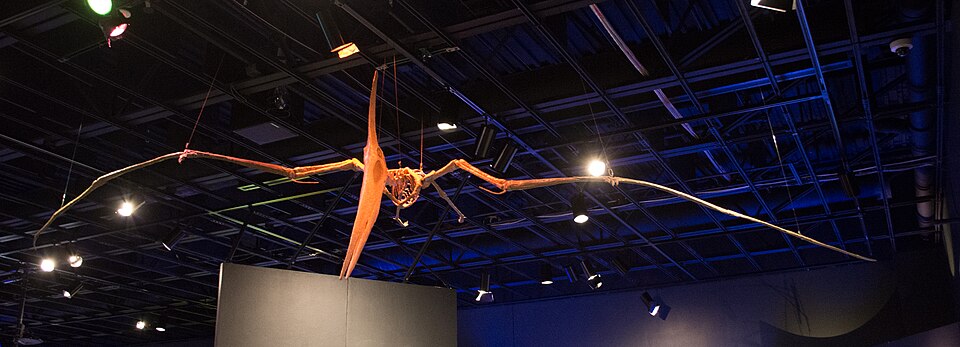
Pterosaurs were the first vertebrates to achieve powered flight. They appeared in the Late Triassic, approximately 230 to 225 million years ago, and persisted until the end-Cretaceous extinction 66 million years ago, spanning a duration of more than 160 million years. During this interval, pterosaurs diversified into a wide array of ecological roles and body sizes, from small, sparrow-sized species to the azhdarchids of the Late Cretaceous, some of which achieved wingspans of 10 to 11 meters — the largest flying animals ever to exist.6, 7
.jpg)
The pterosaur wing was structurally unique among flying vertebrates. It consisted of a membrane of skin, muscle, and other soft tissues called the patagium, stretched primarily along a single hyper-elongated fourth digit of the hand. This design differs fundamentally from the bird wing, in which the flight surface is formed by feathers attached to the arm and hand, and from the bat wing, in which membranes stretch between four elongated fingers. The pterosaur patagium was reinforced by densely packed structural fibers called actinofibrils, which stiffened the membrane and may have allowed pterosaurs to adjust the shape and tension of the wing surface during flight. A forward membrane, the propatagium, extended from the shoulder to the wrist, while in many species a smaller membrane, the cruropatagium, connected the hindlimbs.6, 21
The phylogenetic origin of pterosaurs remained uncertain for decades, but recent analyses have placed them within Archosauria, closely related to the Lagerpetidae — a group of small, cursorial archosaurs from the Triassic. Ezcurra and colleagues demonstrated that lagerpetids share numerous skeletal features with pterosaurs that are absent in other archosaur groups, providing the strongest phylogenetic framework yet for understanding pterosaur origins.22 Unfortunately, the fossil record preserves no clear transitional forms between non-flying pterosaur ancestors and the earliest known pterosaurs, which already possessed fully developed flight apparatus. The earliest pterosaurs, such as Eudimorphodon from the Late Triassic of Italy, had long tails, fully developed wings, and teeth adapted for catching fish or insects, indicating that flight was well established by the time of their appearance.5, 6
Biomechanical analyses of pterosaur flight have demonstrated that even the largest azhdarchids were capable of powered, flapping flight, not merely soaring or gliding. Witton and Habib showed that the skeletal and muscular architecture of giant azhdarchids was consistent with a catapult-style quadrupedal launch, in which the animal vaulted into the air using its powerful forelimbs before transitioning to sustained flapping. This launch mechanism would have allowed animals with wingspans of 10 meters or more to become airborne without the long running takeoffs required by large modern birds.21
The dinosaur-to-bird transition
The evolutionary origin of bird flight is among the most thoroughly documented major transitions in the history of life. A wealth of fossil, anatomical, and molecular evidence demonstrates that birds are theropod dinosaurs — specifically, members of the clade Maniraptora, which also includes dromaeosaurids (such as Velociraptor) and troodontids. The dinosaur-to-bird transition was not a single dramatic leap but a gradual accumulation of avian characteristics over tens of millions of years, with feathers, hollow bones, a furcula (wishbone), and other flight-related features appearing in non-flying theropod lineages long before powered flight evolved.9, 10
.jpg)
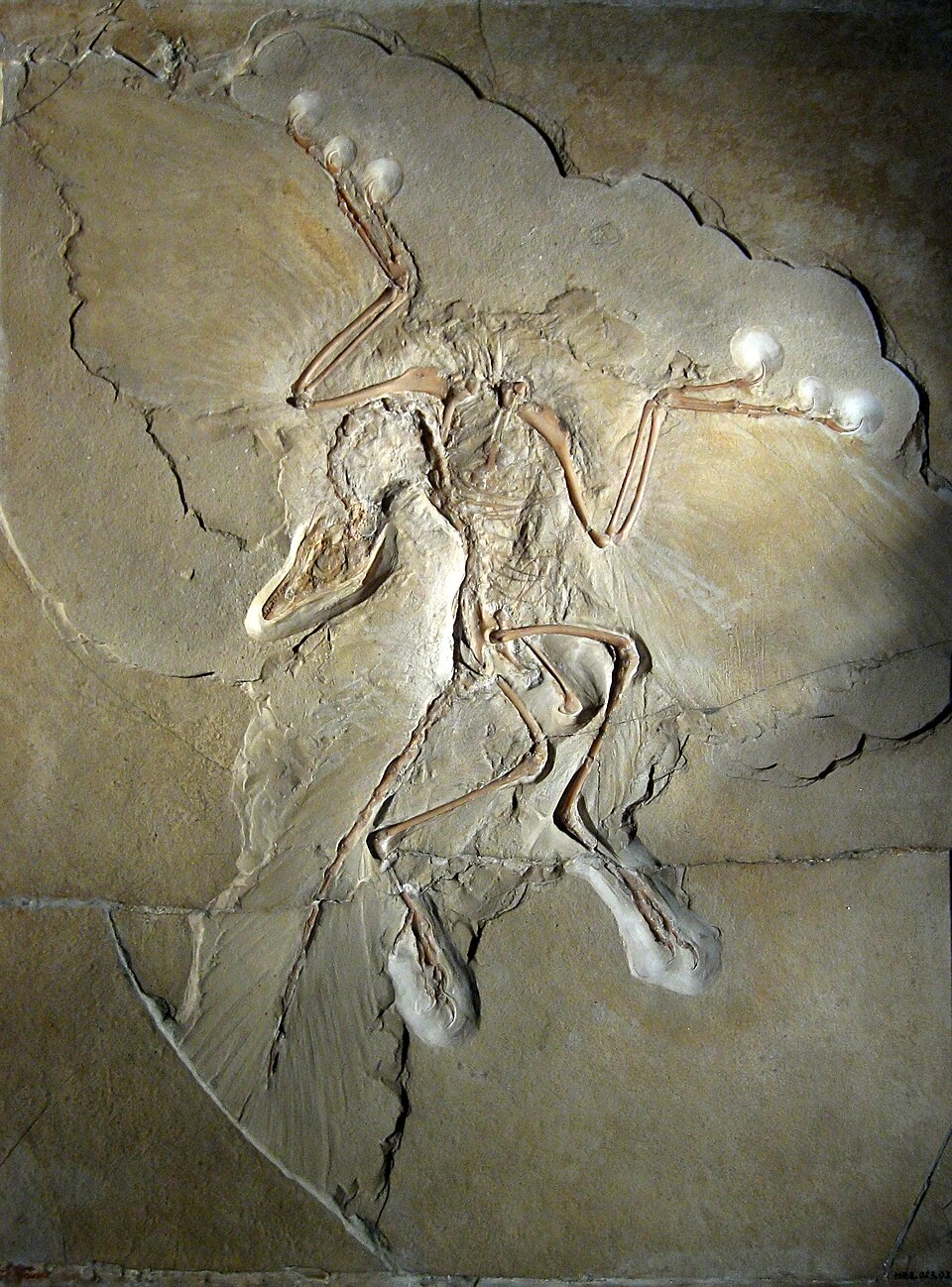
Archaeopteryx, discovered in the Solnhofen limestone of Bavaria in 1861, remains the most iconic transitional fossil between non-avian dinosaurs and modern birds. Dating to approximately 150 million years ago in the Late Jurassic, Archaeopteryx possessed a mosaic of reptilian and avian features: teeth, a bony tail, and clawed fingers alongside asymmetric flight feathers and a wishbone. Whether Archaeopteryx was capable of sustained powered flight or limited to flapping-assisted gliding remains debated, but its wing feather asymmetry — a feature characteristic of aerodynamic function — suggests at least some capacity for active aerial locomotion.8, 24
Discoveries from the Liaoning fossil beds of northeastern China, beginning in the mid-1990s, transformed understanding of the dinosaur-to-bird transition by revealing dozens of feathered non-avian dinosaur species. These fossils demonstrated that feathers were widespread among theropod dinosaurs and were not exclusive to the lineage leading directly to birds. Species such as Sinosauropteryx, which bore simple filamentous integumentary structures, and Microraptor, which possessed asymmetric flight feathers on both forelimbs and hindlimbs in a four-winged configuration, illuminated the evolutionary sequence through which aerodynamic feathers were assembled.10, 11 Microraptor is particularly significant because its four-winged body plan, with long pennaceous feathers on the legs as well as the arms, suggests that early experiments in flight may have involved leg-borne aerodynamic surfaces that were later reduced as the forelimb-dominated wing plan of modern birds was refined.11, 13
The Jurassic avialan Aurornis xui, described by Godefroit and colleagues in 2013, pushes the base of the avialan clade back to approximately 160 million years ago, predating Archaeopteryx by roughly 10 million years and suggesting that the earliest avialans were small, feathered, ground-dwelling or low-canopy animals rather than strong fliers.24 The overall picture that emerges is one of incremental modification: feathers evolved first, likely for insulation or display; some lineages subsequently developed enlarged, vaned feathers on the forelimbs that provided aerodynamic benefits during running, leaping, or descending from elevated perches; and full powered flight was achieved only after a long evolutionary history of increasingly sophisticated feather and skeletal adaptations.10, 14
The evolution of feathers
Feathers are the defining feature of bird flight, but their evolutionary history extends far deeper than the origin of flight itself. Developmental and paleontological evidence indicates that feathers evolved through a series of morphological stages, from simple filaments to the complex, asymmetric vaned feathers that generate aerodynamic lift. Richard Prum proposed an influential developmental model in which feather evolution proceeded through five stages: (1) a simple hollow cylinder arising from a tubular epidermal collar; (2) a tuft of unbranched barbs; (3) a planar vane with barbs fused to a central rachis; (4) the addition of barbules with interlocking hooklets that create a coherent vane; and (5) asymmetry of the vane about the rachis, the feature that distinguishes flight feathers from body contour feathers.14, 20
Fossil evidence confirms this developmental sequence in broad outline. The earliest known feather-like structures, found on compsognathid and tyrannosauroid dinosaurs such as Sinosauropteryx and Dilong, are simple filaments corresponding to Prum's stages 1 and 2. More derived maniraptorans such as Caudipteryx and Protarchaeopteryx bear symmetrical vaned feathers (stages 3–4) on their forelimbs and tails, while Microraptor and Archaeopteryx possess the asymmetric vaned feathers (stage 5) associated with aerodynamic function.10, 14 The early stages of feather evolution — filaments and symmetric vanes — are not aerodynamically functional, indicating that feathers initially evolved for purposes unrelated to flight. Thermoregulation, visual display, and brooding of eggs have all been proposed as the original selective pressures driving feather evolution, and these functions are not mutually exclusive.14, 20
The discovery of melanosomes — pigment-bearing organelles — preserved in fossil feathers has added a further dimension to understanding feather function in non-avian dinosaurs. Li and colleagues reconstructed the plumage coloration of Microraptor and found evidence for iridescent black feathers, similar to those of modern crows and starlings. Such coloration is consistent with a display function, supporting the hypothesis that feathers were used for visual signaling before they were co-opted for flight.11
Bat flight
Bats (order Chiroptera) are the only mammals to have evolved powered flight, and they represent the most recent independent origin of flight among vertebrates. Molecular phylogenetic analyses place the divergence of bats from other placental mammals in the Late Cretaceous, approximately 65 to 70 million years ago, though the oldest bat fossils date to the Early Eocene, around 52 to 55 million years ago.15, 16 This gap between the molecular divergence estimate and the oldest fossils implies a substantial interval — the so-called "ghost lineage" — during which the early stages of bat evolution occurred without leaving a recoverable fossil record.
The bat wing is constructed on a fundamentally different architectural plan from that of any other flying vertebrate. Rather than elongating a single digit (as in pterosaurs) or attaching feathers to a relatively unmodified arm (as in birds), bats support their wing membrane — the patagium — by elongating four of the five manual digits (digits II through V). The membrane stretches between these fingers, connects to the body along the flank, and in most species extends to the hindlimb and sometimes includes an interfemoral membrane (uropatagium) that encloses the tail. This multi-fingered support system gives bats exceptionally fine control over wing shape and camber during flight, enabling high maneuverability and the ability to make rapid adjustments in wing configuration that birds and pterosaurs cannot replicate.15, 23
The earliest well-preserved bat fossil, Onychonycteris finneyi from the Early Eocene Green River Formation of Wyoming (approximately 52.5 million years ago), is crucial for understanding the sequence of adaptations in bat evolution. Onychonycteris possessed fully developed wings capable of powered flight, but its ear morphology lacked the specialized cochlear features associated with laryngeal echolocation in modern microbats. This suggests that flight evolved before echolocation in bats, contradicting an earlier hypothesis that echolocation came first and guided the evolution of flight behavior. However, the conclusion is not universally accepted, and some researchers argue that Onychonycteris may have used a primitive form of echolocation not detectable from skeletal anatomy alone.15
Aerodynamic studies of bat flight have revealed remarkable sophistication. Hedenstrom and colleagues used particle image velocimetry to visualize the airflow patterns generated by bats in flight and found that bats produce complex wake structures that differ substantially from those of birds, including inverted vortex loops during the upstroke that generate negative lift — a pattern not observed in bird flight. These findings indicate that bats have evolved unique aerodynamic strategies that exploit the flexibility of their membrane wings, strategies that may contribute to the exceptional maneuverability observed in insectivorous species that capture prey on the wing in cluttered environments.23
Aerodynamic principles across fliers
Despite their diverse wing architectures, all powered fliers must solve the same fundamental physical problem: generating an aerodynamic force sufficient to oppose gravity while producing forward thrust. Lift is generated when air flows faster over the upper surface of a wing than over the lower surface, creating a pressure differential that pushes the wing upward. The magnitude of this force depends on wing area, airspeed, air density, and the angle of attack — the angle between the wing surface and the oncoming airflow. All four flying lineages have independently evolved wings with appropriate combinations of these parameters for their body sizes and ecological niches.17, 19
The physics of flight scales dramatically with body size. Small insects operate at low Reynolds numbers, where viscous forces dominate and the air behaves almost like a thick fluid; in this regime, unsteady aerodynamic mechanisms such as leading-edge vortices and clap-and-fling are essential for generating adequate lift.17, 18 Larger fliers such as birds and bats operate at higher Reynolds numbers, where inertial forces dominate and conventional steady-state aerodynamics more accurately predict performance. The largest pterosaurs, with wingspans exceeding 10 meters, operated at Reynolds numbers comparable to those of small aircraft and likely relied on thermal soaring and dynamic soaring to cover long distances with minimal energetic expenditure, much as modern albatrosses and vultures do.6, 21
Wing loading — the ratio of body weight to wing area — is a critical parameter that varies systematically across flying lineages and determines flight style. Low wing loading permits slow, maneuverable flight and hovering; high wing loading demands faster flight speeds and reduces maneuverability. Among vertebrate fliers, bats tend to have the lowest wing loading for their body size, reflecting their highly flexible membrane wings and enabling the agile, low-speed flight used for hawking insects in cluttered forest environments. Birds span a wide range of wing loadings, from low-loading hummingbirds that hover at flowers to high-loading diving birds such as loons and auks that trade maneuverability for speed and aquatic pursuit capability.19, 23
Ecological consequences of flight
Each independent origin of flight triggered a major ecological transformation. Insect flight in the Carboniferous opened an entirely new dimension of habitat space and predator-prey interaction, enabling insects to become the dominant terrestrial invertebrates and paving the way for the extraordinary diversification of winged insect orders — beetles, flies, butterflies, wasps, and dragonflies — that collectively account for the majority of described animal species on Earth today. The ability to fly facilitated dispersal to new habitats, access to elevated food sources, escape from ground-dwelling predators, and the evolution of complex mating behaviors involving aerial displays and long-distance pheromone tracking.4
Pterosaur flight in the Triassic represented the first time a vertebrate exploited the aerial niche, and pterosaurs radiated into a diverse array of ecological roles during the Mesozoic. Small pterosaurs occupied insectivorous and piscivorous niches comparable to those of modern swallows and terns, while the giant azhdarchids of the Late Cretaceous may have been terrestrial stalkers that used flight primarily for long-distance movement between foraging grounds, ecologically analogous to modern storks or ground hornbills.6, 7
The evolution of bird flight, building on the feathered theropod body plan, gave rise to the most species-rich radiation of tetrapod vertebrates. Modern birds number approximately 10,000 to 11,000 species and occupy virtually every terrestrial and aquatic habitat on Earth, from deep ocean to high altitude. Flight has been secondarily lost in numerous lineages — ratites, penguins, rails, and others — typically on islands or in ecological contexts where the energetic costs of maintaining flight musculature outweigh the benefits.12
Bat flight enabled mammals to exploit nocturnal aerial insect resources that were largely inaccessible to other mammalian orders. With approximately 1,400 described species, bats are the second most species-rich mammalian order after rodents, and their diversity is greatest in the tropics, where they fill ecological roles ranging from insectivory and carnivory to frugivory and nectarivory. The evolution of echolocation in most bat lineages further expanded their ecological reach by enabling precise prey localization and obstacle avoidance in complete darkness.15, 16
Unresolved questions
Despite the wealth of fossil, developmental, and biomechanical evidence, several fundamental questions about the evolution of flight remain actively debated. For insect wings, the relative contributions of the paranotal and gill-exite origins remain unresolved, and the ecological context of the earliest wing evolution — whether wings first functioned in aquatic, semi-aquatic, or fully terrestrial environments — is still uncertain.1, 2 For pterosaurs, the absence of transitional fossils between non-flying archosaur ancestors and the earliest fully volant pterosaurs leaves the biomechanical pathway to flight poorly constrained, and the phylogenetic placement of pterosaurs, though increasingly well resolved, continues to be refined as new Triassic fossils are discovered.5, 22
The dinosaur-to-bird transition, though exceptionally well documented, still presents open questions about the precise ecological scenario in which flight originated. The "trees-down" hypothesis proposes that flight evolved from arboreal ancestors that glided between trees before developing powered flight, while the "ground-up" hypothesis proposes that flight arose in cursorial (running) dinosaurs that used proto-wings for wing-assisted incline running, thrust generation during leaps, or prey capture before transitioning to powered flight. The four-winged body plan of Microraptor has been cited in support of the trees-down model, but other evidence, including the anatomy of basal avialans and the wing-assisted incline running observed in modern birds, is more consistent with a ground-up or mixed scenario.8, 11, 13
For bats, the ghost lineage between the molecular divergence date and the oldest fossils means that the early stages of bat wing evolution are essentially unknown. Whether the ancestors of bats passed through an intermediate gliding stage, as flying squirrels and colugos do today, or whether powered flight evolved directly from a non-gliding ancestor remains an open question. The answer may lie in as-yet-undiscovered Late Cretaceous or Paleocene fossils that preserve transitional bat morphologies.15, 16
What is not in question is the central finding: powered flight is a spectacular demonstration of the power of natural selection to produce complex adaptations through incremental modification, and its fourfold independent origin is among the strongest examples of convergent evolution in the history of life.
References
Giant insects of the Permian and their relationship to the oxygen content of the atmosphere
Atmospheric oxygen, giant Paleozoic insects and the evolution of aerial locomotor performance
A new azhdarchid pterosaur from the Late Cretaceous of the Transylvanian Basin, Romania: implications for azhdarchid diversity and distribution
A pre-Archaeopteryx troodontid theropod from China with long feathers on the metatarsus
Flight and size constraints: hovering performance of large hummingbirds under maximal loading
The development and evolution of feathers: the evolution of body filaments in theropod dinosaurs
A Jurassic avialan dinosaur from China resolves the early phylogenetic history of birds