Overview
- Annual layers in ice cores, lake sediments, tree rings, and coral skeletons provide independent, countable records of elapsed time that extend hundreds of thousands of years into the past without relying on radiometric decay constants.
- The EPICA Dome C ice core preserves approximately 800,000 years of annual snowfall layers in Antarctica, while the Lake Suigetsu varve record provides a continuous, independently counted chronology spanning 52,800 years that anchors the radiocarbon calibration curve.
- These physically distinct counting methods — glaciological, sedimentological, biological, and geochemical — converge on the same timescales when their overlapping intervals are compared, providing powerful mutual corroboration of deep time.
Annual layer chronology encompasses a family of dating techniques in which researchers count physically or chemically distinct layers deposited once per year in natural archives. Ice cores, lake sediments (varves), tree rings (dendrochronology), and coral skeletons all preserve annual banding that can be counted backwards from the present, providing continuous records of elapsed time that are entirely independent of radiometric dating and its reliance on nuclear decay constants.23, 24 These methods are significant because they offer a direct, intuitive measure of time — one layer equals one year — and because multiple independent archives, each governed by different physical and biological processes, converge on the same timescales wherever their records overlap.7, 17
The longest annual layer records now extend hundreds of thousands of years into the past. The EPICA Dome C ice core in Antarctica preserves approximately 800,000 years of climate history in its layered snowfall record, while the Lake Suigetsu varve chronology in Japan provides a continuous, independently counted sediment record spanning 52,800 years.1, 7 Dendrochronological records constructed by cross-matching overlapping tree-ring sequences reach back more than 12,000 years in central Europe.14 Taken together, these archives constitute some of the most direct empirical evidence for the reality of deep time in the Earth sciences.
Ice-core annual layers
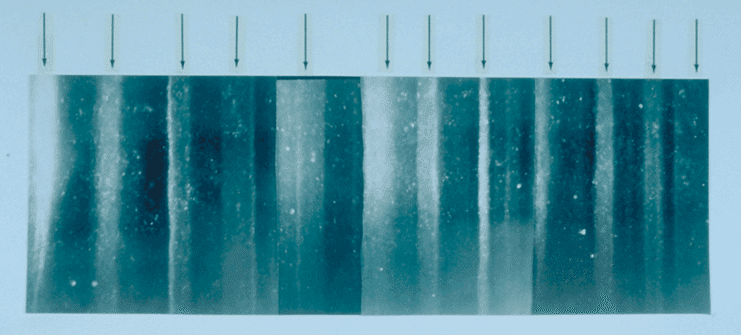

In the polar ice sheets of Antarctica and Greenland, snow accumulates year after year, compresses into firn, and eventually transforms into solid ice. Each annual layer is distinguishable by seasonal variations in dust content, chemical composition (such as concentrations of sodium, calcium, and sulfate ions), stable isotope ratios of oxygen and hydrogen, and in some cases visible layering caused by summer melt or wind crusts.23 Counting these layers is conceptually identical to counting tree rings: each couplet of winter and summer characteristics marks one year.
The Greenland ice sheet has yielded several landmark ice-core paleoclimatology records. The Greenland Ice Sheet Project 2 (GISP2) core, drilled to bedrock in central Greenland in 1993, produced a detailed volcanic and climatic record extending approximately 110,000 years, with annual layers clearly resolvable in the upper portion of the core.4 The North Greenland Ice Core Project (NGRIP) core, completed in 2003, penetrated 3,085 metres of ice and reached basal ice dating to the Eemian interglacial period, approximately 123,000 years ago.3 The Greenland Ice Core Chronology 2005 (GICC05), constructed by counting annual layers in multiple Greenland cores using high-resolution chemical measurements, provides an independently counted timescale extending to 60,000 years before present with a cumulative counting uncertainty of approximately 5 percent at that depth.5, 6
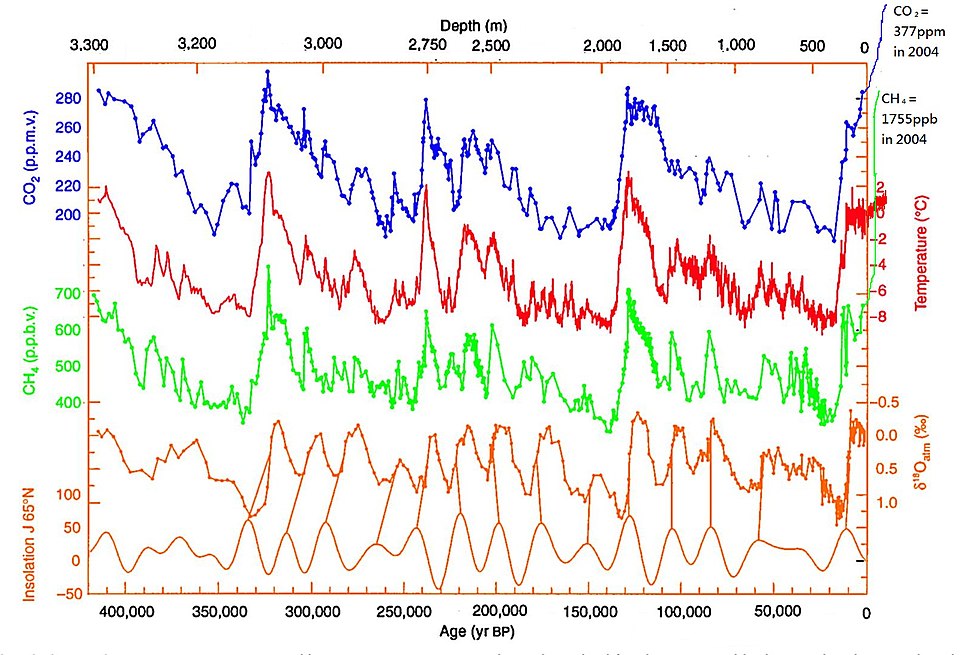
In Antarctica, where lower snowfall rates cause annual layers to thin more rapidly with depth, layer counting is feasible for the upper portions of cores but becomes impractical deeper in the ice sheet. The EPICA Dome C core, drilled between 1996 and 2004, reached a depth of 3,270 metres and recovered ice dating to approximately 800,000 years before present, encompassing eight complete glacial-interglacial cycles.1 The chronology of the deeper portions of this core relies on ice-flow modelling, orbital tuning to Milankovitch cycles, and tie points to independently dated records rather than direct annual layer counting, but the upper sections are constrained by layer-counted intervals and volcanic marker horizons shared with the Greenland records.1, 19 The EPICA record has proven essential for reconstructing the relationship between greenhouse gas concentrations and temperature over the past 800 millennia, demonstrating that atmospheric CO2 and CH4 fluctuated in lockstep with glacial and interglacial periods throughout this interval.19
Varve chronology
A varve is a pair of sediment laminae deposited in a lake or marine basin over the course of a single year. The classic varve consists of a coarser, lighter-coloured layer deposited during spring and summer, when meltwater or biological productivity is high, and a finer, darker layer deposited during autumn and winter, when the water column is quiescent and organic material settles to the bottom.24 In anoxic (oxygen-depleted) lake basins where bottom-dwelling organisms cannot bioturbate the sediment, these annual couplets are preserved with remarkable fidelity over tens or even hundreds of thousands of years.
The most important varve record for modern geochronology is from Lake Suigetsu, a small meromictic lake on the coast of the Sea of Japan in central Honshu. The lake's permanently stratified, anoxic bottom waters prevent disturbance of the laminated sediment, and cores recovered from the lake bed preserve a continuous varved sequence extending at least 52,800 years into the past.7, 8 The Lake Suigetsu varves have been counted independently by multiple research teams, producing a floating chronology that was then anchored to the absolute timescale using radiocarbon measurements on terrestrial plant macrofossils preserved within the sediment.7, 9 Critically, because the plant material is terrestrial rather than aquatic, it is unaffected by the reservoir effects that complicate radiocarbon dating in lake and marine environments. The resulting dataset — more than 800 radiocarbon measurements plotted against the independently counted varve years — provided the first complete terrestrial radiocarbon calibration curve extending to the practical limit of the radiocarbon method, and it anchors the international IntCal20 calibration standard.7, 17
Varved sediments are found in many other settings as well. The Green River Formation of Wyoming, Colorado, and Utah preserves Eocene-age lake sediments with annual laminations spanning millions of years. These varves record the cyclical expansion and contraction of large paleolakes in the western interior of North America approximately 50 million years ago, and their rhythmic bundling into thicker cycles has been linked to orbital forcing by Milankovitch parameters.10 While individual varves in such ancient formations cannot be counted with the same confidence as those in late Quaternary lakes, the sheer number of laminae — estimated in the millions — provides direct visual evidence for the passage of geological time on scales far exceeding thousands of years.
Dendrochronology
Dendrochronology, the science of dating events and environmental change by analysing the annual growth rings of trees, is the oldest and most widely known form of annual layer counting. Each year, a tree in a temperate climate adds a ring of new wood: a wide band of large-celled earlywood formed during the spring growth flush, followed by a narrow band of dense latewood formed as growth slows in late summer and autumn.24 The width of each ring varies according to the growing conditions of that year, particularly temperature and moisture availability, creating a unique pattern of wide and narrow rings that serves as a barcode for that interval of time.
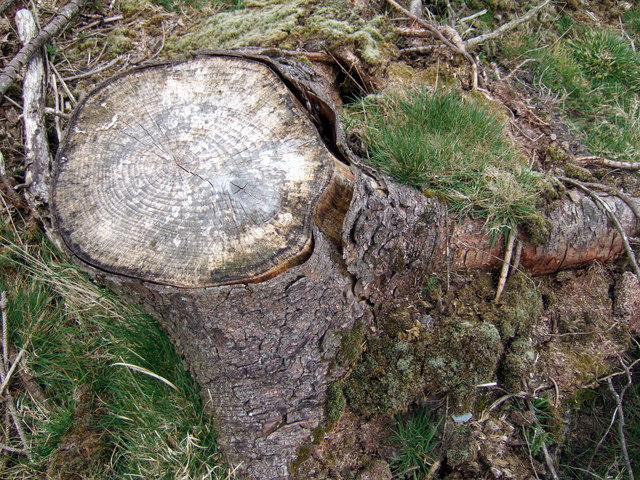

The key technique that extends dendrochronology beyond the lifespan of any single tree is cross-dating: matching the ring-width patterns of overlapping specimens. A living tree provides an absolutely dated sequence from the present backward for its entire lifespan. A dead tree, a structural timber from a historical building, or a subfossil log preserved in a peat bog or river gravel can be matched to the living sequence by aligning their shared ring-width patterns, extending the chronology further into the past.11 By chaining together hundreds of overlapping specimens, dendrochronologists have constructed continuous, year-by-year chronologies reaching thousands of years before the present.
The longest single-species dendrochronology is built from bristlecone pines (Pinus longaeva) in the White Mountains of eastern California. These extraordinarily long-lived trees, some exceeding 4,800 years of age, were first used for chronology construction by Charles Wesley Ferguson at the University of Arizona in the 1960s.12 By cross-dating living specimens with dead wood preserved on the dry mountain slopes, Ferguson and subsequent researchers extended the bristlecone pine chronology beyond 9,000 years, and ongoing work has pushed it past 12,000 years using subfossil material.12, 13 In Europe, an independent chronology using oak (Quercus) and pine (Pinus sylvestris) from central European river gravels, peat bogs, and archaeological timbers extends 12,460 years into the past.14 These two chronologies, constructed on different continents from different species, provide independent confirmation of each other and have been instrumental in calibrating the radiocarbon timescale.17
Coral banding
Reef-building corals deposit calcium carbonate skeletons that, like trees, display annual growth banding. High-density bands form during the warm season when calcification rates are elevated, alternating with low-density bands produced during cooler months. These density couplets are visible in X-ray images of coral slabs and provide an annual growth chronology analogous to tree rings.15 Individual coral colonies can live for several centuries, and the geochemistry of each annual band — particularly the ratios of oxygen isotopes (18O/16O) and trace elements such as strontium to calcium (Sr/Ca) — records sea surface temperature and salinity at the time of deposition.16
Coral chronologies are typically shorter than ice-core or varve records, rarely exceeding 400 to 500 years for a single colony, though fossil corals from uplifted reef terraces can extend the record further when uranium-thorium dating pins their absolute age.16 A particularly compelling application of coral banding involves Devonian-age rugose corals, approximately 370 million years old, which show roughly 400 fine growth ridges per year rather than the 365 expected from the modern calendar. This observation, first reported by John Wells in 1963, is consistent with the prediction from tidal friction models that Earth's rotation has been gradually slowing over geological time, resulting in fewer but longer days per year in the deep past.20, 22 The coral banding thus provides an independent physical confirmation of astronomical calculations and demonstrates that annual layers can record not just the passage of years but changes in the length of the day itself.
Cross-validation of independent records

The scientific value of annual layer chronology derives not only from the reach of any single archive but from the agreement among archives that are governed by entirely different physical processes. Ice cores record atmospheric deposition, varves record lacustrine sedimentation, tree rings record biological growth, and corals record marine calcification. These processes share no common mechanism that could produce systematic errors in the same direction, yet where their temporal ranges overlap, they consistently agree.17, 23
The construction of the IntCal20 radiocarbon calibration curve illustrates this convergence. The curve is anchored by dendrochronological data from 0 to approximately 12,000 years before present, then by the Lake Suigetsu varve-counted radiocarbon measurements from 12,000 to 52,800 years, with additional constraints from uranium-thorium-dated corals and speleothems.17 In the interval where tree-ring and varve records overlap (roughly 10,000 to 12,000 years before present), the two independently counted chronologies agree within their stated uncertainties. Similarly, the GICC05 Greenland ice-core chronology and the Lake Suigetsu varve record agree on the timing of rapid climate events during the last glacial period, such as the Dansgaard-Oeschger oscillations, even though one record was counted in ice and the other in sediment thousands of kilometres away.5, 7, 18
This mutual corroboration extends to radiometric methods as well. Radiocarbon ages measured on samples of known dendrochronological age match the radiocarbon decay curve within the expected scatter, confirming both the tree-ring chronology and the radiocarbon half-life independently.12, 17 Volcanic tephra layers identified by their chemical fingerprints in both Greenland ice cores and European lake sediments provide additional tie points that confirm the synchroneity of the independently counted records.4, 21 The coherence of these independent chronologies constitutes one of the most robust lines of evidence in the Earth sciences for the reliability of geochronological methods.
Temporal reach of major annual layer archives1, 7, 14
Significance for geochronology
Annual layer counting occupies a unique position in the toolkit of geochronology because it provides a measure of time that is both absolute and intuitive. Unlike radiometric methods, which derive ages from the statistical behaviour of radioactive decay and require knowledge of decay constants, initial isotope ratios, and system closure, annual layer counting requires only the ability to distinguish one year's deposit from the next.23, 24 This directness makes it an invaluable check on other dating methods. The fact that radiocarbon ages, uranium-thorium ages, and orbital chronologies all agree with independently counted annual layers across tens of thousands of years provides strong confirmation that the physical constants underlying radiometric decay have not changed over this interval and that the assumptions of radiometric dating are sound.7, 17
Annual layer records also serve as high-resolution archives of past environmental change. The geologic time scale is calibrated in part by annual layer chronologies, which provide precise ages for events such as volcanic eruptions, abrupt climate shifts, and changes in atmospheric composition that can then be correlated across continents and ocean basins.4, 5 The Lake Suigetsu record, for example, has been instrumental in refining the radiocarbon calibration curve and thereby improving the accuracy of radiocarbon dates applied to archaeological and palaeoclimatic records worldwide.7, 17 The Greenland ice-core chronology provides the temporal framework for understanding the abrupt Dansgaard-Oeschger climate oscillations that punctuated the last ice age, enabling researchers to determine their precise duration and pacing.6, 18
The convergence of multiple independent annual layer records on the same timescales is a powerful demonstration of the internal consistency of Earth science chronology. Each method has its own sources of uncertainty — missed layers in ice cores, erosional gaps in varve sequences, missing rings in stressed trees — but these errors are uncorrelated between archives. The probability that ice cores, varves, tree rings, and corals would all independently produce the same chronological framework by chance, in the absence of a real underlying timescale, is vanishingly small.17, 23 Annual layer chronology thus provides one of the most direct and compelling empirical demonstrations that the Earth's geological and climatic history extends far beyond the timescales of recorded human history.
References
A community-based geological reconstruction of Antarctic Ice Sheet deglaciation since the Last Glacial Maximum
High-resolution record of Northern Hemisphere climate extending into the last interglacial period
Greenland Ice Core Chronology 2005 (GICC05): a new timescale from the surface to the base of the NGRIP ice core
A 5480-year oxygen-isotope record from bristlecone pine trees in the White Mountains, California
Constructing long tree-ring chronologies: establishing 12,460 years of dendrochronological data in central Europe
Timing and pacing of the Late Devonian mass extinction event regulated by eccentricity and obliquity