Overview
- Banded iron formations (BIFs) are chemically precipitated sedimentary rocks composed of alternating iron-rich and silica-rich layers, deposited predominantly between 3.8 and 1.8 billion years ago when Earth's oceans were anoxic and rich in dissolved ferrous iron.
- The decline of BIF deposition around 1.8 Ga coincides with the Great Oxygenation Event, during which rising atmospheric oxygen oxidized dissolved oceanic iron and removed it from seawater, while a brief Neoproterozoic reappearance of BIFs is linked to Snowball Earth glaciations that temporarily restored anoxic ocean conditions.
- BIFs are the world's primary source of iron ore, with major deposits in the Hamersley Basin of Western Australia, the Transvaal Supergroup of South Africa, the Kursk Magnetic Anomaly of Russia, and the Lake Superior region of North America, collectively supplying the bulk of global steel production.
Banded iron formations (BIFs) are a distinctive class of chemical sedimentary rock characterized by repetitive, millimetre- to centimetre-scale alternations of iron-rich and silica-rich layers. They represent one of the most voluminous sedimentary rock types of the Precambrian and serve as the principal source of the world’s iron ore.1 Although minor iron-rich sediments occur throughout Earth’s history, the vast majority of BIFs were deposited between roughly 3.8 and 1.8 billion years ago (Ga), a temporal distribution that reflects the profound chemical evolution of the oceans and atmosphere during the Archean and Paleoproterozoic eons.2 Their near-disappearance after 1.8 Ga and brief Neoproterozoic reappearance make BIFs among the most important paleoenvironmental archives in the geological record.
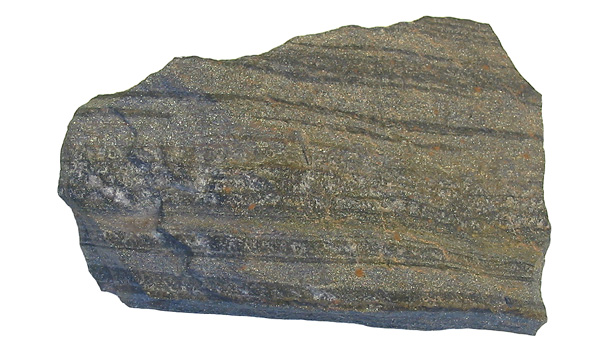

Mineralogy and structure
The defining feature of a banded iron formation is its laminated or banded texture, in which iron-bearing minerals alternate with layers of microcrystalline silica (chert). The iron-rich bands, or mesobands, typically contain iron oxide minerals such as hematite (Fe2O3) and magnetite (Fe3O4), along with iron silicates like minnesotaite and greenalite, and iron carbonates including siderite (FeCO3).12 The silica-rich layers consist predominantly of chert, often stained by finely disseminated iron minerals. Total iron content in a typical BIF ranges from 20 to 40 percent by weight, and silica content from 40 to 50 percent.14
Banding occurs on multiple scales. Microbands, typically less than a millimetre thick, are the finest recognizable units and are commonly composed of alternating iron oxide and chert laminae. Mesobands, ranging from roughly one to several centimetres, group multiple microbands into visually striking alternations visible in hand specimen. At the largest scale, macrobands tens of metres thick represent major depositional cycles that can be correlated across entire sedimentary basins.14 The mineralogy of the iron-bearing bands varies with the degree of metamorphism and the oxidation state of the original precipitate: low-grade BIFs preserve primary iron oxyhydroxides and siderite, while higher-grade equivalents have been recrystallized to coarser magnetite and specular hematite.12
Algoma-type and Superior-type BIFs
Two principal classes of banded iron formation have long been recognized on the basis of their depositional setting and tectonic association. Algoma-type BIFs, named after occurrences in the Algoma district of Ontario, are relatively thin, laterally discontinuous units deposited in volcanic arc and back-arc settings. They are closely associated with submarine volcanic rocks and are thought to derive their iron from nearby hydrothermal vents.2 Algoma-type BIFs occur throughout the Archean and into the early Paleoproterozoic, but individually they represent modest volumes of sediment.
Superior-type BIFs, named for the classic deposits around Lake Superior in North America, are far more extensive. They form laterally continuous, platform-scale sheets deposited on continental shelves and in intracratonic basins, typically in the absence of significant volcanism.14 These formations can extend over hundreds of kilometres and reach cumulative thicknesses of several hundred metres. The iron in Superior-type BIFs is generally attributed to upwelling of iron-rich deep ocean water onto shallow continental margins, where oxidation caused precipitation.2 The great peak of BIF deposition around 2.5–2.4 Ga is dominated by Superior-type formations, reflecting the development of extensive passive continental margins during late Archean and early Paleoproterozoic time.1
Temporal distribution
The temporal distribution of banded iron formations is strikingly non-uniform. The oldest known BIFs occur in the Isua supracrustal belt of southwestern Greenland, dated to approximately 3.8 Ga, and in the Nuvvuagittuq greenstone belt of northern Quebec, which may be even older.2 BIF deposition continued intermittently through the Archean, but reached an extraordinary climax between approximately 2.5 and 2.4 Ga, when the largest iron formations on Earth were laid down.1 This peak coincides with a period of enhanced mantle plume activity, supercontinent assembly, and the transitional interval leading into the Great Oxygenation Event (GOE).
After roughly 1.85 Ga, BIF deposition ceased almost entirely for over a billion years — a gap that spans much of the Mesoproterozoic and is one of the most conspicuous absences in the sedimentary record.3 This disappearance is widely attributed to the progressive oxygenation of the deep ocean, which removed dissolved ferrous iron and eliminated the chemical conditions necessary for BIF precipitation.7 The reappearance of iron formations during the Neoproterozoic, between approximately 750 and 635 million years ago (Ma), is discussed below in the context of Snowball Earth glaciations.
Formation mechanisms
The mechanism by which iron was oxidized and precipitated from Precambrian seawater remains one of the central questions in BIF research. Three principal hypotheses have been proposed, and it is increasingly recognized that all three may have operated to varying degrees at different times and locations.
The first mechanism invokes biological iron oxidation by anoxygenic photoautotrophic bacteria. In this model, iron-oxidizing phototrophs used dissolved ferrous iron (Fe2+) as an electron donor for carbon fixation, producing ferric iron (Fe3+) precipitates without requiring free oxygen.4 Modern analogues of such organisms exist in iron-rich, light-penetrated environments, and experimental work has demonstrated that photoferrotrophic bacteria can generate sufficient iron oxide to account for observed BIF accumulation rates.4 This hypothesis is attractive because it does not require oxygen in the atmosphere or surface ocean, making it applicable to the earliest Archean BIFs deposited well before the GOE.
The second mechanism involves the indirect biological oxidation of iron through cyanobacterial oxygen production. In this scenario, oxygenic photosynthesis by cyanobacteria released molecular oxygen into the shallow ocean, which then reacted abiotically with dissolved ferrous iron to produce insoluble ferric oxyhydroxide precipitates.1 This mechanism becomes increasingly plausible from the late Archean onward, when geochemical evidence suggests that at least localized “oxygen oases” existed in the photic zone prior to the GOE.7
The third mechanism is purely abiotic: the photochemical oxidation of dissolved ferrous iron by ultraviolet radiation. Laboratory experiments have shown that UV light can oxidize Fe2+ to Fe3+ in the absence of both oxygen and biology.5 Under the intense UV flux that reached Earth’s surface before the development of an ozone layer, this process could have contributed significantly to iron precipitation in shallow marine settings. However, more recent work has questioned whether photochemical oxidation rates were sufficient to account for the full volume of BIF deposition, particularly during the 2.5 Ga peak.5
The silica banding in BIFs likely reflects periodic variations in the relative fluxes of iron and silica to the ocean, possibly driven by cycles in hydrothermal input, biological productivity, or seasonal stratification.14 The Precambrian ocean was saturated with dissolved silica in the absence of silica-secreting organisms such as diatoms and radiolaria, which did not evolve until the Phanerozoic. Silica coprecipitated with iron oxyhydroxides or precipitated independently during intervals of reduced iron flux.12
Connection to the Great Oxygenation Event
The temporal relationship between BIF deposition and the Great Oxygenation Event is among the most important constraints on the history of atmospheric oxygen. During the Archean, the ocean was largely anoxic and contained vast quantities of dissolved ferrous iron supplied by hydrothermal vents and submarine volcanism.3 This ferrous iron reservoir could persist only because the atmosphere and ocean lacked sufficient oxygen to oxidize it. As cyanobacterial photosynthesis gradually increased the oxygen content of the atmosphere and surface ocean between 2.45 and 2.32 Ga, dissolved iron was progressively scavenged from the water column through oxidative precipitation.7
The cessation of BIF deposition around 1.85 Ga signals the point at which the deep ocean had been sufficiently oxygenated — or at least sufficiently ventilated with sulfate, which precipitates iron as pyrite — to prevent the accumulation of large dissolved iron reservoirs.3 The disappearance of mass-independent fractionation of sulfur isotopes (S-MIF) at approximately 2.4 Ga provides independent confirmation that atmospheric oxygen rose above roughly 10−5 times present levels during this interval, fundamentally altering ocean chemistry.13 BIFs thus serve as a chemical proxy for ocean anoxia: their presence indicates a reduced, iron-rich ocean, and their absence indicates an oxygenated or sulfidic one.
Isotopic evidence
Iron and sulfur isotope systematics preserved in BIFs provide powerful constraints on the biogeochemical processes active during their deposition. Iron isotopes (expressed as δ56Fe) in BIF minerals show a wide range of fractionation, from values near zero (the composition of hydrothermal fluids) to significantly positive values in oxide-facies BIFs and negative values in carbonate and sulfide facies.6 Positive δ56Fe values in iron oxides are consistent with partial oxidation of a dissolved ferrous iron reservoir, in which the heavier isotope is preferentially incorporated into the ferric precipitate.6 The magnitude and distribution of iron isotope fractionation in Archean BIFs have been interpreted as evidence for both biological (photoferrotrophic) and abiotic oxidation pathways, and for the incomplete oxidation of a large marine iron pool.
Sulfur isotopes in BIF-associated sediments complement the iron isotope record. The presence of mass-independent fractionation of sulfur isotopes in Archean sediments, and its disappearance after 2.4 Ga, constrains the timing of atmospheric oxygenation and helps distinguish between iron oxide and iron sulfide precipitation pathways in the water column.13 Together, iron and sulfur isotope data from BIFs have been instrumental in reconstructing the redox architecture of the Precambrian ocean, revealing a stratified system in which anoxic, iron-rich deep waters coexisted with variably oxygenated surface waters.6, 7
Neoproterozoic reappearance
After a hiatus of more than a billion years, banded iron formations reappeared in the geological record during the Neoproterozoic, with the most prominent examples associated with the Sturtian glaciation (approximately 717–660 Ma) and, to a lesser extent, the Marinoan glaciation (approximately 650–635 Ma).9 These Neoproterozoic iron formations are thinner and less extensive than their Paleoproterozoic predecessors, but their occurrence is geographically widespread, with examples documented in Namibia, Brazil, Australia, and northwestern Canada.8, 9
The Snowball Earth hypothesis provides a compelling explanation for this reappearance. During global glaciation, an ice cover effectively sealed the ocean from the atmosphere, halting oxygen exchange and allowing hydrothermal iron to accumulate once again in anoxic, ice-covered seawater.8 Upon deglaciation, renewed contact between the iron-rich ocean and the now-oxygenated atmosphere triggered rapid oxidation and precipitation of iron, producing iron formations in the same manner as the Archean and Paleoproterozoic BIFs.9 The Neoproterozoic iron formations thus provide some of the strongest sedimentological evidence for the severity and global extent of Snowball Earth glaciations, and they demonstrate that BIF deposition is fundamentally controlled by ocean redox state rather than by any single biological or tectonic factor.
Major deposits and economic importance
Banded iron formations constitute the world’s largest and most economically significant repositories of iron ore. The Hamersley Basin in the Pilbara region of Western Australia hosts the Hamersley Group, a sequence of BIFs deposited between approximately 2.63 and 2.45 Ga that includes the Brockman Iron Formation and the Marra Mamba Iron Formation.15 Supergene enrichment of these BIFs has produced high-grade hematite ores exceeding 60 percent iron, which have been mined on an industrial scale since the 1960s and underpin Australia’s position as the world’s largest iron ore exporter.15
The Transvaal Supergroup of South Africa contains extensive BIFs of similar age, while the Kursk Magnetic Anomaly (KMA) in western Russia encompasses the world’s largest known iron ore reserves, hosted in Paleoproterozoic BIFs of the Voronezh Massif.2 In North America, the Lake Superior iron ranges — including the Mesabi, Marquette, Gogebic, and Vermilion ranges — were among the first BIF deposits exploited commercially and fuelled the industrial expansion of the United States in the late nineteenth and early twentieth centuries.14 Brazil’s Quadrilatero Ferrifero (Iron Quadrangle) in Minas Gerais and the Carajas deposit in the Amazon region are additional world-class BIF-hosted ore bodies that rank among the planet’s largest iron producers.2
The economic exploitation of BIFs has historically focused on high-grade supergene ores formed by the weathering and leaching of silica from the original BIF, leaving behind enriched iron oxide residues. As these high-grade deposits are progressively depleted, the industry has increasingly turned to the beneficiation of lower-grade BIF material (taconite), which requires grinding and magnetic separation to produce iron concentrate suitable for steelmaking.14
Paleoenvironmental significance
Beyond their economic value, banded iron formations are indispensable archives of Precambrian environmental conditions. Their chemical composition records the temperature, pH, redox state, and dissolved element concentrations of ancient seawater. Trace element ratios in BIFs — including rare earth element patterns, phosphorus content, and germanium-to-silicon ratios — have been used to distinguish between hydrothermal and continental weathering sources of dissolved constituents and to trace changes in ocean circulation over time.1, 11
The phosphorus content of BIFs has attracted particular attention because iron oxyhydroxide precipitates scavenge dissolved phosphate from seawater — a process also observed in modern euxinic basins where iron-manganese shuttles control authigenic phosphorus mineral formation.10 Planavsky and colleagues demonstrated that BIF deposition would have acted as a major sink for marine phosphorus, potentially limiting primary productivity and slowing the accumulation of atmospheric oxygen through a negative feedback loop.11 This “phosphorus trap” hypothesis links BIF deposition directly to the pace of biological evolution and the oxygenation trajectory of the planet, illustrating how sedimentary processes on the ocean floor could exert first-order control on the composition of the atmosphere.
The study of banded iron formations thus sits at the intersection of sedimentary geology, geochemistry, microbiology, and planetary science. These ancient rocks preserve a chemical narrative of Earth’s transition from an anoxic, iron-rich world to the oxygenated planet of today — a story written in alternating bands of rust and glass.
References
Iron formations: a global record of Neoarchaean to Palaeoproterozoic environmental history
Iron formation: the sedimentary product of a complex interplay among mantle, tectonic, oceanic, and biospheric processes
Could ferrous iron be oxidized by anoxygenic photosynthesis in banded iron formations? A thermodynamic evaluation
Neoproterozoic iron formation: an evaluation of its temporal, environmental, and tectonic significance
Iron and manganese shuttles control the formation of authigenic phosphorus minerals in the euxinic basins of the Baltic Sea