Overview
- Chalk is a soft, fine-grained limestone composed almost entirely of the calcite remains of coccolithophores — microscopic single-celled algae whose skeletal plates (coccoliths) accumulate on the seafloor at rates of only centimetres per thousand years, meaning that chalk formations hundreds of metres thick required tens of millions of years to form.
- The great chalk deposits of the Late Cretaceous period, including the White Cliffs of Dover and equivalent formations across Europe, Western Asia, and North America, record a sustained interval of warm seas, high sea levels, and prolific coccolithophore productivity spanning approximately 35 million years (roughly 100–66 million years ago).
- The slow, continuous character of chalk accumulation — confirmed by biostratigraphic zonation, radiometric dating of interbedded ash layers, magnetostratigraphic correlation, and Milankovitch cyclicity preserved in the sediment — provides compelling evidence for deep geological time that is incompatible with a young-Earth timescale.
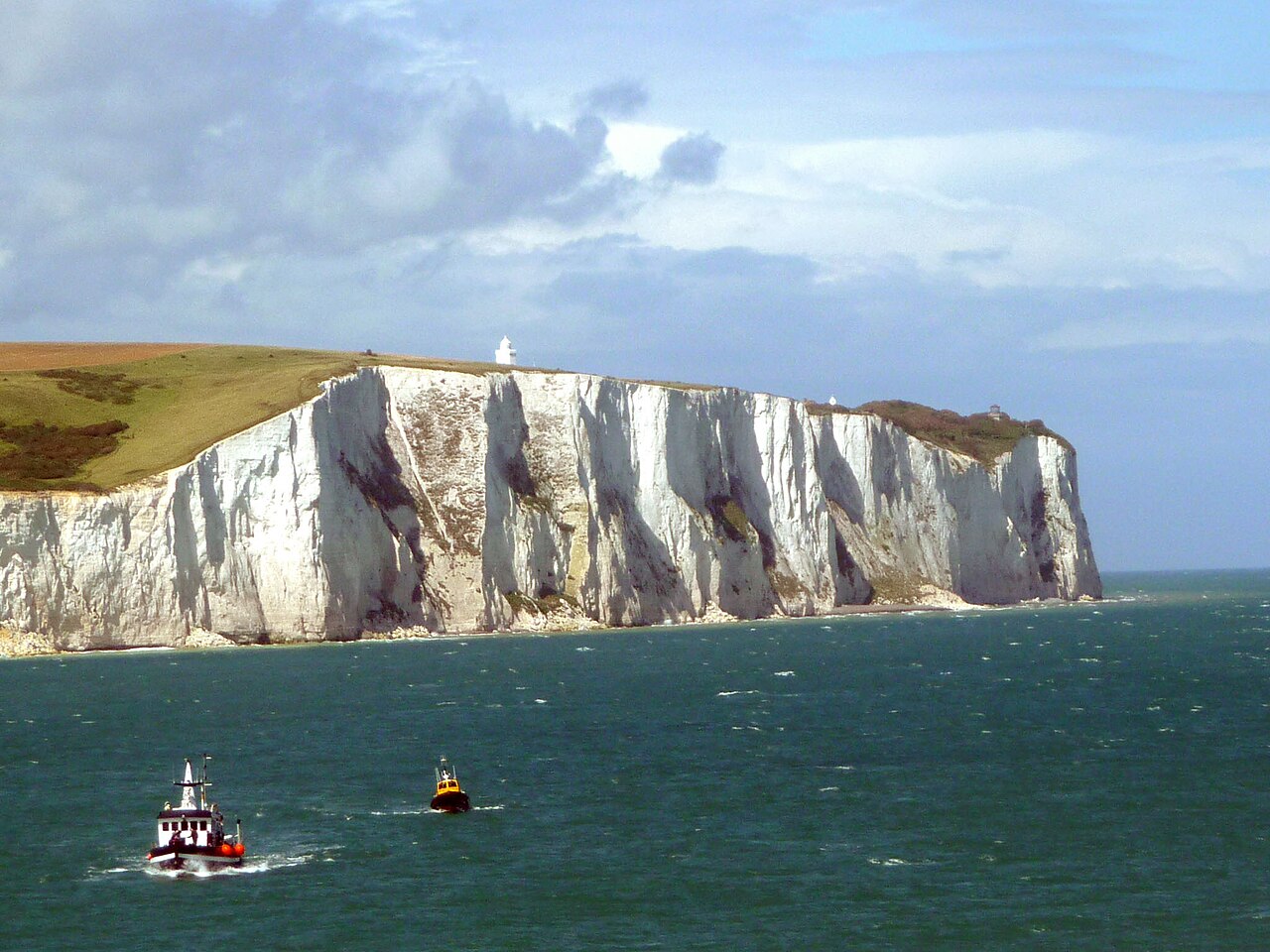
Chalk is a soft, white, fine-grained sedimentary rock composed predominantly of the calcium carbonate (calcite) remains of coccolithophores, single-celled photosynthetic algae that inhabit the upper sunlit layers of the world's oceans. Each coccolithophore cell is surrounded by an armour of interlocking calcite plates called coccoliths, typically 2–10 micrometres in diameter. When the organisms die, their coccolith plates sink to the seafloor and accumulate as a calcareous ooze that, over geological time, lithifies into chalk.2, 5 The great chalk formations of the Cretaceous Period — from which the period takes its name (Latin creta, chalk) — are among the most visually striking demonstrations of deep geological time in the rock record. Formations such as the White Cliffs of Dover, which stand over 100 metres tall, are composed almost entirely of these microscopic skeletal remains, and their thickness testifies to tens of millions of years of slow, continuous marine sedimentation.4, 11

How chalk forms
Coccolithophores are among the most abundant primary producers in the modern ocean, and their calcite-armoured cells have been a major source of marine carbonate sediment since the Jurassic Period.2, 5 In warm, shallow shelf seas with limited input of terrigenous (land-derived) sediment, coccolith plates accumulate on the seafloor in enormous quantities. The purity of true chalk — often exceeding 95 percent calcium carbonate — reflects deposition in settings where the supply of clay, silt, and sand from rivers and coastlines was negligible, typically on broad continental shelves or shallow epicontinental seas far from major land sources.1, 11
The rate of chalk accumulation is slow by any geological standard. Modern pelagic carbonate oozes accumulate at rates of approximately 1–5 centimetres per thousand years in the open ocean.11, 5 On the Cretaceous shelf seas where the European chalk was deposited, rates were somewhat higher due to shallower water and higher productivity, but typical estimates for the English Chalk range from about 2–6 centimetres per thousand years after compaction is accounted for.3, 9 At such rates, the roughly 300 metres of chalk exposed in the cliffs of southeastern England represent on the order of 20–35 million years of continuous deposition — a figure that accords precisely with the biostratigraphic and radiometric age constraints on the formation.6, 13
The White Cliffs of Dover
The White Cliffs of Dover are the most iconic exposure of Cretaceous chalk in the world. Rising to heights of over 100 metres along the coast of Kent, the cliffs expose a section of the Upper Chalk that spans from the Cenomanian to the Campanian stages of the Late Cretaceous, approximately 100 to 72 million years ago.4, 13 The chalk is remarkably uniform in appearance — a featureless white mass at a distance — but close examination reveals rhythmic variations in hardness, colour, and fossil content that correspond to fluctuations in sea level, productivity, and clay input over timescales of tens to hundreds of thousands of years.3, 9
Interspersed within the chalk are conspicuous bands of dark flint nodules, formed by the diagenetic replacement of carbonate by silica derived from the dissolution of siliceous organisms (sponge spicules and radiolaria) within the sediment.11, 15 These flint bands are laterally persistent over tens of kilometres and serve as marker horizons for stratigraphic correlation. The rhythmic alternation of harder and softer chalk beds, often expressed as chalk-marl couplets at centimetre to decimetre scale, has been linked to Milankovitch cycles — the periodic variations in Earth's orbital parameters that modulate insolation and climate on timescales of 20,000 to 400,000 years.9, 14
Global extent of Cretaceous chalk
The chalk is not limited to England. Equivalent Cretaceous chalk formations are found across a vast swath of the Northern Hemisphere, reflecting the exceptionally high sea levels and warm climate of the Late Cretaceous. The Chalk Group extends across northern France (where it forms the cliffs of Normandy and Picardy), Belgium, the Netherlands, northern Germany, Denmark (including the famous cliffs of Møns Klint), southern Sweden, Poland, and into the Russian Platform.6, 13 In North America, the Austin Chalk and Niobrara Formation of the Western Interior Seaway are broadly correlative Cretaceous chalk units deposited in the shallow sea that bisected the continent from the Gulf of Mexico to the Arctic Ocean.7
The widespread distribution of chalk records a period of Earth history when global sea levels were among the highest of the Phanerozoic Eon, flooding continental interiors and creating vast shallow seas ideal for coccolithophore proliferation.10 The warm Cretaceous greenhouse climate, with atmospheric CO2 concentrations estimated at two to four times pre-industrial levels and no permanent polar ice caps, maintained high sea surface temperatures that favored carbonate production and suppressed the deep-ocean dissolution of calcite.6, 10 The end of widespread chalk deposition coincided with the major changes in ocean chemistry and climate that followed the end-Cretaceous mass extinction 66 million years ago.6
Independent dating of the chalk
The age of the chalk is established through multiple independent methods that converge on the same timeframe. Biostratigraphy provides the primary framework: the chalk contains a succession of index fossils — including distinctive species of planktonic foraminifera, coccolithophores, belemnites, ammonites, and inoceramid bivalves — whose sequential appearances and extinctions define a series of biostratigraphic zones correlated globally with the Cretaceous portion of the geologic time scale.2, 6
Radiometric dates from volcanic ash layers (bentonites) interbedded within the chalk sequence provide absolute age control. These thin ash beds, erupted from distant volcanic centres and deposited across the chalk sea, contain minerals suitable for radiometric dating, particularly uranium-lead dating of zircon and potassium-argon dating of sanidine feldspar. Dates from such ash layers consistently place the chalk within the Late Cretaceous interval, from approximately 100 million to 66 million years ago.6, 8 Magnetostratigraphy — the identification of normal and reversed polarity intervals in the chalk corresponding to the geomagnetic polarity timescale — provides a third independent chronological framework that agrees with both the biostratigraphic and radiometric evidence.12
The Milankovitch cyclicity preserved in the chalk succession offers a fourth, orbital chronometer. The regular alternation of chalk and marl beds, when counted and calibrated against the known periodicities of Earth's precession (approximately 21,000 years) and obliquity (approximately 41,000 years) cycles, yields durations for the Cretaceous stages that agree with the radiometric and biostratigraphic framework to within a few percent.9, 14 The convergence of these four independent methods — each based on different physical principles — on the same multi-million-year timescale for the chalk constitutes powerful evidence for the reliability of geological chronology.
Diagenesis and compaction
After deposition, coccolith ooze undergoes a prolonged process of diagenesis — physical and chemical transformation — as it is buried under successive layers of sediment. The initial ooze, with a porosity of 70–80 percent, is progressively compacted by the weight of overlying material, expelling pore water and reducing porosity to 25–45 percent in mature chalk.16 At greater burial depths and higher temperatures, dissolution and reprecipitation of calcite cement the coccolith plates together, reducing porosity further and converting the soft ooze into firm chalk and eventually into dense limestone. This diagenetic sequence, observable in drill cores from the North Sea and other basins, takes millions of years to complete and provides additional confirmation that the chalk formations were buried gradually over geological timescales, not rapidly deposited and cemented in a single event.16, 11
Oceanic anoxic events in the chalk record
The Cretaceous chalk record is punctuated by several oceanic anoxic events (OAEs) — intervals during which large portions of the ocean became depleted in dissolved oxygen, leading to the widespread deposition of organic-rich black shales interbedded within the chalk succession. The most significant of these, OAE 2 (the Cenomanian-Turonian boundary event, approximately 94 million years ago), is expressed in the English Chalk as the Plenus Marls, a distinctive sequence of dark, clay-rich beds separating the Grey Chalk below from the White Chalk above.17 These OAEs are attributed to episodes of enhanced volcanic activity from large igneous provinces, which released carbon dioxide and nutrients that stimulated marine productivity while simultaneously driving ocean deoxygenation.17
The presence of these OAE horizons within the chalk is significant for the deep-time argument because they record specific, identifiable environmental perturbations that can be correlated globally using biostratigraphy, stable isotope geochemistry, and orbital cycle analysis. Each OAE represents a distinct event lasting approximately 200,000 to 500,000 years, embedded within a chalk succession that spans tens of millions of years. The recovery intervals between OAEs — during which normal chalk sedimentation resumed — require millions of years of stable oceanic conditions, further underscoring the vast timescales recorded in these formations.6, 17
Implications for deep time
The chalk presents a particularly intuitive argument for deep geological time. Each coccolith plate is a few micrometres across; each year's accumulation amounts to a few centimetres at most; the resulting formation is hundreds of metres thick.1, 5 No known process can accelerate the growth and deposition of coccolithophores by the orders of magnitude that would be necessary to compress this accumulation into a timeframe of thousands rather than millions of years. The chalk contains no evidence of catastrophic deposition: it is fine-grained, laterally uniform, and free of the graded bedding, erosion surfaces, and coarse clastic interbeds that characterize rapid sedimentation events.1, 11 The biological organisms whose remains compose the chalk — coccolithophores, foraminifera, sponges — are marine plankton and benthos that live, reproduce, and die at rates governed by ecology and ocean chemistry, not by catastrophic processes.
The chalk thus provides a straightforward, visible demonstration that the rock record requires immense spans of time to form. A single cliff face exposes the quiet, continuous rain of microscopic organisms falling to a seafloor over tens of millions of years, compressed into stone by the weight of overlying sediment. Combined with the annual layer chronologies preserved in other sedimentary archives, the concordance of radiometric dating methods, and the systematic ordering of the geological column, the chalk deposits of the Cretaceous stand as one of the most accessible lines of evidence for the reality of deep time in Earth's history.6, 13
References
Origin and evolution of Cretaceous deep-water limestones: Austin Chalk, Upper Cretaceous, Texas
Cretaceous oceanic anoxic events: causes and consequences of oceanic large igneous province volcanism