Overview
- Stone tools are the oldest and most abundant evidence of hominin technology, spanning from the 3.3-million-year-old Lomekwian through the Oldowan, Acheulean, Middle Paleolithic, and Upper Paleolithic industries, each reflecting advances in cognitive complexity, manual dexterity, and cultural transmission.
- The progressive sophistication of lithic reduction strategies — from simple core-and-flake knapping to prepared-core Levallois methods and systematic blade production — documents the evolution of hierarchical planning, abstract spatial reasoning, and the capacity for cumulative cultural learning across the hominin lineage.
- Neuroimaging studies of modern stone tool makers reveal that knapping activates brain regions overlapping with language production areas, and experimental transmission studies demonstrate that complex tool-making techniques require teaching and language for faithful replication, supporting the hypothesis that technology and language co-evolved.
Stone tools are the oldest, most abundant, and most durable evidence of hominin technology. The archaeological record of deliberately manufactured stone artefacts spans from at least 3.3 million years ago to the end of the Neolithic, encompassing roughly 99.5 percent of the total duration of hominin technology use and documenting the progressive evolution of cognitive sophistication, manual dexterity, planning depth, and cultural transmission across dozens of hominin species.1, 10 Because organic materials such as wood, hide, and plant fibre rarely survive in the archaeological record, stone tools provide the primary window through which the behavioural capabilities of extinct hominins can be assessed. Changes in the complexity, standardisation, and regional diversity of stone tool manufacture define the major phases of the Paleolithic and serve as a proxy for the cognitive and social evolution of their makers.16, 22
The study of stone tool technology — known as lithic analysis — relies on understanding the physics of conchoidal fracture, in which a blow to a suitable stone (typically flint, obsidian, quartzite, or basalt) produces a characteristic shell-shaped flake detached from the parent rock. By examining the sequence and geometry of flake removals, archaeologists can reconstruct the reduction strategies, skill levels, and intentions of ancient knappers with remarkable precision.14, 7 The resulting classification of lithic industries — Lomekwian, Oldowan, Acheulean, Middle Paleolithic/Middle Stone Age, and Upper Paleolithic/Later Stone Age — provides the fundamental chronological and behavioural framework for understanding human evolution over deep time.
Lomekwian: the earliest known tools
The oldest known stone tools in the archaeological record were recovered from the site of Lomekwi 3, on the western shore of Lake Turkana in Kenya, and date to approximately 3.3 million years ago. Reported by Harmand and colleagues in 2015, the Lomekwi 3 assemblage consists of cores, flakes, and pounding tools that predate the previously oldest known stone tools by roughly 700,000 years.1 The artefacts were found in situ within securely dated geological deposits and were associated with Pliocene hominin fossils, though the precise species responsible for their manufacture remains uncertain. The only hominin known from the immediate vicinity at that time is Kenyanthropus platyops, though Australopithecus afarensis was also present in eastern Africa during this period.1
The Lomekwi 3 knappers employed a combination of core reduction and battering activities, demonstrating what Harmand and colleagues described as a developing understanding of stone fracture properties. The tools are larger and more crudely fashioned than later Oldowan artefacts, with less controlled flaking and a reliance on anvil-resting techniques in which the core was placed on a stationary stone and struck from above. Despite their relative simplicity, the Lomekwi 3 tools show deliberate, repeated flake removals that cannot be attributed to natural geological processes.1 The researchers proposed the name Lomekwian for this tool tradition, distinguishing it from the later and more refined Oldowan industry.
The discovery of the Lomekwian pushed the origin of stone tool technology back before the emergence of the genus Homo, challenging the long-held assumption that tool manufacture was a defining characteristic of our own genus. Independent evidence of even earlier tool use comes from the site of Dikika in Ethiopia, where McPherron and colleagues reported stone-tool-inflicted cut marks and percussion marks on animal bones dating to approximately 3.39 million years ago, probably the work of Australopithecus afarensis.2 Together, the Lomekwian artefacts and the Dikika evidence demonstrate that the capacity for stone tool manufacture and use extended well into the australopith era, predating any known member of the genus Homo by hundreds of thousands of years.1, 2
The Oldowan industry
The Oldowan industry, named after Olduvai Gorge in Tanzania where Mary Leakey conducted pioneering excavations in the 1960s and 1970s, represents the earliest widely recognised and geographically distributed stone tool tradition.6 Oldowan tools first appear in the archaeological record at approximately 2.6 million years ago and persist until roughly 1.7 million years ago, though some populations continued to produce Oldowan-type artefacts well after the appearance of more advanced technologies.3, 4, 10 The oldest securely dated Oldowan assemblages come from the Gona study area in the Afar region of Ethiopia, where Semaw and colleagues reported stone tools dated between 2.6 and 2.5 million years ago.3 More recent work at Ledi-Geraru, also in Ethiopia, has yielded Oldowan artefacts dated to greater than 2.58 million years ago, confirming the antiquity of this tradition and highlighting technological diversity among the earliest tool makers.4
Oldowan technology is characterised by a simple core-and-flake reduction strategy. The knapper selected a suitable cobble of basalt, quartzite, or other fine-grained stone and struck it with a hammerstone to detach sharp-edged flakes. The resulting flakes served as cutting tools for butchering animal carcasses and processing plant material, while the cores themselves could function as choppers or pounding tools.7, 6 Although the Oldowan has sometimes been characterised as a crude and unsophisticated technology, detailed analyses have revealed a level of technical skill that exceeds initial impressions. At the 2.34-million-year-old site of Lokalalei 2C in West Turkana, Kenya, Roche and colleagues were able to refit more than 60 sets of matching stone artefacts, demonstrating that the knappers maintained consistent striking angles and flaking platforms across extended reduction sequences — evidence of greater cognitive capacity and motor skill than previously assumed for hominins of this period.5
The question of which hominin species manufactured the earliest Oldowan tools remains unresolved. The Oldowan is most commonly associated with early members of the genus Homo, particularly Homo habilis, whose name (meaning "handy man") was chosen explicitly to reflect the association with stone tools at Olduvai Gorge.6 However, the discovery of the Lomekwian tools at 3.3 million years ago and the contemporaneous presence of multiple hominin species at Oldowan sites — including Australopithecus and Paranthropus — means that the makers cannot always be identified with certainty.7, 23 The hand morphology of Paranthropus robustus is consistent with the grip requirements of stone knapping, and bone tools have been found in association with Paranthropus at Swartkrans in South Africa, leaving open the possibility that multiple hominin lineages independently adopted or shared tool-making behaviours.10, 23
The Acheulean handaxe tradition
The Acheulean industry, defined by the production of large, bifacially flaked handaxes and cleavers, represents the longest-lived single tool tradition in human history. It first appears in the archaeological record at approximately 1.76 million years ago at the site of Kokiselei in the Nachukui Formation of West Turkana, Kenya, as reported by Lepre and colleagues.8 The earliest Acheulean at Konso in Ethiopia, dating to approximately 1.75 million years ago, provides additional evidence for the rapid emergence of this technology in eastern Africa, with assemblages characterised by large picks and crude bifaces made predominantly on large flake blanks.9 From its African origins, the Acheulean spread across much of the Old World — into the Levant, Europe, the Indian subcontinent, and parts of East Asia — and persisted until roughly 200,000 to 130,000 years ago, a span of more than 1.5 million years.10, 8
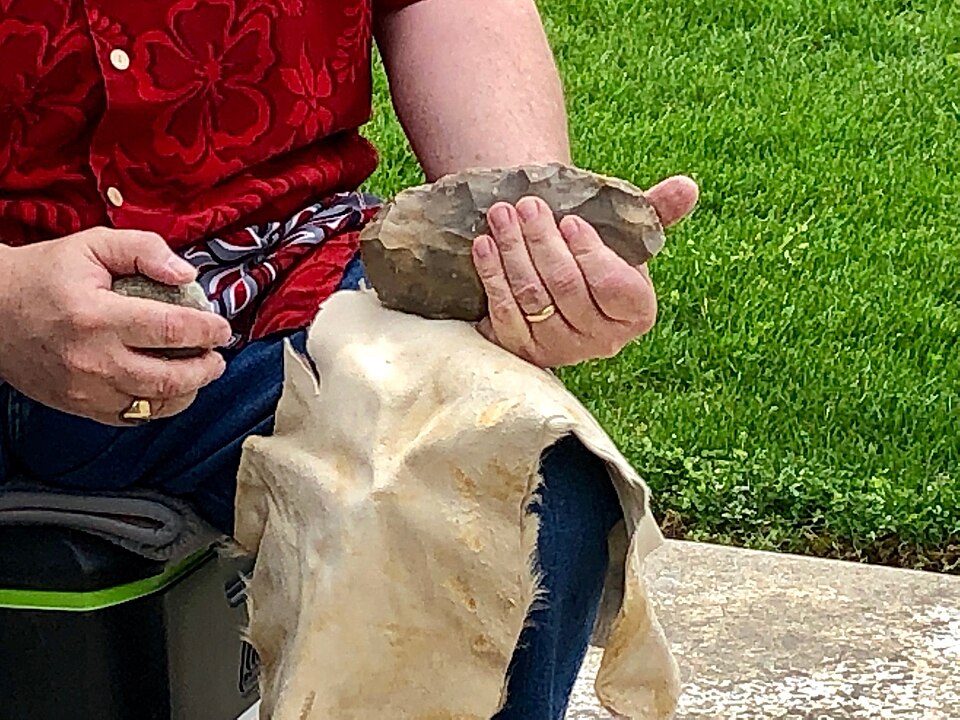

The defining artefact of the Acheulean is the handaxe: a large, teardrop-shaped or ovate tool flaked on both faces (bifacially) to produce a symmetrical form with a continuous working edge around most of its perimeter. Handaxe manufacture requires the knapper to maintain a mental template of the intended final form, to plan a sequence of removals that progressively shapes the tool toward that template, and to coordinate the rotation and positioning of the piece during reduction — cognitive demands that substantially exceed those of Oldowan flake production.22, 10 The bilateral symmetry of well-made handaxes, which is imposed by the knapper rather than dictated by the properties of the raw material, has been interpreted as evidence for a capacity for abstract spatial reasoning that was absent or minimal in the Oldowan.22
The Acheulean is most closely associated with Homo erectus (and the African variant often designated Homo ergaster), but later Acheulean assemblages in Africa and Europe were produced by Homo heidelbergensis and possibly other archaic human species.10 The remarkable standardisation of handaxe form across vast stretches of space and time has long puzzled archaeologists. Handaxes from sites in Africa, the Middle East, India, and Europe, separated by thousands of kilometres and hundreds of thousands of years, often exhibit strikingly similar shapes and proportions, suggesting either strong functional constraints, deeply ingrained cultural traditions transmitted with high fidelity, or both.10, 16 An increase in the refinement and number of flake scars on handaxes is documented through time at sites such as Konso, indicating that the tradition was not entirely static but underwent gradual improvement over its immense duration.9
Middle Paleolithic and Middle Stone Age technologies
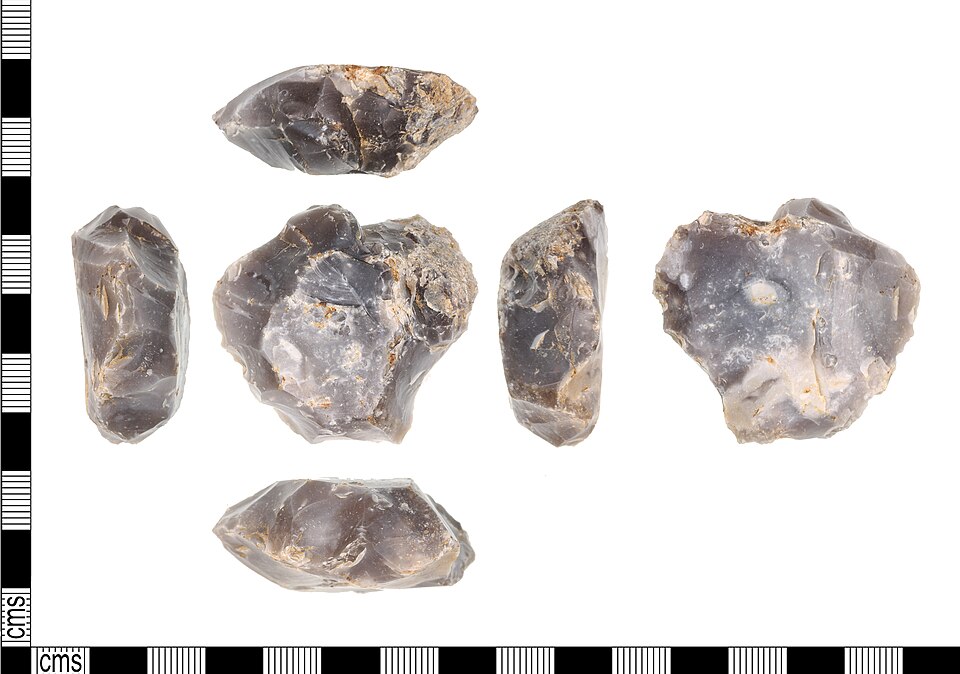
Beginning roughly 300,000 years ago and lasting until approximately 30,000 years ago (with regional variation), the Middle Paleolithic in Eurasia and the Middle Stone Age (MSA) in Africa witnessed a substantial increase in the sophistication and diversity of stone tool manufacture.10, 14 The hallmark technological advance of this period is the Levallois technique, a prepared-core technology in which the knapper carefully shaped a stone core through a series of preparatory removals so that a single blow to the prepared surface would detach a flake of predetermined size and shape. Formally defined by Boëda, the Levallois concept encompasses considerable variability in specific methods — including preferential, recurrent centripetal, and recurrent unipolar variants — but all share the fundamental principle of preparing the core geometry before the target flake is struck.11
.jpg)
The cognitive demands of Levallois reduction are significantly greater than those of either the Oldowan or the Acheulean. The knapper must envision the desired end product before beginning, plan a multi-step sequence of preparatory removals that create the correct core geometry, and possess a deep understanding of conchoidal fracture mechanics to control the shape, thickness, and curvature of the final flake.11, 14 In Eurasia, the Levallois technique is the defining characteristic of the Mousterian industry, associated primarily with Neanderthals but also with early Homo sapiens in the Levant. Neanderthal Mousterian assemblages display considerable regional and temporal variability, with distinct facies (such as the Quina, Ferrassie, and denticulate Mousterian) reflecting different reduction strategies and tool-use patterns adapted to local environments and subsistence needs.10, 14
In sub-Saharan Africa, MSA assemblages exhibit their own distinctive prepared-core methods alongside innovations such as the Still Bay bifacial points of southern Africa, which are finely worked, thin, symmetrical spear points that represent some of the most skilfully manufactured artefacts of the entire Stone Age.19, 20 The Middle Paleolithic and MSA also mark the emergence of composite tools — implements made from multiple materials joined together. The hafting of stone points onto wooden shafts to create spears is attested by residue analyses and experimental studies at multiple sites. At Kathu Pan 1 in South Africa, Wilkins and colleagues reported evidence of hafted spear tips dating to approximately 500,000 years ago, and stone-tipped projectiles from the Ethiopian Rift have been dated to greater than 279,000 years ago.12, 13 The creation of composite tools requires the procurement and preparation of multiple raw materials (stone, wood, binding agents such as plant resin or ochre-based adhesives), the mental capacity to conceptualise how these components fit together, and the manual dexterity to execute the assembly — a substantial leap in technological complexity.16
The pronounced regional variation visible in Middle Paleolithic and MSA assemblages contrasts sharply with the relative uniformity of the preceding Acheulean. Distinct cultural traditions can be identified across different geographic regions: the Mousterian of western Europe, the Aterian of North Africa (notable for its tanged or stemmed tools), the Howiesons Poort and Still Bay industries of southern Africa, and the Nubian Complex of northeastern Africa each exhibit unique technical signatures.10, 20 This diversification suggests that cultural traditions were becoming more localised and that group identity, environmental adaptation, and possibly stylistic preferences were beginning to shape technological choices in ways not seen earlier in the Paleolithic.14, 20
Upper Paleolithic and Later Stone Age blade technologies
The Upper Paleolithic in Eurasia (beginning approximately 50,000 to 45,000 years ago) and the Later Stone Age in Africa (with roots extending back to 50,000 years ago or more) are characterised by a dramatic acceleration in the pace of technological innovation, a proliferation of specialised tool types, and the systematic production of blades — elongated flakes at least twice as long as they are wide, struck from carefully prepared prismatic cores.15, 10 Blade technology yields substantially more cutting edge per kilogram of raw material than either Oldowan or Acheulean techniques, representing a more efficient use of lithic resources. Bar-Yosef and Kuhn noted, however, that the basic techniques for blade production appeared sporadically well before the Upper Paleolithic, and the technology's significance lies not in the blades themselves but in their systematic, large-scale production and their integration into diverse tool kits.15
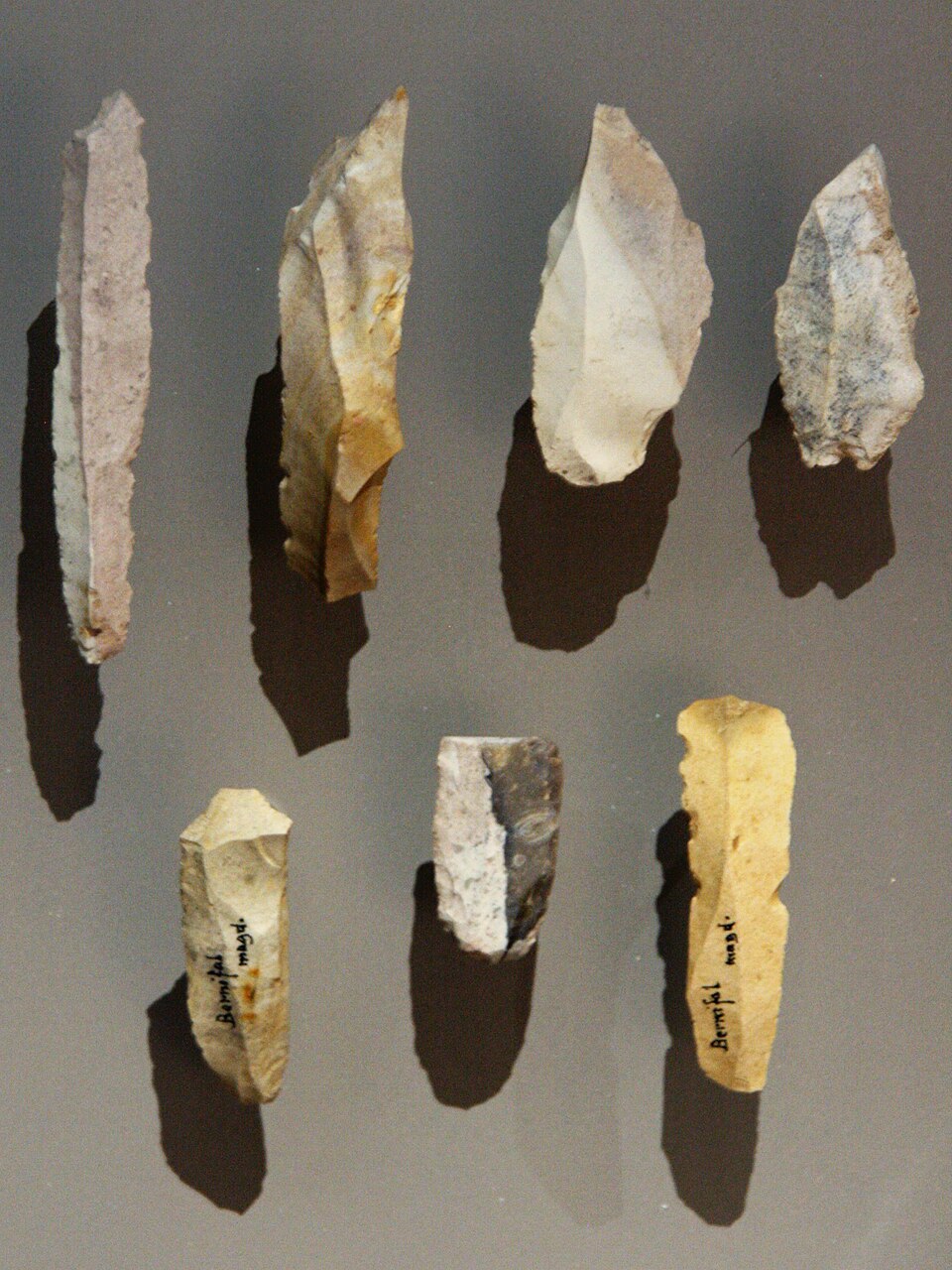

The Upper Paleolithic is conventionally divided into a succession of named industries, each defined by characteristic tool forms and reduction strategies. In Europe, the Aurignacian (approximately 43,000 to 28,000 years ago) is marked by carinated scrapers, split-base bone points, and the earliest widely accepted examples of figurative art and personal ornaments. The Gravettian (approximately 33,000 to 21,000 years ago) is characterised by backed points and bladelets, and is associated with the Venus figurines found across much of Europe. The Solutrean (approximately 22,000 to 17,000 years ago), restricted to southwestern Europe, is noted for exquisitely thin, bifacially flaked laurel-leaf points that represent the highest level of knapping skill achieved during the Paleolithic. The Magdalenian (approximately 17,000 to 12,000 years ago) features elaborate bone and antler working, the production of microliths, and the creation of the great cave art of Lascaux and Altamira.10, 16
Beyond blades and their derivatives, the Upper Paleolithic and Later Stone Age saw the proliferation of entirely new categories of technology. Microliths — small, geometrically shaped stone pieces designed to be mounted in rows along a shaft to create composite cutting or piercing implements — appear in Africa by at least 40,000 years ago and become widespread globally by the end of the Pleistocene.16, 20 Bone, antler, and ivory were systematically worked into needles (enabling the production of tailored clothing), awls, harpoons, and spear-throwers (atlatls). The development of the bow and arrow, attested in the African Later Stone Age, represented a transformative advance in projectile technology, enabling hunting at greater distances with reduced risk to the hunter.16, 10
The rapidity of technological change in the Upper Paleolithic stands in stark contrast to the deep conservatism of earlier traditions. Whereas the Acheulean handaxe persisted in recognisably similar form for over 1.5 million years, Upper Paleolithic industries succeeded one another on timescales of thousands to tens of thousands of years, and regional variation became the norm rather than the exception. This acceleration is widely interpreted as evidence for cumulative cultural evolution — the ratchet-like process by which innovations are preserved, transmitted to the next generation through social learning, and incrementally improved upon.16, 18
The chaîne opératoire analytical approach
One of the most influential frameworks in modern lithic analysis is the chaîne opératoire (operational sequence), a concept developed within the French school of prehistoric archaeology. The approach reconstructs the entire life history of a stone tool, from the initial procurement of raw material through each stage of reduction, use, resharpening, and eventual discard.25 Rather than classifying finished artefacts into typological categories based on their final form, the chaîne opératoire treats each artefact as the product of a dynamic sequence of technical decisions, allowing the analyst to infer the knapper's intentions, skill level, and degree of planning at each stage of the manufacturing process.25, 14
The method relies heavily on refitting studies, in which archaeologists attempt to reassemble flakes, cores, and debitage (the waste produced during knapping) into their original configurations. Successful refits reveal the precise order in which flakes were removed, the direction and force of each blow, and the decision points at which the knapper altered strategy in response to unexpected fractures or changing core geometry. Roche and colleagues' refitting of more than 60 sets at Lokalalei 2C in West Turkana, for example, demonstrated that 2.34-million-year-old Oldowan knappers maintained consistent platform angles and reduction trajectories across extended sequences — a level of procedural consistency that would be invisible from the analysis of individual finished tools alone.5
The chaîne opératoire approach has proven particularly powerful for comparing the cognitive demands of different lithic industries. By decomposing each industry into its constituent operational steps, researchers can quantify the number of hierarchically nested sub-goals, the length of the planning horizon, and the degree to which the sequence must be adjusted in response to contingencies during reduction.22, 25 Oldowan reduction, for instance, involves a relatively short operational sequence with limited hierarchical nesting: select a cobble, identify a platform, and strike. Levallois reduction, by contrast, requires a long, multi-stage sequence in which preparatory removals (themselves requiring careful planning) must be completed before the target flake can be extracted — a nested hierarchy of goals and sub-goals that parallels the syntactic structures of natural language.17, 11
Raw material procurement and exchange networks
The distances over which hominins transported stone raw materials have increased dramatically across the Stone Age, and the reconstruction of these transport distances provides one of the most revealing lines of evidence for the evolution of cognitive complexity, planning depth, and social organisation. In the Oldowan, raw materials were typically obtained from sources within a few kilometres of the sites where they were discarded, suggesting that early tool makers operated within relatively small home ranges and did not engage in long-distance planning or exchange.7, 23 Acheulean hominins occasionally transported raw materials over somewhat greater distances, but the majority of Acheulean assemblages still rely predominantly on locally available stone.10
A marked shift occurs in the Middle Stone Age. At the Olorgesailie basin in southern Kenya, Brooks and colleagues documented that hominins dating to approximately 320,000 to 305,000 years ago were procuring obsidian from sources located 25 to 50 kilometres or more from the sites of discard, a distance that exceeds the typical day range of any known primate and implies deliberate planning, logistical organisation, or inter-group exchange.24 Even more striking, the approximately 200,000-year-old Middle Stone Age assemblage at the Sibilo School Road Site in the Kapthurin Formation of Kenya contains obsidian from three geochemically distinct sources, the most distant of which lies 166 kilometres to the south — the earliest documented evidence of long-distance raw material transport of this magnitude.24
By the Upper Paleolithic and Later Stone Age, the distances over which high-quality raw materials such as obsidian, flint, and marine shell were moved routinely exceeded 200 to 300 kilometres, and in some cases reached several hundred kilometres.16, 10 The geochemical sourcing of obsidian artefacts — using techniques such as X-ray fluorescence spectroscopy and neutron activation analysis to match artefacts to their geological sources with high precision — has revealed extensive exchange networks linking distant communities across eastern Africa, the Mediterranean, Mesoamerica, and the Pacific.24 These networks imply not merely the physical transport of stone but the existence of social relationships, reciprocal obligations, and information exchange between groups, providing indirect evidence for the kind of symbolic and institutional complexity that characterises modern human societies.16, 20
Experimental archaeology and replication studies
Experimental archaeology — the systematic replication of prehistoric technologies under controlled conditions — has been central to the study of stone tools since the mid-twentieth century and remains one of the most productive methods for testing hypotheses about ancient tool-making behaviours. The foundational experimental work of Nicholas Toth in the 1980s demonstrated that many Oldowan core forms previously classified as distinct tool types (choppers, discoids, polyhedrons) are better understood as by-products of a single flake-production strategy, with the flakes rather than the cores serving as the primary intended products.21 By replicating Oldowan artefacts using cobbles of similar raw material and comparing the resulting debitage to archaeological assemblages from Koobi Fora in Kenya, Toth showed that the proportions of different flake types at Oldowan sites matched those produced by systematic experimental knapping, not the proportions expected from random or accidental breakage.21
Experimental replication has been equally important for understanding the Acheulean and Middle Paleolithic. Modern knappers trained to produce Acheulean handaxes have provided crucial data on the time investment, raw material waste, skill development trajectory, and motor demands of bifacial reduction, demonstrating that proficient handaxe production requires years of practice and cannot be achieved through simple trial and error.22, 17 For the Levallois technique, experimental replication has clarified the precise geometric relationships between preparatory removals and the final target flake, confirming that the knapper must possess a sophisticated three-dimensional mental model of the evolving core geometry to produce the intended product successfully.11, 14
The experimental approach has also been applied to questions of tool function, hafting technology, and use-wear formation. Controlled butchery experiments using replicated stone flakes on animal carcasses have produced cut marks and percussion marks that can be compared with marks found on fossil bones, providing the empirical basis for identifying meat processing in the archaeological record.7 Hafting experiments have demonstrated the adhesive properties of various natural resins, ochre-fat mixtures, and plant-based compounds that Middle Stone Age and Middle Paleolithic peoples may have used to attach stone points to wooden shafts, helping to establish the antiquity and complexity of composite tool manufacture.12, 16
Stone tools and cognitive evolution
Stone tools provide the most direct evidence for the cognitive capabilities of extinct hominins. Because the sequence of flake removals during stone tool manufacture is preserved in the geometry of the finished artefact and its debitage, archaeologists can reconstruct not merely the end products but the operational sequences that the knapper followed. Each lithic industry implies a characteristic level of cognitive complexity.22, 14
Oldowan knapping, at its simplest, requires the capacity to select an appropriate raw material, to identify a suitable striking platform, and to control the force, angle, and location of the blow — skills that overlap with but exceed those observed in chimpanzee nut-cracking behaviour.7, 22 Acheulean handaxe manufacture adds requirements for maintaining a mental template of the desired form, imposing bilateral symmetry through coordinated bifacial flaking, and planning a hierarchically organised reduction sequence across many removals. Wynn has argued that the spatial cognition required for Acheulean handaxe production is equivalent to that of modern human adults in non-linguistic spatial tasks, suggesting that a substantial cognitive advance occurred by approximately 1.7 million years ago.22
Levallois and other prepared-core technologies imply a yet more advanced level of planning and abstraction. The knapper must envision the desired end product before beginning, mentally decompose the manufacturing process into a sequence of preparatory and final stages, and monitor the evolving geometry of the core against the mental template throughout the reduction — a form of hierarchical, goal-directed planning that parallels the syntactic structure of language.17, 11 This parallel between stone tool production and language has been substantiated by neuroimaging studies. Using positron emission tomography (PET), Stout and Chaminade demonstrated that the production of both Oldowan and Acheulean tools activates brain regions involved in motor planning and spatial cognition, but that more complex knapping additionally recruits areas in the inferior frontal gyrus overlapping with Broca's area — a region classically associated with language production and syntactic processing.17
Experimental transmission studies have provided further support for the co-evolutionary relationship between tool-making and language. Morgan and colleagues trained chains of modern human participants to produce Oldowan tools using five different transmission mechanisms — reverse engineering, imitation, emulation, gestural teaching, and verbal teaching — and found that transmission fidelity improved significantly with teaching, and particularly with language, but not with imitation or emulation alone.18 These results suggest that the social transmission of increasingly complex lithic technologies would have generated selective pressure favouring the evolution of teaching behaviours and ultimately language, creating a co-evolutionary feedback loop in which advances in technology and communication reinforced one another over millions of years.17, 18
Major lithic industries compared
The progression from the Lomekwian to the Upper Paleolithic encompasses an enormous increase in technological complexity, raw material selectivity, reduction efficiency, and the diversity of tool forms. The following table summarises the defining characteristics of each major lithic industry, the hominin species most commonly associated with its production, and the approximate duration and geographic distribution of each tradition.1, 3, 8, 10, 14
Major lithic industries of the Stone Age10, 14, 16
| Industry | Date range | Associated hominins | Key characteristics | Type sites / regions |
|---|---|---|---|---|
| Lomekwian | ~3.3 Ma | Kenyanthropus?, Australopithecus? | Large cores, anvil-resting technique, crude flaking and battering | Lomekwi 3, West Turkana, Kenya |
| Oldowan | ~2.6–1.7 Ma | Homo habilis, early Homo, possibly Paranthropus | Simple core-and-flake technology, sharp flakes for cutting and scraping | Gona and Ledi-Geraru (Ethiopia); Olduvai Gorge (Tanzania) |
| Acheulean | ~1.76 Ma – ~200 ka | Homo erectus, H. heidelbergensis | Large bifacial handaxes and cleavers, bilateral symmetry, mental template | Kokiselei (Kenya); Konso (Ethiopia); Saint-Acheul (France) |
| Middle Paleolithic / MSA | ~300–30 ka | Neanderthals, early H. sapiens | Levallois prepared-core technique, hafted composite tools, regional variation | Le Moustier (France); Blombos Cave (South Africa) |
| Upper Paleolithic / LSA | ~50–10 ka | Homo sapiens | Systematic blade production, microliths, bone/antler tools, rapid diversification | Aurignac (France); Howieson's Poort (South Africa) |
Several broad patterns emerge from this overview. First, the tempo of technological change accelerated dramatically over the course of the Stone Age: the Lomekwian and Oldowan persisted with minimal change for roughly a million years each, the Acheulean endured for over 1.5 million years, but the Middle and Upper Paleolithic industries succeeded one another on timescales of tens of thousands to a few thousand years.10, 16 Second, the geographic distribution of tool traditions expanded over time, from a solely African record in the Lomekwian and early Oldowan to a pan-Old World distribution in the Acheulean and a fully global reach by the end of the Upper Paleolithic.10 Third, the diversity of tool forms within each successive industry increased, reflecting an expanding range of subsistence activities, environmental adaptations, and cultural traditions.14, 20
Cumulative cultural evolution
Perhaps the most profound implication of the stone tool record is the evidence it provides for cumulative cultural evolution: the process by which knowledge, techniques, and innovations are socially transmitted across generations, with each generation building upon and modifying the achievements of the last. Unlike genetic evolution, which requires changes in allele frequencies across generations, cultural evolution can operate within a single generation and can produce exponential increases in behavioural complexity when innovations are reliably transmitted rather than lost.18, 16
The stone tool record documents the gradual assembly of this capacity over millions of years. The Oldowan shows little evidence of cumulative improvement: assemblages separated by hundreds of thousands of years and thousands of kilometres are remarkably similar, suggesting that the technology was transmitted through relatively simple forms of social learning such as observation and emulation rather than active teaching.7, 18 The Acheulean exhibits a slow drift toward greater refinement over its 1.5-million-year duration, but the pace of change is glacial compared with later periods.9 The Middle Paleolithic and MSA show a marked increase in regional diversity and the first convincing evidence for distinct cultural traditions, though innovations still appear and disappear without consistently ratcheting upward.20
The explosive diversification of the Upper Paleolithic and Later Stone Age, by contrast, displays the hallmarks of fully developed cumulative culture: rapid innovation, regional specialisation, the emergence of entirely new technological categories (bone and antler working, tailored clothing, projectile technology, symbolic artefacts), and the sustained accumulation of improvements over relatively short timescales.16, 19 The behavioural and technological complexity of the Upper Paleolithic is widely regarded as evidence for the cognitive modernity of its makers, who were exclusively Homo sapiens in Europe and Africa, and is often associated with the full emergence of language, symbolic thought, and the capacity for abstract planning that defines the modern human mind.19, 20
The stone tool record thus provides a uniquely long and continuous archive of cognitive and cultural evolution. From the crude battering of cobbles at Lomekwi 3 some 3.3 million years ago to the exquisite Solutrean laurel-leaf points of Ice Age Europe, the trajectory of lithic technology documents the slow, incremental, and occasionally punctuated transformation of hominin minds — a process measured not in generations or centuries but in hundreds of thousands and millions of years.1, 10, 22
References
Evidence for stone-tool-assisted consumption of animal tissues before 3.39 million years ago at Dikika, Ethiopia
Earliest known Oldowan artifacts at >2.58 Ma from Ledi-Geraru, Ethiopia, highlight early technological diversity
Early hominid stone tool production and technical skill 2.34 Myr ago in West Turkana, Kenya
Experimental evidence for the co-evolution of hominin tool-making teaching and language
The origin of modern human behaviour: critique of the models and their test implications