Overview
- During the Mesozoic Era, multiple lineages of terrestrial reptiles independently returned to the sea, evolving into ichthyosaurs, plesiosaurs, mosasaurs, marine crocodylomorphs, and sea turtles that collectively dominated oceanic ecosystems for over 185 million years.
- These marine reptiles exhibited striking convergent evolution with modern cetaceans and other marine mammals, independently evolving streamlined body plans, flippers, live birth, deep-diving physiology, and elevated metabolic rates in response to shared selective pressures of aquatic life.
- All major lineages of Mesozoic marine reptiles except sea turtles were extinguished at the Cretaceous-Paleogene boundary 66 million years ago, vacating ecological niches that would eventually be filled by marine mammals during the Cenozoic.
The Mesozoic Era (252 to 66 million years ago) witnessed one of the most remarkable episodes in vertebrate evolution: the repeated, independent return of terrestrial reptiles to the sea. Over the course of the Triassic, Jurassic, and Cretaceous periods, at least half a dozen distinct reptilian lineages abandoned life on land and evolved into fully marine predators, filling ecological roles from coastal shellfish crushers to open-ocean apex predators rivalling modern great white sharks and killer whales.1, 22 These animals — ichthyosaurs, plesiosaurs, pliosaurs, mosasaurs, marine crocodylomorphs, and sea turtles — dominated the world's oceans for over 185 million years. Their story is one of convergent evolution, ecological innovation, and ultimately catastrophic extinction at the close of the Cretaceous.
The secondary adaptation of air-breathing reptiles to aquatic life required sweeping anatomical and physiological transformations: limbs reshaped into flippers or fins, bodies streamlined for efficient locomotion in a dense medium, sensory systems recalibrated for underwater perception, and reproductive strategies modified to eliminate the need to return to land. In many cases, these transformations produced body plans strikingly similar to those of modern dolphins, whales, and seals — animals that would not evolve for tens of millions of years after the last Mesozoic marine reptiles vanished.3, 15
Ichthyosaurs: fish-shaped reptiles
Ichthyosaurs (order Ichthyosauria) were the first major group of reptiles to become fully marine, appearing in the Early Triassic around 249 million years ago, shortly after the devastating end-Permian mass extinction had emptied most marine ecological niches.2, 22 The earliest known ichthyosauriforms, such as Cartorhynchus from the Lower Triassic of China, were small animals less than 40 centimetres long with relatively flexible wrists and short snouts, suggesting an amphibious lifestyle transitional between land and sea.2 Within approximately 5 million years, however, ichthyosaurs had diversified into a range of body sizes and ecological types, from small coastal forms to large pelagic predators exceeding 15 metres in length.22
.jpg)
_(Posidonia_Shale,_Lower_Jurassic;_Holzmaden_area,_Germany)_(35788640735).jpg)
By the Late Triassic and into the Jurassic, ichthyosaurs had evolved one of the most extreme examples of convergent evolution in the vertebrate fossil record: a body plan virtually indistinguishable in external outline from that of a tuna or dolphin. Advanced ichthyosaurs such as Ophthalmosaurus and Ichthyosaurus possessed a torpedo-shaped body with a dorsoventrally flattened, crescent-shaped tail fin (oriented vertically like a fish's caudal fin rather than horizontally like a cetacean's fluke), a dorsal fin lacking any skeletal support, a narrow caudal peduncle, enormous eyes adapted for low-light or deep-water vision, and forelimbs modified into rigid, hydrofoil-like flippers.1, 21 The largest ichthyosaurs, including the Late Triassic Shonisaurus and the recently described Cymbospondylus, reached estimated lengths of 15 to 21 metres, rivalling modern sperm whales.7
Ichthyosaurs were viviparous — they gave birth to live young in the water. Numerous exceptionally preserved specimens from the Jurassic of Germany and England show embryos within the body cavity or in the process of being born tail-first, an orientation shared with modern cetaceans that prevents the neonate from drowning during delivery.6 Recent analyses of preserved soft tissues have revealed evidence of insulating blubber and a dark, counter-shaded colour pattern (dark above, light below), suggesting elevated metabolic rates and a cryptic colouration strategy convergent with modern oceanic predators.17 Although ichthyosaurs were the dominant marine predators of the Triassic and Early Jurassic, their diversity declined through the Middle Jurassic and Cretaceous, and the last ichthyosaurs disappeared around 90 million years ago in the Cenomanian, approximately 25 million years before the end-Cretaceous mass extinction.21
Plesiosaurs and pliosaurs
The Plesiosauria, a clade of marine reptiles within the larger group Sauropterygia, first appeared in the latest Triassic and radiated extensively through the Jurassic and Cretaceous periods.8 Plesiosaurs evolved a locomotor strategy fundamentally different from that of ichthyosaurs: rather than propelling themselves with an oscillating tail, they used four large, wing-like flippers in a manner analogous to underwater flight, likely combining anterior and posterior pairs in a complex stroke pattern that allowed high manoeuvrability and sustained cruising.9
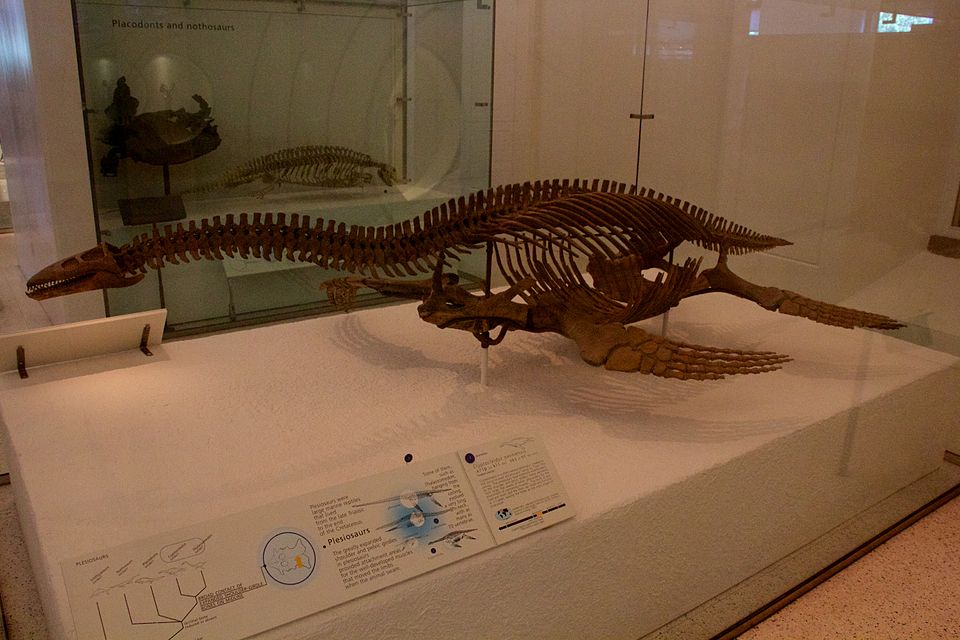

The Plesiosauria encompassed two broadly distinct body plans, or morphotypes. The plesiosauromorph body plan, exemplified by genera such as Plesiosaurus, Cryptoclidus, and the iconic Elasmosaurus, featured a small head on an extremely long, flexible neck (up to 76 cervical vertebrae in Elasmosaurus), a broad, relatively rigid trunk, and four large paddles. These animals likely fed on small fish and cephalopods, using their long necks to strike at prey with rapid lateral movements while the body remained relatively stationary.8, 9 The pliosauromorph body plan, by contrast, featured a short neck, a massive, elongated skull armed with large conical teeth, and a powerful, hydrodynamic body built for speed and power. Pliosaurs such as Liopleurodon, Pliosaurus, and Kronosaurus were apex predators capable of taking large prey, including other marine reptiles. The largest pliosaurs had skulls exceeding 2 metres in length and estimated total body lengths of 10 to 13 metres.9
A landmark discovery in 2011 revealed that at least some plesiosaurs were viviparous and may have invested heavily in parental care. A specimen of the Late Cretaceous plesiosaur Polycotylus latippinus was found with a single, large foetus preserved within the body cavity, suggesting that plesiosaurs gave birth to a small number of well-developed young — a K-selected reproductive strategy more similar to modern whales and dolphins than to most living reptiles.5
Mosasaurs: apex predators of the Late Cretaceous
Mosasaurs (family Mosasauridae) were large marine lizards closely related to modern monitor lizards and snakes. They appeared relatively late in the Mesozoic, with the earliest definitive mosasaurs known from the Turonian stage of the Late Cretaceous, approximately 90 million years ago — coincidentally around the same time the last ichthyosaurs disappeared.10, 11 Despite their late arrival, mosasaurs diversified rapidly and by the Maastrichtian (the final stage of the Cretaceous, 72 to 66 million years ago) had become the dominant marine predators in oceans worldwide.11
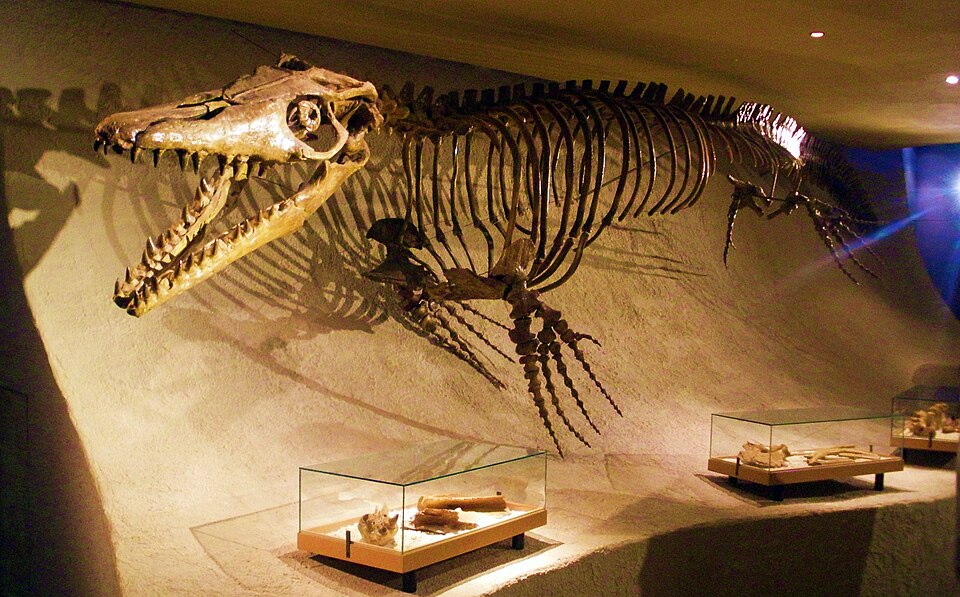

Mosasaurs propelled themselves primarily through lateral undulation of a long, laterally compressed tail, supplemented by paddle-like limbs used for steering and stability. The largest species, Mosasaurus hoffmannii, reached estimated lengths of 13 to 17 metres, while the genus Tylosaurus attained lengths of approximately 13 metres.10, 12 Mosasaur dentition was highly varied across genera, reflecting a broad range of diets: some species had pointed, grasping teeth suited for catching fish and squid; others had blunt, rounded teeth adapted for crushing ammonite shells and bivalves; and still others had cutting teeth capable of processing large vertebrate prey.11 Exceptionally preserved specimens have revealed soft-tissue features including a streamlined body outline, a bilobed tail fluke convergent with those of ichthyosaurs and sharks, and skin covered in small, keeled scales rather than overlapping fish-like scales.15
The Western Interior Seaway, a shallow epicontinental sea that bisected North America during the Late Cretaceous, has yielded an extraordinary fossil record of mosasaur diversity. At least a dozen mosasaur genera coexisted in this single basin, partitioning the water column through differences in body size, tooth morphology, and presumed habitat preference — a level of niche differentiation comparable to modern marine mammal communities.12 Bone microstructure analyses indicate that mosasaurs had rapid growth rates and elevated metabolic rates relative to typical ectothermic reptiles, further underscoring their ecological convergence with modern marine mammals.16
Marine crocodylomorphs and sea turtles
Beyond the three great radiations of ichthyosaurs, plesiosaurs, and mosasaurs, the Mesozoic oceans supported several additional lineages of marine reptiles. Marine crocodylomorphs evolved multiple times from terrestrial ancestors, producing forms ranging from coastal ambush predators to fully pelagic swimmers.13 The Thalattosuchia, a group of Jurassic and Early Cretaceous marine crocodylomorphs, included the metriorhynchids — animals so highly adapted to marine life that they had evolved paddle-like forelimbs, a tail fluke, salt-excreting glands, and smooth, unarmoured skin. Genera such as Metriorhynchus and Dakosaurus were streamlined, fast-swimming predators that likely never left the water, representing one of the most complete land-to-sea transitions in crocodylomorph history.13
Sea turtles (superfamily Chelonioidea) also originated during the Cretaceous, with the earliest definitive marine turtles appearing in the Early Cretaceous, approximately 120 million years ago.14 By the Late Cretaceous, sea turtles had diversified into multiple lineages, including the protostegids — enormous turtles with reduced shells and winglike flippers, the largest of which, Archelon ischyros, reached a shell length of over 4 metres and a flipper span exceeding 4.5 metres. Unlike the ichthyosaurs, plesiosaurs, and mosasaurs, sea turtles survived the end-Cretaceous mass extinction and persist to the present day, making them the only group of Mesozoic marine reptiles with living descendants.14, 18
Convergent evolution with marine mammals
The Mesozoic marine reptiles provide some of the most compelling examples of convergent evolution in the history of life. Separated by tens of millions of years, ichthyosaurs and dolphins evolved remarkably similar body plans: streamlined, fusiform bodies; dorsal fins; crescent-shaped tail flukes (though oriented in perpendicular planes); large eyes; elongated, tooth-bearing snouts; and viviparous reproduction.1, 3 The resemblance extends beyond gross morphology to include inferred physiological traits. Preserved soft tissues in ichthyosaurs indicate the presence of blubber-like insulating layers, counter-shaded pigmentation, and smooth, scaleless skin — features shared with modern dolphins and interpreted as adaptations to endothermy and pelagic life.17
Similar parallels exist between plesiosaurs and modern pinnipeds (seals and sea lions), which share a four-flipper locomotor strategy, and between mosasaurs and large predatory marine mammals such as killer whales, which occupy comparable trophic positions as apex predators of diverse prey.3, 15 These convergences arise because the physics of locomotion in water impose strong constraints on body form regardless of ancestry: drag reduction favours streamlined profiles, efficient thrust generation favours either oscillatory or undulatory propulsion, and the need to maintain body temperature in a thermally conductive medium favours insulation and elevated metabolic rates.17
Convergent traits in Mesozoic marine reptiles and modern marine mammals1, 3, 15, 17
| Trait | Mesozoic marine reptile | Modern marine mammal analogue |
|---|---|---|
| Fusiform, streamlined body | Ichthyosaurs | Dolphins, porpoises |
| Crescent-shaped tail fluke | Ichthyosaurs, mosasaurs | Cetaceans (horizontal fluke) |
| Four-flipper underwater flight | Plesiosaurs | Sea lions, sea turtles |
| Blubber-like insulation | Ichthyosaurs (preserved soft tissue) | Whales, seals |
| Counter-shaded pigmentation | Ichthyosaurs (melanophore evidence) | Dolphins, penguins |
| Viviparity with tail-first birth | Ichthyosaurs, plesiosaurs | Cetaceans |
| Apex predator with varied dentition | Mosasaurs, pliosaurs | Killer whales |
Ecological roles and food webs
Mesozoic marine reptiles occupied virtually every major predatory niche in the ocean. During the Early and Middle Triassic, the initial radiation of marine reptiles filled ecological space left vacant by the end-Permian extinction, with early ichthyosaurs, nothosaurs, and placodonts diversifying rapidly into roles as fish predators, squid hunters, and durophagous (shell-crushing) feeders.19, 22 By the Late Triassic and Jurassic, a mature marine ecosystem had developed in which ichthyosaurs served as mid-level to apex pelagic predators, pliosaurs functioned as top predators comparable to modern killer whales, long-necked plesiosaurs fed on schools of small fish and cephalopods, and marine crocodylomorphs occupied nearshore to open-ocean niches.8, 13
The Late Cretaceous witnessed a significant reorganization of these food webs. The decline and disappearance of ichthyosaurs around 90 million years ago was followed by the explosive radiation of mosasaurs, which rapidly assumed the vacated roles of large pelagic predators.11, 20 In the Western Interior Seaway and other Late Cretaceous marine environments, mosasaurs sat at the apex of food webs that included plesiosaurs, large predatory fish such as Xiphactinus, sharks, ammonites, and a diverse assemblage of bony fishes. Gut contents and bite marks preserved in fossils demonstrate that mosasaurs fed on fish, sharks, other mosasaurs, plesiosaurs, sea turtles, ammonites, and seabirds, confirming their role as generalist apex predators.12
The Triassic marine reptile radiation
The diversification of marine reptiles in the Triassic was one of the most rapid evolutionary radiations in the history of vertebrate life. Following the catastrophic end-Permian extinction approximately 252 million years ago, which eliminated an estimated 81 to 96 percent of all marine species, oceanic ecosystems were rebuilt largely from scratch. Reptiles, which had been predominantly terrestrial prior to the extinction, invaded the marine realm within the first few million years of the Triassic and diversified with remarkable speed.19, 22
By the Anisian stage of the Middle Triassic (approximately 247 to 242 million years ago), at least five distinct lineages of marine reptiles were present in the oceans: ichthyosaurs, sauropterygians (the ancestors of plesiosaurs), thalattosaurs, placodonts, and tanystropheids.22 This rapid diversification indicates that the emptied ecological landscape following the end-Permian extinction provided extraordinary opportunities for lineages capable of exploiting marine resources. Phylogenetic analyses suggest that many of these lineages evolved marine adaptations independently, representing multiple separate invasions of the sea from different terrestrial or semi-aquatic ancestors rather than a single ancestral transition.2, 22
The speed of this radiation was comparable to that observed in mammals following the end-Cretaceous extinction, and the two events are often cited as parallel examples of how mass extinctions create ecological vacuums that catalyse explosive adaptive diversification in surviving lineages.19
Extinction at the Cretaceous-Paleogene boundary
The end-Cretaceous mass extinction 66 million years ago, triggered by the Chicxulub asteroid impact and possibly exacerbated by the Deccan Traps volcanism, extinguished all major lineages of Mesozoic marine reptiles except sea turtles. Mosasaurs, plesiosaurs, and the last surviving marine crocodylomorphs disappeared abruptly at the Cretaceous-Paleogene (K-Pg) boundary, leaving no descendants.18, 20
The fossil record of mosasaurs in the final stages of the Cretaceous shows no evidence of a gradual decline in diversity prior to the extinction. Multiple genera and species of mosasaurs, spanning a wide range of body sizes and ecological roles, persisted until the very end of the Maastrichtian, suggesting that the extinction was geologically sudden rather than the culmination of a long decline.20 Plesiosaurs likewise maintained moderate diversity through the final stage of the Cretaceous, with both long-necked elasmosaurids and short-necked polycotylids present in Maastrichtian deposits worldwide.18
The selectivity of the extinction is instructive. Sea turtles survived the K-Pg event, as did crocodilians (though marine forms did not persist), sharks, and many lineages of bony fish. The factors that determined survival or extinction among marine vertebrates remain debated, but body size, metabolic rate, trophic position, and dependence on primary productivity in the water column have all been proposed as relevant variables. Large-bodied, warm-blooded apex predators dependent on stable food webs anchored by photosynthetic plankton may have been particularly vulnerable to the collapse of marine primary productivity that followed the impact winter.18 The ecological niches vacated by Mesozoic marine reptiles remained largely empty for millions of years before being gradually filled by marine mammals — whales, seals, and sea cows — during the Eocene and Oligocene epochs of the Cenozoic Era.3, 18
Temporal ranges of major Mesozoic marine reptile groups1, 10, 13, 14, 22
References
Evolutionary innovation and ecology in marine tetrapods from the Triassic to the Anthropocene
Viviparity and K-selected life history in a Mesozoic marine plesiosaur (Reptilia, Sauropterygia)
Ichthyosaur embryos outside the mother body: not due to decomposition but to viviparity
Scaling of the axial skeleton in ichthyosaurs and its implications for body-size estimates
The evolution of plesiosaur and pliosaur morphotypes in the Plesiosauria (Reptilia: Sauropterygia)
Mosasauridae (Squamata): a review of the systematics and biogeography of the Late Cretaceous marine lizards
Convergent evolution in aquatic tetrapods: insights from an exceptional fossil mosasaur
Bone microstructure indicates insular dwarfism in a new Late Cretaceous mosasaur species
Ecological and evolutionary consequences of the Cretaceous-Paleogene mass extinction on marine vertebrates
The evolution and extinction of the giant marine lizards (Mosasauridae) and their importance as markers of the end-Cretaceous event
The ichthyosaur from the Aalenian (Middle Jurassic) and the evolution of body shape in ichthyosaurs