Overview
- The logical problem of evil argues that the existence of an omnipotent, omniscient, and perfectly good God is logically incompatible with the existence of evil — a formulation most influentially presented by J. L. Mackie in 1955, who contended that theists hold an internally contradictory set of beliefs
- Alvin Plantinga’s free will defense (1974) is widely regarded as having resolved the logical problem by showing that it is logically possible for God to have morally sufficient reasons for permitting evil, shifting the philosophical debate toward the evidential problem — whether the amount, distribution, and kinds of evil in the world make God’s existence improbable rather than impossible
- William Rowe’s evidential argument from suffering (1979) contends that instances of intense, apparently pointless suffering — such as a fawn dying in agony from a forest fire — constitute strong evidence against the existence of God, prompting responses including skeptical theism, soul-making theodicy, and the argument that human cognitive limitations prevent reliable judgments about whether any evil is truly gratuitous
The problem of evil is the oldest and most widely discussed challenge to theistic belief. In its most general form, it asks how the existence of evil and suffering can be reconciled with the existence of a God who is omnipotent, omniscient, and perfectly good. If God has the power to prevent evil, the knowledge to identify it, and the goodness to desire its elimination, the existence of evil appears to require explanation. The problem has been articulated in multiple forms — the logical problem argues that God and evil are strictly incompatible, the evidential problem argues that evil makes God’s existence improbable, and the existential problem concerns the lived experience of suffering rather than its philosophical implications. This article surveys the historical development of the problem, the major formulations and responses, and the ongoing state of the debate in analytic philosophy of religion.12, 4
Historical background
The problem of evil has ancient roots. Epicurus (341–270 BCE) is credited with an early formulation, preserved by Lactantius: “Is God willing to prevent evil, but not able? Then he is not omnipotent. Is he able, but not willing? Then he is malevolent. Is he both able and willing? Then whence cometh evil? Is he neither able nor willing? Then why call him God?” Whether Epicurus himself formulated the problem in precisely these terms is debated, but the logical structure — the tension between divine attributes and the existence of evil — was recognized in ancient Greek philosophy.12
David Hume developed the problem extensively in Dialogues Concerning Natural Religion (published posthumously in 1779). Through the character of Philo, Hume argued that the evidence of suffering in the natural world undermines the inference from the world to a benevolent designer. Philo catalogues four sources of suffering — the operation of general laws rather than particular providences, the limited faculties of creatures, the frugality of nature in distributing powers, and the “inaccurate workmanship” of the natural order — and argues that these features of the world are more consistent with an indifferent or morally ambiguous cause than with a perfectly good creator. Hume did not argue that evil proves there is no God but rather that the existence of evil prevents the inference from the world to a good God.13
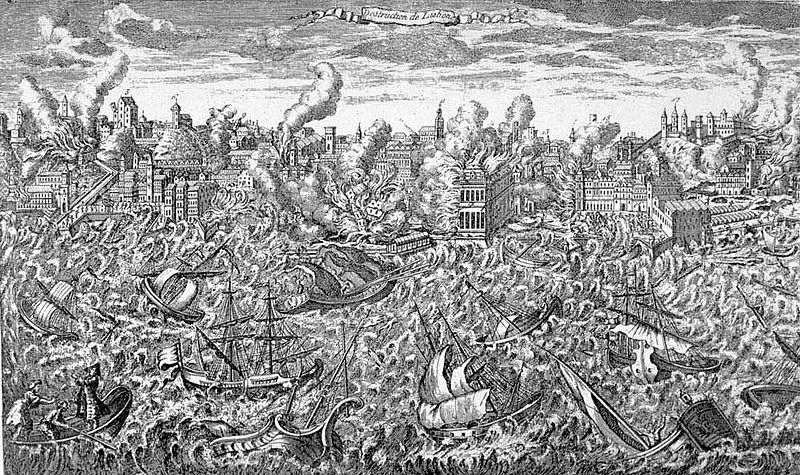

The eighteenth-century Lisbon earthquake (1755), which killed an estimated 30,000–50,000 people on All Saints’ Day while many were attending church, catalyzed philosophical reflection on the problem. Voltaire’s Poem on the Lisbon Disaster (1756) and Candide (1759) attacked Leibnizian optimism — the view that this is the best of all possible worlds — as morally inadequate in the face of catastrophic suffering. Kant wrote a response to the earthquake that challenged the idea that natural disasters serve as divine punishment.12
The logical problem of evil
The logical problem of evil contends that the existence of God is logically incompatible with the existence of evil. The most influential formulation was presented by J. L. Mackie in his 1955 paper “Evil and Omnipotence.” Mackie argued that the following three propositions form an inconsistent triad:1
P1. God is omnipotent.
P2. God is perfectly good.
P3. Evil exists.
C. These three propositions are logically incompatible: at most two can be true simultaneously.
To generate the contradiction, Mackie supplied two additional premises he took to be “quasi-logical rules connecting the terms”: that a good being always eliminates evil as far as it can, and that an omnipotent being faces no limits on what it can do. With these additional premises, the existence of any evil whatsoever is logically incompatible with the existence of an omnipotent, perfectly good God. Mackie acknowledged that theists could escape the contradiction by qualifying one of the three propositions — by limiting God’s power, redefining goodness, or denying the reality of evil — but argued that the resulting positions depart significantly from orthodox theism.1, 5
Mackie also examined and rejected several traditional theodicies. He argued that the claim “evil is necessary as a means to good” contradicts omnipotence, since an omnipotent being could achieve the good without the means. He argued that the claim “evil is necessary as a counterpart to good” confuses epistemological conditions (we may need contrast to recognize good) with metaphysical conditions (good could exist without evil). And he argued that the free will defense, though the “most important” proposed solution, fails because an omnipotent God could have created beings who always freely choose the good.1
Plantinga’s free will defense
Alvin Plantinga’s free will defense, presented in The Nature of Necessity (1974) and God, Freedom, and Evil (1974), is widely regarded as having resolved the logical problem of evil. Plantinga did not argue that he knew why God permits evil — he argued only that it is logically possible for an omnipotent, omniscient, perfectly good God to have morally sufficient reasons for permitting evil. If such a scenario is merely possible, the three propositions in Mackie’s triad are not logically incompatible.2, 8
Plantinga’s central argument invokes the concept of transworld depravity. Plantinga defines a possible world as a maximal state of affairs that could obtain. God, being omnipotent, can actualize any logically possible state of affairs. But if creatures have libertarian free will — if their free choices are not determined by prior causes — then there are facts about what any possible creature would freely do in any given circumstance (these are “counterfactuals of freedom”). It is logically possible, Plantinga argues, that every possible creature suffers from transworld depravity: for every possible world in which that creature exists and is significantly free, there is at least one occasion on which the creature freely chooses wrongly. If this is so, then it is not within God’s power to create a world containing creatures with libertarian freedom who never do wrong — not because God lacks power, but because the creatures’ free choices are not God’s to determine.2
The free will defense addresses moral evil — evil resulting from the free choices of moral agents. Plantinga extended the defense to natural evil (earthquakes, diseases, animal suffering) by suggesting that it is logically possible that natural evil is caused by the free actions of non-human agents such as fallen angels. This extension is more controversial than the core defense, but the logical point requires only that the scenario be possible, not probable or well-evidenced.2
The success of Plantinga’s defense against the logical problem is widely, though not universally, acknowledged. Mackie himself conceded in The Miracle of Theism (1982) that the free will defense shows the logical problem is not “decisive.” However, Mackie maintained that the evidential problem of evil remains a strong challenge to theism. Most contemporary philosophers of religion — including atheists such as William Rowe and Paul Draper — have moved the debate from the logical to the evidential form.5, 12
The evidential problem of evil
The evidential problem of evil argues not that God’s existence is logically impossible given evil but that it is improbable. William Rowe presented the most influential formulation in his 1979 paper “The Problem of Evil and Some Varieties of Atheism”:3
P1. There exist instances of intense suffering which an omnipotent, omniscient being could have prevented without thereby losing some greater good or permitting some evil equally bad or worse.
P2. An omniscient, wholly good being would prevent the occurrence of any intense suffering it could, unless it could not do so without thereby losing some greater good or permitting some evil equally bad or worse.
C. There does not exist an omniscient, wholly good, omnipotent being.
Rowe illustrated P1 with two examples: a fawn caught in a forest fire caused by lightning, which lies in agony for days before dying, and a five-year-old girl who is raped, beaten, and killed by her mother’s boyfriend. In both cases, Rowe argued, it appears that no greater good is served by the suffering and no worse evil is prevented by it. The suffering appears to be “gratuitous” — pointless and unredeemed. Rowe acknowledged that he could not prove that these instances of suffering serve no greater purpose, but argued that after careful reflection, the most reasonable conclusion is that at least some suffering is genuinely gratuitous.3
The key move in Rowe’s argument is the inference from “we cannot see a reason for this suffering” to “there likely is no reason for this suffering.” This inference — sometimes called the “noseeum” inference (“if we can’t see ’em, they aren’t there”) — has become the central point of contention in the contemporary debate. The plausibility of the evidential argument depends on whether human cognitive limitations allow reliable judgments about whether any particular instance of suffering serves a morally sufficient purpose known to God.4, 12
Theodicies
A theodicy (from Greek theos, “God,” and dike, “justice”) attempts to provide a morally sufficient reason why God permits evil. Unlike Plantinga’s defense, which argues only for logical possibility, a theodicy claims to identify the actual reason. Several theodicies have been developed in the philosophical tradition.12
The Augustinian theodicy, rooted in the writings of Augustine of Hippo (354–430 CE), holds that God created the world perfectly good and that evil entered through the free choices of rational creatures — first the fallen angels and then human beings in the Fall described in Genesis. On this account, evil is not a positive substance but a privation (privatio boni), an absence or corruption of the good. Natural evils such as disease and earthquakes are consequences of the cosmic disruption caused by the Fall, and moral evil is the result of creaturely free will turned away from God. The Augustinian framework dominated Western Christian thought for centuries and remains influential, though modern critics note that it depends on a literal reading of the Fall and struggles to account for animal suffering in the millions of years before human beings existed.19, 7
The soul-making theodicy, developed most fully by John Hick in Evil and the God of Love (1966, revised 1977), draws on the thought of Irenaeus of Lyon (c. 130–202 CE) and offers an alternative to the Augustinian approach. Where Augustine locates the origin of evil in a Fall from perfection, the Irenaean tradition views humans as created immature and unfinished, placed in a world of challenge and difficulty precisely so that they can develop morally and spiritually into the “likeness of God.” On this view, a world without suffering would be a world without the conditions necessary for the development of courage, compassion, patience, and moral strength. The “epistemic distance” between God and humanity — the fact that God’s existence is not overwhelmingly obvious — is itself a condition of genuine moral freedom.7
Critics of the soul-making theodicy argue that it cannot account for the distribution and degree of suffering in the world. Some suffering appears too severe to serve any developmental purpose — Adams identifies “horrendous evils” (the Holocaust, child abuse, devastating natural disasters) as suffering so extreme that it appears to defeat the positive meaning of the victim’s life. A child who dies in agony has no opportunity for soul-making. The theodicy also struggles with animal suffering, which occurs in creatures to whom the development of moral virtue does not apply.10, 4
Richard Swinburne’s theodicy in The Existence of God (2004) argues that natural evil serves necessary epistemic functions: natural disasters and diseases provide knowledge about the causal structure of the world (one learns that fire burns by the existence of pain), create conditions for significant moral choice (heroism requires real danger), and allow the kind of free moral development that would be impossible in a pain-free world. Swinburne argues that God would be justified in permitting significant suffering if it serves these greater purposes, and that a world without natural evil would be a world in which meaningful moral action is impossible. Critics respond that the degree of natural evil in the actual world exceeds what is necessary for these purposes — the same epistemic and moral benefits could be achieved with far less suffering.6, 16
Major theodicies and their scope12, 4
| Theodicy | Key proponent | Central claim | Addresses | Main objection |
|---|---|---|---|---|
| Augustinian | Augustine (c. 413) | Evil is a privation of good introduced by the Fall | All evil | Depends on literal Fall; ignores pre-human suffering |
| Free will | Plantinga (1974) | God cannot create free creatures who never do wrong | Moral evil | Does not address natural evil |
| Soul-making | Hick (1966) | Suffering enables moral and spiritual development | Moral and natural evil | Cannot account for extreme or child suffering |
| Natural law | Swinburne (2004) | Regular natural laws are necessary for moral agency | Natural evil | Degree of natural evil exceeds necessity |
| Greater good | Leibniz (1710) | This is the best of all possible worlds | All evil | Difficult to demonstrate optimality |
| Eschatological | Adams (1999) | God will defeat every horrendous evil through individual redemption | Horrendous evils | Requires afterlife; does not address present suffering |
| Warfare | Boyd (2003)14 | Evil results from the free agency of malevolent spiritual beings | Natural evil | Requires contested metaphysical commitments |
Skeptical theism
Skeptical theism has emerged as the most influential response to Rowe’s evidential argument. Rather than providing a reason why God permits evil, skeptical theists challenge the inference from “we cannot see a reason” to “there is no reason.” The approach was pioneered by Stephen Wykstra, who argued in 1984 that Rowe’s inference violates a principle Wykstra called CORNEA (Condition Of ReasoNable Epistemic Access): we are entitled to infer “there is no X” from “we cannot detect X” only if, were X to exist, we would reasonably expect to detect it. Given the cognitive distance between human minds and an omniscient God, Wykstra argued, we have no reason to expect that God’s reasons for permitting suffering would be accessible to us.17
Michael Bergmann refined this approach by articulating three skeptical theses that have become standard in the literature. First, we have no reason to think that the goods we know of are representative of all the goods there are (some goods may be beyond human comprehension). Second, we have no reason to think that the evils we know of are representative of all the evils there are. Third, we have no reason to think that we can reliably assess the entailment relations between the goods and evils we know of (we cannot determine whether permitting a particular evil is necessary for achieving a particular good). If any of these theses is correct, Rowe’s “noseeum” inference fails: the fact that we cannot identify a morally sufficient reason for a particular instance of suffering does not entail that there is no such reason.18, 9
Critics of skeptical theism have raised several objections. Oppy argues that skeptical theism, if taken seriously, undermines not only the evidential argument from evil but all evidential reasoning about God — if we cannot trust our judgments about whether suffering is gratuitous, we also cannot trust our judgments about whether the world exhibits design, whether religious experience is veridical, or whether testimony about miracles is reliable. The same epistemic humility that blocks the argument from evil also blocks the arguments for God’s existence.16 Others argue that skeptical theism has morally problematic consequences: if we cannot know whether any instance of suffering serves a greater good, we have no grounds for preventing suffering — the suffering we would prevent might itself be serving God’s inscrutable purposes.4
The problem of animal suffering
The free will defense and soul-making theodicy address evil caused by or directed at morally responsible agents. Neither directly addresses the suffering of non-human animals, which constitutes the vast majority of suffering in the world’s history. Predation, parasitism, disease, starvation, and natural disasters cause immense animal suffering, and the fossil record documents hundreds of millions of years of such suffering before the emergence of Homo sapiens (see suffering in the Bible).11, 15
Murray identifies animal suffering as a particularly acute challenge for theism because the standard theodicies do not apply: animals cannot develop moral virtue through suffering (soul-making), their suffering is not the result of free moral choices (free will defense), and many animals lack the cognitive capacity to benefit from the epistemic goods that natural evil is said to provide (natural law theodicy). Southgate argues that evolutionary natural selection — the mechanism responsible for the diversity of life — requires competition, predation, and death as constitutive elements. If God created the world through evolutionary processes, animal suffering is not a byproduct of creation but an integral part of the creative mechanism.15, 11
Proposed responses include the suggestion that animals do not suffer as intensely as humans (contested by neuroscience and comparative psychology), that animal suffering will be redeemed in an eschatological transformation of creation (Romans 8:19-22), and that the goods achieved through evolutionary creation — the extraordinary diversity and beauty of life — could not have been achieved without the suffering that natural selection entails. Southgate advocates a “compound theodicy” that acknowledges the real cost of creation through evolution while maintaining that God’s compassion extends to every suffering creature and that eschatological redemption applies to all of creation, not only to humans.11
The problem of divine hiddenness
Closely related to the problem of evil is the problem of divine hiddenness: if a perfectly loving God exists, why do some people who are open to belief in God fail to find evidence of God’s existence? The suffering of those who sincerely seek God and find only silence is itself a form of evil that requires explanation. The psalms of lament in the Hebrew Bible give voice to this experience: “How long, O LORD? Will you forget me forever? How long will you hide your face from me?” (Psalm 13:1, NRSV). Hick’s concept of “epistemic distance” — the notion that God maintains a degree of hiddenness to preserve genuine freedom of belief and moral development — represents one theistic response, but critics argue that the degree of divine hiddenness in the actual world exceeds what is necessary for this purpose.7, 12
Contemporary state of the debate
The contemporary debate on the problem of evil has shifted significantly since the mid-twentieth century. The logical problem is widely regarded as resolved by Plantinga’s free will defense — most philosophers accept that the existence of God and the existence of evil are not logically contradictory. The evidential problem remains actively debated, with the central question being whether Rowe’s “noseeum” inference is cogent: is it reasonable to conclude from the appearance of gratuitous suffering that such suffering is in fact gratuitous?12, 4
Theistic philosophers have pursued multiple strategies. Skeptical theism challenges the human capacity to make reliable judgments about the purposes of suffering. Theodicists attempt to identify the actual reasons God permits evil. Adams has developed an approach focused on “horrendous evils” that argues traditional theodicies are inadequate for the worst forms of suffering and that only a direct, individual divine engagement with each sufferer — an engagement that integrates their suffering into an overall life of positive meaning — can address the problem.10
Atheistic philosophers have responded by developing more sophisticated versions of the evidential argument. Draper’s argument from the biological role of pain and pleasure contends that the distribution of pain and pleasure in the natural world is more probable on the hypothesis of indifference (no God exists) than on the hypothesis of theism. Oppy argues that the problem of evil, combined with other considerations (the success of naturalistic explanations of natural phenomena, the sociological explanation of religious belief), makes naturalism a simpler and more explanatorily powerful hypothesis than theism.16, 4
The problem of evil remains the most discussed topic in analytic philosophy of religion. Surveys of professional philosophers consistently show that the problem of evil is regarded as the strongest objection to theism — stronger than the challenges to cosmological, teleological, or ontological arguments. Whether any response to the problem succeeds remains a matter of active philosophical dispute, with no consensus in sight.12
References
The Humean Obstacle to Evidential Arguments from Suffering: On Avoiding the Evils of ‘Appearance’