Overview
- Kilonovae are thermal electromagnetic transients powered by the radioactive decay of heavy r-process elements synthesised in the neutron-rich ejecta of binary neutron star or neutron star–black hole mergers, reaching peak luminosities roughly 1,000 times that of a classical nova and fading over days to weeks across ultraviolet, optical, and near-infrared wavelengths.
- The first kilonova observed with detailed multi-wavelength coverage was AT 2017gfo, the optical counterpart of the gravitational-wave event GW170817 detected on 17 August 2017, whose spectra revealed the first spectroscopic identification of a freshly synthesised neutron-capture element—strontium—confirming that compact binary mergers are a dominant production site for elements heavier than iron.
- Kilonova emission divides into a fast-evolving blue component from lanthanide-poor polar ejecta and a longer-lived red or infrared component from lanthanide-rich equatorial material, a two-component structure predicted by opacity calculations of Kasen, Barnes, Tanaka, and Hotokezaka in 2013 and confirmed by the observations of AT 2017gfo.
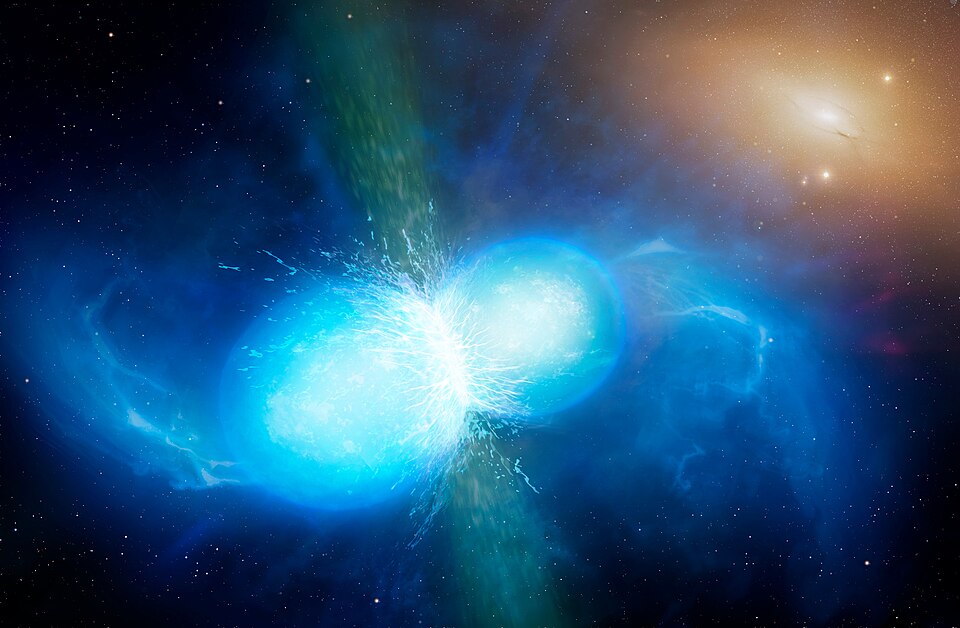
Kilonovae are transient astronomical events that occur in the aftermath of mergers between two neutron stars, or between a neutron star and a black hole, producing a thermal glow powered by the radioactive decay of heavy elements freshly synthesised through the rapid neutron capture process (r-process).2, 14 Reaching peak luminosities approximately one thousand times that of a classical nova—hence the name coined by Brian Metzger and collaborators in 2010—these events evolve over timescales of days to weeks, transitioning from blue ultraviolet and optical emission to red and near-infrared emission as the expanding ejecta cool and the opacities of newly formed lanthanide and actinide elements come to dominate.2, 3, 5 Although roughly 10 to 100 times less luminous than a typical supernova, kilonovae are of extraordinary scientific importance because they represent the primary confirmed astrophysical site where the heaviest elements in nature—including gold, platinum, and uranium—are forged.9, 12
The existence of kilonovae was theoretically predicted in 1998 by Li-Xin Li and Bohdan Paczyński, who recognised that the radioactive ejecta from a neutron star merger would power a supernova-like optical transient.1 The landmark detection of the kilonova AT 2017gfo following the gravitational-wave event GW170817 in August 2017 transformed this theoretical prediction into observational reality, inaugurating a new chapter in multi-messenger astronomy and confirming decades of speculation about the cosmic origin of r-process elements.8, 9, 10
Theoretical foundations
The theoretical groundwork for kilonovae was laid in 1998, when Li and Paczyński argued that the merger of two neutron stars or a neutron star and a black hole would eject a small quantity of extremely neutron-rich matter at velocities of 0.1 to 0.3 times the speed of light.1 They recognised that this material, decompressing from nuclear densities, would undergo rapid neutron capture nucleosynthesis and that the resulting unstable heavy nuclei would provide an internal radioactive heating source analogous to the role of nickel-56 in Type Ia supernovae.1 However, the detailed radioactive heating rates and nuclear reaction networks required to predict the transient’s brightness were not available at the time, limiting the precision of their predictions.1, 14
The decisive theoretical advance came in 2010, when Metzger and collaborators performed the first self-consistent calculations coupling a nuclear reaction network to a radiative transfer model of the expanding merger ejecta.2 They demonstrated that the radioactive heating from a broad ensemble of r-process nuclei follows a robust power-law decline proportional to t−1.2, largely independent of the detailed nuclear composition, because the energy release is dominated by the statistical aggregate of thousands of decaying species rather than any single isotope.2, 14 Their models predicted peak luminosities of approximately 1041 erg s−1—about one thousand times brighter than a classical nova—motivating the term “kilonova” that has since become standard in the literature.2 The predicted timescale to peak brightness was roughly one day, with the transient fading below detectability within one to two weeks, making rapid follow-up observations essential.2, 14
The role of lanthanide opacity
A critical development in kilonova theory occurred in 2013, when three independent groups—Kasen, Badnell, and Barnes; Barnes and Kasen; and Tanaka and Hotokezaka—demonstrated that the optical properties of kilonova ejecta are fundamentally shaped by the opacities of lanthanide elements (atomic numbers 57 through 71).3, 4, 5 Lanthanides possess partially filled 4f electron shells that give rise to millions of closely spaced energy levels and correspondingly dense forests of spectral lines, producing opacities 10 to 100 times higher than those of iron-group elements that dominate supernova ejecta.3, 4 These high opacities dramatically alter the kilonova light curve: photons are trapped for longer within the expanding ejecta, delaying the peak emission to several days and shifting it from optical wavelengths into the near-infrared.3, 5
This insight led to the prediction of a two-component kilonova structure that has since become a cornerstone of the field.3, 4, 5, 14 Material ejected along the polar axis of the merger, where neutrino irradiation from the central remnant raises the electron fraction above approximately 0.25, produces ejecta composed primarily of light r-process elements (atomic mass below about 140) with relatively low opacity.12, 14 This “blue” component peaks within a day at ultraviolet and blue optical wavelengths before fading rapidly.11, 12 In contrast, material expelled along the equatorial plane remains highly neutron-rich, synthesising the full range of r-process elements including lanthanides and actinides, and producing a “red” component that peaks at several days to a week in the near-infrared and persists for weeks.3, 5, 12 The relative contributions of these components depend on the mass ratio of the merging objects, the neutron star equation of state, and the nature of the post-merger remnant (whether a prompt black hole, a hypermassive neutron star, or a long-lived magnetar).12, 14
Subsequent opacity calculations have refined the original estimates, with Tanaka and collaborators systematically computing bound-bound opacities for all elements from calcium (Z = 20) to lawrencium (Z = 103), revealing that actinide elements (Z = 89–103) produce opacities comparable to or exceeding those of lanthanides and that even light r-process elements contribute non-negligible line blanketing at early times.21
Early observational hints
Before the definitive detection of AT 2017gfo, tantalising observational evidence for kilonovae emerged from the afterglows of short-duration gamma-ray bursts, which had long been suspected to arise from neutron star mergers.6, 7 The most compelling early candidate was associated with GRB 130603B, a short-hard gamma-ray burst at a redshift of z = 0.356 detected on 3 June 2013.6, 7 Hubble Space Telescope observations obtained approximately nine days after the burst revealed a faint near-infrared source at the burst position with an F160W magnitude of 25.8 ± 0.2 AB mag, while the optical emission had faded below detection limits, yielding an unusually red colour of V − H > 1.9 magnitudes.6
Two independent teams—Tanvir and collaborators, and Berger, Fong, and Chornock—simultaneously reported this excess near-infrared emission and argued that it was consistent with the predicted signatures of a kilonova rather than a conventional gamma-ray burst afterglow.6, 7 The red colour and fading timescale matched expectations for emission from lanthanide-rich r-process ejecta, and the inferred luminosity corresponded to an ejecta mass of approximately 0.02 to 0.05 solar masses of r-process material.6, 7 Although the evidence was circumstantial—no spectrum of the transient was obtained, and the identification rested on broadband photometry alone—GRB 130603B provided the strongest pre-GW170817 support for the kilonova model and for the compact-binary-merger origin of short gamma-ray bursts.6, 7, 14 Subsequent retrospective analyses identified possible kilonova signatures in a handful of other short GRBs, including GRB 050709 and GRB 060614, though each case was less clear-cut than GRB 130603B.14
AT 2017gfo: the first confirmed kilonova
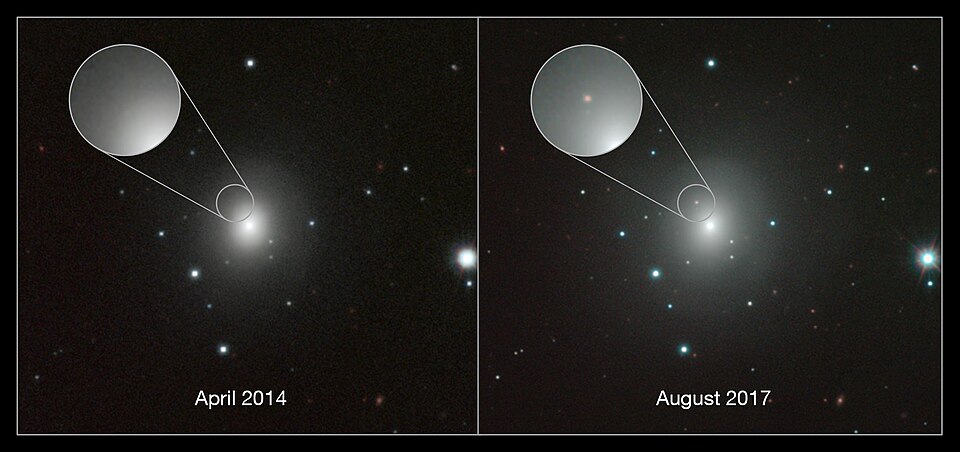
On 17 August 2017, the Advanced LIGO and Virgo gravitational-wave detectors recorded GW170817, the inspiral and coalescence of two neutron stars with a combined mass of approximately 2.74 solar masses, located in the elliptical galaxy NGC 4993 at a distance of roughly 40 megaparsecs.8

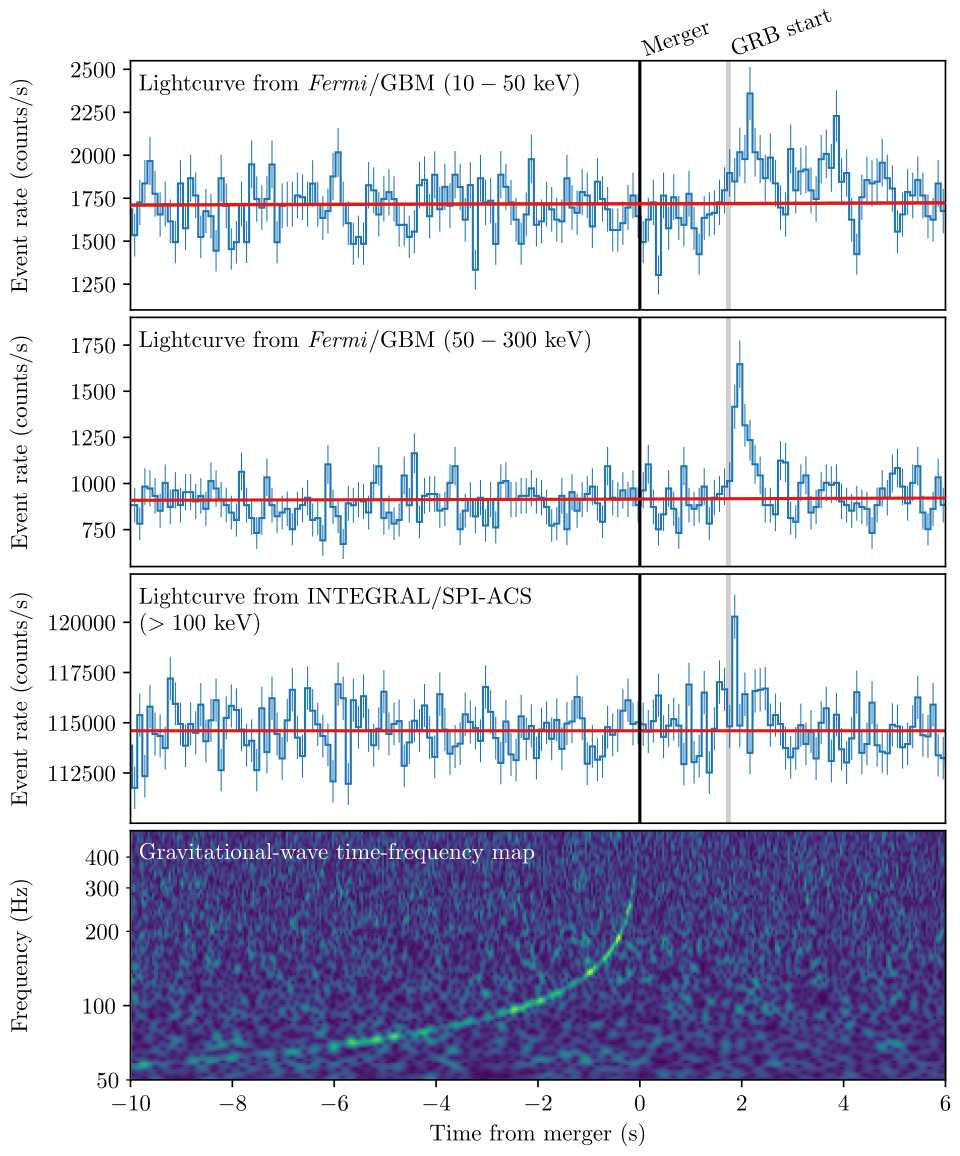
Approximately 1.7 seconds after the merger signal, the Fermi Gamma-ray Burst Monitor and INTEGRAL Anti-Coincidence Shield independently detected a short gamma-ray burst, GRB 170817A.16 Within 11 hours, multiple ground-based survey teams identified a new optical source—designated SSS17a, DLT17ck, or AT 2017gfo—at a projected offset of approximately 10 arcseconds from the centre of NGC 4993, inaugurating the most intensely observed astronomical transient in history.9, 10
The multi-wavelength light curve of AT 2017gfo provided a textbook demonstration of the two-component kilonova structure predicted by theory.10, 11, 12 In the first two days, the transient was bright at ultraviolet and blue optical wavelengths, with an initial temperature exceeding 10,000 kelvin, consistent with the rapid expansion and cooling of lanthanide-poor polar ejecta moving at approximately 0.2 to 0.3 times the speed of light.11 Over the following week, the ultraviolet and optical emission faded rapidly while the near-infrared brightened, revealing the emergence of the lanthanide-rich red component from the lower-velocity equatorial ejecta.10, 12 Kasen and collaborators showed that the combined blue and red light curves could be reproduced by models with a total ejecta mass of approximately 0.05 solar masses, comprising a high-electron-fraction component of roughly 0.02 solar masses and a lanthanide-rich component of roughly 0.03 solar masses.12
The spectroscopic observations of AT 2017gfo were equally groundbreaking. Early spectra showed broad, featureless emission modified by line blanketing, with absorption features that evolved on timescales of hours as the ejecta expanded and cooled.10, 11 In 2019, Watson and collaborators identified the most prominent spectral feature—a P Cygni profile with an absorption minimum near 800 nanometres in the early spectra—as singly ionised strontium (Sr II), marking the first identification of an individual neutron-capture element in a kilonova.13 Strontium, with atomic number 38, is a light r-process element whose spectral lines are comparatively well characterised, making it the most accessible tracer of r-process nucleosynthesis in kilonova spectra.13 Subsequent analysis by Sneppen and collaborators revealed that the kilonova emission was remarkably spherically symmetric, challenging expectations from merger simulations that predicted significantly aspherical ejecta geometries.18
Timeline of AT 2017gfo electromagnetic detections9, 10
R-process nucleosynthesis in merger ejecta
The physical mechanism underlying kilonova emission is the rapid neutron capture process, in which seed nuclei in the expanding merger ejecta absorb free neutrons faster than the resulting unstable isotopes can undergo beta decay, building up nuclei to progressively higher atomic masses along the neutron-rich side of the nuclear chart.2, 12, 14 When the neutron flux is exhausted—typically within about one second of ejection—the accumulated nuclei decay back toward the valley of nuclear stability through a cascade of beta decays, alpha decays, and fission events, releasing energy that heats the ejecta and powers the kilonova emission over days to weeks.2, 14

Several distinct ejecta components contribute to the total r-process yield of a merger.14 The dynamical ejecta, expelled within the first few milliseconds by tidal forces and shock heating at the moment of contact, carry 10−4 to 10−2 solar masses of material at velocities of 0.1 to 0.3c.12, 14 The tidal component, concentrated in the equatorial plane, remains extremely neutron-rich (electron fraction Ye < 0.1) and synthesises the heaviest r-process elements, including the third-peak elements (osmium, iridium, platinum) and the actinides (thorium, uranium).12 The shock-heated component, ejected more isotropically, has higher electron fractions and produces lighter r-process elements.14
On longer timescales of tens of milliseconds to seconds, additional material is ejected by winds driven from the surface of the accretion disc that forms around the central remnant.14 These disc winds, which can carry 0.01 to 0.1 solar masses of ejecta, span a wide range of electron fractions depending on the strength of neutrino irradiation from the central object.12, 14 If the merger produces a long-lived hypermassive or supramassive neutron star before collapsing to a black hole, the intense neutrino flux raises the electron fraction of the disc wind ejecta, favouring light r-process production and enhancing the blue kilonova component.14 If the remnant collapses promptly to a black hole, neutrino irradiation is weaker and a larger fraction of the ejecta synthesises heavy r-process elements.12
Observations of AT 2017gfo suggest a total r-process ejecta mass of approximately 0.04 to 0.06 solar masses, combining dynamical and disc-wind contributions.9, 12 Given estimated binary neutron star merger rates of approximately 80 to 810 per cubic gigaparsec per year derived from gravitational-wave observations, this ejecta mass is broadly sufficient to account for the total r-process element abundance observed in the Milky Way and in r-process-enhanced metal-poor stars, though the exact contribution relative to other potential sites such as collapsars and magnetar-driven supernovae remains an active area of investigation.9, 14, 20
Kilonovae as standard sirens
The joint detection of gravitational waves and a kilonova from GW170817 enabled a fundamentally new method for measuring the expansion rate of the universe.17 Gravitational-wave signals from compact binary mergers encode the luminosity distance to the source directly in the waveform amplitude, without reliance on the cosmic distance ladder of calibrated standard candles that underpins traditional Hubble constant measurements.17 When combined with a redshift measurement from the electromagnetic counterpart—in this case, the identification of the host galaxy NGC 4993—the merger becomes a “standard siren” capable of independently constraining the Hubble constant.17

The initial measurement from GW170817 yielded H0 = 70+12−8 km s−1 Mpc−1, consistent with values derived from both the cosmic microwave background and the local distance ladder, though with large uncertainties due to the degeneracy between the source’s distance and the orbital inclination angle in the gravitational-wave signal.17 Hotokezaka and collaborators subsequently broke this degeneracy by combining the gravitational-wave data with very-long-baseline interferometry observations of the superluminal motion of the relativistic jet launched during the merger, tightening the constraint to H0 = 70.3+5.3−5.0 km s−1 Mpc−1, a fractional uncertainty of approximately 7 percent from a single event.15
The kilonova itself contributes to the standard siren programme in several ways.14, 15 Its detection and localisation enable rapid identification of the host galaxy and hence the redshift, which is essential for events where the gravitational-wave sky localisation is too imprecise for a unique galaxy match. Furthermore, modelling of the kilonova light curve can independently constrain the viewing angle, complementing the information from the gravitational-wave signal and the afterglow jet motion.15 As gravitational-wave detectors improve in sensitivity and the number of detected neutron star mergers with kilonova counterparts grows into the tens and eventually hundreds, the standard siren method is expected to achieve percent-level precision on the Hubble constant, potentially resolving the current tension between early-universe and late-universe measurements.15, 17
Ejecta mass estimates
Estimated ejecta properties from AT 2017gfo12, 14
| Component | Mass (M⊙) | Velocity (v/c) | Electron fraction (Ye) | Peak emission |
|---|---|---|---|---|
| Blue (polar, lanthanide-poor) | ~0.01–0.02 | 0.2–0.3 | > 0.25 | UV/optical, ~1 day |
| Red (equatorial, lanthanide-rich) | ~0.03–0.04 | 0.1–0.2 | < 0.25 | Near-IR, ~3–7 days |
| Total dynamical + disc wind | ~0.04–0.06 | 0.1–0.3 | 0.05–0.45 | Composite |
Ongoing searches and future prospects
Despite the transformative impact of AT 2017gfo, it remains the only kilonova observed with detailed spectroscopic and multi-wavelength photometric coverage as of early 2026.14, 19 The LIGO–Virgo–KAGRA fourth observing run (O4), which began in May 2023, has detected additional binary neutron star and neutron star–black hole merger candidates, including the notable GW230529, a system in which the primary compact object falls within the 2.5 to 4.5 solar mass “mass gap” between the expected mass ranges of neutron stars and black holes.22 Although no confirmed kilonova counterpart has been associated with GW230529, theoretical models suggest that if the event was a neutron star–black hole merger, a kilonova peaking near 23rd magnitude could have been produced, potentially detectable by current ground-based facilities under favourable conditions.22
Kilonova searches following short gamma-ray bursts have yielded additional candidates. Troja and collaborators reported the detection of kilonova-like emission following a very short gamma-ray burst observed in 2022, finding photometric behaviour consistent with r-process-powered ejecta and providing further evidence that the short GRB–kilonova connection extends beyond the single case of GW170817/GRB 170817A.19
The next generation of observational facilities promises to dramatically expand the sample of detected kilonovae. Upgraded gravitational-wave detectors operating at A+ sensitivity will extend the detection horizon for binary neutron star mergers from approximately 160 to 330 megaparsecs, increasing the expected detection rate to several dozen events per year.8, 14 Wide-field survey telescopes such as the Vera C. Rubin Observatory, with its 8.4-metre aperture and 9.6-square-degree field of view, will be capable of identifying kilonovae to distances exceeding 200 megaparsecs within hours of a gravitational-wave alert, even without precise sky localisation.14 In the 2030s, third-generation gravitational-wave detectors—the Einstein Telescope in Europe and Cosmic Explorer in the United States—are expected to detect binary neutron star mergers out to redshifts beyond z = 2, yielding thousands of events per year and transforming kilonovae from rare individual discoveries into a population-level probe of heavy-element production across cosmic time.14
Advances in atomic physics are equally critical to the future of kilonova science. Systematic opacity calculations spanning the full range of r-process elements are needed to interpret kilonova spectra and extract the detailed composition of the ejecta, yet the atomic data for many lanthanide and actinide species remain poorly known.21 Ongoing efforts to compute and experimentally measure energy levels, oscillator strengths, and photoionisation cross-sections for these complex multi-electron atoms will be essential for realising the full diagnostic potential of kilonova spectroscopy and for answering the fundamental question of precisely how much of the periodic table is built in the aftermath of colliding neutron stars.13, 21
References
Electromagnetic Counterparts of Compact Object Mergers Powered by the Radioactive Decay of R-process Nuclei
Effect of a High Opacity on the Light Curves of Radioactively Powered Transients from Compact Object Mergers
The Electromagnetic Counterpart of the Binary Neutron Star Merger LIGO/Virgo GW170817. III. Optical and UV Spectra of a Blue Kilonova from Fast Polar Ejecta
Origin of the Heavy Elements in Binary Neutron-Star Mergers from a Gravitational-Wave Event
Gravitational Waves and Gamma-Rays from a Binary Neutron Star Merger: GW170817 and GRB 170817A
The r-Process Alliance: First Release from the Southern Search for r-Process-Enhanced Stars in the Galactic Halo