Overview
- The 1957 B2FH paper by Burbidge, Burbidge, Fowler, and Hoyle—together with Cameron's independent work the same year—identified eight distinct nuclear processes (hydrogen burning, helium burning, the α-process, e-process, s-process, r-process, p-process, and x-process) that together account for the origin of every naturally occurring element heavier than hydrogen.
- Hydrogen burning proceeds through the proton-proton chains in lower-mass stars and the catalytic CNO cycle in more massive ones, while helium burning relies on the triple-alpha process whose efficiency depends critically on the Hoyle resonance at 7.65 MeV in carbon-12—a nuclear energy level whose existence was predicted by Fred Hoyle before its experimental confirmation in 1953.
- Elements heavier than iron are built by neutron capture: the slow s-process in AGB stars produces abundance peaks at magic neutron numbers (N = 50, 82, 126), while the rapid r-process—now confirmed to operate in neutron star mergers by the 2017 detection of GW170817—synthesizes roughly half of all nuclei above iron, including gold, platinum, and uranium.
The chemical richness of the universe—the existence of ninety-two naturally occurring elements rather than just the hydrogen and helium produced in the Big Bang—is the product of nuclear reactions operating inside stars, in their explosive deaths, and in the collisions of their compact remnants. Understanding the specific pathways by which these elements are synthesized has been a central problem in astrophysics since the mid-twentieth century. Each pathway operates under different physical conditions of temperature, density, and neutron flux, and each leaves a characteristic imprint on the pattern of elemental and isotopic abundances observed in stellar spectra, meteorites, and the interstellar medium.1, 19
The framework connecting nuclear physics to cosmic abundances was established in 1957, when two independent analyses—the celebrated B2FH paper and the work of Alastair Cameron—demonstrated that virtually every element heavier than helium could be traced to a specific stellar process. The decades since have refined these ideas with laboratory measurements of nuclear cross sections, observations of elemental abundances in stars of different ages and metallicities, and, most dramatically, the 2017 multimessenger detection of a neutron star merger that confirmed the astrophysical site of the heaviest elements.1, 2, 12
The B2FH paper and the framework of stellar nucleosynthesis
In 1957, E. Margaret Burbidge, Geoffrey Burbidge, William Fowler, and Fred Hoyle published a landmark paper in Reviews of Modern Physics entitled "Synthesis of the Elements in Stars," now universally referred to by the abbreviation B2FH. Running to over 100 pages, it remains one of the most cited papers in the history of astrophysics. The paper integrated observational data on stellar abundances with theoretical nuclear physics and laboratory measurements to propose that eight distinct nucleosynthetic processes are responsible for the origin of every naturally occurring element heavier than hydrogen.1
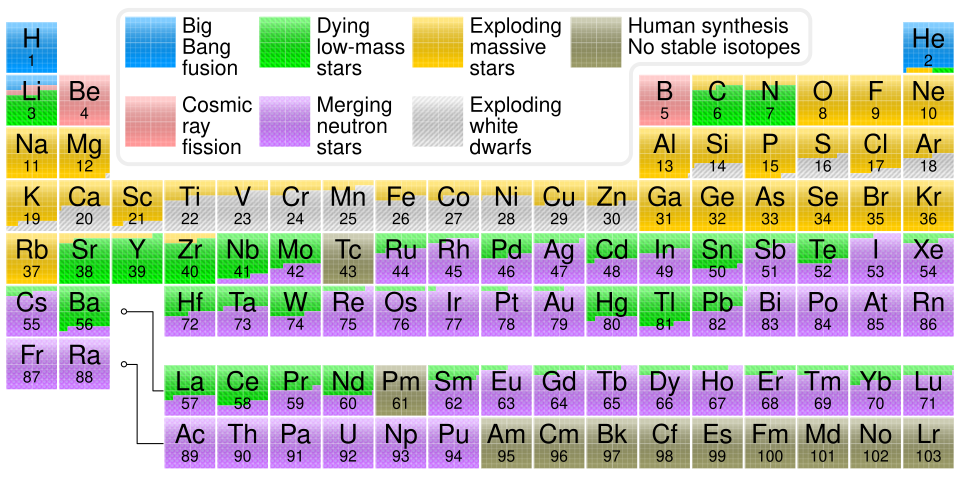
The eight processes identified in B2FH are: hydrogen burning (the conversion of hydrogen to helium via the proton-proton chain and CNO cycle), helium burning (the triple-alpha process producing carbon), the α-process (capture of alpha particles to build elements from neon to titanium), the equilibrium or e-process (formation of iron-peak elements under conditions of nuclear statistical equilibrium), the s-process (slow neutron capture), the r-process (rapid neutron capture), the p-process (production of proton-rich isotopes), and the x-process (production of light elements such as deuterium, lithium, beryllium, and boron, now understood to arise from a combination of Big Bang nucleosynthesis and cosmic-ray spallation).1 While some of these categories have been refined or renamed in subsequent decades, the basic architecture of B2FH has withstood sixty years of scrutiny and remains the organizing framework of the field.
Independently and nearly simultaneously, the Canadian-American astrophysicist Alastair G. W. Cameron published his own comprehensive treatment of nucleosynthesis in stars, covering much of the same ground and arriving at broadly consistent conclusions.2 Cameron's work is particularly notable for its early use of computational methods to model time-dependent nuclear reaction networks, an approach that became central to all subsequent nucleosynthesis calculations. William Fowler was awarded the 1983 Nobel Prize in Physics, shared with Subrahmanyan Chandrasekhar, "for his theoretical and experimental studies of the nuclear reactions of importance in the formation of the chemical elements in the universe."19
Hydrogen burning in detail
The longest and most energetically important phase of a star's life is hydrogen burning—the fusion of hydrogen into helium—which powers the main sequence. Two mechanisms accomplish this conversion, and the dominant pathway depends critically on the core temperature, which is itself set by the star's mass.4

In stars with core temperatures below approximately 17 million kelvins, including the Sun, the proton-proton (pp) chain dominates. The pp chain proceeds through three branches. In pp I, the dominant branch, two protons fuse to form a deuterium nucleus, a positron, and an electron neutrino; the deuterium captures another proton to form helium-3; and two helium-3 nuclei combine to yield helium-4 plus two protons. In the Sun, approximately 83 percent of helium-4 is produced through this branch.4 The pp II branch, responsible for roughly 17 percent of solar helium production, involves the fusion of helium-3 with helium-4 to form beryllium-7, which captures an electron to produce lithium-7, which then captures a proton to form two helium-4 nuclei. The pp III branch accounts for only about 0.02 percent of solar helium production but is of outsized importance because it produces the highest-energy neutrinos in the solar spectrum—the boron-8 neutrinos with energies up to 14.06 MeV—which were the primary signal in early solar neutrino experiments.4
In more massive stars, whose cores exceed roughly 17 million kelvins, the CNO cycle (carbon-nitrogen-oxygen cycle) takes over as the primary energy source. First analyzed in detail by Hans Bethe in 1939, the CNO cycle is a catalytic process in which pre-existing carbon-12 serves as a nuclear catalyst.3 Through a series of four proton captures and two beta decays, the carbon nucleus is progressively converted to nitrogen-13, carbon-13, nitrogen-14, oxygen-15, and nitrogen-15, at which point a proton capture ejects a helium-4 nucleus and regenerates the original carbon-12. The net result is identical to the pp chain—four protons become one helium-4 nucleus—but the CNO cycle is extraordinarily temperature-sensitive, with its reaction rate scaling roughly as the sixteenth to twentieth power of the temperature.4 This steep dependence means that the CNO cycle dominates energy production in stars more massive than about 1.3 solar masses.
The solar neutrino problem, one of the major puzzles of twentieth-century physics, arose directly from hydrogen burning. In 1968, Raymond Davis and collaborators at the Homestake Mine in South Dakota measured the flux of solar neutrinos using a 100,000-gallon tank of perchloroethylene and found only about one-third of the neutrinos predicted by standard solar models.5 This discrepancy persisted for three decades and was resolved in 2002 when the Sudbury Neutrino Observatory (SNO) in Canada, using heavy water sensitive to all three neutrino flavors, demonstrated that the total neutrino flux matches predictions but that a substantial fraction of electron neutrinos produced in the solar core undergo flavor transformation—oscillating into muon and tau neutrinos during their transit to Earth.6 The resolution confirmed both the standard solar model of hydrogen burning and the existence of neutrino mass.
Helium burning and the triple-alpha process
When a star exhausts the hydrogen in its core, the core contracts and heats until helium fusion ignites at temperatures of approximately 100 million kelvins. The mechanism by which three helium-4 nuclei (alpha particles) are converted to carbon-12 is the triple-alpha process, and it involves one of the most remarkable nuclear coincidences in physics.7
The first step is the fusion of two alpha particles to form beryllium-8. However, beryllium-8 is extraordinarily unstable, with a lifetime of only about 8.2 × 10⁻¹⁷ seconds—it decays back into two alpha particles almost instantaneously. For carbon to accumulate, a third alpha particle must collide with this fleeting beryllium-8 nucleus before it disintegrates. Under the conditions prevailing in stellar cores, a small equilibrium concentration of beryllium-8 exists at any given moment, and a third alpha particle occasionally strikes one of these transient nuclei to form an excited state of carbon-12.7
The rate of this three-body reaction is enormously enhanced by a nuclear resonance in carbon-12 at an energy of 7.65 MeV above the ground state, now called the Hoyle state. In 1953, Fred Hoyle predicted that such a resonance must exist, reasoning from the observed cosmic abundance of carbon that the triple-alpha process would be far too slow without it. He visited the Kellogg Radiation Laboratory at Caltech, where William Fowler's experimental group confirmed the resonance within months.7, 19 Without this resonance, the triple-alpha reaction rate would be smaller by a factor of roughly 107, and stars would produce negligible quantities of carbon. The Hoyle state remains one of the most celebrated examples of a successful prediction in nuclear astrophysics, and the 2005 measurements by Fynbo and collaborators provided refined values showing that the reaction rate below approximately 50 million kelvins is even higher than previously estimated.7
Following the production of carbon-12, a fraction of the carbon captures an additional alpha particle to form oxygen-16 via the 12C(α,γ)16O reaction. The rate of this reaction is one of the most critical unknowns in all of nuclear astrophysics, because it determines the ratio of carbon to oxygen in a stellar core at the end of helium burning—a ratio that subsequently governs the entire subsequent evolution of the star, including the composition of the white dwarf or the nucleosynthetic yields of a supernova.8 Despite decades of experimental and theoretical effort, the 12C(α,γ)16O cross section at the relevant stellar energies remains uncertain to roughly 20–30 percent.
Advanced burning stages
In stars more massive than approximately 8 solar masses, the core temperatures and densities achieved after helium exhaustion are sufficient to ignite successively heavier nuclear fuels. Each stage operates at a higher temperature, produces a different set of products, and lasts a dramatically shorter time than the one before it, culminating in the formation of an iron core that can no longer generate energy by fusion.9
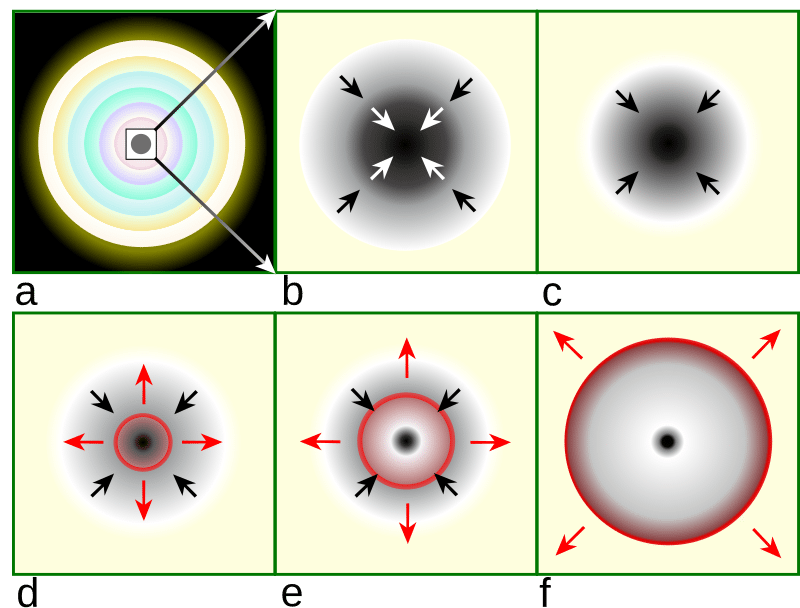

Carbon burning ignites when the core temperature reaches roughly 6 × 10⁸ kelvins. Two carbon-12 nuclei fuse to produce a compound nucleus that decays through several channels, yielding primarily neon-20, sodium-23, and magnesium-24. In a star of 25 solar masses, carbon burning lasts approximately 600 years.9 Neon burning follows at temperatures around 1.5 × 10⁹ kelvins. At these temperatures, thermal photons become energetic enough to photodisintegrate neon-20, liberating alpha particles that are then captured by other neon nuclei to produce magnesium-24 and silicon-28. This process of photodisintegration followed by alpha capture is sometimes called neon photo-erosion, and it lasts roughly one year in a 25-solar-mass star.9
Oxygen burning occurs at temperatures near 2 × 10⁹ kelvins, where two oxygen-16 nuclei fuse to produce silicon-28, sulfur-32, argon-36, and calcium-40 through various decay channels. This stage persists for roughly six months.9 The final hydrostatic burning stage is silicon burning, which begins at core temperatures of approximately 3 × 10⁹ kelvins. At these extreme temperatures, silicon nuclei do not fuse directly. Instead, the intense photon field photodisintegrates silicon and other intermediate-mass nuclei into a sea of protons, neutrons, and alpha particles, which then reassemble under conditions of nuclear statistical equilibrium (NSE) into the most tightly bound nuclei—the iron-peak elements, principally iron-56 and nickel-56.9 Silicon burning lasts approximately one day. The result is an onion-shell structure of concentric layers—hydrogen, helium, carbon, neon, oxygen, silicon, and iron—each representing the ashes of a previous burning stage.
Major nucleosynthetic processes in stars1, 9, 10, 11
| Process | Astrophysical site | Key products | Timescale | Key reaction |
|---|---|---|---|---|
| pp chain | Main-sequence cores (<1.3 M⊙) | He-4 | ~10 Gyr (solar) | p + p → d + e+ + νe |
| CNO cycle | Main-sequence cores (>1.3 M⊙) | He-4, N-14 | ~10 Myr (massive) | 12C(p,γ)13N |
| Triple-α | Red giant / HB cores | C-12, O-16 | ~100 Myr (solar) | 3α → 12C |
| C burning | Massive star cores | Ne, Na, Mg | ~600 yr | 12C + 12C |
| O burning | Massive star cores | Si, S, Ar, Ca | ~6 months | 16O + 16O |
| Si burning | Massive star cores | Fe, Ni (iron peak) | ~1 day | NSE → 56Ni |
| s-process | AGB star interiors | Sr, Ba, Pb | ~103–105 yr | 13C(α,n)16O |
| r-process | NS mergers, CCSNe | Eu, Au, Pt, U | ~1–2 s | Rapid (n,γ) captures |
| p-process / γ-process | CCSN O/Ne shells | 35 p-nuclei | ~seconds | (γ,n), (γ,α), (γ,p) |
The s-process
Elements heavier than iron cannot be produced by charged-particle fusion in stellar cores because the Coulomb barrier becomes prohibitively large. Instead, heavy elements are synthesized by neutron capture, which faces no electrostatic barrier. The s-process (slow neutron capture) operates under conditions where the neutron flux is modest enough that unstable isotopes produced by neutron capture have time to undergo beta decay before capturing another neutron.
The result is a nucleosynthetic pathway that traces the valley of beta stability on the chart of nuclides.10
The primary astrophysical site of the s-process is the interior of asymptotic giant branch (AGB) stars—low- and intermediate-mass stars (roughly 1 to 4 solar masses) in the late stages of their evolution. Two distinct neutron source reactions power the s-process in different environments. In low-mass AGB stars, the dominant neutron source is the 13C(α,n)16O reaction, which operates during the interpulse phase at temperatures of roughly 90 million kelvins. The 13C is produced by the mixing of protons into the helium-rich intershell region, where they are captured by 12C. This neutron source drives the main component of the s-process, responsible for nuclei in the mass range A ≈ 88 to 208.10 In more massive stars (above roughly 8 solar masses), a secondary neutron source—the 22Ne(α,n)25Mg reaction, which activates at higher temperatures during core helium burning and carbon shell burning—drives the weak component of the s-process, producing nuclei in the range A ≈ 56 to 88.10
A distinctive signature of the s-process is the accumulation of nuclei at magic neutron numbers—values of the neutron number N at which the nuclear shell model predicts unusually stable, tightly bound configurations. Nuclei at these magic numbers have anomalously small neutron-capture cross sections, meaning they act as bottlenecks where material piles up. This produces three prominent abundance peaks in the solar system s-process distribution: at N = 50 (strontium-88, yttrium-89, zirconium-90), at N = 82 (barium-138, lanthanum-139, cerium-140), and at N = 126 (lead-208, the heaviest stable s-process product and the termination point of the s-process path).10, 19 The s-process contributes approximately half of the elemental abundances between copper and bismuth in the solar system.
The r-process
The r-process (rapid neutron capture) operates under conditions of extreme neutron density—exceeding 1020 neutrons per cubic centimeter—where seed nuclei capture neutrons so rapidly that many successive captures occur before any beta decay can take place. This drives nuclei far from the valley of stability onto the neutron-rich side of the chart of nuclides, building up isotopes with enormous neutron excesses that are completely inaccessible to the s-process.11
As in the s-process, magic neutron numbers create waiting points where nuclei accumulate, but because the r-process path lies far from stability, these waiting points occur at different mass numbers than the s-process peaks. The r-process abundance peaks are characteristically offset to lower mass numbers by roughly 8 to 12 atomic mass units relative to the corresponding s-process peaks—a shift that arises because the neutron-rich progenitor nuclei must undergo several beta decays to reach stability after the neutron flux ceases.11, 1 The r-process is responsible for approximately half of all nuclei heavier than iron in the solar system, including essentially all of the uranium, thorium, platinum, gold, and europium.
The astrophysical site of the r-process was debated for decades. Core-collapse supernovae were long considered the leading candidate, since they produce the extreme temperatures and densities that could in principle generate the required neutron flux. However, detailed hydrodynamical simulations consistently struggled to achieve the necessary neutron-rich conditions in the neutrino-driven winds above the proto-neutron star.11 The breakthrough came on August 17, 2017, when the LIGO and Virgo gravitational-wave detectors recorded the signal GW170817, produced by the inspiral and merger of two neutron stars at a distance of approximately 40 megaparsecs.12 The electromagnetic counterpart—designated AT 2017gfo and observed across the spectrum from ultraviolet to infrared—displayed spectroscopic signatures consistent with the radioactive decay of freshly synthesized r-process elements, including lanthanides, in roughly 0.03 to 0.05 solar masses of ejected material.13, 14 The infrared "red" component of the emission, powered by the high opacity of lanthanide-rich ejecta, provided particularly compelling evidence. GW170817 demonstrated that neutron star mergers are a major, and possibly the dominant, site of r-process nucleosynthesis in the universe, though the question of whether core-collapse supernovae or other rare events such as collapsars also contribute remains an active area of investigation.11, 14
The p-process and other rare pathways
The s- and r-processes together account for the vast majority of nuclei heavier than iron, but a small population of roughly 35 naturally occurring isotopes on the proton-rich side of the valley of stability cannot be produced by either neutron-capture pathway. These p-nuclei, which include proton-rich isotopes of elements from selenium to mercury, are among the rarest stable isotopes in nature, typically constituting only 0.01 to 1 percent of the total elemental abundance.15
The principal mechanism for producing p-nuclei is the γ-process (gamma-process), which operates through photodisintegration—the destruction of pre-existing s- and r-process nuclei by highly energetic thermal photons. During a core-collapse supernova, the passage of the shock wave through the oxygen and neon burning shells heats the material to temperatures of 2 to 3 billion kelvins for a few seconds. At these temperatures, the photon field is energetic enough to strip neutrons, protons, and alpha particles from heavy nuclei through (γ,n), (γ,p), and (γ,α) reactions, driving the abundance distribution toward more proton-rich isotopes.15 While the γ-process successfully accounts for many p-nuclei, it underproduces certain light p-nuclei, particularly molybdenum-92, molybdenum-94, and ruthenium-96, suggesting that additional processes contribute.15
The rp-process (rapid proton capture) is a distinct nucleosynthetic pathway that operates on the surfaces of accreting neutron stars in X-ray binary systems. When hydrogen-rich material from a companion star accumulates on the neutron star surface, it can ignite in a thermonuclear runaway—an X-ray burst—during which temperatures reach roughly 1 to 2 billion kelvins. Under these conditions, seed nuclei capture protons in rapid succession, building up progressively heavier proton-rich nuclei along the proton drip line. The rp-process proceeds through a series of waiting-point nuclei where the proton capture rate becomes comparable to the beta-decay rate, and it terminates in a closed SnSbTe cycle at mass numbers around A = 104–108.16 Because the products remain gravitationally bound to the neutron star surface, the rp-process does not directly enrich the interstellar medium, but it is of great importance for understanding X-ray burst light curves and the composition of neutron star crusts.
A third rare pathway is the ν-process (neutrino-process), identified by Woosley and collaborators in 1990. During a core-collapse supernova, the proto-neutron star emits roughly 3 × 1053 ergs in neutrinos over about 10 seconds. Although most neutrinos pass through the stellar mantle without interacting, the sheer flux is so enormous that a small but significant number of neutrino-nucleus interactions occur, producing rare isotopes that are difficult to explain by any other mechanism.17 The ν-process is believed to be an important or dominant source of lithium-7, boron-11, and fluorine-19 in the cosmos, as well as certain rare isotopes such as lanthanum-138 and tantalum-180.17
Cosmic chemical evolution
The chemical composition of a star records the history of all the nucleosynthetic events that enriched the gas from which it formed. Astronomers quantify this enrichment through metallicity—the fraction of a star's mass in elements heavier than helium, conventionally denoted Z and often measured relative to the solar value. Because each successive generation of stars processes gas through its nuclear furnaces and returns enriched material to the interstellar medium via stellar winds and supernova explosions, metallicity serves as a rough chemical clock for the age and evolutionary history of a stellar population.18, 22
Stellar populations are classified into three broad groups. Population III stars, which have never been directly observed but are predicted by cosmological models, were the first stars to form from the pristine hydrogen and helium produced in the Big Bang, with zero initial metallicity. Theoretical models suggest these stars were predominantly very massive—tens to hundreds of solar masses—and their supernova explosions provided the first enrichment of heavy elements to the intergalactic medium, producing an elemental pattern that was qualitatively solar in its overall shape but with characteristic deficiencies in odd-Z elements.21 Population II stars are metal-poor objects (typically [Fe/H] < −1) found in the galactic halo and in globular clusters, representing early generations of stars that formed from gas only modestly enriched by their predecessors. Population I stars, including the Sun, are metal-rich objects (near-solar or supersolar metallicity) found predominantly in the thin disk of spiral galaxies, formed from gas that has been processed through many generations of stellar nucleosynthesis.22
The solar composition, as determined by photospheric spectroscopy and meteoritic analysis, provides a remarkably detailed snapshot of the chemical state of the Milky Way's interstellar medium at the time the solar system formed, 4.6 billion years ago. The comprehensive analysis by Asplund and collaborators (2009) established standard reference values for the solar abundances of nearly all elements, showing that hydrogen constitutes about 73.4 percent of the solar mass, helium about 25.0 percent, and all heavier elements together about 1.3 percent.20 This composition reflects the cumulative output of every nucleosynthetic process—Big Bang nucleosynthesis, hydrogen and helium burning, advanced burning stages, the s- and r-processes, and the p-process—integrated over the roughly 8 billion years of galactic chemical evolution that preceded the Sun's formation.
Observations of stars at different metallicities reveal systematic trends that directly trace the contributions of different nucleosynthetic sources over cosmic time. The ratio of alpha elements (oxygen, magnesium, silicon, calcium, titanium) to iron is elevated in metal-poor stars relative to the solar value—a pattern known as the alpha-element enhancement—because core-collapse supernovae, which produce copious alpha elements and relatively little iron, dominate the chemical enrichment of galaxies at early times. As Type Ia supernovae, which are the primary source of iron, begin to contribute with a characteristic delay of hundreds of millions to billions of years, the alpha-to-iron ratio declines toward the solar value.18, 22 Galactic abundance gradients—the systematic variation of metallicity with position in a galaxy—further constrain models of chemical evolution by recording the spatial history of star formation, gas inflow, and outflow across the galactic disk.22
References
Direct evidence for neutrino flavor transformation from neutral-current interactions in SNO
Revised rates for the stellar triple-α process from measurement of 12C nuclear resonances
Spectroscopic identification of r-process nucleosynthesis in a double neutron-star merger
Origin of the heavy elements in binary neutron-star mergers from a gravitational-wave event
Constraining the astrophysical origin of the p-nuclei through nuclear physics and meteoritic data