Overview
- Supernovae are classified spectroscopically into hydrogen-rich Type II events—produced by the gravitational core collapse of massive stars when their iron cores exceed the Chandrasekhar mass—and hydrogen-poor Type I events, of which Type Ia are thermonuclear explosions of white dwarfs that synthesize the majority of iron in the universe through the radioactive decay chain of nickel-56.
- Core-collapse supernovae leave behind neutron stars, supported by neutron degeneracy pressure at densities of 1014–1015 g/cm3, or stellar-mass black holes when the remnant exceeds roughly 2–3 solar masses; neutron stars manifest observationally as radio pulsars, millisecond pulsars, and magnetars with magnetic fields reaching 1015 gauss.
- The expanding debris of supernovae interacts with the interstellar medium over tens of thousands of years, passing through free-expansion, Sedov-Taylor, and radiative phases that heat and enrich the surrounding gas with freshly synthesized heavy elements—a process directly observed in remnants such as Cassiopeia A and the Crab Nebula.
When a massive star exhausts its nuclear fuel, the balance between gravity and thermal pressure that sustained it for millions of years collapses in less than a second. The result is one of the most energetic events in the universe: a supernova. These explosions briefly outshine entire galaxies, eject solar masses of freshly synthesized elements into the interstellar medium, and leave behind the most exotic objects known to physics—neutron stars and black holes. A second class of supernova, produced by the thermonuclear detonation of a white dwarf in a binary system, operates through an entirely different mechanism yet plays an equally fundamental role in the chemical evolution of the cosmos.2, 6
The study of supernovae and their remnants connects nuclear physics, general relativity, plasma dynamics, and observational astronomy into a single discipline. The classification of supernovae by their spectra, the physics of gravitational core collapse and thermonuclear detonation, the nucleosynthetic yields that enrich galaxies with heavy elements, and the nature of the compact remnants they produce are among the most consequential topics in modern astrophysics.4, 10
Supernova classification
The modern classification of supernovae is based primarily on spectroscopic criteria—specifically, the presence or absence of certain elements in the optical spectrum near maximum light. The fundamental division was established in 1941 by Rudolph Minkowski, who recognized two broad classes: Type I supernovae, whose spectra lack hydrogen lines, and Type II supernovae, whose spectra prominently display hydrogen.1 This distinction reflects a basic physical difference: Type II progenitors retain their hydrogen envelopes at the time of explosion, while Type I progenitors have lost theirs through stellar winds, binary mass transfer, or—in the case of Type Ia—the entirely different physics of white dwarf detonation.
As the rate of supernova discoveries increased and spectroscopic data improved through the 1980s and 1990s, the Type I class was subdivided further. Filippenko's 1997 review systematized the modern taxonomy into its current form.2 Type Ia supernovae are defined by the presence of a strong silicon absorption feature (Si II at 6150 angstroms) near maximum brightness and the absence of hydrogen. They are thermonuclear explosions of white dwarfs and are physically unrelated to core-collapse events. Type Ib supernovae lack both hydrogen and the silicon feature but display prominent helium lines, indicating a progenitor that has been stripped of its hydrogen envelope but retains its helium layer. Type Ic supernovae lack hydrogen, silicon, and helium lines, indicating a progenitor stripped down to its carbon-oxygen core.2
Type II supernovae are further divided by light curve morphology. Type II-P (plateau) events exhibit a sustained plateau in their light curve lasting roughly 80 to 120 days, produced by the recombination wave moving inward through the extensive hydrogen envelope as it cools and becomes transparent. Type II-L (linear) events show a steady, roughly linear decline in brightness after maximum, indicating a thinner hydrogen envelope that recombines more quickly.2 Despite this morphological diversity, Types Ib, Ic, II-P, and II-L are all produced by the same fundamental mechanism—the gravitational collapse of an iron core in a massive star—and differ primarily in the extent to which the progenitor has been stripped of its outer layers before the explosion.2, 6
Supernova classification and properties2, 7, 10
| Type | Spectrum | Mechanism | Remnant | Key element yields |
|---|---|---|---|---|
| Ia | No H; strong Si II | WD thermonuclear detonation | None (complete disruption) | Fe, Ni, Si, S, Ca |
| Ib | No H; He I present | Core collapse (stripped H envelope) | Neutron star or black hole | O, Mg, Si, S |
| Ic | No H, no He, no Si II | Core collapse (stripped H + He) | Neutron star or black hole | O, Mg, Si, S |
| II-P | Strong H; plateau light curve | Core collapse (intact H envelope) | Neutron star or black hole | O, Ne, Mg, Si, S, Ca |
| II-L | H present; linear decline | Core collapse (thin H envelope) | Neutron star or black hole | O, Ne, Mg, Si, S, Ca |
Core-collapse mechanism
Stars more massive than approximately 8 solar masses develop an onion-shell structure of successive nuclear burning layers during their post-main-sequence evolution. The outermost shell burns hydrogen; beneath it lie shells burning helium, carbon, neon, oxygen, and silicon, each producing ash that fuels the next stage inward. The final stage—silicon burning—produces an iron-nickel core at the center of the star. Iron-56 and nickel-56 are the most tightly bound nuclei in nature; fusing them into heavier elements absorbs energy rather than releasing it, and so nuclear fusion can proceed no further.6

.jpg)
When the iron core grows to approximately the Chandrasekhar mass (~1.4 solar masses), electron degeneracy pressure can no longer support it against gravity. Two processes then act in concert to trigger catastrophic collapse. First, as the core temperature rises above roughly 1010 kelvins, thermal photons become energetic enough to break iron nuclei apart into alpha particles and free neutrons in a process called photodisintegration. This reaction is endothermic—it absorbs the very thermal energy that was providing pressure support. Second, at these extreme densities, electrons are captured by protons in a process called neutronization (inverse beta decay), converting protons to neutrons and producing a flood of electron neutrinos that escape the core, carrying away additional energy and further reducing electron degeneracy pressure.4, 5
With both thermal and degeneracy pressure catastrophically undermined, the core collapses nearly in free fall. The inner core, roughly 0.5 to 0.8 solar masses, collapses homologously—maintaining its density profile—while the outer core falls supersonically. In less than one second, the inner core reaches nuclear density (roughly 2.7 × 10¹⁴ g/cm3), at which point the strong nuclear force becomes repulsive and abruptly halts the collapse.4 The inner core overshoots its equilibrium configuration slightly, then bounces, launching a powerful shock wave outward into the still-infalling outer core. This is the core bounce.
The bounce shock, however, does not directly explode the star. As it propagates outward through the infalling iron core, it loses energy to the photodisintegration of the iron nuclei it encounters—each 0.1 solar masses of iron dissociated costs roughly 1.7 × 1051 ergs—and the shock stalls within milliseconds at a radius of roughly 100 to 200 kilometers.4, 5 The mechanism by which this stalled shock is revived and ultimately disrupts the star was identified by Bethe and Wilson in 1985: neutrino heating. The newly formed proto-neutron star at the center radiates approximately 3 × 1053 ergs in neutrinos of all flavors over roughly 10 seconds. Although only a small fraction of this neutrino energy—roughly 5 to 10 percent of the neutrino luminosity passing through the region behind the shock—is reabsorbed by the material in the so-called gain region, this is sufficient to re-energize the shock and drive the explosion.3, 4 The total kinetic energy of the resulting supernova is roughly 1051 ergs (one Bethe, or one foe), while approximately 99 percent of the gravitational binding energy released in the collapse escapes as neutrinos that pass through the stellar envelope without significant interaction.4
Type Ia thermonuclear supernovae
Type Ia supernovae arise from a fundamentally different physical mechanism than core-collapse events. Rather than the gravitational implosion of a massive star, they are produced by the thermonuclear detonation of a carbon-oxygen white dwarf in a binary star system. Because the white dwarf is completely disrupted in the explosion, no compact remnant is left behind.7
Two broad progenitor channels have been proposed. In the single-degenerate (SD) channel, a carbon-oxygen white dwarf accretes hydrogen- or helium-rich material from a non-degenerate companion star—typically a red giant or a main-sequence star that fills its Roche lobe. As accreted material accumulates, the white dwarf mass approaches the Chandrasekhar limit of approximately 1.4 solar masses. At this point, carbon fusion ignites in the degenerate core. Because the equation of state of degenerate matter decouples pressure from temperature, the nuclear burning does not produce the self-regulating expansion that occurs in normal stars; instead, a thermonuclear runaway incinerates the entire white dwarf in a few seconds.7, 8
In the double-degenerate (DD) channel, two white dwarfs in a close binary system spiral together through the emission of gravitational waves over millions to billions of years until they merge. If the combined mass exceeds the critical threshold, the merger triggers a thermonuclear explosion. Sub-Chandrasekhar detonation models have also gained support, in which a layer of accreted helium on the surface of a white dwarf detonates and drives a converging shock into the carbon-oxygen core, triggering a secondary detonation even though the total mass remains below the Chandrasekhar limit.7, 8 The relative contributions of the SD and DD channels remain an active area of investigation, with the absence of hydrogen in Type Ia spectra and their occurrence in old stellar populations (where no massive donor stars survive) favoring a significant role for the double-degenerate pathway.8
The physics of the detonation itself has been studied through sophisticated three-dimensional hydrodynamical simulations. The most widely accepted paradigm is the delayed detonation model, in which carbon burning initially propagates as a subsonic deflagration flame, generating turbulence that pre-expands the white dwarf, and then transitions to a supersonic detonation that incinerates the remaining fuel. This two-stage process naturally produces the stratified chemical structure observed in Type Ia ejecta: iron-peak elements in the interior and intermediate-mass elements (silicon, sulfur, calcium) in the outer layers.9
Nucleosynthetic yields
Supernovae are the principal mechanism by which stars return heavy elements to the interstellar medium, and the chemical yields differ dramatically between core-collapse and thermonuclear events. This complementarity means that the two types of supernovae together account for the majority of elements heavier than helium in the universe.10
In a core-collapse supernova, the passage of the shock wave through the star's onion-shell structure ejects the products of millions of years of nuclear burning. The outermost layers contribute hydrogen and helium; the deeper shells contribute oxygen, neon, magnesium, silicon, sulfur, argon, and calcium—the so-called alpha elements produced by successive stages of hydrostatic burning. Core-collapse supernovae are the dominant source of oxygen in the universe, and they also produce significant quantities of carbon, neon, magnesium, and silicon.6, 10 The innermost ejecta, heated to extreme temperatures by the shock, undergo explosive nucleosynthesis that can produce modest amounts of iron-peak elements. However, the total iron yield from a single core-collapse event is relatively modest compared to Type Ia supernovae.11
Type Ia supernovae, by contrast, are the primary source of iron-peak elements in the universe. The complete thermonuclear incineration of a carbon-oxygen white dwarf produces roughly 0.4 to 1.1 solar masses of nickel-56 per event, depending on the details of the explosion model.9 Nickel-56 is radioactive, decaying to cobalt-56 with a half-life of 6.1 days, which in turn decays to stable iron-56 with a half-life of 77.3 days. This radioactive decay chain is the energy source that powers the optical light curve of a Type Ia supernova: the gamma rays and positrons produced by these decays are thermalized in the expanding ejecta, and the resulting thermal emission is what makes the supernova visible for weeks to months after the explosion.7 The luminosity at maximum light is directly proportional to the mass of nickel-56 synthesized, which is why more luminous Type Ia events produce more iron—a relationship that underlies the use of Type Ia supernovae as standardizable candles for measuring cosmic distances.7, 8
The chemical evolution of galaxies reflects this division of labor. Core-collapse supernovae, which occur promptly after star formation because their massive progenitors live only millions of years, dominate the early enrichment of galaxies with alpha elements. Type Ia supernovae, whose progenitor systems require longer evolutionary timescales—typically hundreds of millions to billions of years for the white dwarf to form and accrete sufficient mass or for binary inspiral to complete—contribute their iron-peak elements with a characteristic delay.10 This temporal offset produces the well-observed decline in the alpha-to-iron abundance ratio as galaxies age, a signature that has been used to constrain the star-formation history and Type Ia delay-time distribution of the Milky Way and other galaxies.10
Supernova remnants
After the initial flash of a supernova fades, the ejected material continues to expand into the surrounding interstellar medium (ISM) at velocities of thousands to tens of thousands of kilometers per second. The resulting structure—a supernova remnant (SNR)—can persist as an observable object for tens of thousands of years, radiating across the electromagnetic spectrum from radio wavelengths to X-rays and gamma rays.12

The evolution of a supernova remnant passes through three well-defined dynamical phases. In the free expansion phase, lasting roughly the first few hundred to a thousand years, the ejecta expand ballistically at nearly constant velocity because the mass of swept-up interstellar material is still negligible compared to the ejecta mass. The forward shock driven into the ISM heats the ambient gas to X-ray-emitting temperatures, while a reverse shock propagates back into the ejecta, heating them as well.12 As the remnant sweeps up an amount of ISM comparable to the ejecta mass, it transitions to the Sedov-Taylor phase (also called the adiabatic or blast-wave phase), described by the self-similar solution derived independently by Leonid Sedov and Geoffrey Taylor. During this phase, the remnant radius grows as the two-fifths power of time, and radiative losses remain small compared to the total thermal energy.12 Eventually, as the shock decelerates and the post-shock temperature drops below roughly 106 kelvins, radiative cooling becomes efficient. The remnant enters the radiative (snowplow) phase, in which a thin, dense, cooling shell of swept-up gas forms behind the shock, and the remnant expands under its own momentum until it merges with the general motions of the ISM.12
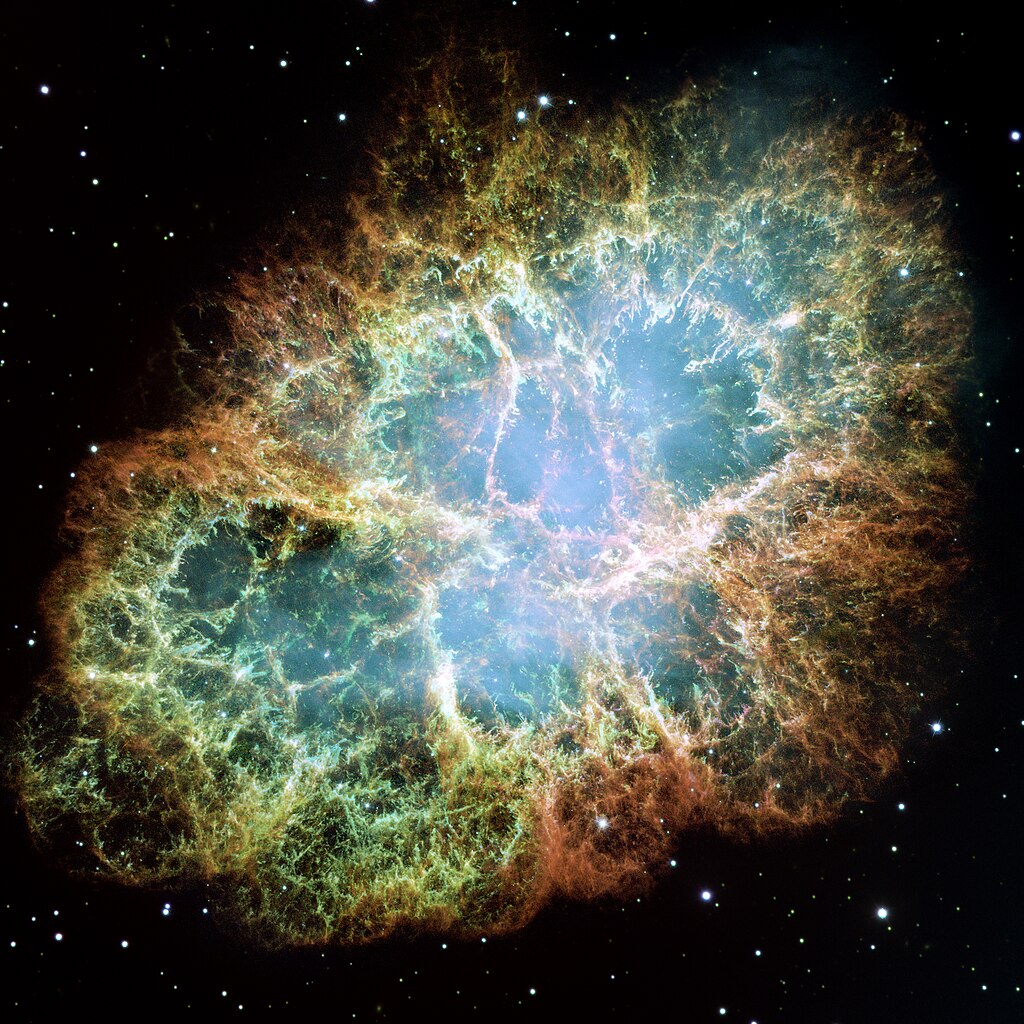
The Crab Nebula (M1), the remnant of the supernova observed by Chinese and Japanese astronomers in 1054 CE (SN 1054), is one of the most intensively studied objects in all of astrophysics. Unlike most supernova remnants, the Crab is powered primarily not by the interaction of ejecta with the ISM but by the Crab pulsar at its center, which injects a relativistic wind of electrons and positrons into the nebula. This pulsar wind nebula radiates synchrotron emission from radio through X-ray wavelengths and contains several solar masses of filamentary ejecta enriched in helium and heavier elements.13 Cassiopeia A, at a distance of approximately 3.4 kiloparsecs, is the youngest known supernova remnant in the Milky Way, with a light-echo analysis dating the explosion to approximately 1681 CE. X-ray observations by the Chandra space telescope have resolved individual knots of silicon, sulfur, argon, calcium, and iron in the expanding ejecta, providing a direct three-dimensional map of the nucleosynthetic output of a core-collapse supernova.12
.jpg)
.jpg)
Neutron stars
When the core of a massive star collapses and the resulting supernova ejects the outer layers, the remnant left behind can be a neutron star—an object with a mass of roughly 1.2 to 2.1 solar masses compressed into a sphere approximately 10 to 12 kilometers in radius. The mean density of a neutron star is 1014 to 1015 g/cm3, comparable to the density of an atomic nucleus. A single teaspoon of neutron star material would weigh roughly a billion metric tons on Earth.14
The internal structure of a neutron star is organized into distinct layers. The outermost is a thin solid crust of neutron-rich nuclei and a relativistic electron gas. Beneath the crust lies the outer core, composed of a superfluid of neutrons permeated by a smaller fraction of superconducting protons, electrons, and muons. In the innermost core, where densities may exceed several times nuclear saturation density, the composition remains uncertain—theoretical models propose exotic phases including hyperons (baryons containing strange quarks), a Bose-Einstein condensate of pions or kaons, or deconfined quark matter.14, 19 The maximum mass a neutron star can support before collapsing into a black hole is determined by the equation of state of this ultra-dense matter, and constraining this upper limit is one of the primary goals of modern neutron-star astrophysics. The most massive precisely measured neutron star to date, PSR J0740+6620, has a mass of 2.08 ± 0.07 solar masses, determined via the relativistic Shapiro delay effect on the arrival times of its radio pulses.20, 19
Neutron stars were first observed in 1967 when Jocelyn Bell (later Bell Burnell) and Antony Hewish detected a rapidly pulsating radio source, designated CP 1919, with a period of 1.337 seconds.15 The extraordinary regularity of the pulses initially defied explanation. Within months, Thomas Gold proposed the correct interpretation: the pulses are produced by a beam of electromagnetic radiation emitted along the magnetic axis of a rapidly rotating, highly magnetized neutron star. Because the magnetic axis is offset from the rotation axis, the beam sweeps across the sky like a lighthouse, producing a pulse each time it crosses the observer's line of sight. This is the lighthouse model of pulsars.16
Over 3,000 pulsars are now known, spanning rotation periods from 1.4 milliseconds to several seconds. The fastest-spinning pulsars, the millisecond pulsars, are thought to have been spun up (or "recycled") by the accretion of angular momentum from a companion star in a close binary system, which transfers mass and angular momentum onto the neutron star surface over millions of years.19 At the opposite extreme of neutron star phenomenology are the magnetars—neutron stars with magnetic fields of 1014 to 1015 gauss, roughly a thousand times stronger than those of ordinary pulsars. Duncan and Thompson (1992) proposed that magnetars form when vigorous convection in the first seconds after the proto-neutron star's birth drives an efficient dynamo that amplifies the magnetic field to these extreme values.18 Magnetars produce sporadic bursts of hard X-rays and soft gamma rays powered by the decay and reconfiguration of their ultra-strong magnetic fields, and a small number have produced giant flares with peak luminosities briefly exceeding 1046 ergs per second.17
Stellar-mass black holes
When the remnant mass left behind by a core-collapse supernova exceeds the maximum mass that neutron degeneracy pressure and repulsive nuclear forces can support—a threshold estimated at roughly 2 to 3 solar masses depending on the equation of state—no known force can halt the collapse, and a stellar-mass black hole forms. The resulting object is defined by its event horizon, the boundary within which the escape velocity exceeds the speed of light and from which no information can escape. For a non-rotating (Schwarzschild) black hole, the radius of the event horizon is the Schwarzschild radius, equal to 2GM/c2, or approximately 3 kilometers per solar mass.14
The first strong observational candidate for a stellar-mass black hole was Cygnus X-1, an X-ray binary system in which a compact object accretes material from the blue supergiant star HDE 226868. In 1972, Charles Thomas Bolton, and independently Louise Webster and Paul Murdin, measured the orbital motion of the companion star and determined that the invisible compact object has a mass far exceeding the maximum possible neutron star mass.22 The accretion of gas from the companion onto the compact object produces an accretion disk heated to millions of kelvins, emitting copious X-rays. Dynamical mass measurements in X-ray binary systems have since established a population of stellar-mass black holes with masses ranging from roughly 5 to 20 solar masses.23
The direct detection of gravitational waves by the Laser Interferometer Gravitational-Wave Observatory (LIGO) opened an entirely new window on stellar-mass black holes. On September 14, 2015, LIGO detected the signal GW150914—gravitational waves from the inspiral and merger of two black holes with masses of approximately 36 and 29 solar masses at a distance of roughly 410 megaparsecs. The merger produced a final black hole of 62 solar masses, with 3 solar masses of energy radiated as gravitational waves in a fraction of a second.21 This detection confirmed a central prediction of general relativity, demonstrated that binary black hole systems exist in nature and merge within the age of the universe, and revealed black holes significantly more massive than those previously identified in X-ray binaries.21
The mass gap
Observations of neutron stars and black holes in binary systems have revealed a puzzling feature of the compact-object mass distribution: an apparent gap between the most massive confirmed neutron stars (approximately 2.0 to 2.1 solar masses) and the least massive confirmed black holes (approximately 5 solar masses). Farr and collaborators (2011), analyzing the dynamical mass measurements of 20 black holes in X-ray binary systems, found strong statistical evidence for this gap, concluding that the data are inconsistent with a continuous mass distribution extending from neutron stars to black holes.23
Several theoretical explanations have been proposed for this mass gap. One leading hypothesis invokes the physics of the supernova explosion itself. In a successful core-collapse supernova, some material initially ejected by the shock may fall back onto the proto-neutron star. If the fallback is modest, the remnant remains a neutron star; if it is substantial, the additional mass pushes the remnant above the maximum neutron star mass, causing prompt collapse to a black hole. Detailed simulations by Sukhbold and collaborators (2016) showed that the relationship between progenitor structure and explosion outcome is not monotonic—stars of certain masses explode successfully as supernovae leaving neutron stars, while nearby masses in the progenitor sequence fail to explode entirely and collapse directly to black holes. This non-monotonic "explodability landscape" can naturally produce a dearth of remnants in the 2 to 5 solar mass range.11
The gravitational-wave event GW190814, detected in August 2019, challenged the clean separation of the mass gap. This event involved the coalescence of a 23-solar-mass black hole with a 2.6-solar-mass compact object—an object either heavier than any known neutron star or lighter than any previously confirmed black hole.24 No electromagnetic counterpart was detected, leaving the nature of the secondary component ambiguous. If it is a neutron star, it would require an unusually stiff equation of state to support such a high mass; if it is a black hole, it would be the lightest ever observed. In either case, GW190814 demonstrates that compact objects can form within the classical mass gap, and its existence places important constraints on the mechanisms of supernova fallback, the maximum mass of neutron stars, and the physics of compact-object formation.24, 19
The mass gap remains one of the most active frontiers in compact-object astrophysics. As gravitational-wave observatories accumulate larger catalogs of merging compact binaries, and as electromagnetic surveys identify new neutron star and black hole masses, the boundaries and nature of this gap—whether it is a true void, a statistical dearth, or an artifact of observational selection—will become clearer, with profound implications for our understanding of the deaths of massive stars and the physics of matter at the highest densities.23, 24
References
Three-Dimensional Delayed-Detonation Models with Nucleosynthesis for Type Ia Supernovae
Core-Collapse Supernovae from 9 to 120 Solar Masses Based on Neutrino-Powered Explosions
Formation of Very Strongly Magnetized Neutron Stars: Implications for Gamma-Ray Bursts
GW190814: Gravitational Waves from the Coalescence of a 23 Solar Mass Black Hole with a 2.6 Solar Mass Compact Object