Overview
- The Sun's position on the main sequence of the Hertzsprung-Russell diagram, combined with standard stellar evolution models, independently yields an age of approximately 4.57 billion years for the solar system, confirming radiometric ages from meteorites.
- White dwarf cooling sequences, globular cluster isochrone fitting, and nucleocosmochronology using thorium and uranium isotope ratios all independently require timescales of billions to tens of billions of years for the Milky Way and its oldest stellar populations.
- The convergence of cosmic microwave background measurements (13.8 billion years for the universe), stellar ages, and Earth's radiometric age into a single self-consistent chronological framework represents one of the strongest lines of evidence in all of science for deep time.
The age of the Earth — 4.54 billion years, established through radiometric dating of meteorites and terrestrial minerals — does not rest on geological evidence alone. A suite of entirely independent astronomical and astrophysical methods, each grounded in different physics, converges on timescales of billions of years for the Sun, the Milky Way, and the observable universe.17, 18 These cosmic chronometers include the modelling of stellar evolution across the Hertzsprung-Russell diagram, the cooling rates of white dwarf remnants, the age determination of globular clusters by isochrone fitting, the decay of long-lived radioactive isotopes produced in supernovae, and the expansion history of the universe as measured from the cosmic microwave background.1, 7, 9, 15 Taken together, these methods establish a nested chronological hierarchy: the universe is approximately 13.8 billion years old, the Milky Way's oldest stars formed within a billion years of the Big Bang, and the Sun and its planetary system condensed from a molecular cloud roughly 4.57 billion years ago. The Earth cannot be older than its parent star, its galaxy, or the universe itself, and the fact that every independent clock agrees on this ordering constitutes one of the most robust findings in modern science.
Stellar evolution and the age of the Sun
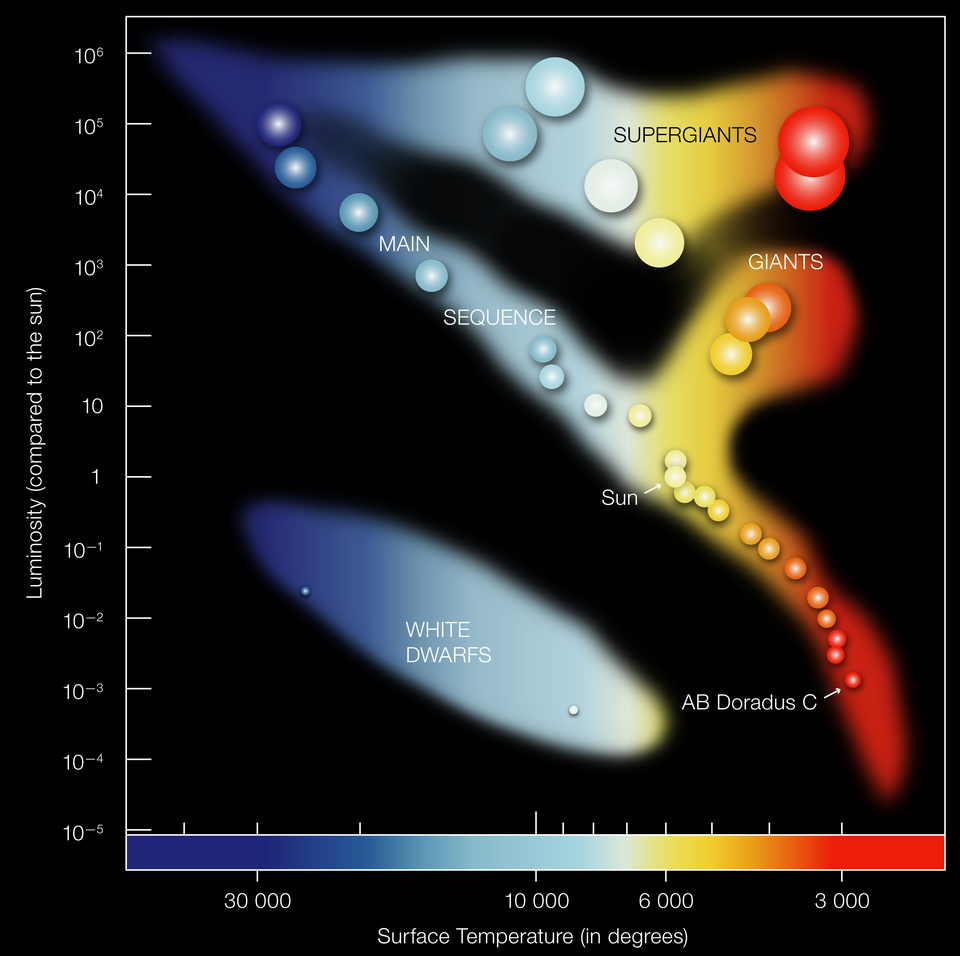

The most direct astronomical constraint on Earth's age comes from the Sun. Stars generate energy by fusing hydrogen into helium in their cores, and the rate at which this process occurs depends on the star's mass, composition, and internal structure. The theory of stellar evolution, developed over the twentieth century and refined through increasingly precise observations and computational models, predicts how a star's luminosity, temperature, and radius change as it converts its hydrogen fuel into helium over time.19 For a star of the Sun's mass and composition, these models predict a specific trajectory across the Hertzsprung-Russell diagram — the fundamental plot of stellar luminosity against surface temperature that classifies stars by their evolutionary state.
The Sun currently resides on the main sequence, the band occupied by stars that are stably burning hydrogen in their cores. Standard solar models, which incorporate the Sun's observed luminosity (3.828 × 1026 watts), surface temperature (approximately 5,772 kelvin), mass (1.989 × 1030 kilograms), and photospheric chemical composition, can be evolved forward and backward in time to determine how long the Sun has been fusing hydrogen. These models consistently yield an age of approximately 4.57 billion years, in striking agreement with the 4.568-billion-year age obtained from lead-lead dating of the oldest calcium-aluminium-rich inclusions in meteorites.1, 2, 4
The solar age derived from stellar models is not merely a theoretical prediction; it is independently confirmed by helioseismology, the study of acoustic oscillations that propagate through the Sun's interior. These oscillations, observed as periodic variations in the Sun's surface brightness and velocity, are sensitive to the internal sound speed profile, which in turn depends on the helium abundance and the extent of nuclear processing in the core. Helioseismological inversions constrain the Sun's core helium mass fraction to approximately 0.64, consistent with 4.57 billion years of hydrogen fusion, and rule out significantly younger or older ages at high confidence.3, 24 The agreement between helioseismology, stellar evolution theory, and meteoritic radiometric dating provides a triple-locked constraint on the age of the solar system.
It is worth emphasising what this means for Earth's age. The Earth formed from the same protoplanetary disk of gas and dust that collapsed to form the Sun, and it therefore cannot be older than the Sun itself. The radiometric age of 4.54 billion years for the Earth, slightly younger than the 4.57-billion-year solar age, is exactly what would be expected if the Earth accumulated from solid planetesimals over a period of tens of millions of years after the Sun ignited.4, 17
White dwarf cooling sequences
.jpg)
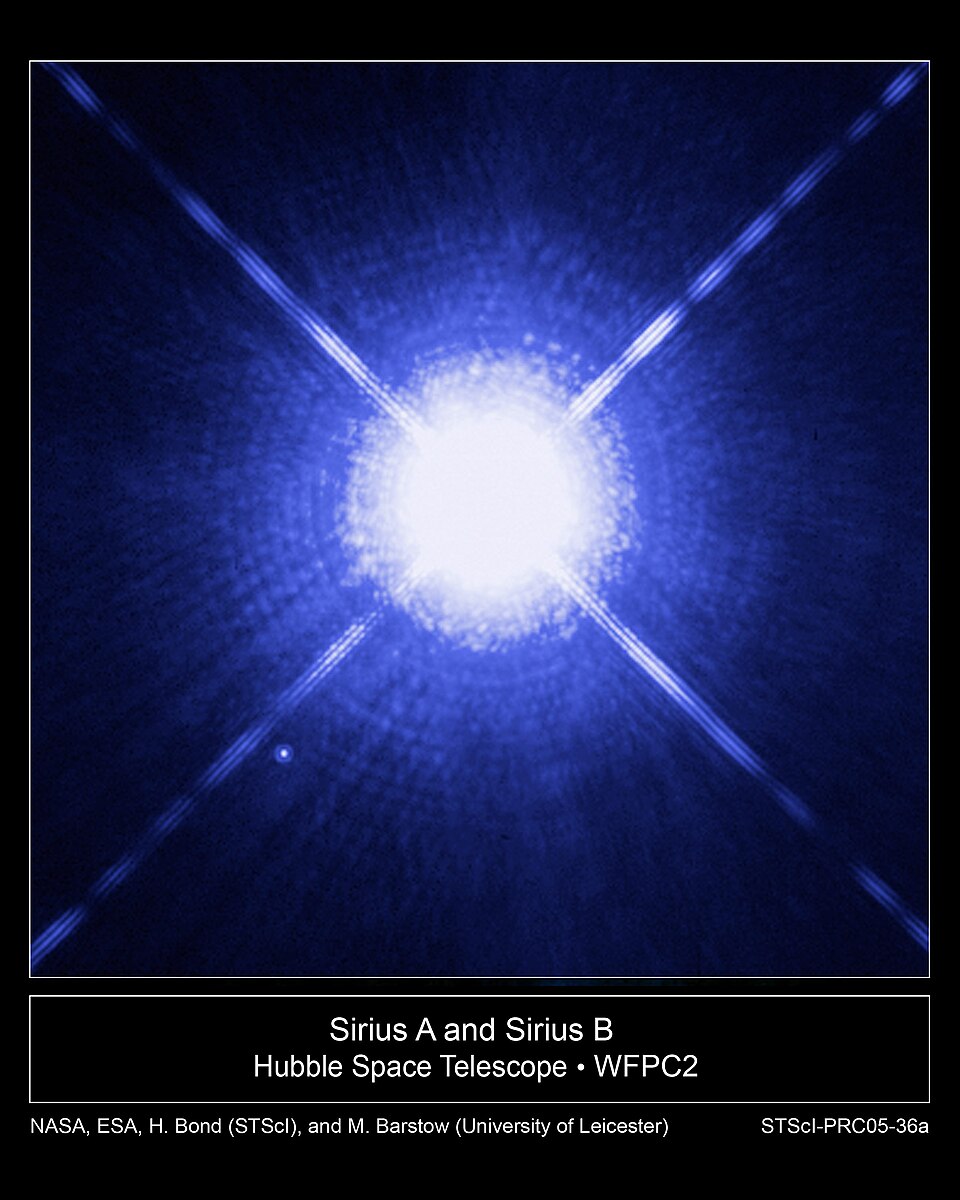
When a star of low to intermediate mass (up to roughly eight solar masses) exhausts its nuclear fuel, it sheds its outer layers and leaves behind a dense, Earth-sized remnant called a white dwarf. White dwarfs no longer generate energy through nuclear fusion; instead, they radiate away their stored thermal energy and gradually cool over billions of years. Because this cooling process is governed by well-understood physics — primarily the heat capacity of the degenerate carbon-oxygen core and the opacity of the thin surface layers that regulate energy loss — the luminosity of a white dwarf is a direct function of its age.7 A hotter, more luminous white dwarf is younger; a cooler, fainter one is older. This relationship transforms white dwarfs into cosmic clocks.
The key observable is the white dwarf luminosity function, the number of white dwarfs per unit luminosity interval in a given stellar population. As a population of stars ages, its white dwarfs accumulate and cool, producing a characteristic pile-up of objects at progressively lower luminosities. The faintest white dwarfs in the population correspond to the oldest, and their luminosity sets a lower bound on the age of the population. In the 1980s, Winget and colleagues used this technique to estimate the age of the Galactic disk at approximately 9.3 billion years, plus or minus approximately 2 billion years, based on the observed cutoff in the white dwarf luminosity function at very low luminosities.6
Subsequent studies with improved observational data and more sophisticated cooling models have refined this estimate. The white dwarf luminosity function of the solar neighbourhood, analysed by Liebert, Dahn, and Monet using a kinematically selected sample, confirmed a sharp drop-off at the faint end consistent with a disk age of 8 to 10 billion years.5 Fontaine, Brassard, and Bergeron provided a comprehensive review of white dwarf cosmochronology, demonstrating that uncertainties in the crystallisation of the carbon-oxygen core, the possible sedimentation of heavier elements, and the treatment of surface convection all affect the inferred ages at the level of 1 to 2 billion years but cannot reduce them below approximately 7 billion years for the Galactic disk.7
The significance of white dwarf cooling ages for Earth's chronology is straightforward. If the Galactic disk is 8 to 10 billion years old, then the Sun — a relatively young disk star — must have formed well after the disk itself, and the Earth must be younger still. An Earth age of 4.54 billion years fits comfortably within this framework. An Earth age of thousands or even millions of years would be physically impossible to reconcile with the existence of white dwarfs whose cooling times alone require billions of years.
Globular cluster ages
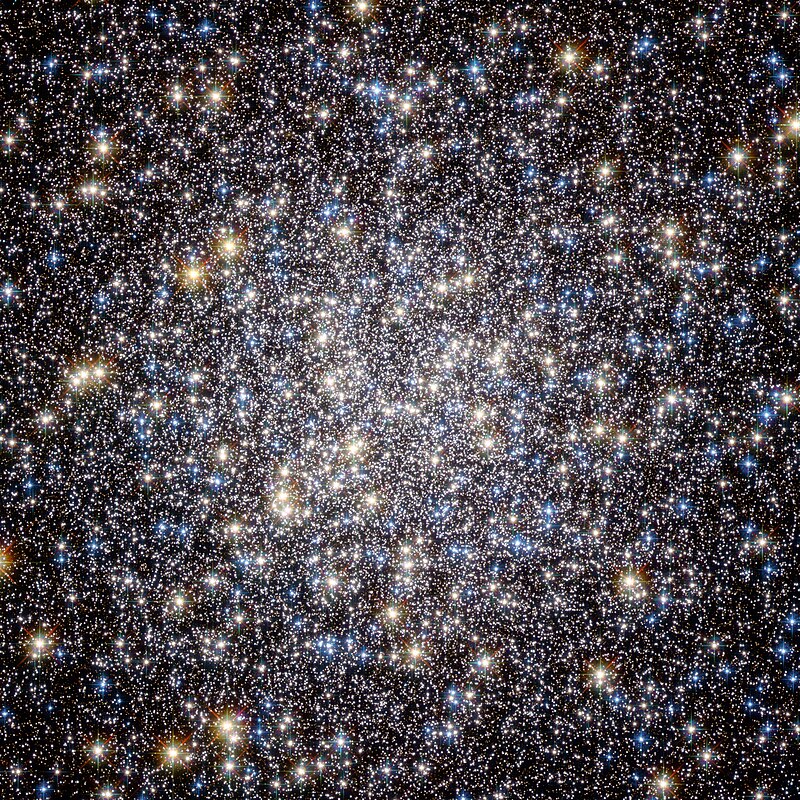

Globular clusters are dense, spherical collections of hundreds of thousands to millions of stars that orbit the Milky Way in its halo. They are among the oldest identifiable structures in the Galaxy, and their ages provide a firm lower bound on the age of the universe. The technique used to date them, called isochrone fitting, is one of the most well-established methods in stellar astrophysics.8
The method works as follows. Stars in a globular cluster all formed at approximately the same time from the same molecular cloud and therefore share the same age and initial chemical composition. On the Hertzsprung-Russell diagram, the cluster's stars define a characteristic pattern: the main sequence (where hydrogen-burning stars reside), a turnoff point (where the most massive remaining main-sequence stars are just beginning to exhaust their hydrogen), and a red giant branch (populated by stars that have already left the main sequence). Because more massive stars burn through their fuel faster, the luminosity and temperature of the main-sequence turnoff point is a direct indicator of the cluster's age — the fainter and cooler the turnoff, the older the cluster.19
Theoretical isochrones — curves in the Hertzsprung-Russell diagram computed from stellar evolution models for a given age and metallicity — are fitted to the observed turnoff to determine the best-matching age. The launch of the Hipparcos astrometry satellite in the 1990s revolutionised this field by providing precise parallax distances to nearby metal-poor subdwarf stars, which serve as calibrators for the globular cluster distance scale. Chaboyer and colleagues used the Hipparcos data to derive ages of 11.5 ± 1.3 billion years for the oldest globular clusters, establishing a robust lower bound on the age of the universe.8
Krauss and Chaboyer subsequently refined the analysis with updated nuclear reaction rates, opacities, and equation-of-state calculations, concluding that the oldest globular clusters are between 11 and 13 billion years old, with a best estimate of approximately 12.5 billion years.9 More recent studies using deep imaging from the Hubble Space Telescope's Advanced Camera for Surveys have extended isochrone fitting to remote halo clusters, confirming ages in the range of 11.5 to 13.0 billion years and revealing that the oldest clusters formed within approximately 1 billion years of the Big Bang.10
The implications are clear. If the oldest star clusters in the Milky Way are 11 to 13 billion years old, then the Galaxy itself must be at least that old, the universe must be older still, and the 4.54-billion-year age of the Earth represents only the most recent third of cosmic history. These ages are derived from nuclear physics and stellar structure theory, entirely independent of the radiometric methods used to date rocks and meteorites, yet they produce a fully consistent chronological picture.
Nucleocosmochronology
Nucleocosmochronology applies the same principle as terrestrial radiometric dating — the predictable decay of radioactive parent isotopes into stable daughter products — but on a galactic scale. Instead of measuring isotope ratios in a single rock, nucleocosmochronology uses the observed abundances of long-lived radioactive isotopes in old stars and in meteorites, combined with models of how those isotopes were produced by nucleosynthesis in supernovae and neutron star mergers, to estimate the age of the elements themselves and thereby the age of the Galaxy.12
The concept was pioneered by Burbidge, Burbidge, Fowler, and Hoyle in their landmark 1957 paper on stellar nucleosynthesis (known as B2FH), which recognised that the relative abundances of thorium-232 (half-life 14.05 billion years), uranium-238 (half-life 4.47 billion years), and uranium-235 (half-life 0.704 billion years) in the solar system contain information about when these isotopes were synthesised.22 Fowler and Hoyle subsequently developed the first quantitative nucleocosmochronological models, concluding that the production of heavy elements in the Galaxy began at least 10 billion years before the formation of the solar system.12
Modern nucleocosmochronology has been greatly advanced by the detection of radioactive isotopes in extremely metal-poor halo stars, which formed early in the Galaxy's history and preserve a near-pristine record of early nucleosynthetic yields. In 2001, Cayrel and colleagues detected uranium in the metal-poor star CS 31082-001 and used the observed thorium-to-uranium ratio, compared with theoretical r-process production ratios, to derive an age of 12.5 ± 3 billion years for that star.21 Dauphas refined the analysis using both meteoritic and stellar data, obtaining a Galactic age of 14.5 (+2.8/−2.2) billion years from the uranium-thorium chronometer, consistent with the age of the universe derived from cosmological observations.13
The uncertainties in nucleocosmochronology are larger than those in other methods — typically 2 to 3 billion years — because they depend on theoretical models of r-process nucleosynthesis yields, which remain an active area of research.11, 14 Nevertheless, the technique provides an independent line of evidence that the heavy elements in the solar system were produced over a period of billions of years before the Sun formed, and that the Galaxy is at least 10 billion years old. This is fully consistent with, and independent of, the stellar evolution ages derived from globular clusters and white dwarf cooling.
The age of the universe from the cosmic microwave background
The most precise measurement of the age of the universe comes not from stars or isotopes but from the cosmic microwave background (CMB), the faint afterglow of radiation emitted approximately 380,000 years after the Big Bang, when the universe cooled sufficiently for hydrogen atoms to form and photons to travel freely through space. The CMB permeates the entire sky at a temperature of 2.7255 kelvin and contains tiny temperature fluctuations (at the level of one part in 100,000) whose angular power spectrum encodes the geometry, composition, and expansion history of the universe.15
The Planck satellite, operated by the European Space Agency from 2009 to 2013, mapped the CMB with unprecedented precision across nine frequency bands. By fitting the observed angular power spectrum to the Lambda-CDM cosmological model — the standard model of cosmology, which includes cold dark matter, dark energy in the form of a cosmological constant, and baryonic matter — the Planck Collaboration derived an age of the universe of 13.797 ± 0.023 billion years.15 This represents a measurement with a precision of better than 0.2 percent, making it one of the most precisely known quantities in all of cosmology. The earlier WMAP satellite had obtained a consistent but less precise value of 13.77 ± 0.06 billion years.16
An independent route to the age of the universe comes from the Hubble time, defined as the reciprocal of the Hubble constant H0, which measures the current expansion rate of the universe. If the universe had expanded at a constant rate (which it has not), the Hubble time would equal the age of the universe. In practice, the expansion was decelerated by gravity during the matter-dominated era and accelerated by dark energy during the recent epoch, so the actual age differs from the simple Hubble time. Using the Planck value of H0 = 67.4 ± 0.5 km/s/Mpc yields a Hubble time of approximately 14.5 billion years; correcting for the effects of deceleration and acceleration gives the 13.8-billion-year age quoted above.15, 20 Direct measurements of H0 from the cosmic distance ladder (using Cepheid variables and Type Ia supernovae) yield a somewhat higher value of approximately 73 km/s/Mpc, which would imply a slightly younger age, though the discrepancy — known as the Hubble tension — remains unresolved and does not alter the fundamental conclusion that the universe is approximately 13 to 14 billion years old.20
The CMB age of 13.8 billion years provides the outermost bracket for all other cosmic ages. Globular clusters at 11 to 13 billion years old fit within it. The Galactic disk at 8 to 10 billion years fits within that. And the Sun and Earth at 4.5 to 4.6 billion years occupy only the most recent third of cosmic history. This nested hierarchy is exactly what would be expected if the universe began in a hot, dense state and evolved through successive stages of structure formation — and it would be impossible to explain if the Earth were young.
How cosmic ages bracket Earth's age
The various cosmic chronometers described in the preceding sections form a logically airtight hierarchy. The universe must be older than its oldest galaxies. The Milky Way must be older than its oldest star clusters. The Sun must be older than the planets that formed from its circumstellar disk. And the Earth's solid surface must be younger than the Earth itself, because the planet required tens of millions of years to accrete and differentiate. Each of these relationships is confirmed by independent physical measurements, and no single chronometer can be adjusted without violating the others.9, 15, 17
The internal consistency of this hierarchy is remarkable. The CMB gives 13.80 billion years for the universe. Globular cluster isochrone fitting gives 11 to 13 billion years for the oldest Milky Way stars, placing their formation within the first one to three billion years of cosmic history — consistent with observations of young galaxies at high redshift. White dwarf cooling gives 8 to 10 billion years for the Galactic disk, meaning the disk formed several billion years after the halo globular clusters, exactly as predicted by models of galaxy formation. Nucleocosmochronology, despite its larger uncertainties, gives 10 to 15 billion years for the onset of heavy-element production in the Galaxy, bracketing the globular cluster and white dwarf ages. And stellar evolution models give 4.57 billion years for the Sun, confirmed to three significant figures by helioseismology and by the 4.568-billion-year lead-lead age of the oldest meteoritic solids.1, 4, 7, 10, 13
The Earth's radiometric age of 4.54 billion years sits at the base of this hierarchy as the youngest major entry, exactly where it should be.17, 18 No cosmic chronometer allows the Earth to be older than the Sun, or the Sun to be older than the Galaxy, or the Galaxy to be older than the universe. The arrows of time all point in one direction, and they all require billions of years.
Cosmic chronometers and their age determinations1, 7, 9, 13, 15, 17
| Method | Object dated | Age (billion years) | Key physics |
|---|---|---|---|
| CMB power spectrum (Planck) | Observable universe | 13.80 ± 0.02 | Expansion history, Lambda-CDM model |
| Nucleocosmochronology (Th/U) | Milky Way heavy elements | 10–15 | Radioactive decay of r-process isotopes |
| Globular cluster isochrones | Oldest Milky Way star clusters | 11–13 | Main-sequence turnoff luminosity |
| White dwarf luminosity function | Galactic disk | 8–10 | Thermal cooling of degenerate remnants |
| Standard solar model + helioseismology | The Sun | 4.57 | Hydrogen fusion rate, acoustic oscillations |
| Pb-Pb radiometric dating | Oldest meteoritic inclusions | 4.568 | Uranium-lead radioactive decay |
| Pb-Pb radiometric dating | Earth (bulk silicate) | 4.54 | Uranium-lead radioactive decay |
The convergence of independent methods
The strength of the case for deep time does not rest on any single measurement or any single method. It rests on the convergence of independent lines of evidence that employ fundamentally different physics, were developed by different scientific communities over the course of more than a century, and yet arrive at the same answer. Stellar evolution models use nuclear fusion cross-sections measured in particle accelerators. White dwarf cooling models use quantum-mechanical calculations of electron degeneracy pressure and crystallisation thermodynamics. Globular cluster ages use photometric observations calibrated by geometric parallax measurements. Nucleocosmochronology uses nuclear physics and astrophysical models of explosive nucleosynthesis. The CMB age uses general relativity and the measured temperature fluctuations of relic radiation from the early universe. Radiometric dating of meteorites uses the measured decay constants of uranium and lead isotopes in laboratory mass spectrometers.1, 7, 9, 12, 15, 17
These methods share no common assumptions, no common instrumentation, and no common theoretical framework beyond the basic laws of physics. If any one of them were fundamentally flawed, the others would not agree with it. The fact that they all independently require billions of years — and that they arrange themselves into a self-consistent chronological hierarchy in which the universe is oldest, the Galaxy's first stars are nearly as old, the Galactic disk is somewhat younger, and the Sun and Earth are younger still — constitutes one of the most overdetermined results in all of natural science.9, 23
Krauss and Chaboyer, in a paper specifically addressing the consistency of cosmological and stellar ages, demonstrated that the age of the universe derived from the CMB exceeds the ages of the oldest globular clusters by approximately 0.8 to 2 billion years, exactly the margin expected for the time required to form the first generation of star clusters after the Big Bang.23 This concordance, achieved with no free parameters adjusted to force agreement, is a powerful confirmation that the underlying physics is correct and that the timescales are real.
The convergence also means that overturning the billions-of-years timescale would require simultaneously invalidating nuclear physics (which underpins both radiometric dating and stellar energy generation), quantum mechanics (which underpins white dwarf cooling and electron degeneracy), general relativity (which underpins the CMB age), and observational astronomy (which underpins globular cluster and white dwarf observations). No alternative chronology has ever been proposed that can simultaneously satisfy all of these independent constraints. The deep-time framework is not a single thread that might be broken; it is a web of interlocking evidence in which every strand reinforces every other.
Significance for Earth science
Cosmic chronometers might seem remote from the concerns of geology, but they are directly relevant to understanding Earth's place in the universe. The solar age derived from stellar models provides the upper bound on the age of all objects in the solar system, including the Earth. The Galactic disk age from white dwarf cooling provides the context for when and where the Sun formed. The globular cluster ages demonstrate that the heavy elements from which the Earth is built — iron, silicon, magnesium, oxygen, and the radioactive isotopes used in radiometric dating — were synthesised in earlier generations of stars billions of years before the solar system existed.22 And the CMB age of the universe establishes the total duration of cosmic evolution within which all of this occurred.
The radioactive isotopes that geologists use as clocks to date terrestrial and meteoritic rocks — uranium-238, uranium-235, thorium-232, potassium-40, rubidium-87 — were themselves forged in the interiors of massive stars and in the violent mergers of neutron stars, then dispersed into the interstellar medium by supernovae and other explosive events over billions of years of Galactic chemical evolution.14, 22 The very existence of these isotopes in the rocks beneath our feet is itself evidence of a long cosmic history. Uranium-235, with its 704-million-year half-life, is far less abundant today than uranium-238 (half-life 4.47 billion years) precisely because more of it has decayed over the 4.57 billion years since the solar system formed. The observed U-235/U-238 ratio in terrestrial and meteoritic samples is approximately 0.00725, a value that is quantitatively predicted by models that assume a solar system age of 4.57 billion years and a history of Galactic nucleosynthesis stretching back 10 or more billion years before that.13, 14
In this sense, every uranium-bearing zircon crystal dated by a geologist carries within it not only a record of when that crystal formed on Earth, but also an indirect record of the billions of years of stellar nucleosynthesis that produced the uranium in the first place. The cosmic and terrestrial chronometers are not separate lines of evidence that happen to agree; they are different chapters of the same continuous physical narrative, written in the language of nuclear physics and readable at every scale from the interior of a mineral grain to the edge of the observable universe.
References
Solar models: current epoch and time dependences, neutrinos, and helioseismological properties
The age of the Solar System redefined by the oldest Pb–Pb age of a meteoritic inclusion
U-Th production ratio and the age of the Milky Way from meteorites and Galactic halo stars
Nine-year Wilkinson Microwave Anisotropy Probe (WMAP) observations: cosmological parameter results
A determination of the Hubble constant from Cepheid and Type Ia supernova observations