Overview
- Nearly all major animal phyla—including Arthropoda, Chordata, Mollusca, Echinodermata, Brachiopoda, and Annelida—make their first unambiguous appearance in the fossil record within an approximately 25-million-year window during the Cambrian period, representing the most concentrated burst of body plan innovation in the history of life.
- Many iconic Cambrian organisms once considered phylogenetic enigmas, such as Hallucigenia, Opabinia, and Wiwaxia, have been resolved through modern cladistic analysis as stem-group members of living phyla, revealing that the Cambrian explosion produced not isolated experimental lineages but the deep roots of the modern animal tree.
- The simultaneous appearance of biomineralized skeletons across dozens of independent lineages, combined with the rise of predation and the colonization of infaunal habitats, drove a predator-prey arms race and a substrate revolution that permanently restructured marine ecosystems.
The Cambrian period, spanning approximately 538.8 to 485.4 million years ago, witnessed the most dramatic diversification of animal life in Earth's history. Within a window of roughly 25 million years beginning near the base of the Cambrian, virtually all of the major animal body plans recognized today—the organizational blueprints classified as phyla—made their first unambiguous appearance in the fossil record.1, 22 Arthropods, chordates, molluscs, echinoderms, brachiopods, annelids, cnidarians, and sponges all have Cambrian or immediately pre-Cambrian representatives, and no entirely new phylum-level body plan has originated in the more than 480 million years since. Understanding which phyla appeared, what their earliest members looked like, and how they relate to modern groups is central to understanding the Cambrian explosion itself and, more broadly, the tempo and mode of animal evolution.1, 2
Many of the earliest Cambrian animals were initially so strange that they defied classification into any known phylum. Organisms such as Hallucigenia, Opabinia, and Wiwaxia, recovered from exceptional preservation sites like the Burgess Shale and the Chengjiang biota, were once treated as representatives of extinct higher-level body plans with no living descendants. Over the past three decades, however, the application of rigorous cladistic methods and the discovery of new, better-preserved specimens have resolved nearly all of these so-called problematic taxa as stem-group members of extant phyla—organisms that branched off before the full suite of modern characters was assembled but that nonetheless belong to the same deep evolutionary lineages as living animals.2, 3
Arthropoda
Arthropoda is the most species-rich and ecologically dominant animal phylum on Earth today, encompassing insects, crustaceans, arachnids, and myriapods. It was equally dominant in the Cambrian, where arthropods constituted the majority of described species in every major Lagerstätte. The phylum's defining characters—a segmented body, jointed appendages, and a hardened external exoskeleton (cuticle)—were already present in early Cambrian representatives, though in combinations and configurations not seen in any living group.1

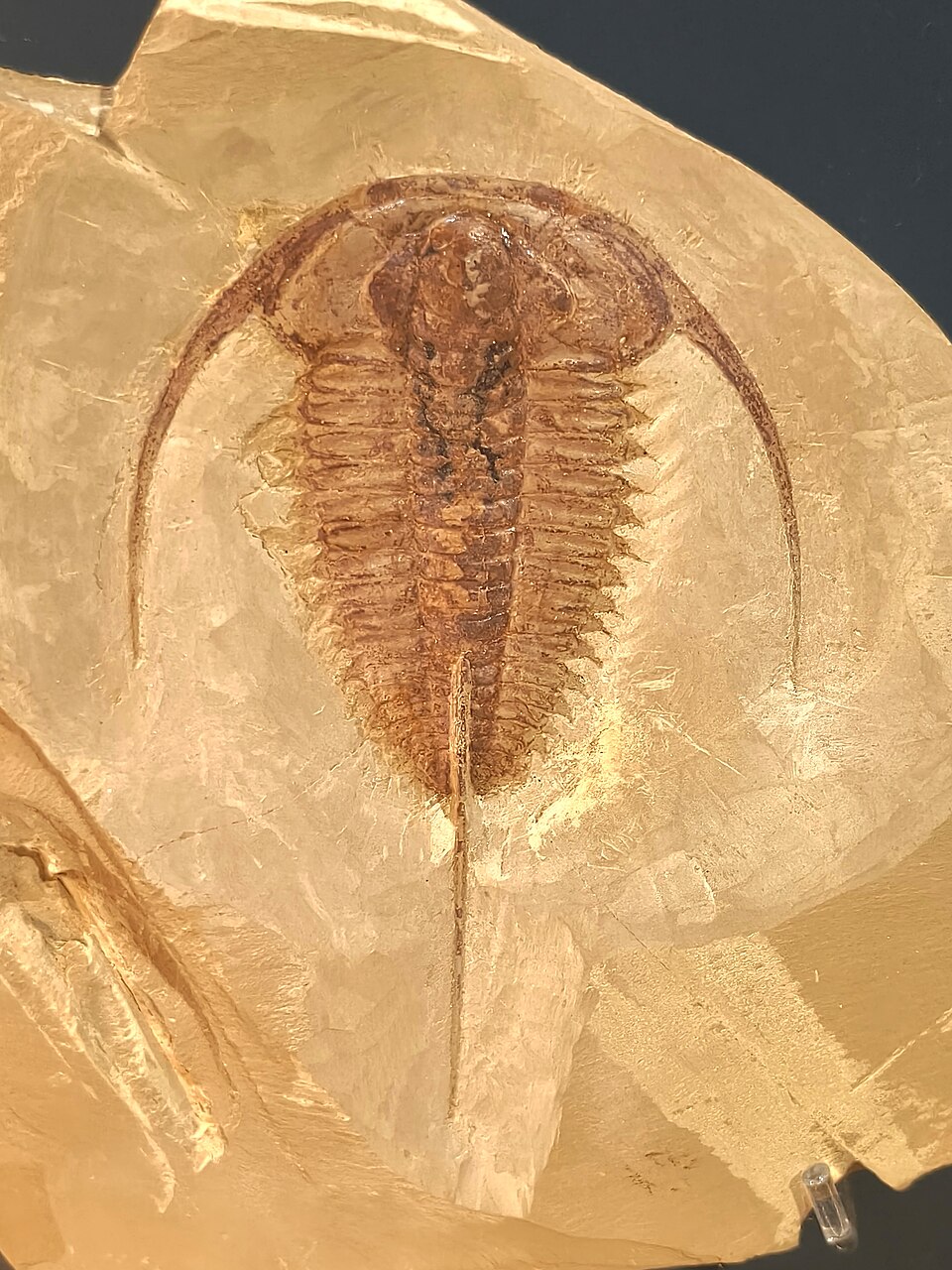
Trilobites are the most familiar Cambrian arthropods. Their calcite-mineralized exoskeletons preserved with exceptional fidelity, making them the most common macrofossils in Cambrian rocks worldwide. Trilobites possessed segmented bodies divided into a cephalon (head shield), thorax, and pygidium (tail), with biramous appendages beneath each segment used for locomotion, gill ventilation, and in some lineages, filter feeding. Most strikingly, trilobites bore compound eyes constructed from crystalline calcite lenses—the earliest well-documented complex visual organs in the fossil record—that enabled visually guided behaviour in a world where many other organisms remained eyeless.1, 22
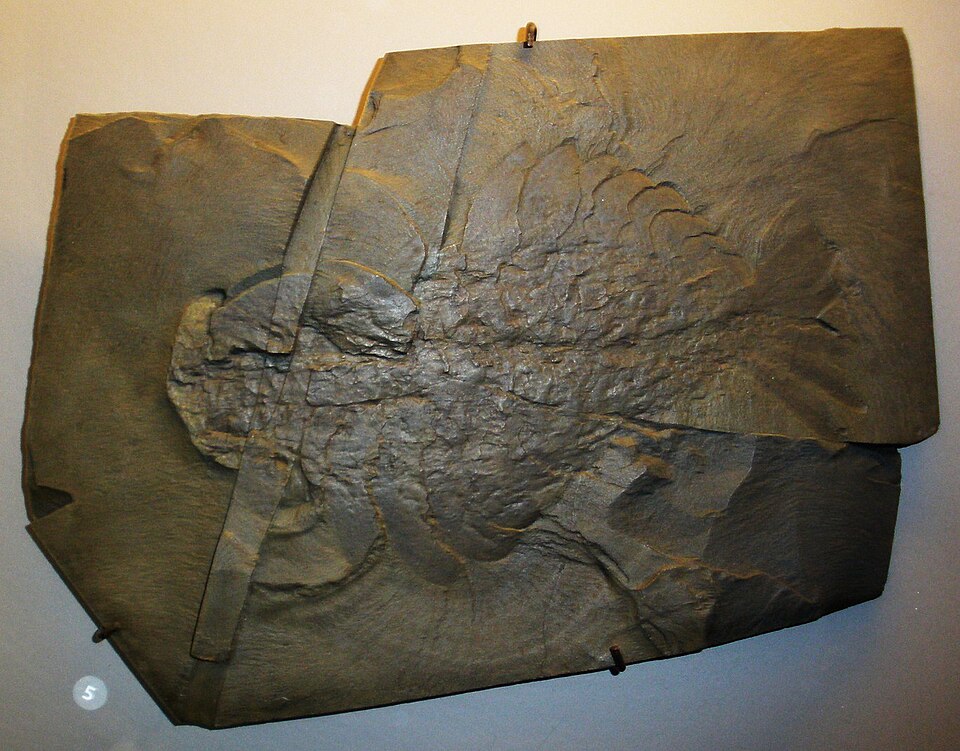
Anomalocaris and its relatives, grouped in the clade Radiodonta, were the apex predators of the Cambrian seas. These stem-group arthropods lacked the fully jointed exoskeleton of crown-group forms but possessed paired frontal appendages armed with spines for grasping prey, a circular oral cone with interlocking plates, and laterally flexible body flaps used for swimming. Some species reached body lengths exceeding half a metre, making them the largest animals of their time.21 Not all radiodonts were predators, however. Vinther and colleagues described a suspension-feeding anomalocarid with elongated, setae-bearing frontal appendages adapted for straining small organisms from the water column, demonstrating that ecological diversification within this successful body plan had already occurred by the Early Cambrian.21
Fuxianhuia protensa, from the ~520-million-year-old Chengjiang biota of Yunnan Province, China, is a stem-group arthropod of particular significance for the study of nervous system evolution. Remarkably preserved specimens analysed by Ma, Strausfeld, and colleagues revealed a tripartite brain and nested optic neuropils comparable in organization to those of modern insects and malacostracan crustaceans, demonstrating that complex neural architecture was present in some of the earliest derived arthropods and did not require hundreds of millions of additional years to evolve.20
Chordata
The phylum Chordata—to which all vertebrates, including humans, belong—is defined by four synapomorphies present at some point in the life cycle: a notochord, a dorsal hollow nerve cord, pharyngeal slits, and a post-anal tail. Remarkably, all four of these characters have been identified in Cambrian fossils, placing the origin of the chordate body plan firmly within the explosion interval.1, 4
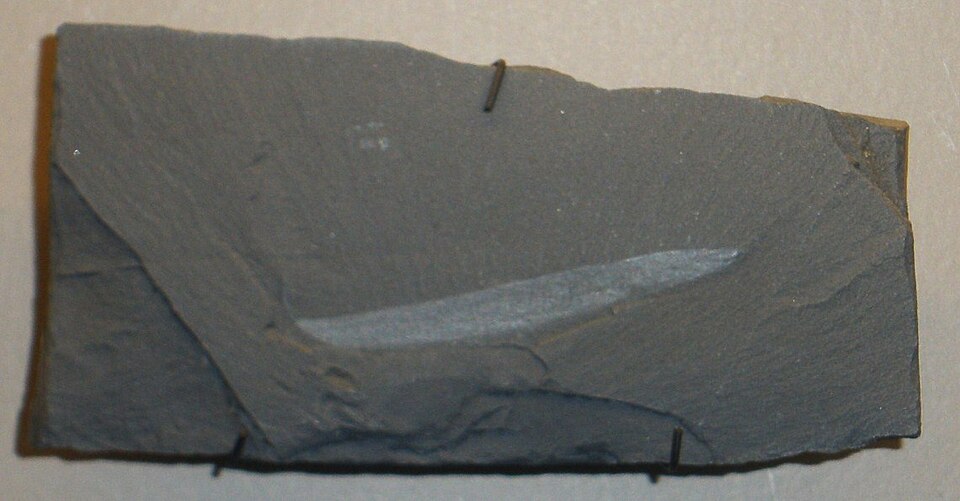

Pikaia gracilens, described from the Burgess Shale by Conway Morris and Whittington in 1979, was for decades considered the oldest known chordate. This ribbon-like animal, typically 4 to 5 centimetres in length, possessed a notochord running the length of its body, segmented muscle blocks (myomeres) arranged in a V-shaped pattern, and a flattened tail fin. It swam above the seafloor in a manner reminiscent of a modern lancelet (amphioxus).6 Although Pikaia has since been displaced as the oldest chordate by somewhat older Chinese taxa, it retains importance as evidence that the vertebrate lineage was already a participant in the Burgess Shale ecosystem approximately 508 million years ago.6
The Chengjiang biota, approximately 15 million years older than the Burgess Shale, has yielded the earliest convincing vertebrates. Haikouichthys ercaicunensis, formally described by Shu and colleagues in 2003, was a small jawless fish-like animal approximately 2.5 centimetres long that possessed a notochord, paired eyes, gill pouches, a possible cranium, W-shaped myomeres, and a post-anal tail with a fin fold. Myllokunmingia fengjiaoa, recovered from the same deposits, exhibits a similar suite of vertebrate characters. Phylogenetic analysis places both taxa as basal vertebrates, more derived than lancelets but more primitive than any living jawless fish.4
Metaspriggina walcotti, redescribed by Conway Morris and Caron in 2014 on the basis of approximately 100 new specimens from British Columbia and other North American localities, pushed the understanding of early vertebrate anatomy further. This primitive fish displayed unambiguous vertebrate features including paired camera-type eyes, paired nasal capsules, W-shaped myomeres, and a branchial region with an array of bipartite bars associated with external gills. The bipartite structure of the branchial bars suggests that a paired arrangement is primitive in vertebrates, reinforcing the interpretation that the branchial basket of modern lampreys represents a derived, simplified condition rather than an ancestral one.5
Mollusca and Annelida
Mollusca—the phylum encompassing snails, clams, octopuses, and chitons—has a deep history that may extend into the Ediacaran. Kimberella quadrata, a bilaterally symmetrical organism from Ediacaran deposits of the White Sea region of Russia dated to approximately 555 million years ago, was reinterpreted by Fedonkin and Waggoner in 1997 as a mollusc-like bilaterian with a non-mineralized univalved shell and a muscular foot used for locomotion. Associated scratch marks on the substrate suggest the animal possessed a radula-like feeding apparatus.11 Whether Kimberella represents a true crown-group mollusc or a stem-group lophotrochozoan remains debated, but its molluscan features push the minimum divergence of the molluscan lineage back well before the Cambrian boundary.1, 11
Unambiguous Cambrian molluscs include helcionelloid gastropods and early monoplacophoran-like forms whose mineralized shells are among the small shelly fossils characteristic of the earliest Cambrian. By the middle Cambrian, the molluscan radiation had produced recognizable representatives of several modern classes. The first cephalopods—represented by small, conical, chambered shells—appear in upper Cambrian strata, marking the origin of the lineage that would eventually produce the nautiloids, ammonites, and modern squid and octopuses.16, 23
Wiwaxia corrugata, a sclerite-bearing organism from the Burgess Shale and the Chengjiang biota, illustrates the difficulty of drawing sharp boundaries between modern phyla in the Cambrian. Wiwaxia bore rows of scale-like sclerites and elongate dorsal spines superficially reminiscent of polychaete annelid chaetae, yet its ventral surface included a broad, creeping foot and its mouth contained elements resembling a molluscan radula. Smith's 2014 analysis of juvenile specimens from Chengjiang supported a molluscan affinity, but also noted that whatever its exact phylogenetic position, Wiwaxia diverged before molluscs and annelids had fully acquired their distinctive modern body plans and therefore serves as a proxy for the common ancestor of these two great lophotrochozoan phyla.10
Echinodermata
Modern echinoderms—sea stars, sea urchins, brittle stars, sea cucumbers, and crinoids—are defined by their pentaradial (five-fold) symmetry and an internal skeleton of calcite plates called stereom. The earliest echinoderms, however, were bilaterally symmetrical, and the transition from bilateral to radial symmetry is documented by a remarkable series of Cambrian fossils.12

Helicoplacoids, known primarily from lower Cambrian strata of western North America (Cambrian Series 2, Stage 3), are among the earliest undisputed echinoderms. These spindle-shaped organisms bore a spirally plated test with three ambulacra radiating from a laterally positioned mouth and were capable of expanding and contracting their body by adjusting the overlap of their plates. Their triradial body plan represents an intermediate condition between bilateral and pentaradial symmetry and suggests that the familiar five-fold symmetry of modern echinoderms was not the ancestral state of the phylum but rather a derived condition achieved through later modification.12
Edrioasteroids, which appear shortly after helicoplacoids in the Cambrian record, are the earliest echinoderms to exhibit the full pentaradial symmetry diagnostic of the modern phylum. These disc-shaped organisms bore five ambulacra arranged around a central mouth and attached directly to hard substrates or shell surfaces. Together with helicoplacoids, edrioasteroids demonstrate that the echinoderm body plan underwent rapid architectural experimentation during the Cambrian, producing at least a dozen distinct body plans (classes) of which only five survive today.12 Zamora and Rahman's phylogenetic analysis of Cambrian echinoderms concluded that the earliest members of the phylum were bilaterally symmetrical and that the acquisition of pentaradial symmetry occurred through an intermediate asymmetric stage, with fossils such as Ctenoimbricata documenting this transition.12
Brachiopoda
Brachiopods are lophophore-bearing marine invertebrates enclosed between two shells (valves) that superficially resemble bivalve molluscs but are fundamentally different in anatomy and phylogenetic position. They are among the most abundant shelly fossils in Cambrian rocks and were major components of marine benthic communities throughout the Palaeozoic era.13
The earliest brachiopods appear in Cambrian Stage 2 to Stage 3, with inarticulate (linguliform) brachiopods preceding the articulate forms. Lingulids, which secrete phosphatic (calcium phosphate) shells, are represented by genera such as Lingulella and Lingulosacculus in the lower Cambrian. These animals lived semi-infaunally, anchored in soft substrates by a fleshy pedicle, and filtered food particles from the water column using a ciliated lophophore. Modern lingulids, such as Lingula, are sometimes cited as examples of morphological conservatism, as their basic shell form has changed remarkably little over more than 500 million years, though detailed anatomical and molecular comparisons reveal substantial internal modification.13
Articulate (rhynchonelliform) brachiopods, which secrete calcitic shells and possess a hinge mechanism linking the two valves, appear slightly later in the Cambrian record. By the middle to late Cambrian, both inarticulate and articulate brachiopods had diversified considerably and occupied a wide range of shallow marine habitats. Their Cambrian fossil record is particularly important because brachiopod shells are commonly preserved in life position, providing direct evidence of ancient community structure and substrate ecology.13
Cnidaria and Porifera
Unlike most other animal phyla, the cnidarians (jellyfish, corals, and sea anemones) and poriferans (sponges) have fossil records that extend into the Ediacaran or possibly earlier, and their presence in the Cambrian represents continuity rather than first appearance. Both phyla are diploblastic or lack true tissues entirely and occupy basal positions in the animal phylogeny, consistent with a pre-Cambrian origin.14, 15
The oldest putative cnidarians are polypoid forms from Ediacaran strata, though their assignment to the phylum remains contested. Van Iten and colleagues reviewed the evidence for early cnidarian diversification and concluded that the major cnidarian clades probably diverged well before the Cambrian, possibly during the Ediacaran or even the Cryogenian, with molecular clock analyses suggesting divergence times as deep as one billion years ago.14 By the Cambrian, unambiguous cnidarian fossils include tabulate-like corals, conulariids (probable scyphozoan medusae with a biomineralized periderm), and various polyp forms preserved in Lagerstätten. The ecological role of cnidarians as sessile filter feeders and, in some lineages, as active predators was thus already established during the Cambrian diversification.14
The sponge fossil record has been the subject of critical reappraisal. Antcliffe, Callow, and Brasier conducted a rigorous review of purported Precambrian sponge fossils and concluded that no pre-Cambrian fossil candidate satisfies all criteria necessary for reliable identification as a sponge. They argued that the oldest reliable sponge body fossils are siliceous spicules from the basal Cambrian of Iran, dated to approximately 535 million years ago, and recommended that molecular clock calibrations for the earliest Porifera should be based on this material rather than on ambiguous Ediacaran candidates.15 Despite this conservative assessment of the body fossil record, molecular phylogenies consistently recover sponges as one of the earliest diverging animal lineages, and biomarker evidence (specifically 24-isopropylcholestane, a steroid characteristic of demosponges) has been reported from Cryogenian-aged rocks, suggesting that sponge-grade organisms existed long before their first recognizable body fossils.15
Problematic taxa resolved
The history of Cambrian palaeontology is punctuated by organisms so morphologically unusual that they resisted classification for decades. Three taxa—Hallucigenia, Opabinia, and Wiwaxia—became emblematic of the interpretive challenge posed by Cambrian life. In the 1970s and 1980s, when Harry Whittington and Simon Conway Morris reanalysed the Burgess Shale fauna, these organisms were presented as evidence that the Cambrian produced a far greater range of fundamental body plans than exists today, many with no living descendants. Stephen Jay Gould amplified this interpretation in Wonderful Life (1989), arguing that these alien creatures demonstrated the radical contingency of evolutionary history.3
Hallucigenia sparsa was originally reconstructed upside-down and backwards: what were interpreted as stilt-like legs turned out to be dorsal defensive spines, and the actual legs were the paired, clawed lobopod limbs beneath the body. Smith and Ortega-Hernández demonstrated in 2014 that the claws of Hallucigenia share a stacked microstructure with the jaws and claws of modern velvet worms (Onychophora), resolving Hallucigenia as a stem-group onychophoran.7 The following year, Smith and Caron described the head of Hallucigenia for the first time, revealing a pair of simple eyes, a terminal buccal chamber with a radial array of sclerotized elements, and a pharynx lined with teeth—structures with homologues in tardigrades, arthropods, and cycloneuralian worms, suggesting they were inherited from the common ancestor of all ecdysozoans.8
Opabinia regalis, with its five stalked eyes and a single anterior proboscis tipped with a grasping claw, provoked laughter when Whittington first presented its reconstruction to an audience of palaeontologists in 1972. Budd's 1996 analysis demonstrated that Opabinia possesses lobopod-like limbs beneath lateral swimming lobes and shares derived characters with radiodonts and true arthropods, placing it in the stem lineage of Arthropoda as part of a paraphyletic grade leading to the crown group. This interpretation transformed Opabinia from an evolutionary orphan into a key transitional form documenting the lobopod-to-arthropod transition.9
Wiwaxia, as discussed above, has been resolved as most likely allied to the Mollusca based on radula-like mouthparts and a creeping foot, though its sclerite armour retains annelid-like features. Together, the resolution of these three iconic taxa illustrates a broader pattern: as cladistic methods have improved and new specimens have been discovered, the number of genuinely phylum-level orphans in the Cambrian has declined sharply. Most former "problematica" have been accommodated as stem-group members of living phyla, bridging morphological gaps that once appeared unbridgeable.3, 10
Stem groups and crown groups in Cambrian phylogeny
The distinction between stem groups and crown groups has become the single most important conceptual tool for interpreting Cambrian biodiversity. A crown group is defined as the smallest clade containing all living members of a given lineage and their last common ancestor; a stem group comprises all fossil taxa that are more closely related to a given crown group than to any other but that diverged before the last common ancestor of the living members was reached. Stem-group organisms possess some but not all of the defining characters of the crown group and thus represent earlier, more primitive evolutionary stages of the lineage.2
Budd and Jensen's influential 2000 review applied this framework rigorously to the bilaterian phyla and reached a striking conclusion: although the branching points of many animal clades may indeed have occurred in the Early Cambrian or before, the appearance of the modern body plans—the full crown-group character suites that define phyla as we recognize them today—was in most cases later than traditionally assumed. Very few bilaterian phyla in the strict, crown-group sense have demonstrable representatives in the earliest Cambrian.2 What the Cambrian explosion produced in abundance were stem-group organisms: animals that were recognizably related to modern phyla but that lacked the complete complement of derived characters diagnostic of the living forms.
This insight resolves much of the tension between the fossil record and molecular clock estimates. Molecular clocks date the branching points of lineages—the divergence of stem lineages from one another—which may have occurred in the Ediacaran or earlier. The fossil record preserves the body plans that evolved along those stem lineages, which became recognizable (and preservable) primarily during the Cambrian. The explosion was therefore not the origin of phyla in the genetic sense but the acquisition of phylum-defining morphologies in the phenotypic sense: the moment when lineages that had been diverging genomically for tens of millions of years finally manifested as morphologically distinct, ecologically significant, and palaeontologically visible animals.2, 3, 22
Major Cambrian animal phyla and representative stem- and crown-group taxa1, 2, 3
| Phylum | Cambrian stem-group example | Cambrian crown-group example | First appearance |
|---|---|---|---|
| Arthropoda | Anomalocaris, Opabinia | Trilobites, Fuxianhuia | ~521 Ma (Chengjiang) |
| Chordata | Pikaia | Haikouichthys, Myllokunmingia | ~520 Ma (Chengjiang) |
| Mollusca | Wiwaxia, Kimberella (?) | Helcionelloids, Pelagiella | ~535 Ma (SSF assemblages) |
| Echinodermata | Ctenoimbricata | Edrioasteroids | ~520 Ma (Series 2) |
| Brachiopoda | — | Lingulella, Lingulosacculus | ~521 Ma (Stage 2–3) |
| Cnidaria | Ediacaran polypoids (?) | Conulariids, tabulate-like forms | Ediacaran or earlier |
| Porifera | — | Hexactinellid spicules (Iran) | ~535 Ma (basal Cambrian) |
Ecological innovations
The appearance of so many new body plans during the Cambrian was accompanied by, and in many cases driven by, a suite of ecological innovations that permanently restructured marine ecosystems. Three developments were especially consequential: the independent evolution of biomineralized skeletons across dozens of lineages, the rise of predation as a dominant ecological interaction, and the colonization of infaunal habitats through burrowing.1, 16, 18
Biomineralization—the biological precipitation of minerals such as calcium carbonate, calcium phosphate, and silica into structural hard parts—appeared independently in at least two dozen animal lineages within a few million years near the base of the Cambrian. Knoll showed that the geochemistry of the early Cambrian ocean, with elevated calcium and bicarbonate concentrations, lowered the energetic cost of skeleton formation and facilitated this convergent innovation.16, 23 Murdock's synthesis of genomic and palaeontological evidence concluded that these independent origins were enabled by a shared ancestral "biomineralization toolkit"—a conserved set of genes and proteins inherited from the last common ancestor of all animals and co-opted independently by different lineages to produce mineralized structures as diverse as trilobite exoskeletons, brachiopod shells, echinoderm stereom, and mollusc nacre.17
Predation intensified dramatically in the Cambrian, inaugurating the first predator-prey arms race in the history of complex life. Bengtson and Zhao documented bore holes in Cambrian shells attributable to predatory drilling, providing direct physical evidence of predation on hard-bodied organisms.18 Vermeij's escalation hypothesis, first articulated in 1987, proposed that the intensification of predation through geological time was a primary driver of morphological evolution, with prey lineages evolving ever more elaborate defences (thicker shells, spines, burrowing behaviour) and predator lineages evolving increasingly sophisticated attack strategies (stronger claws, drilling apparatus, venom).24 The Cambrian represents the opening chapter of this escalatory dynamic, with the simultaneous appearance of predatory appendages in radiodonts and defensive mineralization in dozens of prey lineages constituting a tightly coupled arms race.18, 24
The Cambrian substrate revolution refers to the transformation of the seafloor from a mat-dominated, largely two-dimensional habitat into a three-dimensional mixed substrate penetrated by burrowing organisms. Before the Cambrian, microbial mats covered most shallow marine substrates, sealing the sediment from overlying water and creating anoxic, hydrogen-sulphide-rich conditions beneath the surface. The evolution of animals capable of vertical burrowing broke through these mats, oxygenating the upper layers of sediment and opening an entirely new ecological domain—the infaunal zone—for colonization. Bottjer, Hagadorn, and Dornbos documented this transition through the trace fossil record, showing a dramatic increase in the depth and complexity of burrows across the Ediacaran-Cambrian boundary.19 The substrate revolution had cascading consequences: the destruction of microbial mats eliminated a food source for mat-grazing organisms while creating habitats for deposit feeders, destabilized sedimentary surfaces, and enhanced the cycling of nutrients between sediment and water column.19
Tempo and mode of evolution
The Cambrian explosion raises fundamental questions about the tempo and mode of evolutionary change. The near-simultaneous appearance of most animal phyla within roughly 25 million years—less than one percent of the time since the origin of life—has been interpreted as evidence of an exceptional period of evolutionary innovation qualitatively different from the gradual, continuous change Darwin envisioned.1, 22 Yet the explosion, properly understood, was neither instantaneous nor without antecedent. Molecular clock analyses consistently place the divergence of major animal lineages tens to hundreds of millions of years before their first appearance in the Cambrian fossil record, indicating that the genomic foundations of phylum-level diversity were being assembled throughout the Ediacaran and possibly earlier.22
The most productive current interpretation views the Cambrian explosion as the product of multiple reinforcing causes operating simultaneously: a genetic toolkit of developmental regulatory genes (including the Hox gene family) that had been assembled in the late Ediacaran; rising atmospheric and oceanic oxygen levels that permitted large body size and active metabolism; ocean chemistry favourable to biomineralization; the ecological disruption caused by the rise of predation; and the opening of new habitats through burrowing and the substrate revolution.1, 16, 19, 23 No single cause suffices, but the coincidence of enabling conditions and triggering events produced a feedback loop: predation favoured mineralization and mobility; mobility opened new niches; new niches drove further morphological diversification; and diversification fuelled further ecological complexity.
The stem-group framework has also clarified what the explosion was and was not. It was not the sudden, simultaneous genesis of fully formed modern phyla from nothing. Rather, it was the interval during which lineages that had been diverging genomically crystallized into morphologically distinct, ecologically dominant, and palaeontologically visible body plans.2, 3 The roughly 25 million years of the explosion comfortably exceed the duration of other major adaptive radiations—the post-Cretaceous mammalian radiation, for instance, achieved comparable disparity in a similar timeframe—suggesting that the Cambrian explosion, while extraordinary in its consequences, may not have required evolutionary mechanisms fundamentally different from those operating at other times in Earth history.1, 22
What makes the Cambrian unique is not the rate of change per se but the scale of its consequences. The phyla that appeared during this interval have persisted for more than 480 million years, surviving five major mass extinctions, and no new phylum-level body plan has originated since. The Cambrian explosion thus established the basic architectural framework within which all subsequent animal evolution has operated—a framework whose deep roots, extraordinary breadth, and remarkable durability are revealed most clearly by the fossils of the Cambrian animal phyla themselves.1, 2
References
Wonderful strife: systematics, stem groups, and the phylogenetic signal of the Cambrian radiation
Origin and early diversification of the phylum Cnidaria Verrill: major developments in the analysis of the taxon's Proterozoic–Cambrian history