Overview
- The oldest widely accepted evidence of life on Earth dates to approximately 3.5 billion years ago in the form of stromatolites, microfossils, and isotopically light carbon in the Pilbara Craton of Australia and the Barberton Greenstone Belt of South Africa, with contested geochemical signatures in the Isua Supracrustal Belt of Greenland pushing the record toward 3.7–3.8 billion years.
- Cyanobacteria evolved oxygenic photosynthesis by at least 2.7 billion years ago and triggered the Great Oxidation Event around 2.4 billion years ago, fundamentally transforming Earth's atmosphere, ocean chemistry, and the trajectory of biological evolution.
- Prokaryotic life dominated Earth for roughly three billion years, diversifying into the domains Bacteria and Archaea, colonizing virtually every habitat from deep-sea hydrothermal vents to hypersaline lakes, and establishing the biogeochemical cycles that continue to sustain the biosphere today.
For roughly three billion years, from the earliest traces of biological activity around 3.5 to 3.8 billion years ago until the emergence of complex multicellular organisms in the late Neoproterozoic, life on Earth was exclusively prokaryotic. These single-celled organisms lacking membrane-bound nuclei — the Bacteria and Archaea — built the planet's first ecosystems, invented the major metabolic pathways that power the biosphere, transformed the composition of the atmosphere and oceans, and established the biogeochemical cycles of carbon, nitrogen, and sulfur that remain fundamental to all life today.6, 11 The story of early life is therefore overwhelmingly a story of prokaryotes, written in the chemical signatures and microfossils preserved in some of the oldest rocks on Earth.
The oldest evidence of life
The search for the earliest traces of life on Earth is complicated by the fact that rocks of sufficient age have almost invariably been subjected to intense metamorphism and deformation, obscuring or destroying the delicate biological signatures they may once have contained. Nevertheless, several localities preserve evidence widely interpreted as biological in origin from the early Archean eon, between approximately 3.8 and 3.4 billion years ago.
The Isua Supracrustal Belt of southwestern Greenland, dated to approximately 3.7 to 3.8 billion years, contains the oldest contested evidence of life. Graphite particles in these rocks display carbon isotope ratios depleted in the heavy isotope 13C relative to inorganic carbon, a fractionation pattern consistent with biological carbon fixation.1 In 2016, Nutman and colleagues reported the discovery of conical stromatolite-like structures in 3.7-billion-year-old metacarbonate rocks from Isua, which, if confirmed as biogenic, would represent the oldest known stromatolites.1 However, these interpretations remain debated, as the high-grade metamorphism experienced by the Isua rocks makes it difficult to exclude abiotic explanations for both the isotopic signatures and the morphological structures. Ferruginous sedimentary rocks from the Nuvvuagittuq Supracrustal Belt in Quebec, Canada, dated to at least 3.77 billion years and possibly as old as 4.28 billion years, contain haematite tubes and filaments interpreted by some researchers as microfossils of iron-oxidizing bacteria, though this interpretation is similarly contested.2
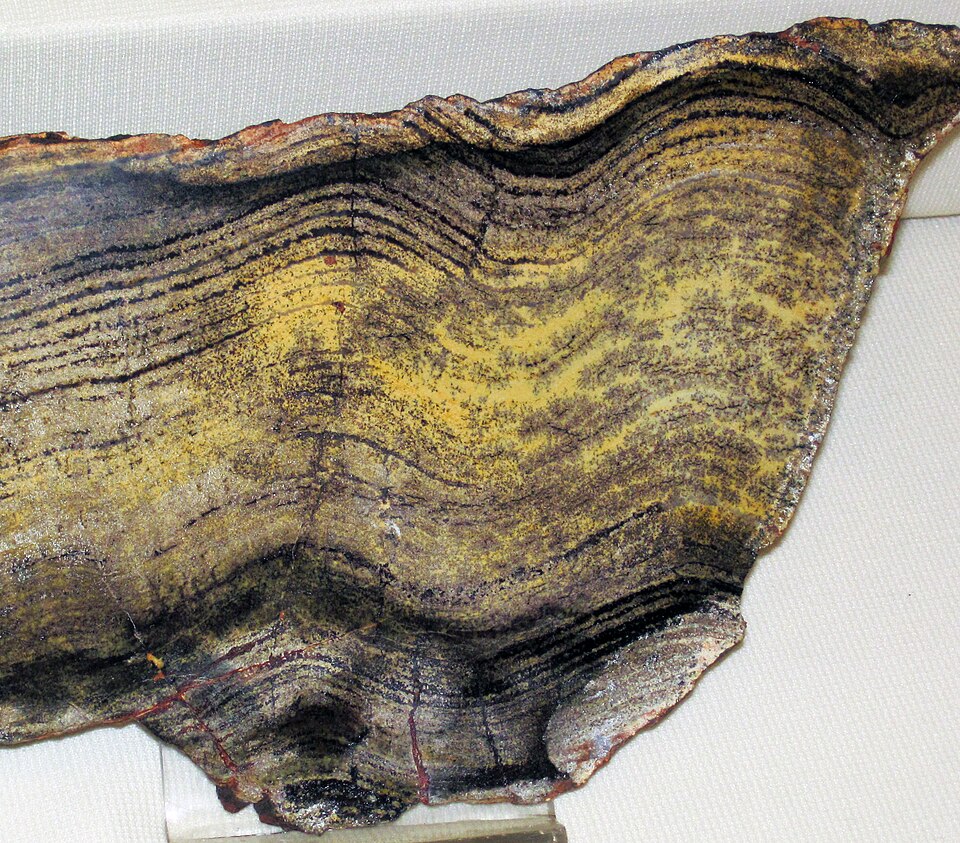
The most widely accepted early evidence of life comes from the Pilbara Craton of Western Australia and the Barberton Greenstone Belt of South Africa and Eswatini, both dated to approximately 3.4 to 3.5 billion years. The Dresser Formation and Strelley Pool Formation of the Pilbara preserve stromatolites — layered sedimentary structures produced by the trapping and binding of sediment by microbial mats — whose morphological complexity, environmental context, and association with isotopically light carbon strongly support a biological origin.4, 5 Microfossils of sulfur-metabolizing cells have been identified in 3.4-billion-year-old sandstones from the Strelley Pool Formation, providing direct morphological and chemical evidence of Archean microbial life.3 The Barberton Greenstone Belt contains complementary evidence in the form of carbonaceous microstructures and isotopically fractionated carbon and sulfur, indicating that diverse microbial metabolisms were already operating by 3.4 to 3.5 billion years ago.18
_1_(17346619166).jpg)
Stromatolites and microbial mats
Stromatolites are the most visible and iconic record of early prokaryotic life. These laminated, often dome-shaped or columnar structures form when communities of microorganisms, typically dominated by filamentous cyanobacteria or other photosynthetic prokaryotes, trap and bind fine-grained sediment on their sticky surfaces, building successive layers upward over time.
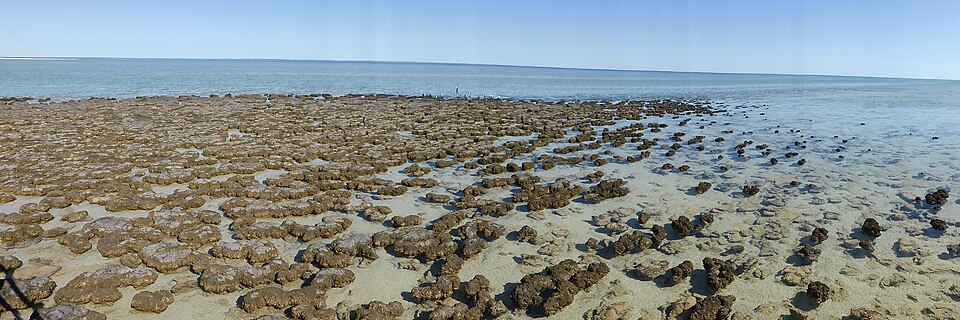

The oldest widely accepted stromatolites, from the 3.5-billion-year-old Dresser Formation of the Pilbara Craton, demonstrate that mat-forming microbial communities were already established in shallow marine environments during the Paleoarchean.5
The biological interpretation of ancient stromatolites requires care, because certain abiotic processes — such as chemical precipitation from supersaturated fluids or the physical draping of sediment over irregularities — can produce superficially similar laminated structures. Allwood and colleagues developed criteria for distinguishing biogenic from abiotic stromatolites based on morphological complexity, environmental context, and geochemical signatures. The 3.43-billion-year-old Strelley Pool Formation stromatolites, which exhibit diverse morphotypes across a carbonate platform with facies-dependent variation, satisfy these criteria and represent some of the strongest evidence for Archean biological stromatolite construction.4
Through the later Archean and the Proterozoic eon, stromatolites became widespread in shallow marine environments worldwide, reaching their peak diversity and abundance between approximately 2.0 and 1.0 billion years ago before declining in the Neoproterozoic, possibly due to grazing by newly evolved eukaryotic organisms.13 Living stromatolites persist today in a few restricted environments, most famously in the hypersaline waters of Shark Bay, Western Australia, and in the freshwater pools of Cuatro Cienegas, Mexico, where conditions limit the eukaryotic grazers that would otherwise disrupt mat growth.
The Archean biosphere
The Archean eon, spanning from approximately 4.0 to 2.5 billion years ago, witnessed the establishment of life and its diversification into a range of metabolic strategies, all within an environment profoundly different from the modern Earth. The Archean atmosphere was essentially devoid of free oxygen, as demonstrated by the presence of mass-independent fractionation of sulfur isotopes in Archean sedimentary rocks, a geochemical signature that can only form in the absence of an ozone layer and thus confirms that atmospheric oxygen concentrations were below approximately 0.001 percent of present levels.20

In this anoxic world, the earliest microbial communities relied on metabolisms that did not require molecular oxygen. Geochemical evidence from the Barberton Greenstone Belt indicates that elemental sulfur, rather than sulfate, was the preferred electron acceptor for early Archean microorganisms, consistent with the low sulfate concentrations expected in an ocean that had not yet been exposed to oxidative weathering of continental sulfide minerals.18 Carbon isotope records from Archean sediments display consistent depletions in 13C, indicating that biological carbon fixation was a pervasive process throughout the eon, most likely driven by a combination of anoxygenic photosynthesis and chemolithotrophic metabolisms.6
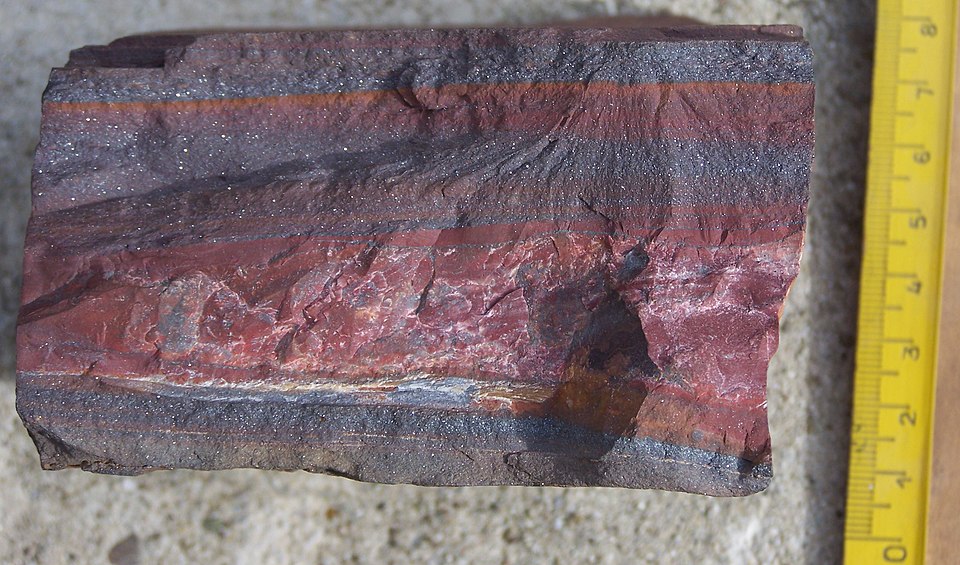
The Archean ocean was rich in dissolved ferrous iron and largely devoid of dissolved sulfate, creating a chemical environment very different from the sulfate-rich, iron-poor oceans of the Phanerozoic. Banded iron formations — sedimentary rocks consisting of alternating layers of iron oxides and silica — were deposited extensively during the late Archean and early Proterozoic, and their origin is linked to the biological or abiotic oxidation of dissolved ferrous iron in the water column, followed by precipitation of insoluble ferric iron minerals.7 The biological contribution to iron oxidation may have involved anoxygenic phototrophs that used ferrous iron as an electron donor, directly coupling iron cycling to primary production in the sunlit surface waters of the Archean ocean.12
The evolution of metabolism
The metabolic diversity of modern prokaryotes reflects a long evolutionary history of biochemical innovation that began in the Archean. Reconstructing the sequence in which the major metabolic pathways arose is one of the central challenges of early life research, approached through a combination of molecular phylogenetics, comparative biochemistry, and the geochemical record preserved in ancient sedimentary rocks.
Chemolithotrophy — the extraction of energy from inorganic chemical reactions — is widely considered to include some of the most ancient metabolisms. Organisms that derive energy from the oxidation of hydrogen, ferrous iron, or reduced sulfur compounds using electron acceptors such as carbon dioxide, ferric iron, or elemental sulfur occupy deep branches of both the bacterial and archaeal phylogenetic trees, suggesting that these metabolisms were among the first to evolve.9, 12 The chemical environment of early Earth, rich in reduced compounds and volcanic gases, would have provided ample substrates for chemolithotrophic organisms, particularly in hydrothermal settings where steep chemical gradients supplied abundant energy.17
Anoxygenic photosynthesis, in which light energy is used to fix carbon using electron donors other than water (such as hydrogen sulfide, ferrous iron, or hydrogen gas), is thought to have evolved before oxygenic photosynthesis. Molecular phylogenetic analyses of the reaction centre proteins used in photosynthesis indicate that anoxygenic photosynthetic systems are more ancient than the coupled Photosystem I and Photosystem II used by cyanobacteria and their descendants in oxygenic photosynthesis.12 Anoxygenic phototrophs would have thrived in the iron-rich, sulfidic waters of the Archean ocean, and their metabolic activity may have been responsible for much of the primary production in pre-oxygenic ecosystems.
Oxygenic photosynthesis, the process by which water is split using light energy to produce oxygen as a byproduct, represents one of the most consequential metabolic innovations in the history of life. This process requires the linked operation of two photosystems and a manganese-containing oxygen-evolving complex, a biochemically demanding arrangement that appears to have evolved only once, in the cyanobacterial lineage.13 Molecular biomarker evidence, specifically the detection of 2-methylhopanes (lipids characteristic of cyanobacteria) in 2.7-billion-year-old shales from the Pilbara Craton, initially suggested that oxygenic photosynthesis had evolved by the late Archean, though the syngeneity of these biomarkers has been questioned in subsequent studies.16 Independent geochemical evidence, including trace enrichments of redox-sensitive elements such as molybdenum and rhenium in 2.5-billion-year-old marine shales, supports the presence of transient oxygen production prior to the Great Oxidation Event, consistent with cyanobacterial activity in at least some environments by the late Archean.19
Cyanobacteria and the Great Oxidation Event
The most profound environmental transformation wrought by prokaryotic life was the Great Oxidation Event (GOE), the rapid and irreversible rise of atmospheric oxygen that occurred approximately 2.4 to 2.3 billion years ago. Before the GOE, Earth's atmosphere contained only trace amounts of oxygen produced locally by cyanobacterial photosynthesis, which was immediately consumed by reaction with reduced gases and minerals. The GOE marks the point at which cyanobacterial oxygen production overwhelmed these geological sinks, allowing free oxygen to accumulate permanently in the atmosphere.7, 8
The geochemical evidence for the GOE is striking. The disappearance of mass-independent fractionation of sulfur isotopes from the sedimentary record at approximately 2.4 billion years ago provides a sharp marker for the onset of significant atmospheric oxygenation, because this fractionation signal is destroyed by even modest concentrations of atmospheric oxygen and ozone.20 Additional evidence includes the appearance of oxidized detrital minerals (such as haematite) and the disappearance of reduced detrital minerals (such as pyrite and uraninite) from ancient riverbeds, the onset of widespread red beds, and changes in the abundance and isotopic composition of redox-sensitive trace elements in marine sedimentary rocks.8
The consequences of the GOE were far-reaching. Atmospheric oxygen enabled the development of the ozone layer, shielding the surface from ultraviolet radiation and opening new habitats for life. The oxidation of dissolved iron in the oceans led to the cessation of banded iron formation deposition. Perhaps most dramatically, the rise of oxygen was likely catastrophic for the vast majority of obligately anaerobic organisms that had dominated the biosphere for over a billion years, constituting what has been called the first mass extinction.22 At the same time, oxygen made possible the evolution of aerobic respiration, a far more efficient means of extracting energy from organic molecules than any anaerobic metabolism, and ultimately paved the way for the evolution of complex multicellular life.7, 22
Key events in early Earth and the rise of oxygen7, 8, 20
| Time (Ga) | Event | Key evidence |
|---|---|---|
| ~3.8 | Oldest contested evidence of life (Isua, Greenland) | Depleted 13C in graphite; possible stromatolites |
| ~3.5 | Oldest widely accepted stromatolites (Pilbara, Australia) | Laminated structures with biogenic morphology |
| ~3.4 | Microfossils of sulfur-metabolizing cells | Cellular structures with sulfur isotope fractionation |
| ~2.7 | Molecular biomarkers suggest cyanobacteria present | 2-methylhopanes in Pilbara shales (debated) |
| ~2.5 | Transient whiffs of oxygen | Mo and Re enrichments in marine shales |
| ~2.4 | Great Oxidation Event | Loss of mass-independent S isotope fractionation |
The diversification of Bacteria and Archaea
All prokaryotic life is divided between two domains, Bacteria and Archaea, a classification first proposed by Carl Woese and colleagues in 1990 on the basis of ribosomal RNA sequence comparisons. Despite their superficial morphological similarity — both lack membrane-bound nuclei and are typically unicellular — the two domains are as fundamentally distinct from each other in their molecular biology as either is from the Eukarya. They differ in the composition of their cell membranes (ester-linked fatty acids in Bacteria versus ether-linked isoprenoids in Archaea), their RNA polymerase structure, their ribosomal proteins, and many aspects of their DNA replication and transcription machinery.11
Modern molecular phylogenetics, employing hundreds of conserved protein-coding genes, has refined the tree of prokaryotic life considerably. Within the Bacteria, major lineages include the Proteobacteria (a metabolically versatile group encompassing nitrogen-fixing, sulfur-oxidizing, and pathogenic species), the Cyanobacteria (the inventors of oxygenic photosynthesis), the Firmicutes, the Actinobacteria, and the deeply branching Chloroflexi and Aquificae.10 Within the Archaea, the discovery of the Asgard superphylum in the 2010s was transformative: these organisms possess genes previously thought to be exclusive to eukaryotes, including those encoding components of the cytoskeleton and membrane-trafficking systems, and phylogenomic analyses consistently place eukaryotes within the Asgard archaea, supporting a two-domain rather than three-domain topology of the tree of life.21
The deep divergence between Bacteria and Archaea must have occurred very early in the history of life, likely during the Eoarchean or Paleoarchean, though molecular clock estimates carry substantial uncertainty at such remote time depths. What is clear is that by the time the geochemical record becomes interpretable, around 3.5 billion years ago, prokaryotic life had already diversified sufficiently to support multiple metabolic strategies, including sulfur metabolism, carbon fixation, and mat-building behaviour.3, 18
Extremophiles and the limits of prokaryotic life
Among the most remarkable aspects of prokaryotic diversity is the ability of certain organisms to thrive in environments that would be lethal to most other forms of life. These extremophiles — organisms adapted to extremes of temperature, salinity, pH, pressure, or radiation — are found predominantly among the Archaea, though Bacteria include extremophilic representatives as well.15
Hyperthermophilic archaea, such as members of the genera Pyrolobus and Methanopyrus, grow at temperatures exceeding 100 degrees Celsius in deep-sea hydrothermal vents and volcanic hot springs, with the current record holder, Methanopyrus kandleri strain 116, capable of growth at 122 degrees Celsius under elevated pressure. At the opposite extreme, psychrophilic prokaryotes metabolize in Antarctic ice and permafrost soils at temperatures well below zero. Halophilic archaea of the family Halobacteriaceae inhabit saturated brine pools and salt crystals. Acidophilic organisms thrive at pH values below 1, while alkaliphiles grow at pH values exceeding 12.15
The deep subsurface biosphere, first proposed as a significant habitat by Thomas Gold in 1992, has since been confirmed as an enormous reservoir of prokaryotic life. Bacteria and archaea have been recovered from boreholes and mines at depths exceeding 3 kilometres in continental crust and from sediments beneath the deep ocean floor, where they persist on vanishingly small energy fluxes with generation times measured in centuries to millennia.17 The existence of these deep communities suggests that the habitable volume of the planet is far larger than the thin veneer of surface environments might imply, and it has informed the search for potential life in the subsurfaces of Mars and the icy moons of the outer solar system.
The ecological success of extremophiles is significant for understanding the Archean biosphere, because many of the conditions that are extreme by modern standards — high temperatures, anoxia, high concentrations of dissolved iron and sulfide — were the norm in the early oceans. The metabolisms and stress-tolerance mechanisms of modern extremophiles may therefore offer a window into the physiology of the earliest life forms.14, 15
Molecular phylogenetics and prokaryotic deep history
The reconstruction of prokaryotic evolutionary history has been revolutionized by molecular phylogenetics, the comparison of conserved gene sequences to infer relationships among organisms. The foundational work of Carl Woese in the 1970s and 1980s, using small-subunit ribosomal RNA (16S rRNA) as a molecular chronometer, established the three-domain classification of life and revealed that the Archaea, previously lumped with Bacteria as "prokaryotes," constitute a separate and ancient lineage.11
Subsequent advances in genomic sequencing and phylogenomic methods — which use concatenated alignments of dozens to hundreds of conserved marker genes rather than a single gene — have greatly refined the prokaryotic tree of life. The Candidate Phyla Radiation, a vast assemblage of bacterial lineages known almost exclusively from metagenomic data and environmental DNA sequences, has expanded the known diversity of Bacteria enormously, revealing that the majority of bacterial phyla have never been cultivated in the laboratory.10 Similarly, within the Archaea, the discovery of the DPANN superphylum (a group of small-celled, often symbiotic archaea) and the Asgard superphylum has reshaped understanding of archaeal diversity and its relationship to eukaryotic origins.21
Molecular clock analyses, which calibrate the rate of sequence divergence against geological or fossil evidence, have been applied to estimate the timing of major prokaryotic divergences. While these estimates carry large uncertainties due to rate variation across lineages and the scarcity of reliable calibration points in the Archean, they generally support a very early origin for the bacterial and archaeal domains, consistent with the geochemical evidence for diverse metabolisms by 3.5 billion years ago. The last universal common ancestor (LUCA) of all life is inferred from genomic reconstruction to have been an anaerobic organism capable of carbon fixation and potentially hydrogen-dependent metabolism, consistent with an origin in a hydrothermal setting.10, 14
The three-billion-year reign of microbial life
Perhaps the most striking fact about the history of life on Earth is the sheer duration of prokaryotic dominance. Life originated no later than 3.5 billion years ago and possibly as early as 3.8 to 4.0 billion years ago, yet the first unambiguous evidence of complex multicellular organisms — the Ediacaran biota — does not appear until approximately 575 million years ago. For roughly three billion years, the biosphere was an exclusively microbial world, dominated by prokaryotic communities that were invisible to the naked eye yet profoundly shaped the planet's surface chemistry.6, 13
During this vast interval, prokaryotes accomplished the major biogeochemical transformations that made the modern Earth habitable. They established the carbon cycle through carbon fixation and organic carbon burial. They built the nitrogen cycle through biological nitrogen fixation, making atmospheric nitrogen accessible to the biosphere. They drove the sulfur cycle through sulfate reduction and sulfide oxidation. And, most consequentially, cyanobacteria oxygenated the atmosphere, converting a reducing world into an oxidizing one and establishing the chemical conditions necessary for the eventual evolution of aerobic eukaryotic life.6, 9, 22
The transition from a prokaryote-only biosphere to one that included eukaryotes and eventually complex multicellular organisms was itself a product of prokaryotic evolution. The origin of the eukaryotic cell is now understood to have involved an endosymbiotic merger between an archaeal host cell, likely from the Asgard superphylum, and an alphaproteobacterial endosymbiont that became the mitochondrion.21 This event, which occurred no earlier than approximately 2.0 billion years ago based on the fossil record and molecular clock estimates, was made possible by the prior oxygenation of the environment by cyanobacteria, as the alphaproteobacterial endosymbiont was an aerobic organism that required oxygen for its respiratory metabolism. In this sense, the emergence of complex life was not a departure from the prokaryotic world but rather its culmination — a transformation made possible by three billion years of prokaryotic biogeochemical engineering.7, 21
References
Rapid emergence of life shown by discovery of 3,700-million-year-old microbial structures
Microfossils of sulphur-metabolizing cells in 3.4-billion-year-old rocks of Western Australia
Towards a natural system of organisms: proposal for the domains Archaea, Bacteria, and Eucarya
2.7-billion-year-old molecular fossils from the Pilbara Craton document the antiquity of oxygenic photosynthesis
Mass-independent fractionation of sulfur isotopes in Archean sediments: strong evidence for an anoxic Archean atmosphere