Overview
- Roughly 66 million years ago, an asteroid roughly 10 kilometers in diameter struck what is now Mexico's Yucatán Peninsula, triggering a global catastrophe that killed approximately 76 percent of all species on Earth.
- The impact left a worldwide chemical fingerprint—an anomalous concentration of the element iridium—that allowed scientists to pinpoint the event in the geologic record on every continent and in ocean sediments worldwide.
- The extinction was highly selective: non-avian dinosaurs, ammonites, and marine reptiles were wiped out, while birds, mammals, crocodilians, and turtles survived, setting the stage for the subsequent diversification of modern life.
Approximately 66 million years ago, at the boundary between the Cretaceous and Paleogene periods, Earth experienced one of the most catastrophic biological crises in its history. An estimated 76 percent of all species were extinguished in what geologists designate the Cretaceous-Paleogene, or K-Pg, extinction event—the "K" derived from Kreide, the German word for Cretaceous.3 The event terminated the reign of the non-avian dinosaurs, along with the ammonites, mosasaurs, plesiosaurs, and the vast majority of marine plankton, while leaving intact the lineages that would eventually give rise to modern birds, mammals, crocodilians, and flowering plants. The cause of this event—long debated—is now understood to be primarily a bolide impact of unprecedented violence, corroborated by a chain of physical evidence spanning every continent and the floors of every ocean.
The Alvarez hypothesis
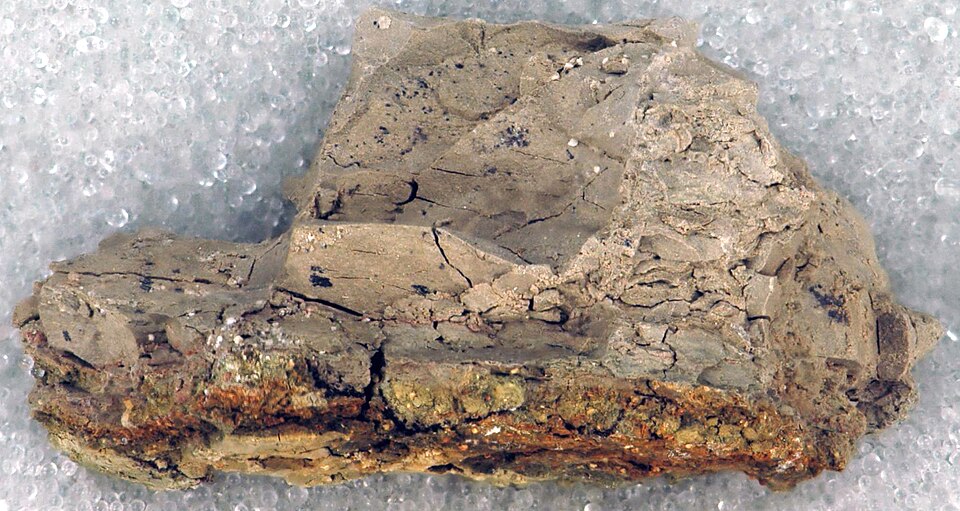
The scientific case for an extraterrestrial cause was assembled and published in 1980 by a team led by physicist Luis W. Alvarez and his geologist son Walter Alvarez, working with nuclear chemists Frank Asaro and Helen Michel at the Lawrence Berkeley Laboratory. Studying a thin reddish-brown clay layer at Gubbio, Italy—a layer that corresponds precisely to the boundary between the Cretaceous and Paleogene rock strata—the team measured concentrations of the element iridium that were 30 times higher than in adjacent sediments above and below.1
_boundary_clay_(65_Ma,_Quipar-Jorquera_Formation;_Agost-Castalia_Road,_southeastern_Spain)_(14617961128).jpg)
The iridium anomaly was not a local Italian curiosity. Because iridium is vanishingly rare in Earth's crust but relatively abundant in certain classes of meteorites, the team proposed that this geochemical anomaly marked the fallout layer from a massive asteroid impact. Their paper, published in Science in June 1980, proposed that the impactor was approximately 10 kilometers in diameter, and that the resulting ejecta cloud had blanketed the globe with a soot-and-dust veil sufficient to collapse photosynthesis worldwide.1
The iridium anomaly was not a local Italian curiosity. Within years of the 1980 publication, the enrichment was documented at more than 100 sites around the world, in marine sediments, continental deposits, deep-sea cores from the Pacific, Atlantic, and Indian Oceans, and in boundary clays from New Zealand to Denmark.3 Alongside the iridium, researchers identified other markers consistent with hypervelocity impact: microscopic spherules of glass formed by the rapid quenching of vaporized rock, and—critically—grains of quartz bearing planar deformation features caused only by pressures exceeding 5 to 10 gigapascals, far above anything achievable by volcanic or metamorphic processes.24 These shocked quartz grains were reported from K-Pg boundary sections in North America and Europe beginning in 1984, and their presence at sites far from any known impact structure required a global dispersal mechanism consistent only with an extremely large impact event.24
Discovery and characterization of Chicxulub
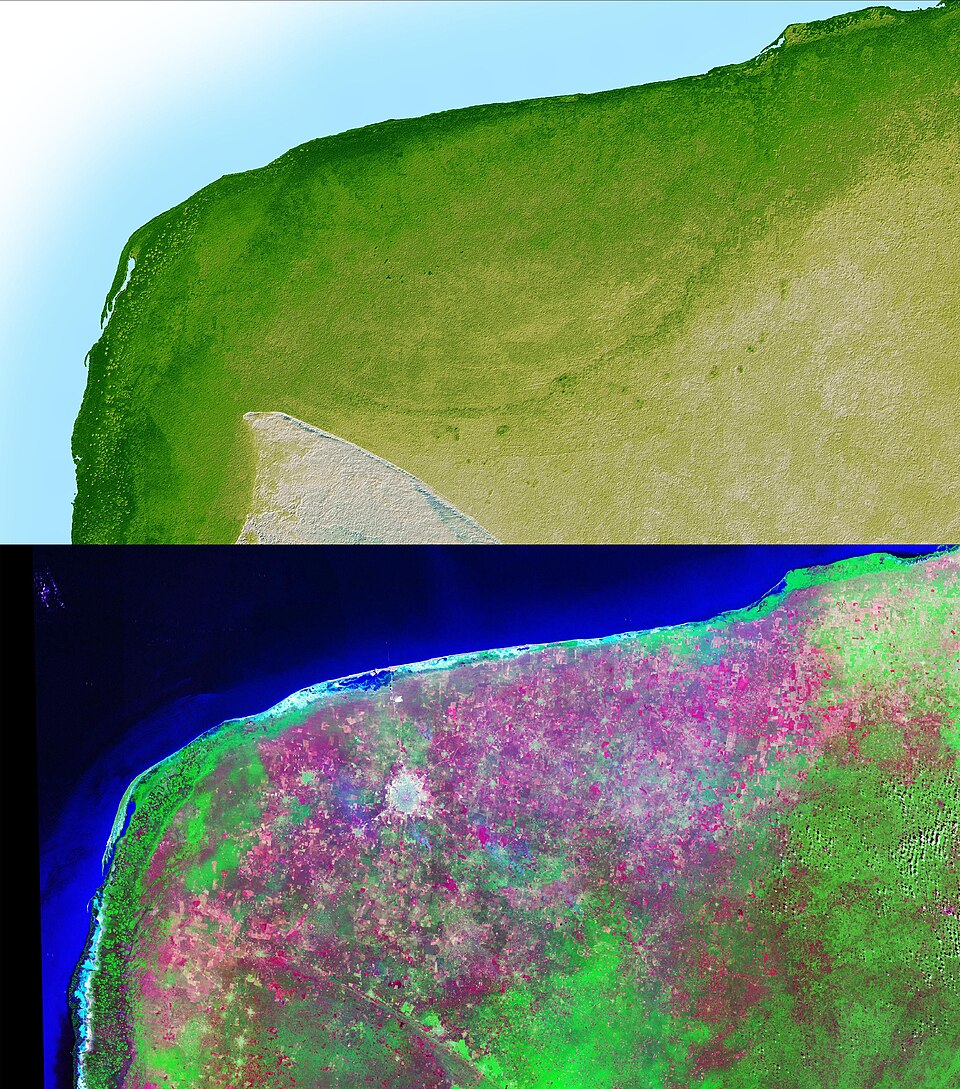

The Alvarez hypothesis demanded a specific prediction: somewhere on Earth there must be a buried impact crater of approximately 150 to 200 kilometers in diameter, formed at exactly 66 million years ago. That structure had, in fact, already been discovered—though not recognized as an impact crater at the time. In 1978, geophysicist Glen Penfield, working for the Mexican state oil company Petróleos Mexicanos (Pemex), identified a semicircular gravity and magnetic anomaly buried beneath the sediments of the Yucatán Peninsula and the adjacent Gulf of Mexico shelf. Penfield co-presented his findings at a geophysics conference in 1981, suggesting the structure might be an impact crater, but the connection to the K-Pg boundary went unrecognized for another decade.4
The link was made definitively in 1991, when geologist Alan Hildebrand, then a doctoral student, collaborated with Penfield to publish a formal description of the buried structure, named Chicxulub after a nearby village on the Yucatán coast.5 Analysis of Pemex drill cores from inside the anomaly revealed impact melt rock, breccias rich in shocked minerals, and an age—determined by argon-argon radiometric dating—of 65.5 million years, matching the K-Pg boundary precisely.5 A subsequent study published in Nature in 1992 by Hildebrand and colleagues characterized the crater's morphology more fully, establishing a diameter of roughly 180 kilometers and confirming its origin as the largest known impact structure on Earth that formed within the Phanerozoic eon.2
Further resolution came from a landmark scientific drilling expedition conducted between 2016 and 2017 by the International Ocean Discovery Program (IODP) and the International Continental Scientific Drilling Program (ICDP). The drilling targeted the crater's peak ring—the raised annular ridge of shattered rock that forms inside large complex craters—at a location about 30 kilometers offshore the Yucatán coast. Core samples recovered granites from the original basement of the Yucatán platform, now found within the peak ring, demonstrating that these rocks had been uplifted from depths of at least 8 to 10 kilometers during the impact and then collapsed outward in a process spanning only minutes.6, 7 The cores also contained layers of impact melt and breccia grading upward into early Paleogene sediment, offering a precise stratigraphic record of the impact and its immediate geological aftermath.
Kill mechanisms
An asteroid approximately 10 to 15 kilometers in diameter striking a shallow carbonate and evaporite platform at tens of kilometers per second would release energy equivalent to several billion nuclear weapons detonating simultaneously.3, 10 The immediate effects—a fireball, a megatsunami radiating outward from the Gulf of Mexico, and ejecta re-entering the atmosphere as incandescent particles across the entire hemisphere—were severe but geologically brief. The longer-lasting and more ecologically devastating consequences unfolded over months to years.


Within hours of the impact, ejecta re-entering Earth's atmosphere at high velocity heated the stratosphere globally, generating a pulse of thermal radiation intense enough to ignite surface vegetation across much of North America and possibly beyond.9, 25 Geochemical evidence for globally distributed charcoal at the K-Pg boundary, identified in boundary sections from multiple continents, confirms that wildfires burned on a continental scale in the immediate aftermath of the impact.9 These fires contributed soot and smoke to an already dust-laden atmosphere.
The most consequential kill mechanism was the collapse of photosynthesis. A combination of impact dust, sulfate aerosols from the vaporization of Yucatán's sulfur-rich evaporite rocks, and wildfire soot created an optically dense aerosol layer in the stratosphere that blocked sunlight from reaching the surface for months to years.12, 14 Modeling studies and geochemical evidence from marine sediments indicate that surface temperatures fell by an estimated 8 to 11 degrees Celsius in the Northern Hemisphere within weeks of the impact, and that darkness severe enough to suppress photosynthesis persisted for at least several months.10, 14 For any organism dependent on living plant matter—whether directly as an herbivore or indirectly through food chains anchored in primary production—this impact winter represented an existential threat.
Ocean chemistry also deteriorated rapidly. The vaporization of carbonate and sulfate rocks at Chicxulub produced enormous quantities of sulfur dioxide and carbon dioxide, which dissolved in seawater and ocean-surface layers, causing rapid acidification.11 This ocean acidification was particularly damaging to calcareous plankton—the foraminifera and coccolithophores that form the base of the marine food web—whose calcium carbonate shells dissolve in acidic water. Planktonic foraminifera suffered extinction rates approaching 90 percent at the K-Pg boundary, and the marine carbon cycle took hundreds of thousands of years to restabilize.11, 26
Major kill mechanisms and their primary victims at the K-Pg boundary3, 10, 12
| Mechanism | Duration | Primary biological impact |
|---|---|---|
| Thermal pulse / re-entry heating | Hours | Wildfires; direct heat mortality across N. America |
| Impact winter (dust and soot) | Months to years | Collapse of photosynthesis; food web collapse |
| Sulfate aerosol cooling | Years to decades | Prolonged cooling; acid rain; reduced sunlight |
| Ocean acidification | Thousands of years | Calcareous plankton collapse; marine food web disruption |
| Greenhouse warming (CO₂ pulse) | Tens of thousands of years | Long-term warming stress on recovering ecosystems |
The Deccan Traps debate
Before and independently of the Alvarez hypothesis, some paleontologists had proposed that a prolonged episode of massive volcanic activity—specifically the eruption of the Deccan Traps, a vast flood basalt province in what is now west-central India—was responsible for the end-Cretaceous extinctions. The Deccan eruptions produced over one million cubic kilometers of lava and are thought to have released enormous quantities of sulfur dioxide and carbon dioxide into the atmosphere over a span of roughly one million years straddling the K-Pg boundary.13
The question of the Deccan Traps' contribution has remained scientifically active and contentious. High-precision uranium-lead dating of zircons from Deccan lava flows published in Science in 2019 found that eruption rates approximately doubled in the 50,000 years following the Chicxulub impact, suggesting that seismic energy from the impact may have triggered a pulse of enhanced volcanic activity.15 This finding complicates the simple narrative of impact versus volcanism, raising the possibility that both processes were linked in a causal chain.
The scientific consensus, articulated most clearly in a comprehensive review signed by 41 specialists and published in Science in 2010, holds that the Chicxulub impact was the primary cause of the end-Cretaceous mass extinction, and that Deccan volcanism—while it may have stressed Cretaceous ecosystems in the final million years of the period—was insufficient on its own to account for the abruptness, global reach, and magnitude of the biological crisis at the K-Pg boundary.3 The key evidence for the impact's primacy is the stratigraphic precision of the extinction: the vast majority of species disappear in the rock record synchronously with the iridium layer, not gradually over the longer timescale of Deccan volcanism.3, 18
The Tanis site
One of the most dramatic paleontological discoveries related to the K-Pg boundary was reported in 2019 from a site called Tanis, in the Hell Creek Formation of North Dakota. Paleontologist Robert DePalma and colleagues described a deposit interpreted as a seiche wave—a standing oscillation in an inland body of water triggered by seismic waves from the Chicxulub impact—that had buried a rich assemblage of fish, plant material, tree trunks, and other organisms within hours of the impact event, approximately 3,000 kilometers from the impact site.8 The deposit contained impact spherules, interpreted as glassy ejecta that had traveled through the upper atmosphere and rained down onto the site, embedded within the gills of fossil paddlefish and sturgeon.8 Shocked quartz grains were also recovered from the deposit. If the interpretation is correct, Tanis represents the closest thing yet discovered to a snapshot of the impact's immediate aftermath: a single deposit formed on the day of the extinction event, preserving organisms killed within hours of the bolide striking the Yucatán.
The Tanis discovery attracted substantial scientific scrutiny, and some aspects of the site interpretation—including the mechanism of spherule deposition and the precise timing of the seiche wave—remain subjects of ongoing investigation. Nevertheless, the presence of shocked minerals, iridium enrichment, and impact spherules within a vertebrate death assemblage at the K-Pg boundary layer is broadly consistent with the established impact scenario.
Selectivity of the extinction
The end-Cretaceous extinction was not a random culling of life. Its victims and survivors exhibit patterns that reflect the nature of the kill mechanisms, particularly the prolonged collapse of photosynthesis and primary productivity. Understanding who died and who survived provides some of the most compelling evidence that the extinction scenario is correctly understood.
Non-avian dinosaurs, which had dominated terrestrial ecosystems for over 165 million years, were completely extinguished. All major lineages—the sauropods, hadrosaurs, ceratopsians, ankylosaurs, pachycephalosaurs, and the large theropods including tyrannosaurs and dromaeosaurs—disappear from the fossil record at the K-Pg boundary with no survivors in the Paleogene.16, 17 Their large body sizes, high metabolic demands, and dependence on abundant plant matter made them acutely vulnerable to the collapse of terrestrial vegetation. In marine environments, the large reptilian predators—mosasaurs and plesiosaurs—were similarly extinguished, their food webs undermined by the collapse of fish and cephalopod populations.3
Ammonites, the coiled cephalopod mollusks that had diversified spectacularly through the Mesozoic, suffered complete extinction at the K-Pg boundary. Their close relatives, the nautiloids, survived—a difference plausibly explained by the fact that nautilus eggs hatch as fully formed juveniles that can survive on detritus, while ammonites had planktotrophic larvae that fed on the phytoplankton destroyed by ocean acidification and darkness.3
The survivors present an equally instructive pattern. Birds—the avian dinosaurs—passed through the extinction, though with significant losses among lineages known from the latest Cretaceous.19 Their survival has been linked to small body size, dietary flexibility (seed-eating in particular, since seeds can remain dormant through an impact winter), and the ability to exploit detritus-based food chains that persisted even when photosynthesis collapsed.19 Crocodilians survived the extinction entirely, retaining all their major lineages into the Paleogene, a fact often attributed to their semi-aquatic habits, dependence on detritus-based aquatic food chains, low metabolic rates, and tolerance of prolonged fasting.20 Turtles, lizards, snakes, and freshwater fish also passed through the boundary with relatively low extinction rates, suggesting that aquatic and semi-aquatic habitats buffered by sediment organic matter provided refugia from the worst of the impact winter's effects.
Mammals survived as a group, though latest Cretaceous mammals were small, ecologically generalized, and probably omnivorous or insectivorous—characteristics that conferred resilience when large herbivore and carnivore niches were emptied.23 The extinction of the non-avian dinosaurs left those ecological niches vacant, setting the stage for the explosive diversification of placental mammals in the Paleocene and Eocene epochs that followed.
Approximate species-level extinction rates for major groups at the K-Pg boundary3, 17
Recovery of ecosystems
The biological recovery from the end-Cretaceous extinction was not instantaneous. The scale of the disruption—the near-total collapse of marine primary productivity and the wholesale elimination of terrestrial megafauna—left ecosystems fundamentally restructured for hundreds of thousands to millions of years.
In marine environments, geochemical proxies for ocean productivity, including carbon isotope ratios in bulk carbonate, collapsed immediately at the K-Pg boundary and remained severely depressed for up to three million years in some ocean basins.26 Foraminifera that survived the extinction initially diversified into a depauperate, low-diversity assemblage dominated by generalist, opportunistic species. The recovery of diverse marine plankton communities required several million years of the early Paleocene.26
On land, the earliest Paleocene plant communities in western North America were dominated by ferns, whose spores can disperse rapidly and colonize denuded landscapes. This fern spike—a brief stratigraphic interval of near-total fern dominance immediately above the K-Pg boundary clay in many continental sections—is itself taken as evidence of the catastrophic defoliation of Cretaceous forests.21 The recovery of diverse angiosperm-dominated forests in the Rocky Mountain and Great Plains region took approximately 1.4 million years following the boundary event, based on leaf diversity proxies in early Paleocene fossil floras.21
Mammalian diversity responded to the newly emptied ecological landscape with remarkable speed on geological timescales. The latest Cretaceous mammal fauna of North America was relatively depauperate, dominated by small multituberculates and primitive therians. Within approximately 300,000 years of the K-Pg boundary, mammalian faunas in the northern Rocky Mountain region show the first appearances of perissodactyl-grade and artiodactyl-grade placental mammals, animals substantially larger than any Cretaceous mammal, filling the browsing and grazing niches vacated by the hadrosaurs and ceratopsians.23 The full diversification of the major modern mammal orders—bats, rodents, whales, primates—unfolded over the subsequent tens of millions of years of the Paleogene.22
The evolutionary ecologist David Jablonski, reviewing the aftermath of the K-Pg extinction in 2017, observed that recovery was not simply a matter of refilling vacated niches with ecological equivalents. The extinction fundamentally reshuffled the evolutionary deck: lineages that had been subordinate or marginal under Mesozoic conditions—above all the placental mammals and the flowering plants—became the dominant architects of post-Cretaceous ecosystems in ways that persist to the present day.22 In this sense, the catastrophe that ended the Cretaceous was also the generative event that produced the biological world in which modern humans live.
References
The Chicxulub asteroid impact and mass extinction at the Cretaceous-Paleogene boundary
Chicxulub crater: a possible Cretaceous/Tertiary boundary impact crater on the Yucatan Peninsula, Mexico
Drilling into the Chicxulub crater to understand the dynamics of large meteorite impacts
Ocean acidification and the end-Cretaceous mass extinction: to what extent does this apply?
Production of sulphate-rich vapour during the Chicxulub impact and implications for ocean acidification
Deccan volcanism, the Chicxulub impact, and the end-Cretaceous mass extinction: coincidence or cause and effect?
The eruptive tempo of Deccan volcanism in relation to the Cretaceous-Paleogene boundary
Reassessing the relationship between the body mass of non-avian dinosaurs and the K/Pg mass extinction
End-Cretaceous extinction in Antarctica linked to both Deccan volcanism and meteorite impact via climate change
The ecological and evolutionary aftermath of the Cretaceous-Paleogene mass extinction
Rapid resurgence of marine productivity after the Cretaceous-Paleogene mass extinction