Overview
- The Late Devonian extinction was a prolonged biodiversity crisis spanning roughly 25 million years of the Late Devonian period, with two especially severe pulses — the Kellwasser events at the Frasnian-Famennian boundary (~372 Ma) and the Hangenberg event at the Devonian-Carboniferous boundary (~359 Ma) — that together eliminated approximately 75% of all species.
- Unlike the other Big Five mass extinctions, the Late Devonian crisis was not a single catastrophic event but a sustained interval of depressed origination and elevated extinction that devastated tropical reef ecosystems, ended the dominance of armored placoderms, and created an evolutionary bottleneck for jawed vertebrates.
- The causes were likely multicausal, with the spread of the first deep-rooted forests accelerating continental weathering and nutrient runoff into shallow seas, promoting eutrophication and oceanic anoxia, potentially compounded by volcanism from the Viluy Traps and global cooling during the Late Devonian greenhouse-to-icehouse transition.
The Late Devonian extinction is one of the five largest biodiversity crises in the history of complex life, yet it stands apart from the other members of the Big Five for being neither sudden nor easily attributable to a single catastrophic cause.1, 2 Whereas the end-Permian and end-Cretaceous extinctions were geologically instantaneous, the Late Devonian crisis unfolded over a protracted interval of roughly 25 million years during the Late Devonian period, from approximately 383 to 359 million years ago, punctuated by at least two acute pulses of severe extinction.3, 23 The more intense of these pulses were the Kellwasser events at the Frasnian-Famennian boundary (~372 Ma) and the Hangenberg event at the Devonian-Carboniferous boundary (~359 Ma), each of which individually ranks among the most devastating biotic crises in Earth history.6, 8 By the time the crisis had run its course, approximately 75% of all species had been eliminated, the largest reef systems the planet had ever known lay in permanent ruin, and the armored placoderms that had dominated Devonian seas for tens of millions of years had been swept from existence.5, 7
The Devonian period was the "Age of Fishes," a time when vertebrate life reached unprecedented diversity in the oceans while the first forests and the first tetrapods transformed the terrestrial landscape. Understanding how this vibrant world collapsed requires examining not only the geological and geochemical evidence for environmental change but also the complex interplay between the evolution of life on land and the chemistry of the global ocean, a relationship that may have turned the greening of the continents into a trigger for marine catastrophe.4, 22
The Devonian world
The Devonian period (419 to 359 Ma) was characterized by a warm greenhouse climate, extensive shallow epicontinental seas, and a global geography dominated by two major landmasses: Euramerica (Laurussia) in the tropics and the supercontinent Gondwana extending from the equator to the south pole.20 Between these landmasses lay the Rheic Ocean, while the vast Panthalassic Ocean covered much of the northern hemisphere. Atmospheric carbon dioxide concentrations were substantially higher than modern levels, contributing to global temperatures that were among the warmest of the Paleozoic era, and sea levels were high, flooding continental interiors with shallow, warm, sunlit seas.9, 20
_(Late_Devonian;_Cleveland,_Ohio,_USA)_1_(34189080296).jpg)
These shallow seas supported the most extensive reef ecosystems in Earth's history. Stromatoporoid sponges and tabulate corals, together with rugose corals, constructed massive bioherms that rivalled or exceeded the scale of modern coral reefs, forming a continuous reef belt across tropical Euramerica and the margins of Gondwana.5 The reefs were far more taxonomically diverse during the Givetian and early Frasnian than at any time before or since in the Paleozoic; Copper's global reef database documents over 200 genera of calcified reef-builders active during the Middle Devonian peak.5 These reef ecosystems were ecological powerhouses, supporting dense communities of brachiopods, trilobites, crinoids, bryozoans, and conodonts, with an extraordinary diversity of fish swimming through and around them.
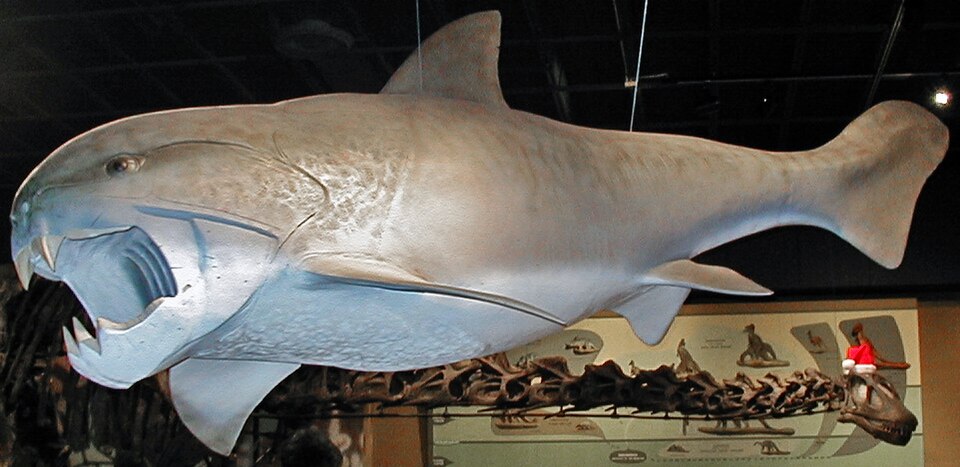
The Devonian oceans were dominated by an astonishing radiation of fishes, earning the period its nickname. Armored placoderms, including predators such as Dunkleosteus that reached lengths of six metres or more, were the apex predators of Devonian seas. Early sharks, acanthodians, and bony fishes (both ray-finned and lobe-finned lineages) diversified alongside them.7, 23 The lobe-finned fishes were of particular evolutionary significance, for it was from this group that the first tetrapods arose. By the Late Devonian, transitional forms such as Tiktaalik, Acanthostega, and Ichthyostega had begun to explore the margins of land and water, foreshadowing the great vertebrate invasion of terrestrial habitats.23
On land, the Devonian witnessed an equally transformative revolution. The first true forests appeared during the Middle to Late Devonian, dominated by Archaeopteris, a genus of progymnosperm trees that grew up to 30 metres tall and developed deep root systems penetrating metres into the substrate.4 These forests represented a fundamental change in the relationship between life and the terrestrial surface: for the first time, plants were physically breaking apart rock with their roots, building deep soils, and dramatically accelerating the chemical weathering of silicate minerals on continental surfaces. This biological transformation of the land surface would have profound, and ultimately catastrophic, consequences for the marine realm.4, 22
The Kellwasser events
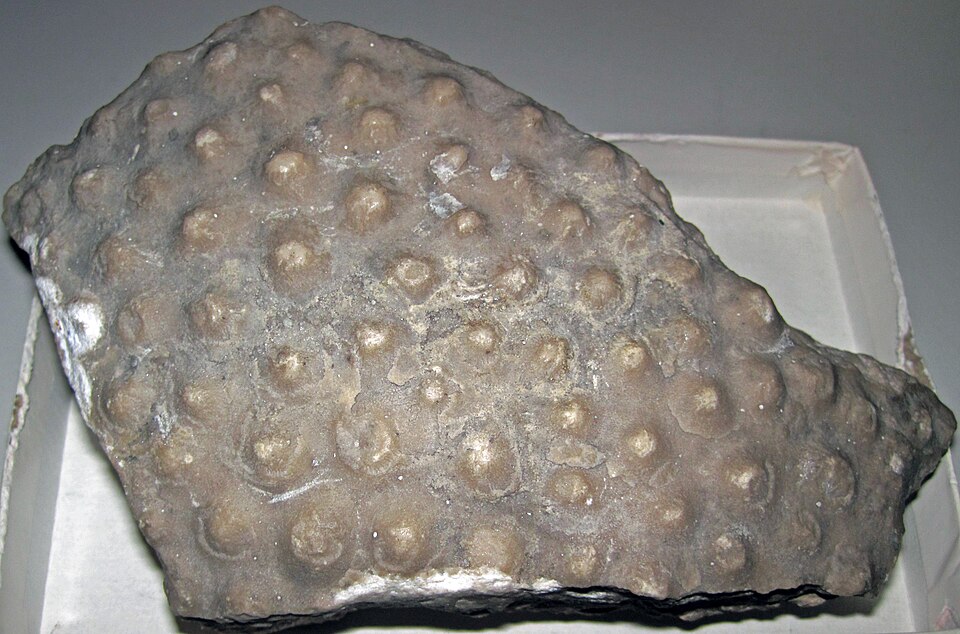
The most widely studied phase of the Late Devonian extinction is the pair of extinction pulses at the boundary between the Frasnian and Famennian stages, collectively known as the Kellwasser events, named after distinctive black limestone beds exposed near Kellwasser in the Harz Mountains of Germany.3, 6 High-precision U-Pb dating has constrained the Frasnian-Famennian boundary to approximately 372 Ma, with the most precise estimates placing it at 371.9 to 371.8 Ma.11 The two events are designated the Lower Kellwasser event and the Upper Kellwasser event; the latter, coinciding precisely with the stage boundary, was the more severe of the two and constitutes the main extinction pulse traditionally recognised as the Frasnian-Famennian mass extinction.6, 12
_1_(27138607267).jpg)
Cyclostratigraphic analysis suggests that the Lower and Upper Kellwasser positive carbon-isotope excursions are separated by approximately 600,000 years, with the Upper Kellwasser excursion paced by obliquity cycles in a manner analogous to the Cretaceous Oceanic Anoxic Event 2 (OAE-2).12 This astronomical connection implies that the extinction pulses occurred during a minimum of the 2.4-million-year eccentricity cycle, a period in which obliquity forcing dominates over precessional forcing, potentially amplifying seasonal contrasts and promoting oceanic mixing and nutrient redistribution.12
The Kellwasser events were characterised by the global deposition of organic-rich black shales, signalling the expansion of anoxic (oxygen-depleted) and in some cases euxinic (hydrogen-sulfide-bearing) conditions across vast areas of the shallow continental shelves and epicontinental seas.6, 15 Basin-scale geochemical reconstructions of the Bakken Shale in the Williston Basin of North America have documented stepwise transgressions of toxic euxinic waters from deep basinal settings into progressively shallower environments during the Late Devonian extinction interval, demonstrating that the expansion of anoxia was neither instantaneous nor uniform but rather a series of escalating incursions that progressively eliminated habitable shelf environments.15
The biological toll was devastating, and it fell disproportionately on tropical marine organisms. Stromatoporoid sponges and tabulate corals, the primary reef-builders of the Devonian, were nearly annihilated; Copper's analysis shows that reef construction collapsed during the late Frasnian even before the boundary itself, with the final pulse of the Upper Kellwasser event eliminating the last remnants of the stromatoporoid-coral reef ecosystem that had dominated tropical seas for over 40 million years.5 Brachiopods suffered severe losses, with the atrypid and pentamerid orders eliminated entirely. Trilobites, already in long-term decline since the Ordovician, lost numerous families. Ammonoids were severely reduced, with only a few lineages surviving into the Famennian. The selectivity of the extinction was strongly latitudinal, with tropical taxa suffering far greater losses than those in higher-latitude, cooler-water environments, consistent with a mechanism involving the disruption of warm, shallow-water habitats.6, 23
The Hangenberg event
The second major pulse of the Late Devonian extinction occurred at the very end of the period, at the Devonian-Carboniferous boundary approximately 358.9 Ma, and is known as the Hangenberg event after black shale exposures in the Rhenish Massif of Germany.8, 21 For much of the twentieth century, the Hangenberg event received far less attention than the Kellwasser events, but quantitative analyses over the past two decades have revealed that it was a first-order mass extinction of comparable or even greater magnitude, affecting a broader range of environments and organismal groups than previously appreciated.8, 14
High-precision U-Pb geochronology constrains the main Hangenberg black shale interval to an extremely brief duration of approximately 50,000 to 100,000 years, establishing it as a geologically rapid event despite the protracted nature of the broader Late Devonian crisis.21 The event is recorded globally by a characteristic sequence of lithological and geochemical signals: a positive carbon-isotope excursion, widespread deposition of organic-rich black shales indicative of oceanic anoxia, followed by evidence of glaciation and a major sea-level fall (the Hangenberg Regression), and finally the deposition of glacially derived sediments including diamictites in Gondwanan regions.8, 14, 19
The biological consequences of the Hangenberg event were sweeping. Armored placoderms, which had been the dominant vertebrate predators throughout the Devonian, were entirely eliminated at or just below the boundary; not a single placoderm lineage survived into the Carboniferous.7 Sallan and Coates's comprehensive analysis of over 1,250 vertebrate taxa demonstrated that the Hangenberg event produced long-term diversity losses exceeding 50% across all major vertebrate clades, creating an evolutionary bottleneck that fundamentally shaped the subsequent radiation of modern jawed vertebrates. Sharks, ray-finned fishes, and tetrapods all passed through this bottleneck, and the post-extinction radiation that followed in the Early Carboniferous established the basic ecological structure of vertebrate communities for the remainder of the Paleozoic.7
Ammonoids were reduced to just a handful of lineages, and conodont diversity plummeted. Marine invertebrate communities were restructured at every trophic level. On land, early tetrapod diversity was also affected; the relatively rich Late Devonian tetrapod fauna, which included forms such as Acanthostega and Ichthyostega, gave way to a gap in the tetrapod fossil record spanning several million years of the earliest Carboniferous (sometimes called Romer's Gap), though the extent to which this gap reflects genuine extinction versus preservational bias remains debated.7, 8
Proposed causes
The causes of the Late Devonian extinction remain actively debated, but the current consensus favours a multicausal explanation in which several reinforcing mechanisms operated together over an extended interval, rather than a single catastrophic trigger.3, 16 The prolonged, pulsed nature of the crisis, its strong association with oceanic anoxia, and its coincidence with major changes in terrestrial ecosystems all point toward Earth-bound mechanisms rather than an extraterrestrial impact.3, 11
The most influential hypothesis, proposed by Algeo and Scheckler, links the Late Devonian marine crisis directly to the evolution and spread of the first forests.4, 22 The explosive expansion of Archaeopteris forests during the Late Devonian introduced deep root systems to the continental surface for the first time, fundamentally altering terrestrial biogeochemistry through several interconnected pathways. Deep roots physically fragmented bedrock and vastly accelerated the chemical weathering of silicate minerals, drawing down atmospheric CO2 in the process. The resulting deep soils trapped and released enormous quantities of nutrients, particularly phosphorus, which were flushed into rivers and carried to the sea. In the warm, shallow epicontinental seas of the Devonian, this nutrient influx promoted algal blooms and eutrophication, which in turn drove bottom-water anoxia as the decomposition of organic matter consumed dissolved oxygen.4, 22 Recent Earth system modelling and continental lacustrine geochemical records have provided independent support for this hypothesis, demonstrating that both volcanism and nutrient runoff from expanding forests were required to reproduce the observed patterns of marine anoxia and extinction.16
Volcanic activity from the Viluy Traps, a large igneous province in eastern Siberia, has been proposed as a contributing factor, particularly for the Kellwasser events. Radiometric dating of Viluy Traps basalts has yielded ages clustering around 373 to 364 Ma, with the earliest volcanic phase overlapping the Frasnian-Famennian boundary within analytical uncertainty.10, 17 Large igneous province eruptions can drive environmental change through massive emissions of CO2 and sulfur dioxide, causing initial warming followed by cooling, acid rain, and disruption of marine carbonate chemistry. However, the total volume of the Viluy Traps is modest compared to other extinction-associated flood basalts such as the Siberian Traps or the Deccan Traps, and the temporal correlation, while suggestive, remains imprecise.10, 17
Climatic cooling played a significant role, particularly in the Hangenberg event. Oxygen isotope data from conodont apatite document a cooling of tropical sea-surface temperatures by 5 to 7 degrees Celsius during the late Frasnian, from approximately 32 degrees Celsius to 26 degrees Celsius, consistent with a drawdown of atmospheric CO2 driven by enhanced organic carbon burial and silicate weathering.9 By the end of the Famennian, cooling had progressed to the point where continental ice sheets developed on Gondwana, producing the diamictites and glacial deposits that accompany the Hangenberg event and driving a major eustatic sea-level fall.8, 19 Enhanced continental weathering driven by the expansion of vascular land plants has been identified as a trigger for the Hangenberg Crisis specifically, with lithium isotope evidence from South China documenting a rapid increase in weathering rates that preceded the main extinction pulse.18
Bolide impacts have been proposed but lack strong temporal correlation with the main extinction pulses. The Alamo impact in Nevada (~382 Ma) and the Siljan impact in Sweden (~377 Ma) both occurred during the Late Devonian, but high-precision dating has shown that neither corresponds closely to the Frasnian-Famennian boundary.11 Unlike the end-Cretaceous extinction, where iridium anomalies and shocked quartz provide unambiguous evidence of a major impact, no such global signature has been identified at either the Kellwasser or Hangenberg horizons.3, 11
An additional factor may have been the suppression of speciation rather than simply elevated extinction. Stigall's analysis of Late Devonian biogeographic patterns demonstrated that the biodiversity crisis was characterised not only by increased extinction rates but also by a marked collapse in the rate at which new species originated, driven in part by the homogenisation of marine faunas as cosmopolitan invasive species displaced endemic communities during intervals of sea-level change and habitat connectivity.13 This "speciation collapse" distinguishes the Late Devonian crisis from most other mass extinctions, which are primarily driven by spikes in extinction rate alone.2, 13
Victims and survivors
The Late Devonian extinction reshaped the composition of marine and terrestrial ecosystems in ways that persisted for tens of millions of years. The losses were not distributed evenly across taxonomic groups or ecological niches; instead, the extinction was strongly selective, targeting specific clades and ecological roles while leaving others comparatively unscathed.5, 7, 23
The most conspicuous victims were the reef-building organisms. Stromatoporoid sponges, which had constructed the structural framework of Devonian reefs, were reduced from a diverse clade of hundreds of species to near-total extinction by the end of the Frasnian. Tabulate corals suffered comparably severe losses, and rugose corals, though somewhat less affected, were dramatically diminished.5 The collapse of these reef-builders did not merely reduce biodiversity; it eliminated an entire ecosystem type. The complex three-dimensional reef habitat that had supported diverse communities of invertebrates and fishes simply ceased to exist, and it would not be rebuilt on a comparable scale for approximately 100 million years, when scleractinian corals finally began constructing large reefs during the Middle to Late Triassic.5
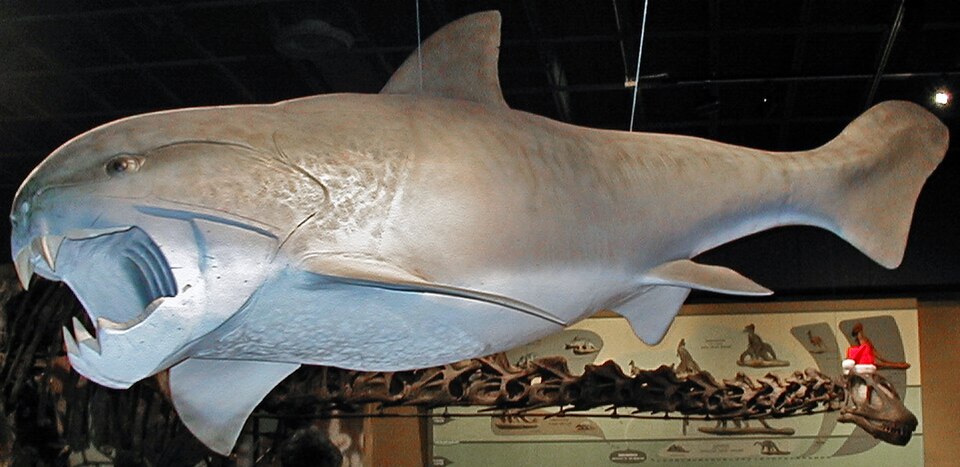
Among vertebrates, the placoderms suffered the most absolute fate: complete extinction. Despite being the most species-rich vertebrate group throughout the Devonian, not a single lineage of these armored fishes survived the Hangenberg event.7 Acanthodians were severely reduced but persisted into the Permian. Among the survivors, chondrichthyans (sharks and their relatives) and osteichthyans (bony fishes) both passed through the Hangenberg bottleneck and diversified rapidly in the Early Carboniferous, filling ecological roles vacated by the placoderms.7 Trilobites, which had already suffered significant losses during the Kellwasser events, were reduced to just two orders (Proetida and Phacopida) by the end of the Devonian, and only the proetids survived into the Carboniferous, persisting as a single order until their final extinction in the end-Permian crisis.23 Brachiopods lost multiple orders and never regained their Devonian levels of diversity, yielding ecological dominance in many benthic communities to bivalve molluscs over the subsequent Paleozoic.23
Major taxonomic groups and their fate during the Late Devonian extinction5, 7, 8, 23
| Group | Pre-extinction status | Kellwasser impact (~372 Ma) | Hangenberg impact (~359 Ma) | Post-Devonian fate |
|---|---|---|---|---|
| Stromatoporoids | Dominant reef builders | Near-total extinction | Already eliminated | Functionally extinct; minor Mesozoic occurrences |
| Tabulate corals | Major reef builders | Severely reduced | Further reduced | Persisted as minor component; extinct in Permian |
| Rugose corals | Reef-associated, diverse | Moderate losses | Significant losses | Recovered partially; extinct in Permian |
| Placoderms | Most diverse vertebrate group | Moderate losses | Total extinction | Extinct |
| Trilobites | Reduced but still diverse | Lost multiple families | Reduced to one order | Proetida only; extinct in Permian |
| Brachiopods | Dominant benthic fauna | Lost atrypids, pentamerids | Further losses | Reduced; never regained Devonian diversity |
| Ammonoids | Diverse nektonic predators | Severely reduced | Nearly eliminated | Radiated from few survivors in Carboniferous |
| Sharks (Chondrichthyes) | Moderate diversity | Minor losses | Moderate losses | Rapid Carboniferous diversification |
| Bony fishes (Osteichthyes) | Moderate diversity | Minor losses | Significant bottleneck | Major Carboniferous radiation |
| Early tetrapods | Emerging from lobe-finned fishes | Uncertain (few fossils) | Apparent diversity loss | Romer's Gap; Carboniferous diversification |
The nature of the crisis
One of the most important insights to emerge from modern studies of the Late Devonian extinction is that it was fundamentally different in character from the other Big Five mass extinctions. When Raup and Sepkoski first identified the five major Phanerozoic extinction events in 1982, they noted that the Late Devonian event stood somewhat apart from the others: its signal in the marine fossil record was smeared across a longer time interval, and its statistical distinctiveness from background extinction was weaker than that of the end-Ordovician, end-Permian, end-Triassic, or end-Cretaceous events.1 Subsequent analyses have confirmed that the Late Devonian crisis was characterised not by a single spike in extinction rate but by a sustained depression of biodiversity driven by a combination of elevated extinction and, crucially, suppressed origination of new species over an extended interval.2, 13
Bambach's quantitative reassessment of Phanerozoic extinction patterns demonstrated that the Late Devonian event, like the end-Triassic, was driven as much by an origination deficit as by high extinction rates, distinguishing both events from the end-Permian and end-Cretaceous, which were dominated by acute spikes in extinction.2 Stigall's biogeographic analysis provided a mechanistic explanation for this origination collapse: during intervals of high sea level and increased habitat connectivity in the Late Devonian, cosmopolitan species expanded their ranges and displaced endemic taxa, reducing the geographic isolation that drives speciation and producing a sustained decline in the rate at which new species formed.13
The prolonged, multicausal character of the Late Devonian extinction has made it both scientifically fascinating and difficult to study. Unlike the end-Cretaceous event, where a single bolide impact provides a clear, testable causal hypothesis, the Late Devonian crisis involves the interaction of multiple Earth-system processes, biological innovations, and climatic transitions operating on timescales ranging from tens of thousands to millions of years.3, 16 This complexity has led some researchers to describe the Late Devonian not as a single mass extinction but as an extended interval of ecological instability and biodiversity decline, within which the Kellwasser and Hangenberg events represent the most acute episodes but not the entire story.3, 23
Recovery and aftermath
The aftermath of the Late Devonian extinction reshaped the biosphere in ways that persisted for the remainder of the Paleozoic and beyond. The most dramatic ecological consequence was the "reef gap," a prolonged interval of approximately 100 million years during which no large metazoan reef ecosystems existed anywhere on Earth.5 After the destruction of the stromatoporoid-tabulate coral reef system in the Kellwasser events, the few reef-like structures that appeared in the Famennian and Early Carboniferous were built predominantly by microbial communities, cyanobacterial consortia such as Renalcis and Girvanella that constructed small, low-diversity buildups bearing little resemblance to the vast Devonian reef tracts.5 It was not until the Middle Triassic, more than 100 million years after the Kellwasser events, that scleractinian corals began to construct large framework reefs comparable to those of the Devonian. The reef gap stands as one of the longest ecological recovery intervals in the fossil record, testifying to the severity of the Late Devonian disruption of tropical marine ecosystems.5
In the vertebrate realm, the Hangenberg bottleneck had paradoxically creative consequences. With the elimination of the placoderms and the severe reduction of other Devonian vertebrate groups, ecological space was opened for surviving lineages to radiate into previously occupied niches. Sharks diversified explosively during the Early Carboniferous, evolving a remarkable variety of body forms and ecological strategies, including the bizarre whorl-toothed Helicoprion and the large predatory Cladoselache-grade forms.7 Ray-finned fishes, which had been a relatively minor component of Devonian fish faunas, began the long evolutionary expansion that would eventually make them the most species-rich vertebrate group on Earth. Tetrapods, after passing through the Hangenberg bottleneck and the poorly understood Romer's Gap of the earliest Carboniferous, diversified into the coal swamp forests of the Late Carboniferous, giving rise to the first amniotes and establishing the vertebrate communities that would dominate terrestrial ecosystems for the remainder of the Paleozoic.7, 8
The terrestrial world itself was transformed. The Carboniferous period that followed the Devonian was characterised by the spread of vast lowland swamp forests dominated by lycopsid trees and horsetails, which thrived in the warm, humid conditions and whose buried remains formed the great coal deposits that give the Carboniferous its name. The atmospheric changes initiated during the Late Devonian, particularly the drawdown of CO2 through enhanced weathering and organic carbon burial, continued into the Carboniferous, contributing to the Late Paleozoic Ice Age that began in the mid-Carboniferous and persisted into the Permian.4, 9 In this sense, the Late Devonian extinction was not merely a biological catastrophe but a turning point in the long-term evolution of Earth's climate system, marking the transition from the sustained greenhouse conditions of the Early and Middle Paleozoic to the icehouse world that would characterise the Late Paleozoic.9, 19
Ongoing research and unresolved questions
Despite decades of investigation, fundamental questions about the Late Devonian extinction remain open. The relative contributions of the various proposed causes, the precise kill mechanisms at work during the Kellwasser and Hangenberg events, and the reasons for the extreme selectivity of the extinction continue to be debated.3 Recent advances in geochemistry, geochronology, and Earth system modelling have begun to converge on a picture in which multiple interacting factors were responsible, but the details of these interactions remain poorly constrained.
The 2023 study by Sahoo and colleagues, which reconstructed euxinia across the entire Williston Basin using geochemical data from 90 drill cores, demonstrated that toxic hydrogen-sulfide-bearing waters expanded stepwise from deep basinal settings into shallow shelves during the Late Devonian, providing the most spatially comprehensive evidence yet for the mechanism by which anoxia drove marine extinction.15 In the same year, Smart and colleagues integrated continental lacustrine records with Earth system model simulations to show that the expansion of land plants could produce the observed patterns of marine anoxia only when combined with volcanic CO2 emissions, suggesting that neither factor alone was sufficient to trigger the extinction.16 These studies exemplify the shift in understanding toward a multicausal, systems-level explanation in which the greening of the continents, volcanic degassing, climatic cooling, and oceanographic changes all interacted to produce the prolonged biodiversity crisis.15, 16
Other unresolved questions include the potential role of ultraviolet radiation. Some researchers have proposed that ozone depletion, possibly triggered by volcanic halogens or by a nearby supernova, could have contributed to terrestrial extinctions and the morphological abnormalities observed in Late Devonian plant spores.3 The relative importance of the Kellwasser versus Hangenberg events as the "main" Late Devonian extinction remains a point of discussion, with the Hangenberg event increasingly recognised as being of first-order magnitude in its own right.8 The causes of the prolonged reef gap, whether it reflects continued environmental stress or simply the loss of the specific clades capable of reef construction, is likewise debated.5 And the links between the Late Devonian climate transition and the much longer-term shift from Paleozoic greenhouse to Late Paleozoic icehouse conditions remain an area of active investigation, with implications for understanding how biological innovations, such as the evolution of forests, can drive global environmental change on geological timescales.4, 9, 18
References
Terrestrial-marine teleconnections in the Devonian: links between the evolution of land plants, weathering processes, and marine anoxic events
The role of sea-level change and marine anoxia in the Frasnian–Famennian (Late Devonian) mass extinction
End-Devonian extinction and a bottleneck in the early evolution of modern jawed vertebrates
The global Hangenberg Crisis (Devonian–Carboniferous transition): review of a first-order mass extinction
Conodont apatite δ¹⁸O signatures indicate climatic cooling as a trigger of the Late Devonian mass extinction
Preliminary dating of the Viluy traps (Eastern Siberia): eruption at the time of Late Devonian extinction events?
Precisely dating the Frasnian–Famennian boundary: implications for the cause of the Late Devonian mass extinction
Timing and pacing of the Late Devonian mass extinction event regulated by eccentricity and obliquity
Speciation collapse and invasive species dynamics during the Late Devonian ‘Mass Extinction’
Devonian–Carboniferous Hangenberg mass extinction event, widespread organic-rich mudrock and anoxia: causes and consequences
The expansion of land plants during the Late Devonian contributed to the marine mass extinction
New ⁴⁰Ar/³⁹Ar and K–Ar ages of the Viluy traps (Eastern Siberia): further evidence for a relationship with the Frasnian–Famennian mass extinction
Late Frasnian–Famennian climates based on palynomorph analyses and the question of the Late Devonian glaciations
High-precision U–Pb age and duration of the latest Devonian (Famennian) Hangenberg event, and its implications
Late Devonian oceanic anoxic events and biotic crises: ‘rooted’ in the evolution of vascular land plants?