Overview
- Cosmological arguments are a family of philosophical arguments that infer the existence of a first cause, necessary being, or ultimate explanation from general features of the universe such as change, causation, contingency, or the fact that something exists rather than nothing.
- Major variants include Aristotle's argument from motion, Aquinas's first three Ways, Leibniz's argument from contingency and the principle of sufficient reason, and the Kalam cosmological argument revived by William Lane Craig, which draws on both philosophical reasoning about infinity and scientific evidence from Big Bang cosmology.
- Critics from Hume and Kant to contemporary philosophers and physicists have challenged the arguments on grounds including the questionable necessity of a first cause, the possibility of brute facts, the inapplicability of causal reasoning to the universe as a whole, and alternative cosmological models such as quantum cosmology and cyclic universes.
Cosmological arguments are a family of philosophical arguments that seek to demonstrate the existence of a first cause, necessary being, or sufficient reason for the universe. Unlike ontological arguments, which proceed from concepts alone, or teleological arguments, which appeal to apparent design, cosmological arguments begin with some general feature of the observed world — the existence of change, causation, contingent beings, or simply the fact that something exists rather than nothing — and reason backward to an ultimate explanatory principle that transcends the natural order.20 The tradition extends from Plato and Aristotle through medieval Islamic and Christian philosophy to contemporary analytic philosophy and intersects in important ways with modern physical cosmology, which provides empirical evidence bearing on questions about whether the universe had a temporal beginning.
Cosmological arguments have generated an enormous philosophical literature, with major contributions from both defenders and critics. While proponents maintain that the arguments identify a genuine metaphysical requirement for the existence of the world, critics contend that they rest on questionable assumptions about causation, explanation, and the nature of infinity — and that the conclusions, even if valid, do not establish the attributes traditionally ascribed to God.9, 13 This article surveys the principal forms of the argument, their historical development, the main lines of criticism, and their relationship to findings in modern cosmology.
Historical origins in ancient philosophy
The roots of cosmological reasoning lie in ancient Greek philosophy. In the Timaeus, Plato presented the cosmos as the handiwork of a divine craftsman or demiurge who imposes rational order on pre-existing chaotic matter. Although the Timaeus is more a cosmogonic myth than a formal argument, it established the idea that the ordered structure of the universe requires an intelligent cause — a premise that would recur throughout the history of natural theology.20
Aristotle developed the idea into a rigorous philosophical argument. In Book VIII of the Physics, he argued that motion (understood broadly as any kind of change) is eternal but that every moving thing must be moved by something else. Since an infinite regress of movers, each depending on the next, cannot explain the existence of motion, there must be an unmoved mover — a being that causes motion without itself undergoing any change.1 In Book XII (Lambda) of the Metaphysics, Aristotle further characterised this unmoved mover as pure actuality, devoid of potentiality, eternally engaged in self-contemplation, and the ultimate final cause of the cosmos: it moves the heavens not by mechanical push but by being the object of desire and aspiration toward which all things tend.2 Importantly, Aristotle did not argue that the universe had a beginning in time. His unmoved mover is not a temporal first cause but an eternally sustaining explanatory ground for the eternal process of cosmic motion.1, 2
This distinction between a temporal first cause and an atemporal sustaining cause would prove central to later developments. Medieval philosophers inherited both Aristotle's framework and the question of whether the universe could be eternal, and they divided sharply on the answer.
Aquinas and the first three Ways
Thomas Aquinas (1225–1274) presented five arguments for the existence of God in Question 2, Article 3 of the Summa Theologiae, known collectively as the Five Ways. The first three are generally classified as cosmological arguments, each beginning from an observable feature of the world and reasoning to a transcendent cause.3
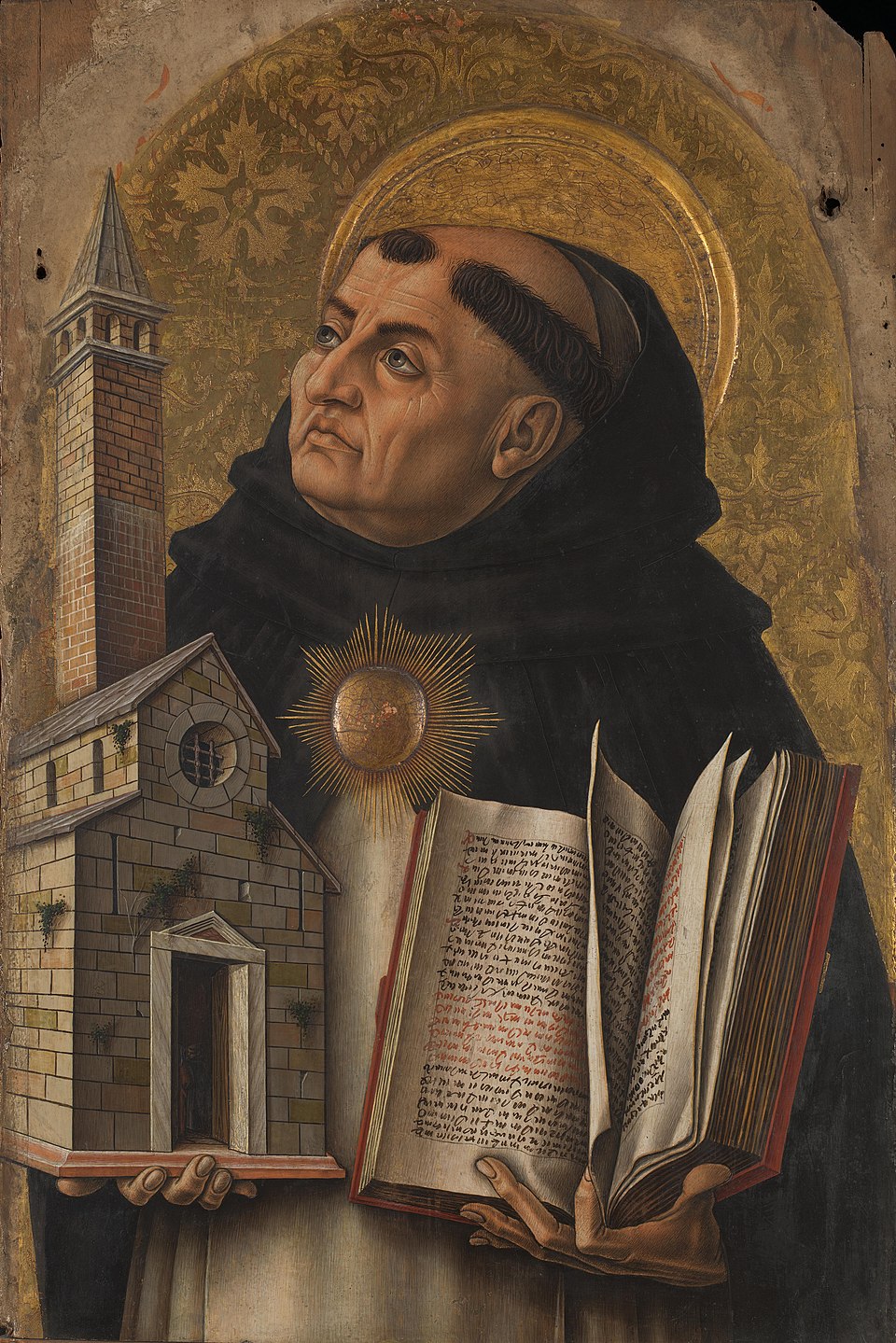

The First Way (the argument from motion) closely follows Aristotle. Aquinas observed that things in the world are in motion — that is, they undergo change from potentiality to actuality. Whatever is moved must be moved by another, and this chain of moved movers cannot proceed to infinity, since then there would be no first mover and consequently no subsequent movers. Therefore, there must be a first unmoved mover, which Aquinas identified with God.3
The Second Way (the argument from efficient causation) parallels the first but applies to the order of efficient causes rather than motion. In the observable world, nothing is found to be the efficient cause of itself, since this would require it to exist prior to itself. Nor can a series of efficient causes proceed to infinity, because removing the first cause would eliminate all subsequent causes and effects. Therefore, a first efficient cause exists.3
The Third Way (the argument from contingency) introduces a different line of reasoning. Aquinas observed that some things in the world are contingent — they are capable of existing and not existing, as shown by the fact that they come into being and pass away. If everything were merely contingent, then at some point nothing would have existed, and since nothing can come from nothing, nothing would exist now. Therefore, not everything is contingent; there must be at least one necessary being that owes its necessity to nothing outside itself, and this is God.3
A crucial and often misunderstood feature of Aquinas's arguments is that they do not require the universe to have had a temporal beginning. Aquinas explicitly held that reason alone could not demonstrate that the world had a beginning in time; he accepted this as a truth of faith rather than philosophy. His arguments concern the concurrent or hierarchical dependence of effects on causes at each moment, not a linear temporal sequence stretching back to a first event. Even if the universe were eternal, Aquinas maintained, it would still require an uncaused cause to sustain it in existence at every instant.3, 9
The Leibnizian argument from contingency
Gottfried Wilhelm Leibniz (1646–1716) formulated what is widely regarded as the most sophisticated version of the contingency argument. In his 1697 essay On the Ultimate Origination of Things, Leibniz asked what he considered the most fundamental question in philosophy: "Why is there something rather than nothing?"4 His answer rested on the principle of sufficient reason (PSR): for every fact, there must be a sufficient reason why it is so and not otherwise.
Leibniz argued that the sufficient reason for the existence of the world cannot be found within the series of contingent things that constitute the world, even if that series were infinite. Each contingent state of the world is explained by its predecessor, but the entire series of contingent states requires an explanation external to itself. Even an eternally existing universe, with no first moment, would still be contingent and therefore require a sufficient reason for its existence as a whole. That reason must be found in a necessary being — one whose existence is self-explanatory and whose non-existence is impossible — and this being Leibniz identified with God.4, 9
The Leibnizian version differs from Aquinas's Third Way in important respects. Where Aquinas argued from the possibility of non-existence of individual things to the need for a necessary being, Leibniz made the more ambitious claim that the entire contingent universe, taken as a totality, requires an explanation that transcends it. The force of the argument depends entirely on the truth of the PSR. If every contingent fact genuinely requires a sufficient reason, and if the universe as a whole is contingent, then the argument appears to follow with deductive force.9, 11
The eighteenth-century philosopher Samuel Clarke developed a related argument that William Rowe later took as the most fruitful version of the cosmological argument for contemporary philosophical analysis. Clarke's argument makes the principle of sufficient reason explicit and applies it systematically, requiring that the existence of dependent beings be ultimately explained by an independent, self-existent being.9
The Kalam cosmological argument
The Kalam cosmological argument takes a fundamentally different approach from the Leibnizian and Thomistic versions by arguing that the universe had a temporal beginning and therefore requires a cause. The argument's name derives from kalām, the Arabic term for Islamic scholastic theology, in which medieval Muslim philosophers developed detailed arguments for the finitude of the past.5
The eleventh-century Persian philosopher Abū Ḥāmid al-Ghazālī gave one of the most influential formulations in his Tahāfut al-Falāsifah (The Incoherence of the Philosophers), written around 1095. Against the Aristotelian philosophers of his day who maintained that the universe was eternal, al-Ghazālī argued that the existence of an actual infinite number of past events is impossible and that therefore the universe must have begun to exist. Since whatever begins to exist requires a cause, the universe has a cause, which al-Ghazālī identified with God.21
The contemporary American philosopher William Lane Craig revived and expanded the Kalam argument in his 1979 monograph The Kalām Cosmological Argument and has defended it extensively in subsequent publications.5, 6 Craig's formulation can be stated in two premises and a conclusion:
(1) Whatever begins to exist has a cause.
(2) The universe began to exist.
(3) Therefore, the universe has a cause.6
Craig supports premise (1) by appealing to the metaphysical intuition that something cannot come into being from nothing without a cause, and supports premise (2) with both philosophical arguments against the possibility of an actual infinite and scientific evidence from Big Bang cosmology. The philosophical arguments hold that an actually infinite number of things cannot exist in reality (as opposed to mathematics) and that an infinite temporal series of past events cannot be formed by successive addition. The scientific arguments point to the standard Big Bang model's prediction of an initial singularity and to the Borde-Guth-Vilenkin (BGV) theorem, which demonstrates that any universe that has, on average, been expanding throughout its history must have a past spacetime boundary.6, 16
From the conclusion that the universe has a cause, Craig undertakes a conceptual analysis of what properties such a cause must possess. He argues that the cause must be uncaused (to avoid an infinite regress), timeless and spaceless (since it created time and space), immaterial, enormously powerful, and personal — the last because only a personal agent with free will can produce a temporally finite effect from an eternally existing cause.5, 6
Structure of major cosmological argument variants20
| Variant | Key proponents | Starting point | Key principle | Conclusion |
|---|---|---|---|---|
| Argument from motion | Aristotle, Aquinas | Change / motion exists | No infinite regress of movers | Unmoved mover |
| Argument from efficient causation | Aquinas | Efficient causes exist | No infinite regress of causes | First uncaused cause |
| Argument from contingency | Aquinas, Leibniz, Clarke | Contingent beings exist | Principle of sufficient reason | Necessary being |
| Kalam argument | Al-Ghazālī, Craig | The universe began to exist | Whatever begins has a cause | Transcendent personal cause |
| Modal contingency argument | Pruss, Koons | A contingent proposition is true | PSR applied to modal logic | Necessary being |
Modern formulations and defenses
In contemporary analytic philosophy, cosmological arguments have been refined using the tools of modern logic, modal metaphysics, and probability theory. Alexander Pruss has mounted the most extensive modern defense of the principle of sufficient reason, devoting a full monograph to arguing that the PSR is rationally compelling and that its denial leads to unacceptable epistemological consequences. If we cannot assume that events and states of affairs have explanations, Pruss contends, then our entire edifice of empirical reasoning is undermined.11
Pruss formulates a Leibnizian cosmological argument that begins with the claim that there exists a contingent proposition that is true (for example, the proposition that contingent beings exist), invokes the PSR to demand an explanation for the truth of this proposition, argues that the explanation must ultimately terminate in a necessary being, and concludes that a necessary being exists. Pruss responds to the standard objections — including the claim that the PSR is self-refuting, that it leads to modal fatalism, and that brute facts are intelligible — with detailed philosophical arguments.11
Robert Koons has developed a related but distinct version that uses defeasible or probabilistic reasoning rather than the strict PSR. Koons argues that there is a strong default presumption that every wholly contingent state of affairs has a cause, and that denying this presumption constitutes a form of special pleading that requires justification. His argument seeks to avoid the objections that have been raised against the unrestricted PSR while preserving the force of the cosmological argument.12
Craig's defense of the Kalam argument has also evolved in response to criticisms. In his contribution to The Blackwell Companion to Natural Theology, co-authored with James Daniel Sinclair, Craig provided an extensive survey of contemporary cosmological models — including quantum gravity scenarios, string cosmologies, and cyclic models — arguing that none of them successfully eliminates the need for an absolute beginning of the universe.6 Craig has also engaged directly with philosophical critics, responding to objections from J. L. Mackie, Graham Oppy, Wes Morriston, and others regarding the coherence of his premises.23
Classical philosophical objections
David Hume (1711–1776) mounted one of the earliest and most influential critiques of cosmological reasoning. In Part IX of the Dialogues Concerning Natural Religion, published posthumously in 1779, Hume raised several objections through the character of Cleanthes. First, Hume questioned the claim that an infinite series of causes requires an external explanation. If each member of a causal series is explained by its predecessor, Hume argued, then every individual element is accounted for, and demanding a further explanation for the collection as a whole is illegitimate — the collection is nothing over and above its members. This objection targets the principle of sufficient reason directly and anticipates the later distinction between explanations of individual members and explanations of aggregates.7
Hume also challenged the intelligibility of the concept of a necessary being. If a necessary being is one whose non-existence implies a contradiction, Hume argued, then no being can be shown to be necessary through a posteriori reasoning, since whatever we can conceive as existing we can equally conceive as not existing. This objection suggests that the concept of necessary existence is either incoherent or applicable only to abstract objects such as mathematical truths, not to concrete beings.7
Immanuel Kant (1724–1804) developed a different and in some ways more radical critique in the Critique of Pure Reason (1781). In the section on the Antinomies of Pure Reason, Kant argued that questions about whether the world has a beginning in time and whether there exists a necessary being are questions that pure reason is constitutionally incapable of answering. The thesis (the world has a beginning, a necessary being exists) and the antithesis (the world is eternal, no necessary being exists) can both be supported by seemingly valid arguments, revealing not a flaw in one side but a fundamental limitation of human reason when it attempts to extend beyond the bounds of possible experience.8
Kant further argued that every cosmological argument secretly depends on the ontological argument. The cosmological argument establishes at most the existence of a necessary being; to identify this being with God (understood as a supremely perfect being), one must invoke the ontological argument's identification of necessary existence with maximal perfection. Since Kant believed the ontological argument to be fallacious — existence, he argued, is not a real predicate — the cosmological argument inherits its defects.8
J. L. Mackie, in The Miracle of Theism (1982), provided an influential twentieth-century restatement of several of these objections. Against the Kalam argument specifically, Mackie questioned whether the concept of a beginning of all time is coherent and argued that the causal principle (whatever begins to exist has a cause) may not apply to the universe as a whole, which is categorically different from the ordinary objects within it from which the principle is inductively derived.10 Against the Leibnizian version, Mackie objected that the principle of sufficient reason imposes an unreasonably strong demand for explanation — that the universe's existence may simply be a brute fact without further explanation.10
Graham Oppy has offered the most comprehensive contemporary critique in Arguing about Gods (2006). Oppy argues that no version of the cosmological argument succeeds in establishing rational obligation to accept its conclusion. He contends that a naturalist who posits a necessarily existing initial physical state of the universe is in a symmetrical dialectical position with a theist who posits a necessarily existing God — neither has a decisive advantage, and the choice between them must be made on other grounds.13
Cosmological arguments and modern physics
The relationship between cosmological arguments and empirical cosmology is complex and contested. The development of Big Bang cosmology in the twentieth century appeared to some philosophers and theologians to provide striking scientific confirmation of the Kalam argument's second premise — that the universe began to exist. The standard Big Bang model, extrapolated backward, predicts an initial singularity at a finite time in the past, approximately 13.8 billion years ago, at which the density and temperature of the universe were infinite and the known laws of physics break down.22
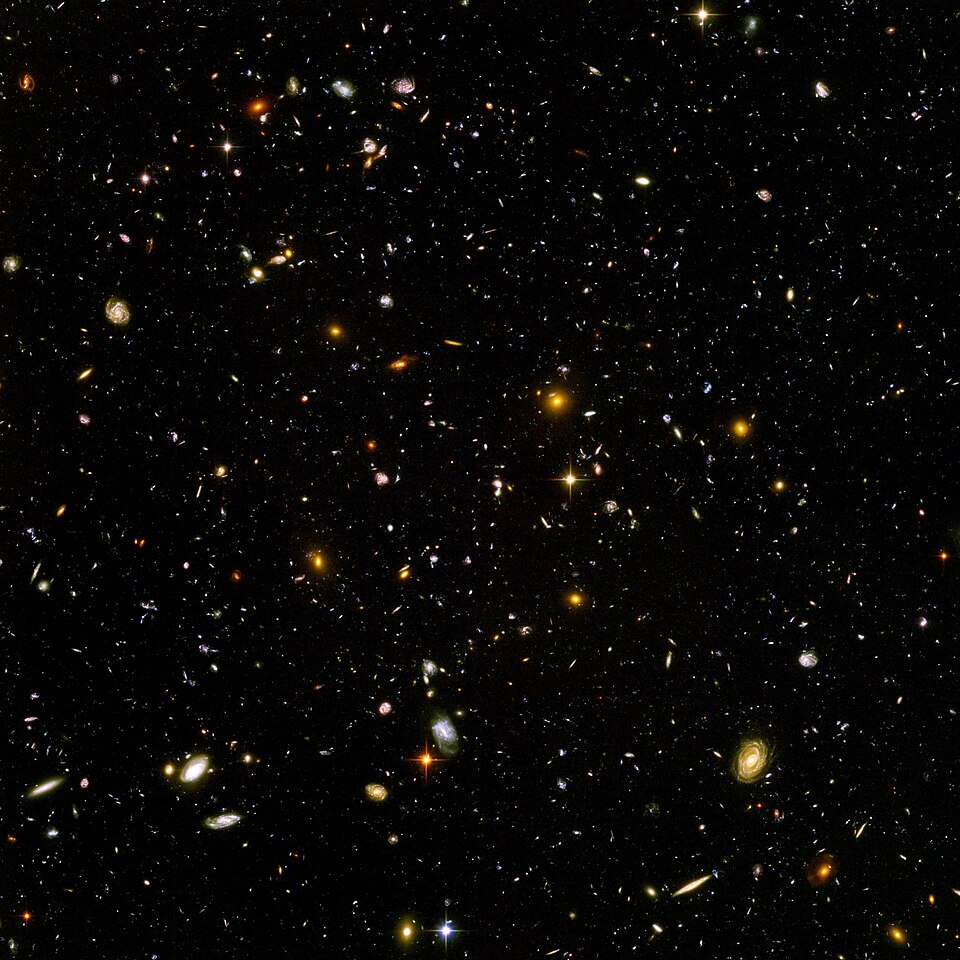

Craig and other defenders of the Kalam argument have drawn heavily on this convergence between physics and philosophy. The Borde-Guth-Vilenkin theorem, published in 2003, provides an especially powerful result: any spacetime region in which the average expansion rate is positive (that is, the Hubble parameter averaged along past-directed geodesics is greater than zero) must be geodesically incomplete in the past. This means that such a region must have a past boundary — a beginning — regardless of the specific energy conditions or physical model assumed.16 Craig has argued that this theorem applies to the observable universe and to all plausible inflationary models, establishing the beginning of the universe as a robust scientific result.6
However, the interpretation of these results for philosophy is disputed. Physicists and philosophers of physics have raised several important qualifications. First, the initial singularity of the standard Big Bang model is generally regarded by physicists not as a physical event but as a signal that general relativity breaks down at extreme densities and that a quantum theory of gravity is needed to describe the earliest moments. The singularity does not, by itself, establish that the universe had an absolute temporal beginning as opposed to a transition to a physical regime not yet understood.19
Second, the BGV theorem establishes that certain spacetimes must be past-incomplete, but it does not by itself specify what lies at the boundary. As Alexander Vilenkin has noted, the theorem shows that there must be a boundary in the past, but the physics of that boundary is not determined by the theorem and could involve quantum gravitational processes that do not conform to classical notions of a "beginning."16
Quantum cosmology and alternatives to a beginning
Several proposals in theoretical physics seek to describe the very early universe in ways that potentially avoid an absolute temporal beginning, providing material for scientific responses to the Kalam argument.
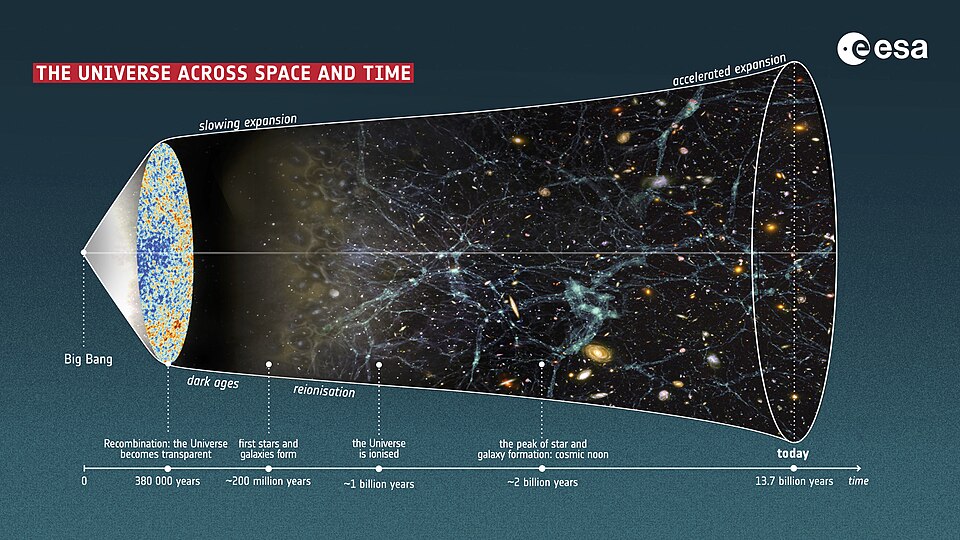

The Hartle-Hawking no-boundary proposal (1983) is perhaps the most famous. James Hartle and Stephen Hawking proposed that the quantum state of the universe is determined by a path integral over all compact, positive-definite four-dimensional geometries — roughly, all possible spatial histories of the universe that have no boundary or edge. In this framework, time as we experience it emerges gradually from a Euclidean (imaginary-time) regime near the origin of the universe. There is no singular point, no boundary, and in a precise sense no "before" the universe. As Hawking put the point in popular terms, asking what came before the Big Bang is like asking what is south of the South Pole — the question presupposes a structure that does not exist.14
Defenders of the Kalam argument have responded that the no-boundary proposal does not truly eliminate the beginning of the universe but merely redescribes it. The universe still has a finite past, even if the initial state is smooth rather than singular, and it is this finitude that the Kalam argument appeals to. Critics counter that the proposal undermines the ordinary concept of temporal beginning on which the causal premise depends, since in the no-boundary model there is no moment at which the universe "begins to exist" in the sense of transitioning from non-existence to existence.6, 19
Alexander Vilenkin proposed in 1982 that the universe could have originated through quantum tunnelling from nothing — a process in which a universe nucleates spontaneously from a state of zero spatial volume through a quantum mechanical effect analogous to the tunnelling of particles through potential barriers.15 Vilenkin's "nothing" is not the philosopher's absolute nothing (the absence of all being) but a state with no classical spacetime, no matter, and no energy — a quantum vacuum state governed by the laws of quantum mechanics. Critics on both sides of the debate have observed that this "nothing" still presupposes the existence of quantum laws, and the philosophical question of why those laws exist remains unanswered.15, 19
The cyclic model proposed by Paul Steinhardt and Neil Turok (2002) offers yet another alternative. In this model, the universe undergoes an endless sequence of cycles, each beginning with a "big bang" and ending with a "big crunch," followed by a new expansion. The model draws on concepts from M-theory and the ekpyrotic scenario and aims to explain observed features of the universe — flatness, homogeneity, the accelerating expansion — without requiring an initial singularity or inflationary epoch.17 If the cyclic model is correct and the sequence of cycles extends infinitely into the past, the universe would have no beginning, and the Kalam argument's second premise would be false.
Anthony Aguirre and Steven Gratton (2002) constructed a model of steady-state eternal inflation that is geodesically complete — that is, it has no past boundary — by exploiting a time-reversal symmetry in de Sitter space. In their model, the universe expands in both temporal directions from a central hypersurface, with time running "forward" in both halves. This construction technically satisfies the conditions of the BGV theorem (which requires a positive average expansion rate) by having different regions of spacetime expand in different temporal directions.18 Whether such models are physically realistic and whether they truly avoid a beginning remain subjects of active debate among cosmologists.
The physicist Sean Carroll has argued that the demand for a "cause" or "explanation" of the universe may be fundamentally misguided when applied to the universe as a whole. Modern fundamental physics, Carroll contends, does not operate with the Aristotelian or Leibnizian notion of sufficient reason. The laws of physics describe patterns and regularities within the universe but do not guarantee that the universe itself admits of the kind of external explanation that cosmological arguments demand. Any chain of explanation must ultimately bottom out in a set of brute facts — whether those facts concern a necessary being or the quantum state of the universe is a question that physics alone cannot settle.19
The objection from special pleading and the problem of the necessary being
One of the most persistent objections to cosmological arguments is the charge of special pleading. If everything requires a cause or explanation, critics ask, then what caused God? If the answer is that God is an exception — an uncaused cause or self-explanatory necessary being — then the argument appears to apply its central causal or explanatory principle to everything except the entity it concludes to, which seems arbitrary.7, 10
Defenders of cosmological arguments respond that the objection rests on a misunderstanding of their premises. The Kalam argument, for instance, does not assert that "everything has a cause" but rather that "whatever begins to exist has a cause." Since God, by hypothesis, did not begin to exist, the principle does not apply to God, and no special pleading is involved.5, 6 Similarly, proponents of the contingency argument do not claim that everything requires an external explanation but rather that every contingent thing does; a necessary being, by definition, carries its own explanation in its nature and requires no external cause.11
Critics reply that these responses simply relocate the problem. The naturalist can equally posit that the universe itself (or some fundamental physical state) is the necessary being, or that the universe began to exist but that the beginning is a brute fact without a cause. Oppy has argued that positing a necessarily existing physical cosmos is no more and no less problematic than positing a necessarily existing God, and that the cosmological argument therefore fails to establish a rational preference for theism over naturalism.13
The status of the necessary being also raises difficult questions of its own. Even if the argument establishes that a necessary being exists, it does not immediately follow that this being has the attributes traditionally ascribed to God — omniscience, omnipotence, moral perfection, personhood, and so on. This is the so-called "gap problem": the logical distance between the conclusion of the cosmological argument (a first cause or necessary being exists) and the God of classical theism is substantial, and bridging it requires additional philosophical arguments that go beyond the cosmological argument itself.9, 20
The problem of infinite regress
The question of whether an infinite regress of causes, explanations, or past events is possible is central to nearly every form of the cosmological argument. Aristotle, Aquinas, and Craig all maintain that some relevant kind of infinite regress is impossible, but the nature and force of this claim has been extensively debated.20
Aquinas's arguments against infinite regress apply specifically to what later philosophers called "essentially ordered" (or "per se ordered") causal series, in which each member depends simultaneously on the causal activity of its predecessor, as distinguished from "accidentally ordered" (or "per accidens") series, in which each member was produced by its predecessor but no longer depends on it for its continued existence. A chain of ancestors is accidentally ordered — a grandchild exists even after the grandparents have died. But a chain in which a hand moves a stick that moves a stone is essentially ordered — remove the hand, and the stone stops moving. Aquinas denied that an essentially ordered series can be infinite while accepting that an accidentally ordered one potentially can.3, 9
The Kalam argument, by contrast, denies the possibility of an actually infinite accidentally ordered series of past events. Craig argues that while the concept of infinity is indispensable in mathematics, an actually infinite collection of concrete, mind-independent entities cannot exist in reality. The paradoxes that would result from an actual infinite — such as Hilbert's Hotel, where a fully occupied hotel with infinitely many rooms can always accommodate additional guests — are taken to show that actual infinites are metaphysically impossible, not merely physically unrealisable.5, 6
Critics have challenged this reasoning on multiple fronts. Some philosophers, including Oppy and Wes Morriston, argue that the "paradoxes" of the actual infinite are not genuine contradictions but merely counterintuitive features of infinite sets that mathematicians work with routinely. The strangeness of Hilbert's Hotel, they contend, reflects the unfamiliarity of infinity rather than its impossibility.13 Morriston has further argued that if the future can be potentially infinite (which Craig accepts), then there is no principled reason to deny that the past can be actually infinite, since the distinction between the two relies on a metaphysics of time (the A-theory, on which only the present exists) that is itself controversial.13
Defenders of the argument respond that the asymmetry between past and future is genuine: the past consists of events that have already occurred and therefore constitute a completed collection, whereas the future is always in the process of being formed and is never a completed totality. Whether this distinction can bear the weight placed on it remains one of the most actively debated issues in the philosophy of the cosmological argument.6, 20
Current status of the debate
The cosmological argument remains one of the most vigorously debated topics in the philosophy of religion and in the intersection of philosophy with theoretical physics. No consensus exists among professional philosophers either for or against the argument's soundness. Surveys of philosophers of religion show that a significant minority find some version of the argument compelling, while a majority of philosophers in general do not — though the reasons for rejection vary widely, from denial of the principle of sufficient reason to scepticism about the concept of necessary existence to acceptance of brute facts.20
Several features of the contemporary debate are noteworthy. First, the arguments have become increasingly technical and sophisticated on both sides. Modern defenses by Pruss, Koons, and Craig employ the formal apparatus of modal logic, Bayesian probability theory, and mereology (the theory of parts and wholes), while critics such as Oppy and Morriston engage with the same tools at the same level of precision.11, 12, 13
Second, the intersection with physical cosmology has become both richer and more contested. The BGV theorem, the no-boundary proposal, quantum tunnelling models, cyclic cosmologies, and eternal inflation each contribute empirical and theoretical considerations that bear on the question of whether the universe had a beginning. However, no existing cosmological model has achieved the status of an established scientific theory regarding the ultimate origin (or lack thereof) of the universe. All proposals for the very earliest moments of cosmic history involve speculative physics that has not been empirically tested, and the question of whether the universe had an absolute beginning remains open from the standpoint of physics alone.6, 16, 19
Third, the debate has increasingly focused on metaquestions about the nature of explanation itself. Is the principle of sufficient reason a necessary truth, a defeasible presumption, or an unjustified assumption? Can the universe as a whole be the kind of thing that requires or admits of an explanation? Is the demand for a reason why something exists rather than nothing a legitimate philosophical question or a conceptual confusion? These metaquestions are arguably more fundamental than the cosmological arguments themselves and may ultimately determine their fate.9, 11, 19
What is clear is that cosmological arguments, in their various forms, continue to provoke serious philosophical engagement more than two millennia after Aristotle first articulated the reasoning. Whether they succeed or fail, they raise questions about causation, explanation, contingency, infinity, and the relationship between philosophy and physics that remain among the deepest in human thought.20