Overview
- Lookback time is the difference between the age of the universe at observation and the age of the universe when a distant object emitted its light, meaning that every astronomical observation is necessarily a view into the past — nearby galaxies are seen as they were millions of years ago, and the cosmic microwave background reveals the universe at an age of only 380,000 years.
- Because the speed of light is finite and the universe has a finite age of approximately 13.8 billion years, there exists a maximum lookback time corresponding to the most distant observable signals, defining the boundary of the observable universe at a comoving distance of about 46.3 billion light-years due to the cumulative expansion of space during the light's journey.
- The relationship between lookback time and redshift is not linear but depends on the cosmological parameters — the matter density, radiation density, and dark energy density of the universe — making lookback time a probe of cosmic expansion history that has been precisely calibrated by missions such as WMAP and Planck.
Light travels at a finite speed — approximately 299,792 kilometres per second in vacuum — and the universe has a finite age of roughly 13.8 billion years.6 Together, these two facts produce a profound observational consequence: every astronomical observation is necessarily a view into the past. The light arriving at a telescope today from a galaxy one billion light-years away was emitted one billion years ago, so the galaxy is seen not as it exists now but as it existed when the universe was roughly 12.8 billion years old. This interval between the moment of emission and the moment of observation is called the lookback time, and it is one of the most fundamental distance-related quantities in observational cosmology.1, 3 The concept became practically important once Edwin Hubble and Milton Humason established that galaxies are receding at velocities proportional to their distances, implying that the universe is expanding and that more distant objects are seen at earlier cosmic epochs.4, 5
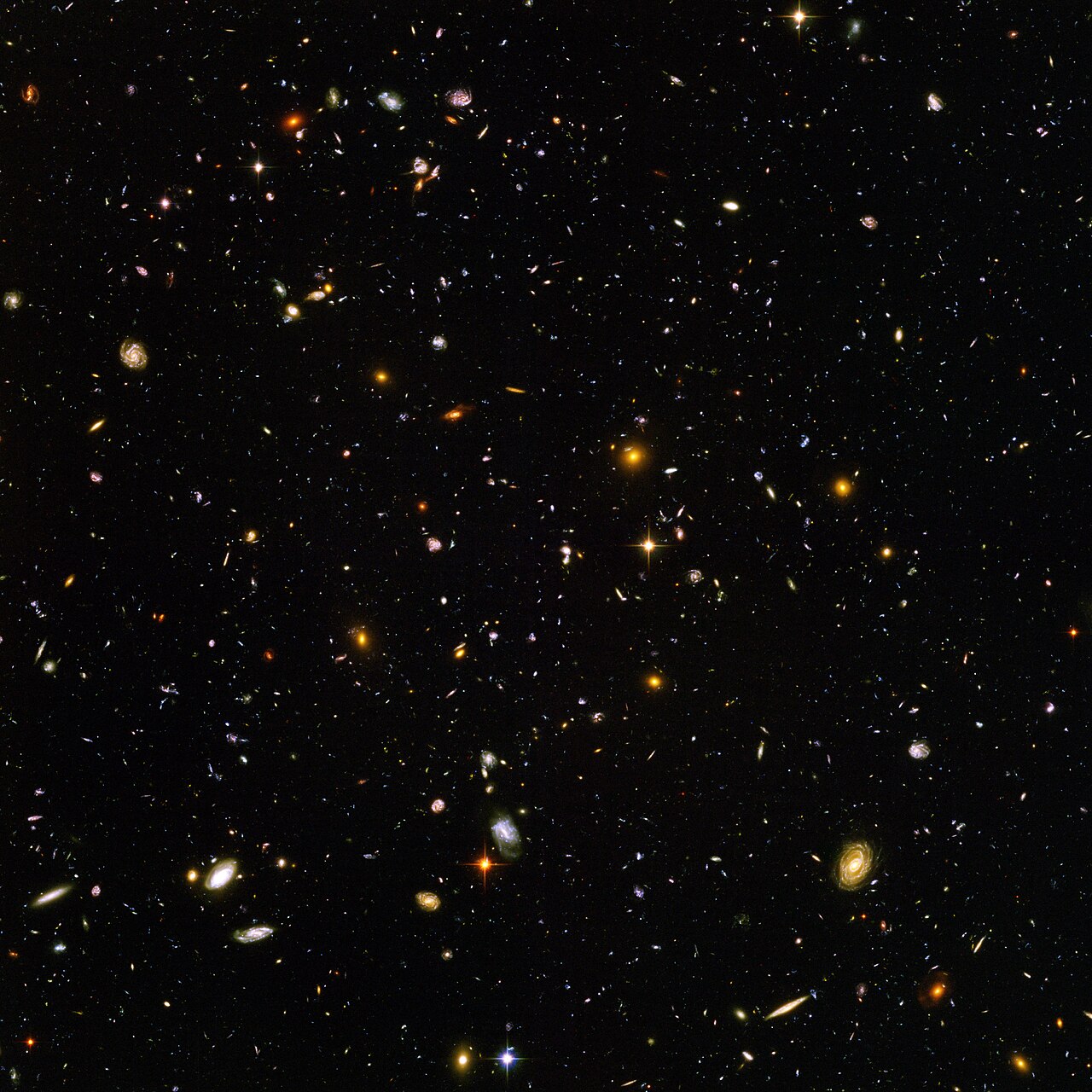

Lookback time transforms the night sky into a time machine. A nearby star is seen as it was years or decades ago; the Andromeda Galaxy is observed as it appeared roughly 2.5 million years in the past; a quasar at redshift z = 7 is viewed when the universe was only about 750 million years old, less than six percent of its present age.2, 14 The deepest astronomical observations peer back to within a few hundred million years of the Big Bang itself, and the cosmic microwave background radiation represents a lookback time of approximately 13.4 billion years, revealing the universe at an age of only 380,000 years when atoms first formed and photons began to travel freely through space.6, 17
Definition and relation to redshift
In formal cosmological terms, lookback time tL is defined as the difference between the present cosmic time t0 (the current age of the universe) and the cosmic time tem at which a distant source emitted the photons now being observed: tL = t0 − tem.3, 14 For objects at cosmological distances, the lookback time is most naturally expressed as a function of redshift z, which measures how much the wavelength of light has been stretched by the expansion of space during the photon's journey. A source at redshift z emitted its light when the universe's scale factor was a fraction 1/(1 + z) of its present value; higher redshifts correspond to earlier epochs and therefore to longer lookback times.1, 2
In the simplest case of a matter-dominated, spatially flat universe with no dark energy (the Einstein–de Sitter model), the lookback time has an analytic form: tL = t0[1 − (1 + z)−3/2], where t0 = 2/(3H0) is the age of the universe and H0 is the Hubble constant.2, 15 In the real universe, which contains radiation, matter, and dark energy, no such simple closed-form expression exists. The lookback time must instead be computed numerically by integrating the Friedmann equation, which relates the expansion rate to the energy content of the universe at each epoch.3, 14
The integral takes the form tL(z) = ∫0z dz′ / [(1 + z′) H(z′)], where H(z) is the Hubble parameter as a function of redshift. This parameter depends on the present-day densities of radiation (Ωr), matter (Ωm), and dark energy (ΩΛ), as well as the curvature of space and the dark energy equation of state. Because these cosmological parameters govern the expansion history, the mapping from redshift to lookback time encodes information about the composition and dynamics of the universe.3, 13
Lookback time in the standard cosmological model
Under the best-fit parameters from the Planck satellite — H0 ≈ 67.4 km s−1 Mpc−1, Ωm ≈ 0.315, ΩΛ ≈ 0.685, and a total age of 13.797 ± 0.023 billion years — the lookback time as a function of redshift takes a characteristic shape.6 At low redshifts, the relationship is approximately linear: a galaxy at z = 0.01 (roughly 140 million light-years away in comoving distance) has a lookback time of about 140 million years, consistent with the naive expectation from multiplying distance by the speed of light.3 As redshift increases, however, the relationship becomes markedly nonlinear. An object at z = 1 has a lookback time of roughly 7.9 billion years — slightly more than half the age of the universe — while an object at z = 2 has a lookback time of about 10.4 billion years, and z = 5 corresponds to approximately 12.5 billion years.6, 15
This nonlinearity arises because the expansion rate of the universe has changed over time. During the first several billion years, the expansion was decelerating under the gravitational influence of matter and radiation. Approximately five billion years ago, the repulsive effect of dark energy began to dominate, and the expansion began to accelerate.9, 10 These transitions alter the rate at which cosmic time accumulates per unit of redshift, compressing the lookback time at high z relative to a constant-expansion model. The result is that the lookback time asymptotically approaches the age of the universe as redshift increases toward infinity, with diminishing gains at very high redshifts: the difference in lookback time between z = 6 and z = 10 is only about 500 million years, compared to roughly 3.5 billion years between z = 0.5 and z = 1.6, 14
Lookback time versus other distance measures
Lookback time is one of several distance-related quantities in cosmology, and it is important not to confuse it with physical distance. In an expanding universe, the concept of "distance" is ambiguous because space itself is growing. The distance measures most commonly used alongside lookback time include proper distance (the distance measured at a single instant of cosmic time), comoving distance (which factors out the expansion so that objects at rest with respect to the cosmic flow maintain constant coordinates), luminosity distance (derived from the inverse-square law relating observed flux to intrinsic luminosity), and angular diameter distance (derived from the apparent angular size of an object of known physical size).3, 18
The "light-travel distance" — defined as c × tL, where c is the speed of light — is numerically equal to the lookback time expressed in light-years and is perhaps the most intuitive distance measure for general audiences.8 When astronomers say that a galaxy is "13.4 billion light-years away," they typically mean that the light has been travelling for 13.4 billion years. However, due to the expansion of space during the photon's journey, the present-day proper distance to that galaxy is considerably larger. For example, the cosmic microwave background was emitted from matter that is now approximately 46.3 billion light-years away in comoving distance, even though its light-travel distance (lookback time expressed in light-years) is only about 13.8 billion light-years.6, 14 This discrepancy is a direct consequence of the expansion of space: the photons have been travelling through a universe that has been growing throughout their journey, so the source has moved far beyond the distance that light could traverse in a static universe of the same age.1, 2
The observable universe and the maximum lookback time
The finite speed of light combined with the finite age of the universe imposes a fundamental horizon on observation. The maximum possible lookback time is equal to the age of the universe itself: no signal can reach Earth from an event that occurred before the Big Bang, because there was no "before" in the standard cosmological model.1, 14 The boundary defined by this maximum lookback time is the particle horizon — the surface enclosing all events from which light has had time to reach the observer since the beginning of the universe. In the Planck cosmology, the comoving radius of the particle horizon is approximately 46.3 billion light-years, defining the observable universe as a sphere roughly 93 billion light-years in diameter.6
The existence of the particle horizon means that regions of the universe beyond it are not merely unseen but fundamentally unobservable at present. Light from those regions has not had enough time to reach Earth since the Big Bang, regardless of the power of the telescope. As the universe ages, the particle horizon expands and previously unobservable regions come into view — but in an accelerating universe, this process is counteracted by the cosmological event horizon, beyond which objects are receding faster than light (in the sense that the recession velocity due to expansion exceeds c). In the ΛCDM model, the event horizon asymptotically approaches a comoving radius of about 17 billion light-years, meaning that any galaxy currently beyond that distance will never be observable, no matter how long one waits.13, 14
Observing cosmic history
The lookback time framework means that astronomers can directly observe the universe at different epochs by looking at objects at different redshifts. This capability is the foundation of observational cosmology and galaxy evolution studies. By surveying galaxies across a range of redshifts, astronomers have assembled a remarkably detailed history of cosmic star formation, tracing the rise and fall of the cosmic star formation rate density from its peak at z ≈ 1.5–2.5 (roughly 10–11 billion years ago) to the present day, when it has declined by roughly an order of magnitude.16
At the highest currently accessible redshifts, observations probe the era of the first galaxies. The galaxy GN-z11, originally identified at a photometric redshift of z ≈ 11.1 using the Hubble Space Telescope, was spectroscopically confirmed at z = 10.60 by the James Webb Space Telescope's NIRSpec instrument, corresponding to a lookback time of approximately 13.4 billion years — when the universe was only about 430 million years old.11, 12 JWST has since pushed this frontier further, identifying candidate galaxies at redshifts beyond z = 13, corresponding to lookback times within 300 million years of the Big Bang. These extreme lookback times reveal a universe in the process of assembling its first stellar populations, offering direct observational constraints on the formation of the earliest cosmic structures.16
The cosmic microwave background represents the ultimate lookback time achievable with electromagnetic radiation. Emitted at the epoch of recombination when the universe was approximately 380,000 years old (z ≈ 1,100), the CMB is a snapshot of the universe when it first became transparent to photons.6, 17 The tiny temperature fluctuations imprinted on the CMB — at the level of one part in 100,000 — encode the seeds of all subsequent cosmic structure, from galaxies and clusters to the filamentary cosmic web that pervades the universe today. Between the CMB epoch and the appearance of the first stars lies the so-called "cosmic dark ages," a period of several hundred million years during which the universe contained no luminous sources and which remains largely inaccessible to current observational techniques.7, 17
Lookback time as a cosmological probe
Because the mapping from redshift to lookback time depends on the cosmological parameters, precise measurements of the age of the universe at different redshifts can be used to constrain these parameters independently of other methods. The "cosmic chronometer" approach uses the differential age evolution of passively evolving galaxies — galaxies that formed their stars in a single burst and have been aging without further star formation — to measure dz/dt at various redshifts, thereby directly probing the Hubble parameter H(z) without assuming a particular cosmological model.14, 15
The sensitivity of lookback time to dark energy is most pronounced at intermediate redshifts (z ≈ 0.5–2), where the transition from matter domination to dark energy domination occurred. During matter domination, the expansion decelerates and cosmic time accumulates relatively quickly per unit of redshift; during dark energy domination, the expansion accelerates and cosmic time accumulates more slowly. The precise redshift at which this transition occurs, and the rate at which it happens, depend on the dark energy density and equation of state, making lookback time measurements at these redshifts a complementary probe alongside Type Ia supernovae, baryon acoustic oscillations, and the cosmic microwave background.9, 10, 13
Lookback time thus occupies a dual role in cosmology. Conceptually, it provides the most intuitive answer to the question "how far back in time are we seeing?" and underlies the remarkable fact that the observable universe is also a visible history of itself. Technically, it is a derived quantity that encodes the integral of the expansion history, connecting the redshift of an observed source to the age of the universe when its light was emitted. Every image of a distant galaxy, every spectrum of a high-redshift quasar, and every fluctuation in the cosmic microwave background is an artifact of lookback time — evidence that the finite speed of light grants astronomy an unparalleled privilege among the sciences: the ability to observe the past directly.1, 2, 14
References
Nine-year Wilkinson Microwave Anisotropy Probe (WMAP) observations: cosmological parameter results
Observational evidence from supernovae for an accelerating universe and a cosmological constant
JADES NIRSpec spectroscopy of GN-z11: Lyman-α emission and possible enhanced nitrogen abundance in a z = 10.60 luminous galaxy