Overview
- Dark matter is a form of matter that neither emits nor absorbs electromagnetic radiation. It accounts for approximately 27% of the universe's total energy content and about 85% of all matter, yet has never been directly observed in a laboratory.
- Its existence is inferred from at least five independent lines of observational evidence: galaxy rotation curves, gravitational lensing, the cosmic microwave background, large-scale structure formation, and the Bullet Cluster merger.
- The leading particle physics candidates—WIMPs, axions, and sterile neutrinos—are the subject of a worldwide experimental program, but no confirmed detection has yet been made.
Dark matter is a hypothetical form of matter that does not emit, absorb, or reflect electromagnetic radiation and therefore cannot be directly observed with any telescope sensitive to light, radio waves, X-rays, or any other part of the electromagnetic spectrum. Its presence is inferred entirely from the gravitational influence it exerts on visible matter and on light itself. According to the most precise cosmological measurements yet made, dark matter constitutes approximately 26.8% of the total energy content of the universe, compared to only 4.9% for the ordinary baryonic matter that makes up stars, planets, gas, and every structure visible to astronomers.4 The remaining 68.3% is attributed to dark energy, the poorly understood component driving the accelerating expansion of the universe.4, 23 Dark matter is therefore not a minor correction to standard cosmology; it is the dominant component of all matter, outweighing visible matter by a ratio of roughly five to one.
Zwicky and the Coma Cluster
The first scientific argument for the existence of invisible mass in a galaxy cluster was advanced by Swiss-American astronomer Fritz Zwicky in 1933. Zwicky measured the radial velocities of galaxies within the Coma Cluster, a rich concentration of over a thousand galaxies approximately 320 million light-years from Earth, using the redshift of their spectral lines.1 Applying the virial theorem—a classical mechanics relation that connects the kinetic energy of a gravitationally bound system to its potential energy—Zwicky estimated the total mass of the cluster required to keep the member galaxies gravitationally bound. The result was startling: the dynamical mass implied by the galaxies' velocities was several hundred times larger than the mass that could be accounted for by the visible light emitted by the galaxies themselves.1
Zwicky coined the German term dunkle Materie—dark matter—to describe this unseen component, and he speculated that it might take the form of cold, dark stars, gas, or other objects too faint to detect with the instruments of his era.1 His results were received with considerable skepticism at the time, in part because measurements of galaxy velocities in the 1930s carried large uncertainties. It would take four decades for a second, far more direct line of evidence to emerge from an entirely different observational technique, transforming Zwicky's curious anomaly into a mainstream scientific problem.
Rubin, Ford, and galaxy rotation curves
In 1970, Vera Rubin and W. Kent Ford Jr. published a detailed spectroscopic study of the rotational velocities of gas and stars in the Andromeda Galaxy (M31). By measuring the Doppler shifts of emission lines at increasing distances from the galactic center, they were able to construct a rotation curve—a plot of orbital speed as a function of radius.2 Newtonian mechanics predicts a specific shape for this curve. In the solar system, for example, planets far from the Sun move more slowly than those nearby, because gravitational force weakens with distance and the vast majority of the system's mass is concentrated at the center. A galaxy in which most mass is concentrated in the luminous central bulge should display the same behavior: rotational velocities should rise steeply near the nucleus, reach a peak, and then fall off gradually with distance in a pattern called Keplerian decline.


Rubin and Ford did not observe Keplerian decline. Instead, the rotation curve of M31 remained flat—orbital velocities stayed approximately constant at large radii, rather than decreasing as the visible light of the galaxy faded away.2 In 1978, Rubin, Ford, and Norbert Thonnard extended this analysis to a sample of ten high-luminosity spiral galaxies spanning a wide range of types and luminosities. All ten exhibited flat or gently rising rotation curves extending to the limits of their measurable extent, a result wholly inconsistent with the mass distribution traced by the visible stellar disk.3 The only way to reconcile the observed velocities with Newtonian dynamics was to invoke a large amount of additional, invisible mass distributed in a roughly spherical halo surrounding each galaxy—a dark matter halo extending far beyond the visible stellar disk.3, 19
These findings, replicated across hundreds of subsequent studies, established that the mass-to-light ratio of spiral galaxies increases dramatically with radius: the outer regions contain far more mass per unit luminosity than the inner disk. This behavior is precisely what is expected if each galaxy is embedded in a much larger, spherically distributed dark matter halo whose density profile falls off more gradually than the luminous stellar component.19 In 2020, the American Astronomical Society awarded Rubin and Ford's 1970 paper the status of a landmark publication in recognition of its foundational importance to modern cosmology.
Cosmic energy budget: contributions from dark energy, dark matter, and baryonic matter4
Gravitational lensing
A second class of evidence for dark matter comes from the gravitational lensing of light. Einstein's general theory of relativity predicts that massive objects curve the fabric of spacetime, causing light rays passing nearby to follow curved paths. This effect was first confirmed during the 1919 solar eclipse, and it has since become one of the most powerful tools in observational cosmology. When a massive foreground object—a galaxy or a galaxy cluster—lies between an observer and a more distant background source, the foreground mass acts as a gravitational lens, bending and magnifying the background light.6
Gravitational lensing is sensitive to all forms of mass, including dark matter, regardless of whether that mass emits light. Astronomers distinguish between strong lensing, which produces dramatic arcs and multiple images of background sources when the alignment is nearly perfect, and weak lensing, which produces subtle statistical distortions of many background galaxy shapes and is sensitive to the projected mass distribution of the foreground structure along the line of sight.6, 17 In both regimes, the mass inferred from lensing systematically exceeds the mass that can be attributed to the visible stars and hot gas, with the discrepancy increasing at larger radii from the center of a cluster. This excess mass traces the same large, roughly spherical distribution inferred from galaxy rotation curves—the dark matter halo.6, 17
Weak gravitational lensing surveys have been used to map the dark matter distribution on cosmological scales. Projects such as the Canada-France-Hawaii Telescope Lensing Survey (CFHTLenS) and, more recently, the Dark Energy Survey (DES) and the Kilo-Degree Survey (KiDS) have measured the statistical correlation of galaxy shape distortions across hundreds of square degrees of sky, producing maps of the projected dark matter density consistent with the predictions of cold dark matter cosmology.17
The Bullet Cluster
Perhaps the single most direct observational evidence for dark matter as a physical substance, as opposed to a modification of gravity, comes from the Bullet Cluster (1E 0657-558), a system consisting of two galaxy clusters that have passed through each other at high velocity. The collision was studied in detail by Clowe and colleagues in a landmark 2006 paper that was widely described as providing an empirical proof of the existence of dark matter.5
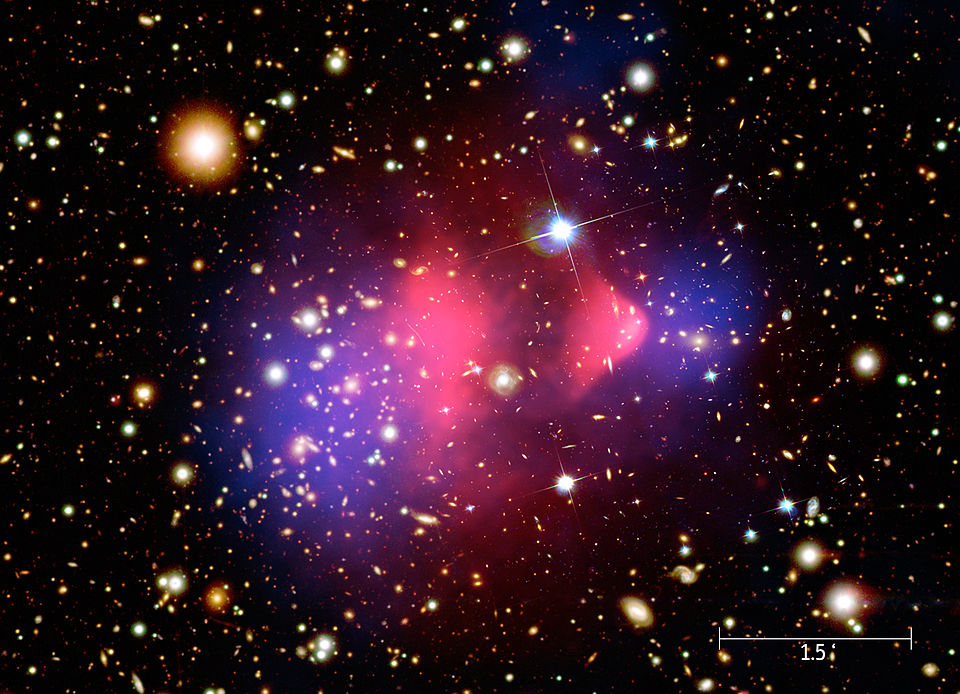

When two galaxy clusters collide, the individual stars and dark matter particles, if dark matter exists, pass through each other largely unimpeded: the galaxies are so sparsely distributed that direct stellar collisions are vanishingly rare, and dark matter interacts only gravitationally. The hot intracluster gas, however, which constitutes the majority of the ordinary baryonic mass in a cluster, is collisional: it interacts electromagnetically with itself and slows down, creating a shock front. In the Bullet Cluster, this shock is clearly visible as a bow-shaped feature in X-ray observations made by the Chandra X-ray Observatory.5
Clowe and colleagues combined the X-ray data, which traces the baryonic gas, with weak gravitational lensing maps, which trace the total projected mass distribution regardless of its nature. The result was unambiguous: the center of mass of each cluster, as determined by lensing, had separated spatially from the hot gas visible in X-rays, with the mass peaks coinciding with the positions of the galaxies.5 The most natural interpretation is that the bulk of the mass—the dark matter—behaved collisionlessly and passed through the merger zone like the galaxies, while the gas was slowed and displaced by ram pressure. This spatial separation of the gravitational mass from the baryonic mass provides evidence for dark matter that is difficult to explain within purely modified-gravity frameworks, since any modification of gravity must apply to all matter equally.5, 18
The CMB and large-scale structure
Independent evidence for dark matter comes from observations of the cosmic microwave background (CMB), the thermal radiation left over from the epoch approximately 380,000 years after the Big Bang when the universe had cooled enough for protons and electrons to combine into neutral hydrogen atoms, allowing photons to travel freely for the first time.

The CMB is not perfectly uniform; it contains tiny temperature fluctuations of about one part in 100,000 that reflect density fluctuations in the early universe, from which all the large-scale structure observed today ultimately grew.4
The detailed pattern of these temperature fluctuations, measured with extraordinary precision by the Wilkinson Microwave Anisotropy Probe (WMAP) and the Planck satellite, encodes the relative densities of baryonic matter, dark matter, and dark energy at the time of last scattering. A universe containing only baryonic matter would produce a CMB power spectrum with a characteristic pattern of acoustic peaks whose heights and spacings differ quantitatively from what is actually observed. The observed pattern is fully consistent with a universe in which dark matter is roughly five times more abundant than baryonic matter, confirming the proportions inferred from galaxy dynamics and lensing.4 The Planck satellite's 2018 data release determined the dark matter density to be Ωch² = 0.120 ± 0.001, a measurement with sub-percent precision.4
Large-scale structure observations provide a further constraint. The observed distribution of galaxies across the sky, characterized by the galaxy power spectrum measured by surveys such as the Sloan Digital Sky Survey, reflects the gravitational amplification of the early density fluctuations over cosmic time. The characteristic scale imprinted on this distribution by baryon acoustic oscillations—pressure waves that propagated through the early universe's baryon-photon fluid before recombination—serves as a cosmological standard ruler.25 Fitting the observed galaxy power spectrum requires a dark matter component that provides the gravitational scaffolding for structure formation. Models without dark matter fail to reproduce both the amplitude and the shape of the observed structure at all scales simultaneously.7, 14
Dark matter halos and N-body simulations
In the framework of cold dark matter (CDM) cosmology, dark matter is assumed to consist of particles that were moving slowly compared to the speed of light when they decoupled from the rest of the universe's matter and radiation content in the early universe. This "coldness" is important because it determines the scale on which dark matter clumps: cold dark matter can clump on very small scales, allowing the formation of the smallest dwarf galaxies, whereas warm or hot dark matter would have erased small-scale structure.14 In this model, galaxies form inside dark matter halos, overdense regions that collapsed under their own gravity and provided the potential wells into which ordinary baryonic gas subsequently fell, cooling and condensing to form stars.14
N-body simulations, which numerically integrate the gravitational interactions of billions of dark matter particles over cosmic time, have proven to be a powerful tool for testing this framework. The Millennium Simulation, published in 2005 by Springel and colleagues, followed the evolution of approximately ten billion dark matter particles from shortly after the Big Bang to the present day in a cubic volume of space roughly 700 million light-years on a side.8 It produced a web of dark matter filaments, voids, and dense halos whose large-scale arrangement closely matches the observed distribution of galaxies and galaxy clusters, including the characteristic cosmic web structure visible in galaxy redshift surveys.8
The IllustrisTNG project, a more recent suite of simulations that adds baryonic physics—gas dynamics, star formation, supernova feedback, and black hole accretion—to the gravitational backbone of cold dark matter, further demonstrated that combining a dark matter scaffold with realistic baryonic processes reproduces a wide range of observed galaxy properties, including stellar masses, galaxy sizes, star formation rates, and morphologies, across a broad dynamic range.9 While these simulations do not in themselves prove that dark matter exists, they demonstrate the explanatory power of the cold dark matter framework and the difficulty of reproducing observed cosmic structure without it.8, 9
Particle physics candidates
The physical nature of dark matter remains one of the most pressing open questions in physics. A wide range of particle physics candidates has been proposed, each motivated by different theoretical considerations and each with distinct observational signatures.24
The most extensively studied class of candidates is weakly interacting massive particles, or WIMPs. WIMPs are hypothetical particles with masses in the range of a few GeV to a few TeV (billion to trillion electron-volts), comparable to known particles such as the W and Z bosons that mediate the weak nuclear force. Their theoretical appeal rests on what has been called the WIMP miracle: if dark matter particles were produced in thermal equilibrium in the hot early universe and had interaction strengths comparable to the weak nuclear force, they would naturally freeze out of equilibrium as the universe cooled and yield a relic abundance that matches the observed dark matter density.24 Many extensions of the Standard Model of particle physics, most notably supersymmetry, predict stable, electrically neutral particles with WIMP-like properties, providing additional theoretical motivation. However, despite extensive searches, no confirmed WIMP signal has been detected in any experiment to date.10, 11
Axions are an entirely different class of candidates, originally motivated by a problem within the Standard Model unrelated to dark matter. The strong CP problem refers to the empirical observation that the strong nuclear force conserves the combined symmetry of charge conjugation and parity (CP) to extraordinary precision, even though the mathematics of quantum chromodynamics permits large CP violation. Roberto Peccei and Helen Quinn proposed in 1977 that the resolution involves a new global symmetry, whose spontaneous breaking produces a new light pseudoscalar particle, the axion. Subsequent work showed that axions produced in the early universe through a non-thermal mechanism could constitute cold dark matter if their mass lies in the range of roughly 10 to 1000 microelectron-volts.20 Axions are sought using resonant microwave cavities in experiments such as ADMX and HAYSTAC, which search for the weak conversion of axions into photons in a strong magnetic field.20
Sterile neutrinos are hypothetical heavy partners of the three known active neutrino flavors. Unlike active neutrinos, which interact via the weak force, sterile neutrinos would interact only gravitationally and through mixing with active neutrinos, making them extremely difficult to detect. If they exist with masses in the keV range, sterile neutrinos produced by oscillations with active neutrinos in the early universe could constitute the dark matter.21 A potentially significant feature of sterile neutrino dark matter is that a sterile neutrino can slowly decay into an active neutrino and a photon, producing a narrow X-ray spectral line at an energy equal to half the sterile neutrino mass. A tentative 3.55 keV line was reported in stacked X-ray spectra of galaxy clusters and the Andromeda galaxy in 2014, consistent with decay of a 7.1 keV sterile neutrino, but subsequent analyses using higher-sensitivity data have yielded conflicting results, and the claim remains contested.21
A further candidate that has attracted renewed attention in recent years is primordial black holes (PBHs): black holes that may have formed in the early universe from the gravitational collapse of large density fluctuations, rather than from the death of stars. If a population of PBHs formed with masses in certain ranges—particularly in the asteroid-mass range of 1017 to 1023 grams—they could survive to the present day and account for some or all of the observed dark matter.22 Gravitational microlensing surveys and observations of the CMB have placed stringent upper limits on the abundance of PBHs across most mass ranges, ruling out PBHs as the sole explanation for dark matter over most of parameter space, although some windows remain open.22
Detection experiments
The experimental search for dark matter particles proceeds along three complementary frontiers: direct detection, indirect detection, and collider production. Each strategy exploits a different predicted interaction between dark matter and ordinary matter and together they cover a wide range of the theoretical parameter space.24
Direct detection experiments attempt to observe the recoil of an atomic nucleus struck by a dark matter particle passing through a terrestrial detector. Because the Earth moves through the Milky Way's dark matter halo at roughly 230 kilometers per second, detectors on Earth should be exposed to a flux of dark matter particles. If those particles have even a small probability of interacting with ordinary nuclei, a sufficiently sensitive detector should register the resulting nuclear recoil as a tiny pulse of heat, light, or ionization. To minimize backgrounds from cosmic rays, direct detection experiments are located deep underground; the XENON experiment operates at the Gran Sasso Laboratory beneath the Apennine Mountains in Italy, while the LUX-ZEPLIN (LZ) experiment is located in the Sanford Underground Research Facility in South Dakota.10, 11
XENON1T, which completed its primary science run in 2018, set the most sensitive limits of its time on WIMP-nucleon interaction cross-sections, excluding interaction probabilities as small as 4.1 × 10-47 cm2 for WIMP masses near 30 GeV.10 The LZ experiment, which began operations in 2021 using 10 tonnes of liquid xenon, published its first results in 2023, improving on XENON1T's sensitivity by a further factor of approximately four and setting a new world-leading exclusion limit for WIMP-nucleon scattering without observing a dark matter signal.11 While these null results do not rule out all WIMP candidates, they have significantly compressed the allowed parameter space and excluded many of the most theoretically favored models.11
Indirect detection searches for the products of dark matter annihilation or decay in astrophysical environments where dark matter is expected to be dense, such as the galactic center, dwarf spheroidal galaxies, or galaxy clusters. If dark matter particles can annihilate with their antiparticles, they should produce high-energy photons, neutrinos, or charged particles detectable by space-based observatories. The Fermi Large Area Telescope (Fermi-LAT), a gamma-ray space observatory launched in 2008, has searched for excess gamma-ray emission from dark matter-rich targets and has placed stringent upper limits on WIMP annihilation cross-sections, excluding simple thermal-relic WIMPs with masses below roughly 100 GeV annihilating into bottom quarks for many dark matter density profiles.12
At particle colliders, most notably the Large Hadron Collider (LHC) at CERN, experiments search for dark matter produced in high-energy proton-proton collisions. If dark matter particles are produced in pairs, they would escape the detector unobserved, but their production could be inferred from an imbalance in the transverse momentum of the visible collision products—a signature called missing transverse energy. Despite extensive searches at center-of-mass energies up to 13 TeV, the LHC experiments have not observed a signal attributable to dark matter production, placing constraints on models where dark matter interacts with quarks through massive mediator particles.24
Modified gravity and its limits
Not all physicists have accepted the dark matter hypothesis. In 1983, the Israeli physicist Mordehai Milgrom proposed an alternative called Modified Newtonian Dynamics, or MOND, which posits that Newton's second law of motion requires modification at extremely low accelerations of the kind experienced by stars in the outer regions of galaxies.13 In Milgrom's proposal, below an acceleration threshold of roughly 1.2 × 10⁻¹⁰ m/s2, the effective gravitational force becomes proportional to the square root of the true Newtonian force, rather than to the Newtonian force itself. This modification produces flat rotation curves as a natural consequence, with no need to invoke invisible matter.13
MOND achieves notable empirical successes at the scale of individual galaxies. It correctly predicts flat rotation curves, and it predicts a tight correlation between the total baryonic mass of a galaxy and its asymptotic rotation velocity—the baryonic Tully-Fisher relation—that is reproduced quantitatively without free parameters for individual galaxies.13 These successes have kept MOND alive as a research program for decades. However, the theory faces serious difficulties at scales beyond individual galaxies. MOND and its relativistic extensions predict the gravitational dynamics of galaxy clusters incorrectly: even with MOND's modification, the visible baryonic mass of clusters is insufficient to explain their internal velocity dispersions, requiring additional unseen mass in most MOND calculations.18
The Bullet Cluster poses a particularly acute challenge for MOND and all alternative gravity theories. In a modified gravity framework, the effective gravitational mass of a system must follow the distribution of ordinary baryonic matter, since it is the baryons whose gravitational force is being enhanced by the modification. The Bullet Cluster observation shows precisely the opposite: the effective gravitational mass, as traced by lensing, has separated from the baryonic gas and tracks the collisionlessly moving galaxies.5, 18 Angus and colleagues examined whether MOND with additional hot dark matter in the form of sterile neutrinos could fit the Bullet Cluster data and found that reproducing the lensing maps required surface mass densities that strongly constrained MOND-based models.18 Reproducing the full ensemble of cosmological observations—CMB anisotropies, baryon acoustic oscillations, and large-scale structure simultaneously—remains beyond the reach of any MOND variant proposed to date, while cold dark matter cosmology accounts for all of these observations within a single coherent framework.4, 7, 25
Summary of evidence for dark matter across observational scales3, 5, 4, 6, 8
| Evidence | Scale | Key observation | Dark matter implication |
|---|---|---|---|
| Galaxy rotation curves | Galactic (~100 kpc) | Flat velocity profiles at large radii | Massive spherical dark matter halo |
| Gravitational lensing | Galactic to cluster (~Mpc) | Lensing mass exceeds visible mass | Dark matter halo extends far beyond stars |
| Bullet Cluster | Cluster (~Mpc) | Lensing mass separated from hot gas | Collisionless dark matter passed through merger |
| CMB power spectrum | Cosmological (~Gpc) | Acoustic peak ratios require non-baryonic matter | Ωch² = 0.120 ± 0.001 |
| Large-scale structure | Cosmological (~Gpc) | Galaxy clustering matches CDM predictions | Dark matter scaffolding required for structure |
| N-body simulations | Cosmological | CDM simulations reproduce cosmic web | Cold dark matter model fits observations |
Current status and open questions
The dark matter problem occupies an unusual position in modern science: a phenomenon supported by an overwhelming convergence of independent evidence, yet whose fundamental nature remains entirely unknown. No confirmed laboratory detection of any dark matter candidate has been made. The most sensitive direct detection experiments have ruled out large regions of the WIMP parameter space that were considered theoretically natural a decade ago, leading some researchers to speculate that WIMPs may not exist or may have masses or interaction strengths far from the values naively suggested by supersymmetric models.11 Meanwhile, the axion and sterile neutrino searches are making rapid progress but have not yet reached the parameter space most strongly motivated by theory.20, 21
The absence of a detection has prompted a broadening of the theoretical landscape. Ultra-light axion-like particles, sometimes called fuzzy dark matter, with masses of order 10-22 eV, have attracted attention as an alternative to WIMPs that would resolve some small-scale structure problems within CDM cosmology.20 Self-interacting dark matter, in which dark matter particles interact with each other through a new force, has been proposed to explain apparent discrepancies between the density profiles of dwarf galaxy dark matter halos and the predictions of pure N-body CDM simulations.15 Whether these discrepancies reflect new physics in the dark matter sector or the poorly understood effects of baryonic feedback—the influence of star formation, supernova explosions, and active galactic nuclei on dark matter halo structure—is an active area of research in both observation and simulation.9, 16
The convergence of five independent lines of evidence—galaxy rotation curves, gravitational lensing, the Bullet Cluster, CMB anisotropies, and large-scale structure—from observations spanning spatial scales from individual galaxies to the observable universe, each pointing to the same dark matter fraction and the same broad halo distribution, makes dark matter one of the most robust inferences in modern cosmology. The challenge that remains is not whether dark matter exists, but what it is made of—a question that sits at the intersection of observational astronomy, theoretical cosmology, and experimental particle physics and that is likely to define a major frontier of science for decades to come.4, 24
References
Die Rotverschiebung von extragalaktischen Nebeln (On the redshift of extragalactic nebulae)
Extended rotation curves of high-luminosity spiral galaxies. IV. Systematic dynamical properties
The Millennium Simulation: the large-scale structure of the universe in a standard cold dark matter cosmology
First results from the IllustrisTNG simulations: the stellar mass content of groups and clusters of galaxies
Constraints on dark matter models from a Fermi-LAT search for high-energy cosmic-ray electrons from the Sun
Galaxy formation efficiency and the multiverse explanation of the cosmological constant with EAGLE simulations
Observational Evidence from Supernovae for an Accelerating Universe and a Cosmological Constant
Baryon acoustic oscillations in the Sloan Digital Sky Survey Data Release 7 galaxy sample