Overview
- The discovery that galaxies are receding at velocities proportional to their distances — first derived theoretically by Lemaître in 1927 and confirmed observationally by Hubble in 1929 — established that the universe is expanding, overturning the millennia-old assumption of a static cosmos.
- The Hubble constant H₀ quantifies the present expansion rate, but a persistent 4–6σ discrepancy between the early-universe value from the cosmic microwave background (~67.4 km/s/Mpc) and the late-universe value from supernovae and Cepheids (~73.0 km/s/Mpc) constitutes the Hubble tension, one of the most important open problems in modern cosmology.
- The Friedmann equations, derived from general relativity under the assumption of a homogeneous and isotropic universe, govern the dynamics of cosmic expansion and predict three possible spatial geometries — open, closed, and flat — with observations strongly favouring a spatially flat universe.
The discovery that the universe is expanding stands as one of the most consequential insights in the history of science. For millennia, the cosmos was assumed to be eternal and unchanging; even Einstein, when he first applied general relativity to cosmology in 1917, introduced a cosmological constant specifically to enforce a static solution.6 Within little more than a decade, a convergence of theoretical prediction and astronomical observation overturned that assumption entirely. Vesto Slipher's spectroscopic measurements of spiral nebulae revealed that the vast majority were receding from Earth at remarkable velocities.1 Georges Lemaître, working from general relativity, derived in 1927 both the theoretical framework for an expanding universe and an empirical estimate of the proportionality between recession velocity and distance.2 Edwin Hubble's 1929 publication of a clear distance-velocity relation, based on Cepheid-calibrated distances to nearby galaxies, provided the observational confirmation that launched modern cosmology.3
The relationship now known as the Hubble–Lemaître law — that the recession velocity of a galaxy is proportional to its distance — is expressed as v = H₀d, where H₀ is the Hubble constant, the present-day expansion rate of the universe.3, 22 Determining the precise value of H₀ has been a central pursuit of observational cosmology for nearly a century, and a persistent discrepancy between measurements derived from the early universe and those from the local universe — the Hubble tension — has emerged as one of the most important unresolved problems in physics.11, 12
Slipher's redshifts and the first evidence
The observational foundation for the expanding universe was laid not by Hubble but by Vesto Melvin Slipher, an astronomer at Lowell Observatory in Flagstaff, Arizona. Beginning in 1912, Slipher undertook a systematic programme of spectroscopy on the so-called spiral nebulae — objects whose extragalactic nature was not yet established. By measuring the Doppler shifts of absorption lines in their spectra, he determined their radial velocities with unprecedented precision. His first published result, for the Andromeda Nebula (M31), revealed a blueshift corresponding to an approach velocity of approximately 300 kilometres per second, one of the highest velocities measured for any astronomical object at the time.1
As Slipher extended his survey over the following years, a striking asymmetry emerged. By 1917, he had obtained spectra for 25 spiral nebulae and found that 21 of them exhibited redshifts — they were receding from Earth — while only four, all members of the Local Group, showed blueshifts.1 The recession velocities were enormous by the standards of stellar astronomy, reaching several hundred to over a thousand kilometres per second. Slipher presented these results to the American Philosophical Society in 1917, noting the predominance of positive (recessional) velocities without attributing the pattern to a systematic cosmic expansion.1 The significance of his measurements would only become clear once distances to these nebulae could be determined, but Slipher's velocity catalogue provided the essential kinematic data upon which the discovery of the expanding universe would rest.
Lemaître's derivation and Hubble's confirmation
The theoretical prediction of an expanding universe preceded its definitive observational confirmation. In 1922, the Russian mathematician Alexander Friedmann showed that Einstein's field equations of general relativity, when applied to a homogeneous and isotropic universe, naturally yielded non-static solutions in which the spatial scale factor changes with time — the universe could be expanding or contracting.5 Einstein initially rejected Friedmann's result, then reluctantly acknowledged it as mathematically correct while maintaining that a static universe was physically preferred.5, 6
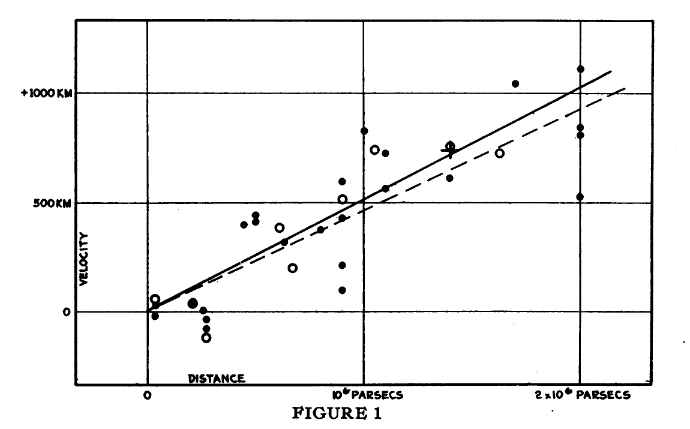

In 1927, the Belgian priest and physicist Georges Lemaître independently derived the same expanding-universe solutions from general relativity and, crucially, took the further step of connecting theory to observation. Using Slipher's published radial velocities and rough distance estimates available at the time, Lemaître calculated a proportionality constant between recession velocity and distance, obtaining a value of approximately 575 to 625 kilometres per second per megaparsec.2, 18 His paper, published in French in the Annales de la Société Scientifique de Bruxelles, contained both the theoretical framework and the empirical estimate of what is now called the Hubble constant — two years before Hubble's more famous publication.2 The paper received little attention at the time, partly because of the obscurity of the journal in which it appeared.
In 1929, Edwin Hubble published a short paper in the Proceedings of the National Academy of Sciences presenting distances to 24 galaxies, estimated primarily using Cepheid variable stars and the brightest stars as distance indicators, plotted against their radial velocities, most of which came from Slipher's earlier measurements. Hubble identified a roughly linear relation: more distant galaxies recede faster, with a proportionality constant he estimated at approximately 500 kilometres per second per megaparsec.3 By 1931, Hubble and his colleague Milton Humason had extended the relation to much greater distances using galaxy clusters, strengthening the case for a systematic linear relationship and reducing the scatter considerably.4
In 1931, Lemaître's 1927 paper was translated into English and published in the Monthly Notices of the Royal Astronomical Society, but the translated version omitted the paragraphs in which Lemaître had computed his estimate of the expansion rate. For decades, this omission fed speculation that the passages had been removed by an editor to protect Hubble's priority. In 2011, the astronomer Mario Livio discovered a letter in the Royal Astronomical Society archives demonstrating that Lemaître himself had performed the translation and voluntarily omitted his earlier numerical estimate, reasoning that Hubble's subsequent data had rendered it obsolete.15 In 2018, the International Astronomical Union formally voted to recommend that the expansion law be referred to as the Hubble–Lemaître law, acknowledging both scientists' contributions.22
The cosmological redshift
The redshifts observed in distant galaxies are frequently described in popular accounts as a Doppler effect — the galaxies are "moving away" and their light is shifted to longer wavelengths, much as the pitch of a receding ambulance siren drops. While this analogy captures the qualitative result, the physical mechanism is fundamentally different. In the framework of general relativity, galaxies at cosmological distances are not moving through a pre-existing space; rather, the fabric of spacetime itself is expanding, and the galaxies are carried along with it. The wavelength of a photon travelling through this expanding space is stretched in proportion to the expansion that occurs during its journey, a phenomenon called the cosmological redshift.21, 23
The cosmological redshift is quantified by the parameter z, defined such that 1 + z equals the ratio of the scale factor of the universe at the time of observation to the scale factor at the time of emission. A galaxy at redshift z = 1 emitted its light when the universe was half its present size; a galaxy at z = 2 emitted when the universe was one-third its present size.14, 21 For nearby galaxies, where z is small (much less than 1), the cosmological redshift is numerically indistinguishable from a classical Doppler shift, and the linear Hubble–Lemaître law v = H₀d holds to excellent approximation. At higher redshifts, however, the relationship between redshift and distance depends on the full expansion history of the universe and requires the machinery of relativistic cosmology to interpret correctly.14
An important consequence of the cosmological redshift is that it applies uniformly to all wavelengths of electromagnetic radiation. The cosmic microwave background, emitted approximately 380,000 years after the Big Bang when the universe was roughly 1,100 times smaller than it is today, has been redshifted from its original thermal spectrum at approximately 3,000 kelvin to the 2.725-kelvin microwave radiation observed at present — a cosmological redshift of z ≈ 1,089.10
The Friedmann equations and cosmic geometry
The theoretical framework governing the expansion of the universe is provided by the Friedmann equations, derived by Alexander Friedmann in 1922 from Einstein's field equations under the assumption that the universe is spatially homogeneous and isotropic on large scales.5 This assumption — the cosmological principle — was later given a rigorous mathematical foundation by Howard Robertson and Arthur Geoffrey Walker, who proved that a homogeneous, isotropic spacetime must have a metric of a specific form now called the Friedmann–Lemaître–Robertson–Walker (FLRW) metric.7
The first Friedmann equation relates the rate of expansion of the universe (the Hubble parameter H, defined as the time derivative of the scale factor divided by the scale factor itself) to the total energy density of its contents — matter, radiation, and dark energy — and to the spatial curvature. The second Friedmann equation, sometimes called the acceleration equation, describes how the rate of expansion changes over time and depends on both the energy density and the pressure of the cosmic constituents.5, 21 Together, these two equations govern the entire dynamical evolution of a homogeneous, isotropic universe.
The Friedmann equations admit three classes of solution depending on the spatial curvature, which is conventionally parameterised by the curvature constant k. If k = +1, the universe has positive curvature, analogous to the surface of a sphere, and is spatially finite (“closed”). If k = −1, the curvature is negative, analogous to a saddle or hyperbolic surface, and the universe is spatially infinite (“open”). If k = 0, space is flat — Euclidean in its geometry — and also spatially infinite.5, 21 Whether the universe is open, closed, or flat depends on the ratio of the actual energy density to a critical value ρcrit defined by the Friedmann equation; this ratio is the density parameter Ω. If Ω = 1, the universe is spatially flat. Observations from the cosmic microwave background, baryon acoustic oscillations, and Type Ia supernovae have converged on a value of Ω extremely close to unity, indicating that the observable universe is spatially flat to within the precision of current measurements.10, 20
The deceleration parameter q₀ describes whether the expansion is slowing down or speeding up at the present epoch. A positive q₀ indicates deceleration (as would be expected in a matter-dominated universe where gravity opposes expansion), while a negative q₀ indicates acceleration. The discovery in 1998 that Type Ia supernovae at high redshift are fainter than expected in a decelerating universe demonstrated that q₀ is negative: the expansion of the universe is accelerating, driven by dark energy.16, 17 Current measurements place q₀ at approximately −0.55, consistent with a universe in which dark energy constitutes roughly 68 percent of the total energy density.10, 23
Cosmological distance measures
In an expanding universe, the concept of "distance" is not straightforward. Unlike in Euclidean space, where distance is unambiguous, the stretching of space during the time it takes light to travel from a distant galaxy to an observer means that several different operationally defined distances must be distinguished. These distance measures are all derived from the FLRW metric and are related to one another through factors of the redshift z.14
The comoving distance dC is the distance between two objects measured along a spatial geodesic at the present cosmic time, with the expansion of the universe factored out. It represents the distance that would be measured if one could somehow freeze the expansion and lay a ruler between the two points. The comoving distance to an object at redshift z is obtained by integrating the inverse of the Hubble parameter H(z) over redshift from 0 to z, and it increases monotonically with redshift.14
The luminosity distance dL is defined by the relationship between the absolute luminosity of an object and its observed flux: dL = (1 + z) dC. It is the distance measure relevant when using standard candles such as Type Ia supernovae or Cepheid variable stars to determine distances. Because the cosmological redshift reduces the energy of each photon by a factor of (1 + z) and also stretches the time interval between photon arrivals by the same factor, a distant object appears fainter than it would in a static universe at the same comoving distance — hence the luminosity distance exceeds the comoving distance.14
The angular diameter distance dA is defined as the ratio of an object's physical size to the angle it subtends on the sky: dA = dC / (1 + z). It is the distance measure relevant for standard rulers, such as the baryon acoustic oscillation scale imprinted in the distribution of galaxies. Counterintuitively, the angular diameter distance does not increase monotonically with redshift; it reaches a maximum at a redshift of roughly 1.5 and then decreases, meaning that very distant objects can appear larger on the sky than somewhat closer ones. This behaviour is a direct consequence of the expansion of the universe and has no analogue in Euclidean geometry.14, 21
Measuring the Hubble constant
Hubble's original 1929 estimate of the expansion rate was approximately 500 km/s/Mpc, a value that implied a disturbingly young universe — younger than the age of Earth as estimated from radioactive dating of rocks.3 This discrepancy motivated decades of effort to refine the distance scale. In the early 1950s, Walter Baade discovered that the Cepheid variable stars used to calibrate extragalactic distances actually belonged to two distinct populations with different period–luminosity relations, and that Hubble had conflated the two. Correcting this error roughly doubled all extragalactic distances and halved the Hubble constant to approximately 250 km/s/Mpc.8
Throughout the 1960s and 1970s, Allan Sandage and his collaborators systematically identified and corrected additional sources of error in the distance ladder, including the effects of interstellar dust absorption and the confusion of individual bright stars with compact star clusters. By 1958, Sandage had revised the Hubble constant to approximately 75 km/s/Mpc, remarkably close to modern values, although subsequent work by different groups would produce estimates ranging from roughly 50 to 100 km/s/Mpc, fuelling a contentious debate that persisted for decades.8
The launch of the Hubble Space Telescope in 1990 enabled a programme specifically designed to resolve this dispute. The HST Key Project, led by Wendy Freedman, used the telescope's superior angular resolution to observe Cepheid variable stars in galaxies out to approximately 25 megaparsecs, calibrating several secondary distance indicators. The final result, published in 2001, was H₀ = 72 ± 8 km/s/Mpc, a 10 percent measurement that brought the Hubble constant into the modern precision era.9
Historical measurements of the Hubble constant3, 8, 9, 10, 11
| Year | Investigator(s) | Method | H₀ (km/s/Mpc) |
|---|---|---|---|
| 1929 | Hubble | Cepheids + brightest stars | ~500 |
| 1952 | Baade | Revised Cepheid calibration | ~250 |
| 1958 | Sandage | Corrected distance ladder | ~75 |
| 2001 | Freedman et al. (HST Key Project) | Cepheids + multiple secondary indicators | 72 ± 8 |
| 2020 | Planck Collaboration | CMB power spectrum + ΛCDM model | 67.4 ± 0.5 |
| 2022 | Riess et al. (SH0ES) | Cepheids + Type Ia supernovae | 73.04 ± 1.04 |
| 2024 | Freedman et al. (CCHP/JWST) | TRGB + JAGB (JWST) | 69–70 (preliminary) |
The Hubble tension
The most significant unresolved discrepancy in modern cosmology is the Hubble tension: a persistent disagreement between the value of H₀ inferred from observations of the early universe and the value measured directly from the local universe. The Planck satellite's observations of the cosmic microwave background, interpreted within the standard ΛCDM cosmological model, yield H₀ = 67.4 ± 0.5 km/s/Mpc.10

The SH0ES (Supernova H₀ for the Equation of State) collaboration, led by Adam Riess, uses a distance ladder of Cepheid-calibrated Type Ia supernovae to measure H₀ = 73.04 ± 1.04 km/s/Mpc.11 The difference of approximately 6 km/s/Mpc may appear modest in absolute terms, but given the small uncertainties on both measurements, it represents a discrepancy of 4 to 6 standard deviations — far too large to be dismissed as a statistical fluctuation.11, 12
The tension is not confined to these two experiments. Multiple independent methods of measuring H₀ from the local universe — including the tip of the red giant branch (TRGB) method, strong gravitational lensing time delays, megamaser distances, and surface brightness fluctuations — have generally yielded values in the range of 69 to 74 km/s/Mpc, while early-universe constraints from baryon acoustic oscillations combined with the CMB consistently favour the lower range near 67 to 68 km/s/Mpc.12, 13 The Chicago-Carnegie Hubble Program (CCHP), led by Wendy Freedman, has used the James Webb Space Telescope to recalibrate the TRGB distance ladder and has reported preliminary values in the range of 67 to 70 km/s/Mpc, closer to the Planck result, although this finding remains under active discussion.19
Extensive investigation has failed to identify a systematic error in either the early-universe or late-universe measurements that could account for the discrepancy.11, 13 This has led many cosmologists to consider whether the tension might be signalling physics beyond the standard ΛCDM model. Proposed theoretical solutions fall into two broad categories. Early-time solutions modify the physics of the pre-recombination universe — for example, by introducing additional relativistic species (extra radiation) or a brief period of early dark energy that increases the expansion rate just before the epoch when the CMB was emitted, shifting the inferred value of H₀ upward.12 Late-time solutions modify the expansion history after recombination, for instance by allowing the dark energy equation of state to vary with time or by introducing interactions between dark matter and dark energy.12, 13 No proposed solution has yet achieved broad consensus, and the tension remains one of the most actively investigated problems in cosmology.
The Hubble tension: early-universe vs. late-universe measurements of H₀10, 11, 19, 20
Expansion, acceleration, and the fate of the universe
Hubble's law, in its simplest form, describes a universe that is expanding. But the rate at which it expands — and whether that rate is increasing, decreasing, or constant — depends on the composition and geometry of the cosmos. In a universe containing only matter and radiation, gravitational attraction would decelerate the expansion over time. For most of the twentieth century, measuring the deceleration parameter q₀ was considered the central problem of observational cosmology, because it would reveal the ultimate fate of the universe: whether it would expand forever (open or flat geometry) or eventually recollapse (closed geometry).21, 23
The answer, when it arrived in 1998, was entirely unexpected. Two independent teams — the Supernova Cosmology Project led by Saul Perlmutter and the High-z Supernova Search Team led by Brian Schmidt and Adam Riess — found that distant Type Ia supernovae were fainter than predicted in any decelerating model, indicating that the expansion of the universe has been accelerating for roughly the past five billion years.16, 17 This discovery, awarded the 2011 Nobel Prize in Physics, implied the existence of a repulsive component of the universe now called dark energy, which opposes gravitational deceleration and drives the expansion to accelerate. In the standard ΛCDM model, dark energy takes the form of Einstein's cosmological constant Λ, a uniform energy density permeating all of space.17, 23
The current best-fit cosmological model, constrained by the CMB, baryon acoustic oscillations, and supernova data, describes a spatially flat universe composed of approximately 68 percent dark energy, 27 percent dark matter, and 5 percent ordinary baryonic matter.10 In such a universe, the expansion will continue to accelerate indefinitely: galaxies beyond the Local Group will recede ever faster, eventually crossing the cosmological event horizon beyond which no signal can ever reach us. The Hubble parameter H(t) will asymptotically approach a constant value set by the cosmological constant, and the observable universe will grow increasingly empty and cold.23 Recent data from the Dark Energy Spectroscopic Instrument (DESI), however, have provided tantalising hints that dark energy may not be a perfect constant but could be evolving over cosmic time, which, if confirmed, would fundamentally alter predictions for the long-term future of cosmic expansion.20
Significance and continuing research
The Hubble–Lemaître law is far more than a simple empirical correlation. It is the observational expression of the most fundamental property of our universe: that spacetime itself is dynamic, not static. From this single insight flow the entire edifice of Big Bang cosmology, the prediction and subsequent detection of the cosmic microwave background, the framework for primordial nucleosynthesis, and the theoretical basis for the formation of cosmic structure from tiny initial density perturbations.21, 23
The Hubble constant sits at the nexus of multiple subdisciplines of physics and astronomy. Its value determines the age of the universe (approximately 13.8 billion years in the standard model), the size of the observable universe, and the critical density that governs cosmic geometry.10 Resolving the Hubble tension would either validate the standard ΛCDM model by identifying a subtle systematic error, or, more provocatively, reveal new fundamental physics beyond the current paradigm — additional particle species, evolving dark energy, modifications to general relativity, or phenomena not yet conceived.12, 13 With the James Webb Space Telescope refining the local distance ladder, DESI mapping the baryon acoustic oscillation signal with unprecedented precision, and next-generation CMB experiments like the Simons Observatory and CMB-S4 on the horizon, the coming decade promises either a resolution of the tension or a deepening of the mystery.19, 20
References
Un univers homogène de masse constante et de rayon croissant rendant compte de la vitesse radiale des nébuleuses extra-galactiques
Final results from the Hubble Space Telescope Key Project to measure the Hubble constant
A comprehensive measurement of the local value of the Hubble constant with 1 km/s/Mpc uncertainty from the Hubble Space Telescope and the SH0ES team
Cosmology intertwined: a review of the particle physics, astrophysics, and cosmology associated with the cosmological tensions and anomalies
Observational evidence from supernovae for an accelerating universe and a cosmological constant
Republication of: A homogeneous universe of constant mass and increasing radius accounting for the radial velocity of extra-galactic nebulae
Status report on the Chicago-Carnegie Hubble Program (CCHP): measurement of the Hubble constant using the Hubble and James Webb Space Telescopes
DESI 2024 VI: cosmological constraints from the measurements of baryon acoustic oscillations
Gravitation and Cosmology: Principles and Applications of the General Theory of Relativity
IAU 2018 Resolution B4: on the recommended renaming of the Hubble law as the Hubble–Lemaître law