Overview
- Dinosaurs first appeared in the Late Triassic, roughly 231 to 243 million years ago, and rapidly diversified into the dominant large-bodied terrestrial vertebrates on Earth, a position they held for approximately 165 million years.
- The two major lineages—Saurischia (lizard-hipped) and Ornithischia (bird-hipped)—encompass all known dinosaur groups, from multi-tonne sauropods and predatory theropods to the armored ankylosaurs and horned ceratopsians.
- Birds are living theropod dinosaurs descended from feathered maniraptoran ancestors, making dinosaurs not an extinct group but the most species-rich class of land vertebrates alive today.
Dinosaurs constitute one of the most successful and morphologically diverse groups of vertebrates in the history of life on Earth. From their origins in the Late Triassic Period, approximately 231 to 243 million years ago, they radiated into an astonishing range of body plans, ecological roles, and geographic distributions, ultimately dominating terrestrial ecosystems on every continent for roughly 165 million years.1 Understanding the dinosaurs requires appreciating not just the iconic giants of popular imagination—the long-necked sauropods, the predatory theropods, the horned and armored ornithischians—but also the anatomical innovations that made their long evolutionary success possible, and the profound scientific recognition that dinosaurs are not in fact extinct: birds are living dinosaurs, the direct descendants of small feathered theropods that survived the end-Cretaceous mass extinction approximately 66 million years ago.1, 23
The earliest dinosaurs
The evolutionary origin of dinosaurs is inseparable from the broader story of terrestrial vertebrate diversification during the Triassic Period (252 to 201 million years ago). Following the catastrophic end-Permian mass extinction, which eliminated more than 90 percent of marine species and a large proportion of terrestrial ones, the surviving tetrapod lineages rapidly diversified to fill vacant ecological roles. Among the archosaurs—a group that today includes birds and crocodilians—one lineage, the dinosauriformes, gave rise to true dinosaurs sometime in the Middle to Late Triassic.1, 2

The candidate for the earliest confirmed dinosaur is Nyasasaurus parringtoni, known from fragmentary remains discovered in the Manda Beds of Tanzania. Radiometric dating of the containing strata suggests an age of approximately 240 to 245 million years, which would place Nyasasaurus in the Middle Triassic, earlier than any other definitive dinosaur. Its femur bears the enlarged fourth trochanter characteristic of dinosaurs and their close relatives, and its humerus displays the posterolateral process associated with dinosaur forelimb musculature, though the incompleteness of the material means its placement as a true dinosaur or as a very close dinosaurian relative remains debated.4
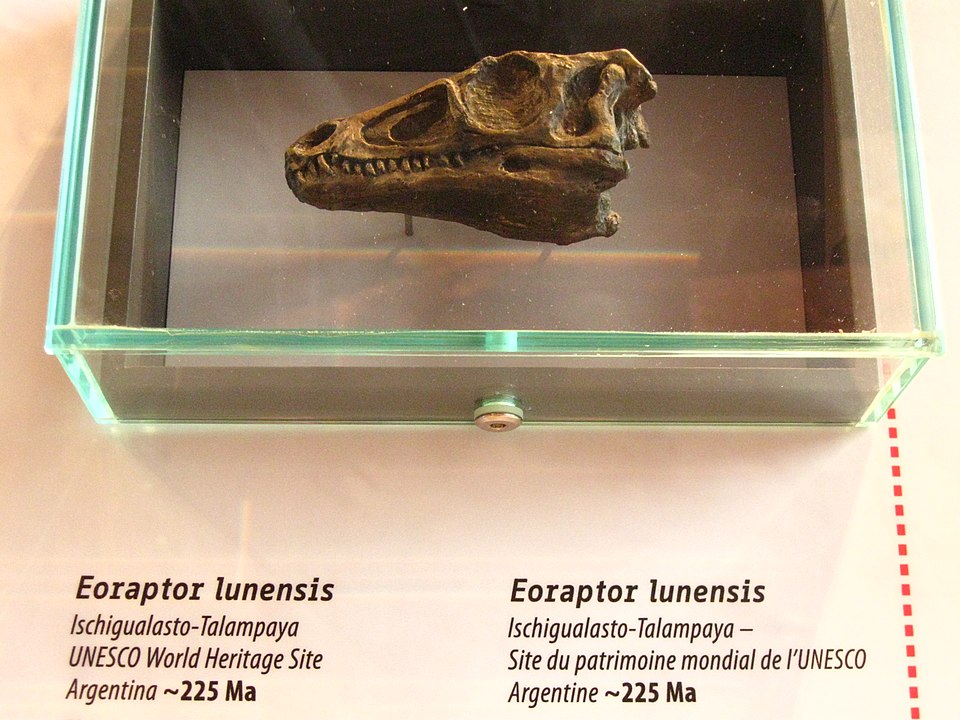
More complete and unambiguous early dinosaurs come from the Ischigualasto Formation of northwestern Argentina, a sequence of red mudstones deposited roughly 231 to 229 million years ago during the Carnian Age of the Late Triassic. The formation has yielded three of the best-known early dinosaurs. Eoraptor lunensis, a small omnivore approximately one meter in length, possesses a mixture of primitive and derived features that has complicated its precise placement within the dinosaur family tree but confirms its status as an early representative of the group.8 Herrerasaurus ischigualastensis, a larger predator reaching perhaps three to five meters in length, represents one of the earliest known predatory dinosaurs and demonstrates that carnivorous ecological roles were occupied by dinosaurs very early in their history.1 The more recently described Eodromaeus murphi, from the same formation, has been interpreted as an early theropod, pushing the divergence of major dinosaur lineages back to at least the Carnian.2
A striking feature of the earliest dinosaur record is how geographically restricted it initially appears: the richest early dinosaur assemblages come from South America and, to a lesser degree, Africa and North America, consistent with the configuration of the supercontinent Pangaea, which allowed faunal interchange across much of its land area during the Triassic.3 Early dinosaurs were not yet dominant in their ecosystems. At Ischigualasto and at equivalent sites in North America and Europe, dinosaurs were a minority of the large-bodied terrestrial fauna, which was still dominated by non-dinosaurian archosaurs and large herbivorous synapsids. The ecological ascent of dinosaurs to dominance unfolded over millions of years and accelerated dramatically at the boundary of the Triassic and Jurassic periods.1, 20
Dinosaur phylogeny: the two great lineages
All dinosaurs belong to one of two major clades defined by the anatomy of the hip girdle. The classification, established by Harry Seeley in 1887 and refined by subsequent cladistic analyses, divides Dinosauria into Saurischia (lizard-hipped dinosaurs, in which the pubis points forward and downward) and Ornithischia (bird-hipped dinosaurs, in which the pubis is rotated backward to lie parallel to the ischium). The paradox of these names is immediately apparent: birds are descended from saurischian dinosaurs, not ornithischians. The "bird-hipped" condition of ornithischians evolved independently of the bird lineage and served different functional purposes.1, 6
The traditional phylogenetic arrangement, supported by most morphological and phylogenomic analyses for over a century, places Saurischia and Ornithischia as the two sister clades within Dinosauria. Saurischia itself is divided into two major groups: the Theropoda (bipedal predators and their descendants, including birds) and the Sauropodomorpha (long-necked herbivores that culminated in the enormous sauropods of the Jurassic and Cretaceous). This topology was challenged in 2017 when Baron, Norman, and Barrett proposed a radically different arrangement in which theropods form a clade with ornithischians (grouped together as Ornithoscelida), while sauropodomorphs are the earliest-branching saurischians, sister to a group including herrerasaurids and silesaurids.6 While this alternative topology generated significant discussion and some subsequent analyses have found partial support for elements of it, the traditional arrangement retains broad support and the debate remains active in the paleontological literature.6
Within Ornithischia, the major subdivisions include the Thyreophora (armored dinosaurs, including stegosaurs and ankylosaurs), the Ornithopoda (including iguanodonts and hadrosaurs), the Marginocephalia (comprising the horned ceratopsians and the dome-headed pachycephalosaurs), and possibly the earliest-branching heterodontosaurids. All ornithischians were herbivorous, possessed a distinctive predentary bone at the tip of the lower jaw that anchored a keratinous beak, and most developed elaborate cranial or body armor that likely served defensive and display functions.10
The Triassic–Jurassic transition
The end-Triassic mass extinction, approximately 201 million years ago, ranks among the five largest extinction events in the history of animal life, eliminating an estimated 70 to 75 percent of all species then living.21 The principal driver was the eruption of the Central Atlantic Magmatic Province (CAMP), a vast outpouring of flood basalts associated with the initial rifting of Pangaea into the future continents of Laurasia and Gondwana. Massive volumes of carbon dioxide and sulfur dioxide injected into the atmosphere drove rapid warming and ocean acidification, devastating marine ecosystems and severely disrupting terrestrial ones.21
The end-Triassic extinction was catastrophic for many vertebrate groups, including the non-dinosaurian archosaurs such as the aetosaurs, phytosaurs, and most of the large rauisuchians that had shared ecological space with early dinosaurs. The extinction effectively cleared the ecological playing field, and dinosaurs, which had already been diversifying through the Late Triassic, emerged into the Jurassic as the uncontested dominant large-bodied vertebrates on land.1, 20 The pattern of this transition is visible in the fossil record: assemblages just above the Triassic–Jurassic boundary are often dominated by dinosaur tracks and bones in proportions that have no counterpart in Late Triassic deposits.21
The Early and Middle Jurassic saw the diversification of the major dinosaurian lineages into the body plans that would characterize the rest of the Mesozoic. Sauropodomorphs rapidly achieved large body sizes; the first true sauropods, with their characteristic columnar limbs and horizontal body posture, appear in the Early Jurassic. Theropods diversified into a range of predator body sizes, from small cursorial hunters to the largest terrestrial predators that ever lived. Ornithischians began the adaptive radiation that would eventually produce some of the most morphologically distinctive animals in vertebrate history, including ankylosaurs with tail clubs, stegosaurs with dorsal plates and thagomizers, and ceratopsians with elaborate cranial horns and frills.1
Theropods: from predators to birds
The Theropoda, defined by their bipedal posture and hollow, thin-walled bones, encompasses the most thoroughly studied dinosaur clade and the one with the clearest connection to modern vertebrates through the origin of birds. Theropods first appear in the Late Triassic and persist to the present day in the form of birds, making the group unique among non-avian dinosaur clades in having living members.5 The major theropod subdivisions include the ceratosaurs (which dominated the Triassic and Jurassic and persisted into the Cretaceous in Gondwana), the tetanurans (a large clade including megalosaurs, allosauroids, compsognathids, and the maniraptoran lineage that produced birds), and the abelisauroids (specialized Cretaceous predators of the southern continents).5
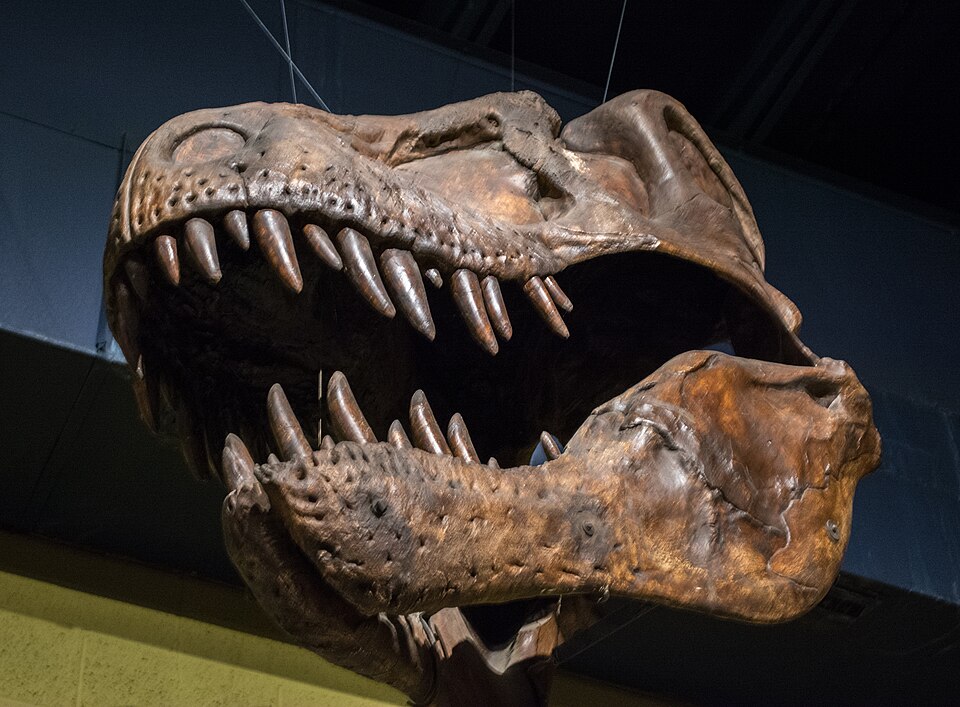
The largest theropods achieved body sizes that exceed those of any other terrestrial predator in Earth's history. Tyrannosaurus rex, from the Late Cretaceous of western North America, reached body masses estimated at 8 to 14 tonnes in the largest individuals. The South American abelisauroid Giganotosaurus carolinii and the carcharodontosaurids of Africa and South America were comparable in length, representing the peak of predatory dinosaur body size evolution in Gondwanan lineages.24 At the other end of the size spectrum, the maniraptoran theropods, which include oviraptorosaurs, troodontids, dromaeosaurids, and ultimately birds, demonstrate a long-term evolutionary trend toward smaller body sizes and increased relative brain size.24
.jpg)
The skeletal anatomy of theropods is characterized by several features that were later refined in the evolution of birds: a furcula (wishbone) formed by the fusion of the clavicles, an elongated forelimb with a semilunate carpal bone that permitted a folding wrist motion, hollow pneumatized bones connected to an air-sac respiratory system, and a foot anatomy in which the functional digits are reduced to three.14 The discovery that many of these features predate the origin of flight—appearing in clearly terrestrial dinosaurs—has been central to establishing the dinosaurian origin of birds on an anatomical basis independent of the feather evidence.14, 23
Sauropods: the largest land animals
The Sauropodomorpha is the dinosaur group containing the largest animals ever to walk on land. Sauropodomorphs first appear in the fossil record as small to medium-sized bipedal or semibipedal herbivores in the Late Triassic, exemplified by forms such as Eoraptor (which some analyses place as an early sauropodomorph) and Panphagia from the Ischigualasto Formation of Argentina.8 By the Early Jurassic, the clade had produced the first true sauropods: fully quadrupedal animals with elongated necks, long tails, columnar limbs, and small heads relative to body size, all features that would characterize the group throughout the remainder of the Mesozoic.9
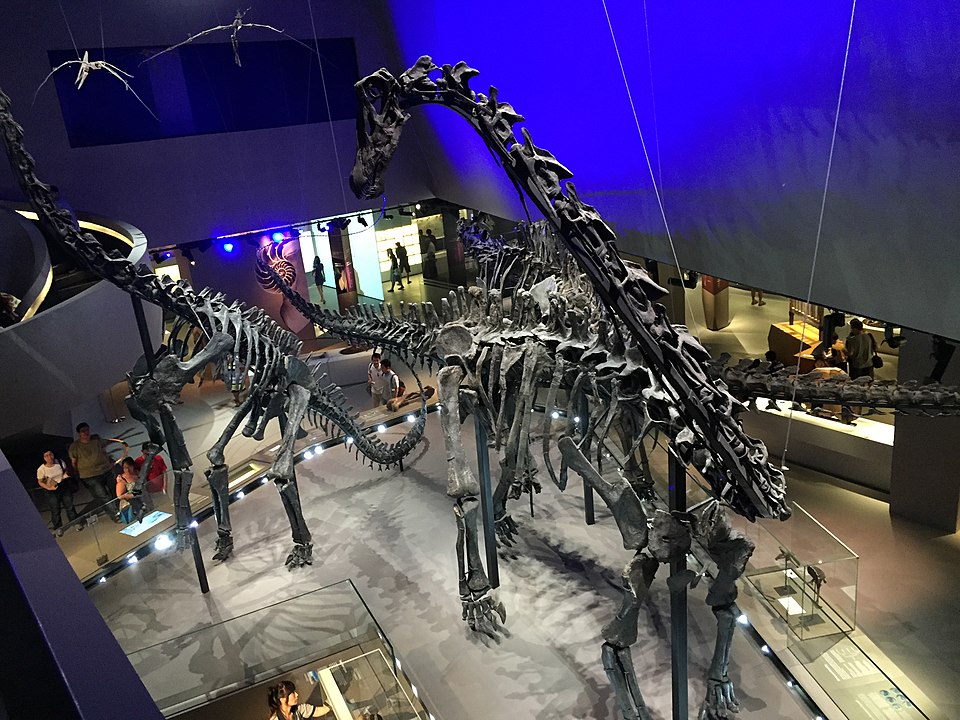

The success of the sauropod body plan rested on a suite of physiological and anatomical innovations that enabled extreme body size. The pneumatized vertebral column, in which air sacs invaded the centra and neural arches of the vertebrae, reduced skeletal mass while maintaining structural integrity. Bone histology studies demonstrate that sauropods grew rapidly and continuously throughout their lives, reaching sexual maturity before attaining maximum size and sustaining high growth rates that required metabolic rates elevated above those of ectothermic reptiles of comparable size.15 The long neck, which could exceed ten meters in some forms, allowed sauropods to harvest vegetation over a large area without moving the body, reducing the energetic cost of foraging.9
The largest sauropods for which mass estimates can be made with reasonable confidence include titanosaurs such as Patagotitan mayorum and Dreadnoughtus schrani from the Late Cretaceous of Argentina. Dreadnoughtus, described from an exceptionally complete specimen in 2014, has been estimated at approximately 65 tonnes based on femoral and humeral circumference measurements, though more conservative estimates using scaling equations suggest masses between 40 and 65 tonnes.7 These animals would have had no predators capable of threatening an adult; the ecological pressure on sauropod size likely came from the extreme energetic requirements of digesting large quantities of low-quality plant material, with greater body size conferring more efficient fermentation through longer gut retention times.9
Major dinosaur groups: estimated size ranges and temporal distribution1, 7, 9, 24
| Group | Clade | Diet | Max. mass estimate | Temporal range |
|---|---|---|---|---|
| Sauropods | Saurischia | Herbivore | 40–65 tonnes | Early Jurassic–Late Cretaceous |
| Large theropods | Saurischia | Carnivore | 8–14 tonnes | Middle Triassic–present (birds) |
| Hadrosaurs | Ornithischia | Herbivore | 3–4 tonnes | Early Cretaceous–Late Cretaceous |
| Ceratopsians | Ornithischia | Herbivore | 9–12 tonnes | Late Jurassic–Late Cretaceous |
| Ankylosaurs | Ornithischia | Herbivore | 4–8 tonnes | Early Jurassic–Late Cretaceous |
| Stegosaurs | Ornithischia | Herbivore | 2–4 tonnes | Middle Jurassic–Early Cretaceous |
Ornithischian diversity
The ornithischian dinosaurs, though less directly connected to living species than the theropods, achieved remarkable morphological diversity during the Jurassic and Cretaceous periods. All ornithischians were herbivorous, and many evolved elaborate cranial and body structures whose functions are interpreted as involving both defense against predators and intraspecific signaling for mate selection or social dominance.10
The Thyreophora, or armored dinosaurs, first appear in the Early Jurassic and split into two major lineages. The Stegosauria, exemplified by Stegosaurus stenops from the Late Jurassic Morrison Formation of North America, are recognized by the distinctive paired rows of bony plates and spines running along the dorsal midline. The function of stegosaurian plates remains debated: thermal regulation, display, and species recognition have all been proposed, and histological analysis shows that the plates were heavily vascularized, consistent with a thermoregulatory or display role.1 The Ankylosauria, the other thyreophoron lineage, achieved their greatest diversity in the Cretaceous. Ankylosaurs were covered in extensive osteoderms (bony skin inserts) forming a nearly complete dorsal armor, and many ankylosaurid ankylosaurs evolved a massive tail club formed by fused and expanded tail vertebrae and osteoderms, which biomechanical analyses suggest was capable of breaking bone when swung at a predator.1
The Ornithopoda, a largely unarmored clade of bipedal and secondarily quadrupedal herbivores, includes some of the most ecologically successful dinosaurs of the Cretaceous. The hadrosaurs, or duck-billed dinosaurs, were among the most abundant large herbivores of Late Cretaceous ecosystems in North America and Asia. Many hadrosaurs evolved elaborate hollow cranial crests whose internal passages formed resonating chambers, likely used in vocal communication. The remarkable preservation of hadrosaur specimens including skin, soft tissues, and gut contents has provided paleontologists with uniquely detailed information about dinosaur integument and diet.19
The Marginocephalia, uniting the horned ceratopsians with the bone-headed pachycephalosaurs, represent one of the most taxonomically diverse ornithischian groups of the Late Cretaceous. Ceratopsians evolved elaborate cranial features including bony frills extending from the back of the skull and nasal and orbital horns that reached extraordinary dimensions in large genera such as Triceratops horridus, whose horns could exceed one meter in length. The frills and horns almost certainly served signaling functions, with intraspecific variation in frill size and ornamentation potentially encoding species identity or individual quality in ways analogous to the antlers of living deer.1
Feathered dinosaurs and the origin of birds
The discovery over the past three decades of exquisitely preserved feathered dinosaurs from the Early Cretaceous Yixian and Jiufotang formations of Liaoning Province, northeastern China, has transformed the understanding of the evolutionary transition between non-avian dinosaurs and birds from a theoretical inference based on skeletal anatomy into a directly documented progression in the fossil record.11 These deposits, laid down in volcanic lake environments roughly 125 to 130 million years ago, preserve soft tissues including feathers, scales, and in some cases color patterns, with a fidelity unparalleled in the global dinosaur record.
The most primitive feather-like structures known from dinosaurs are the filamentous integumentary structures (sometimes called "proto-feathers" or dino-fuzz) found in non-maniraptoran theropods such as Sinosauropteryx prima, a compsognathid from the Yixian Formation. These simple, unbranched or sparsely branched filaments lack the complex hierarchical structure of true flight feathers but are clearly not scales: they are flexible, appear to have been distributed widely across the body surface, and in Sinosauropteryx preserve evidence of banding coloration interpreted as counter-shading and possibly camouflage or signaling patterns.11 The presence of feather-like structures in multiple non-avian dinosaur lineages, including both coelurosaurs and, potentially, ornithischians, suggests that some form of filamentous integument may be a broadly ancestral feature of dinosaurs, though this remains an area of active research.11
More derived feather structures, including pennaceous (quill-like) feathers with a central rachis and branching barbs, are well documented in maniraptoran theropods, the clade most closely related to birds. Particularly striking is the discovery of four-winged dromaeosaurid dinosaurs, most notably Microraptor gui, in which long flight feathers were present on both the forelimbs and hindlimbs, suggesting an arboreal or gliding stage in the early evolution of flight.12 Microraptor and its relatives demonstrate that aerodynamic feathers evolved in dinosaurs before the development of a fully bird-like flight apparatus, a finding consistent with a trees-down or "four-winged" intermediate stage in the evolution of powered flight.12
The earliest unambiguous bird, Archaeopteryx lithographica, is known from a series of remarkably complete specimens from the Late Jurassic Solnhofen limestones of Bavaria, Germany, dated to approximately 150 million years ago. Archaeopteryx possesses a mosaic of avian and non-avian features: it had fully developed asymmetric flight feathers on wings and tail, but also retained teeth, clawed fingers on its hands, and a long bony tail without the shortened pygostyle found in modern birds.13 Phylogenetic analyses consistently place Archaeopteryx at or near the base of Avialae, the clade containing all birds living and extinct, confirming its status as a transitional form in the strict sense: a taxon that combines characters of two major groups.13, 23
Approximate timing of key evolutionary innovations in the theropod–bird lineage1, 11, 12, 13, 23
Dinosaur physiology: the warm-blooded question
For much of the twentieth century, dinosaurs were conventionally depicted as ectotherms (cold-blooded animals) in the manner of living lizards and crocodilians, sluggish and dependent on external heat sources to maintain body temperature. This view began to change in the 1970s when paleontologist Robert Bakker and colleagues argued, on the basis of bone structure, posture, predator–prey ratios, and other lines of evidence, that many or all dinosaurs were endothermic (warm-blooded) in a manner analogous to living mammals and birds.22 The debate has since been substantially clarified by the development of bone histology as a window into dinosaur growth physiology.
Studies of the bone microstructure of a wide range of dinosaurian taxa have consistently found a tissue type called fibrolamellar bone, which is characterized by rapid, uninterrupted deposition of bone matrix and is associated in living vertebrates with high, sustained growth rates requiring endothermic metabolic support. Growth rings analogous to tree rings, which form in ectothermic vertebrates that experience seasonal growth pauses, are also present in dinosaur bone but often widely spaced, indicating that dinosaurs grew much faster than living ectotherms of comparable size.22 Erickson and colleagues calculated in 2001 that large theropods such as Tyrannosaurus rex grew at rates of several kilograms per day during peak growth phases, rates that approach those of the fastest-growing living birds and mammals and that would be physiologically impossible for an ectotherm.22
Isotopic evidence has added further resolution to the physiological picture. Analyses of stable oxygen isotopes in dinosaur tooth enamel, combined with data on body temperature-sensitive isotopic fractionation, have suggested that some large-bodied dinosaurs may have used gigantothermy—maintaining elevated and relatively stable body temperatures through sheer body mass and consequent low surface-area-to-volume ratios—rather than the fully endothermic metabolic regulation characteristic of birds and mammals.16 The current consensus is that dinosaurian metabolism was likely diverse and that a simple dichotomy between ectothermy and endothermy is insufficient to capture the physiological complexity of the group. Many non-avian dinosaurs probably occupied an intermediate metabolic zone, with small maniraptoran theropods being fully endothermic in a manner essentially continuous with their avian descendants.16
One anatomical innovation with clear physiological implications is the air-sac respiratory system, a network of thin-walled membranous sacs that invade the vertebrae and other bones and create a unidirectional flow of air through the lungs. In living birds, this system is the most efficient respiratory mechanism known among vertebrates, enabling sustained aerobic performance at altitude and during high-intensity activity. Fossil evidence for such a system in non-avian theropods comes from the distinctive excavations and foramina (openings) in the vertebrae and ribs that served as attachment points for the air sacs, demonstrating that the avian respiratory system has deep evolutionary roots in the theropod lineage.14
Nesting behavior and parental care
Dinosaurs were oviparous (egg-laying), a reproductive strategy inherited from their archosaurian ancestors and retained in their avian descendants. The study of dinosaur eggs, nests, and embryos has grown dramatically since the 1970s and now provides substantial evidence about dinosaurian reproductive biology, incubation strategies, and in some taxa, the degree of parental care extended to offspring after hatching.18
The most influential early discovery of dinosaur nesting behavior was made by John Horner and Robert Makela at a site in Montana dubbed "Egg Mountain," where extensive nesting colonies of the hadrosaur Maiasaura peeblesorum were found preserving nests containing eggs, hatchlings, and juveniles of different developmental stages. The poor ossification of hatchling limb bones indicated that newly hatched Maiasaura were altricial—helpless and dependent on parental care—and the growth series found together in nests implied that adults returned to feed and protect young after hatching, a level of parental care previously unrecognized in non-avian dinosaurs.19 The genus name Maiasaura, meaning "good mother lizard," was chosen to recognize this discovery.
Studies of embryonic dinosaur teeth using growth-line analysis have yielded direct estimates of incubation duration for two non-avian dinosaur species. Erickson and colleagues, analyzing the daily growth increments in the teeth of embryonic Protoceratops andrewsi (a small ceratopsian from Mongolia) and Hypacrosaurus stebingeri (a hadrosaur from Alberta), determined that the eggs of these species required approximately 83 days and 171 days to hatch, respectively.18 These durations are substantially longer than those of any living birds of comparable body size and fall within the range of large crocodilians, suggesting that early in dinosaur evolution, extended incubation periods with metabolic strategies more similar to those of crocodiles than to modern birds prevailed, with the rapid incubation of birds being a derived feature of the avian lineage.18
Dinosaurs in Mesozoic ecosystems
Dinosaurs were the dominant large-bodied terrestrial vertebrates for approximately 165 million years, from the close of the Triassic to the end of the Cretaceous, and during this interval they participated in and helped shape a succession of distinctly different global ecosystems. The Jurassic world was characterized by warm, equable temperatures, high sea levels, and an absence of polar ice, conditions that supported lush vegetation at high latitudes and enabled large-bodied dinosaurs to range widely across connected land masses.17
The Late Jurassic Morrison Formation of the western United States offers one of the most studied dinosaur ecosystems in the fossil record: an extensive floodplain environment inhabited by a diverse fauna including multiple giant sauropods (Brachiosaurus, Diplodocus, Apatosaurus, Camarasaurus), large theropod predators (Allosaurus, Ceratosaurus, Torvosaurus), armored stegosaurs, and small ornithopods. The coexistence of multiple large sauropod species in the same formation implies ecological differentiation in diet or habitat use, a form of niche partitioning analogous to that observed in modern African megafaunal communities.9
The Cretaceous saw significant changes in global vegetation, most notably the diversification of flowering plants (angiosperms), which had replaced conifers as the dominant flora in many regions by the Late Cretaceous. The relationship between angiosperm diversification and dinosaur evolution remains an area of active investigation: some researchers have proposed that the radiation of new plant types drove evolutionary change in herbivorous dinosaurs, particularly the hadrosaurs and ceratopsians, whose dental batteries and beak morphologies suggest highly specialized plant-processing capabilities.1
Evidence for dinosaur migration at high paleolatitudes demonstrates the ecological flexibility of the group. Dinosaur fossils are known from Cretaceous deposits well within the Arctic Circle, including sites in Alaska with faunas dominated by hadrosaurs and ceratopsians that appear to have been year-round or seasonal residents rather than casual visitors.17 The ability of dinosaurs to inhabit polar regions with pronounced seasonal darkness and temperature variation implies behavioral and physiological adaptations—possibly including some form of overwintering behavior in herbivores, migratory behavior in others, or physiological tolerance of cold temperatures enabled by insulating feathers or elevated metabolism—that speak to the ecological breadth of the dinosaur radiation.17
The 165-million-year reign of non-avian dinosaurs came to an abrupt end at the close of the Cretaceous, approximately 66 million years ago, in an extinction event caused by the impact of a large extraterrestrial body at what is now the Yucatán Peninsula of Mexico. All non-avian dinosaur lineages disappeared at or near the Cretaceous–Paleogene boundary, along with pterosaurs, non-avian marine reptiles, and a substantial proportion of marine and terrestrial species. One lineage of small, feathered maniraptoran theropods survived the extinction and diversified into the roughly 10,000 species of birds that inhabit Earth today—making Dinosauria, measured by species richness, one of the most successful vertebrate groups in the history of life on the planet.1, 23
References
The oldest known dinosaur from Africa and the early evolution and biogeography of Dinosauria
Nyasasaurus parringtoni (Dinosauriformes) from the Middle Triassic of Tanzania: the earliest record of a dinosaur
New information on the anatomy and relationships of Dreadnoughtus schrani, an exceptionally complete titanosaur from the Upper Cretaceous of Argentina
A basal sauropodomorph (Dinosauria: Saurischia) from the Ischigualasto Formation (Triassic, Carnian) and the early evolution of Sauropodomorpha
An ornithischian dinosaur from the Triassic of southern Brazil and the origin of the ornithischian predentary bone
Feathered dinosaurs reconsidered: new insights from barb morphology and microstructure
Dinosaur incubation periods directly determined from growth-line counts in embryonic teeth show reptilian-grade development