Overview
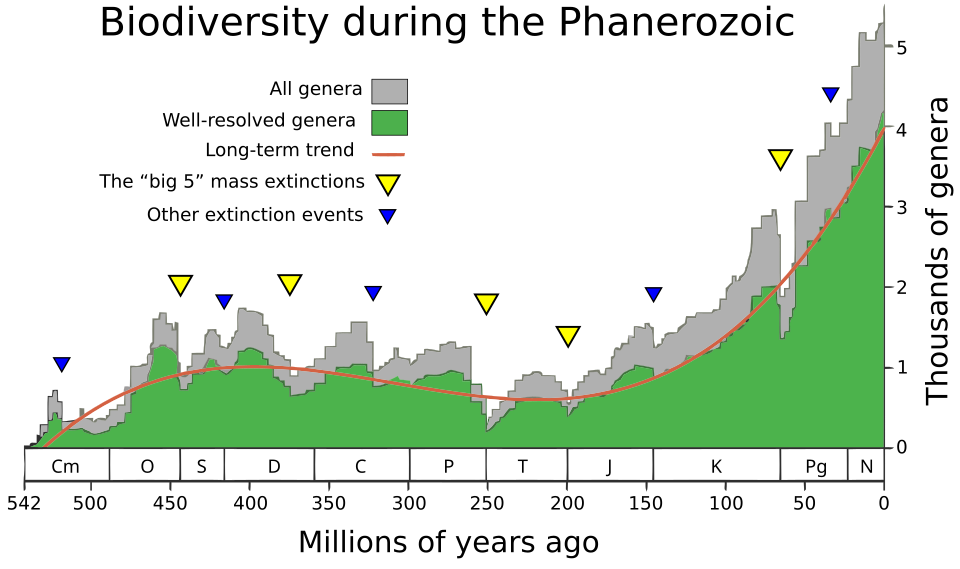
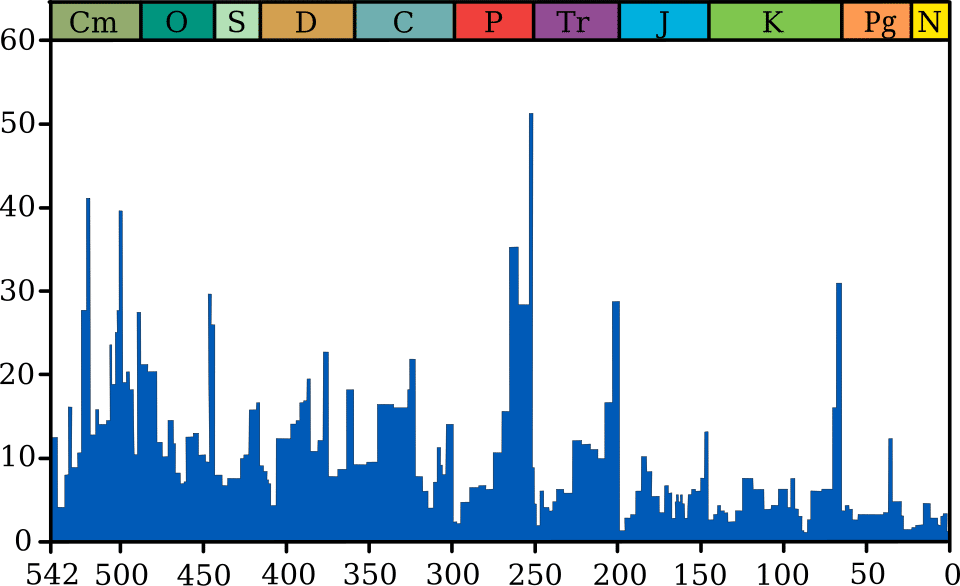
- Five major mass extinctions have punctuated the last 541 million years of animal life, each eliminating more than 75 percent of species and permanently altering the trajectory of evolution on Earth.
- The causes range from glaciation and sea-level change (End-Ordovician) to massive volcanic eruptions (End-Permian, End-Triassic) to asteroid impact (End-Cretaceous), but all share common kill mechanisms: rapid climate change, ocean anoxia, and collapse of primary productivity.
- Mass extinctions are evolutionary turning points: by removing dominant groups, they open ecological space for surviving lineages to diversify, most famously enabling the rise of mammals after the End-Cretaceous event 66 million years ago.
The history of animal life on Earth has been punctuated by episodes of catastrophic species loss that paleontologists call mass extinctions. Five such events stand out in the Phanerozoic Eon—the 541-million-year window during which hard-bodied, readily fossilized animals have existed—each eliminating at least 75 percent of species within geologically brief intervals. These five events were formally identified by David Raup and J. John Sepkoski in their foundational 1982 analysis of the marine fossil record, which demonstrated that the Big Five stood statistically apart from the ordinary background rate of species turnover.1 Their subsequent work quantified extinction intensities and showed that these events were not merely the upper end of a smooth distribution, but qualitatively distinct catastrophes requiring exceptional causal explanations.2
What unites the Big Five is not a single cause but a set of recurring kill mechanisms through which environmental disruptions translate into species loss. Rapid climate change, ocean anoxia, ocean acidification, habitat destruction through sea-level change, and collapse of primary productivity appear in various combinations across all five events.3 The severity of any given extinction correlates with the degree to which multiple kill mechanisms operate simultaneously: the End-Permian event, the worst of all, involved warming, anoxia, acidification, and toxic hydrogen sulfide acting together at global scale, while the comparatively more recoverable End-Ordovician event was driven primarily by glaciation and habitat loss.4, 5

The Big Five mass extinctions: estimated species loss1, 3
Causes and common patterns
Large igneous provinces—massive outpourings of flood basalt driven by mantle plumes—are the geological common thread linking three of the five events. The End-Permian extinction coincided with the eruption of the Siberian Traps, one of the largest volcanic provinces in Earth history, which covered an estimated 2 to 3 million square kilometers of Siberia with lava and injected enormous quantities of carbon dioxide, sulfur dioxide, and halogen gases into the atmosphere over geologically short timescales.5 The End-Triassic event is closely linked to the Central Atlantic Magmatic Province (CAMP), the largest continental flood basalt known, associated with the rifting of Pangaea. In both cases, volcanic carbon dioxide drove rapid global warming, which in turn reduced ocean oxygen solubility, drove widespread anoxia, and acidified surface waters—a cascading environmental collapse that devastated marine and terrestrial ecosystems simultaneously.5

The End-Cretaceous event differs from the volcanic pattern. In 1980, Luis and Walter Alvarez and colleagues proposed that a large asteroid impact caused the extinction, based on anomalously high concentrations of iridium—an element rare in Earth's crust but abundant in extraterrestrial material—at the Cretaceous–Paleogene boundary worldwide. The subsequent identification of the roughly 180-kilometer Chicxulub impact crater beneath Mexico's Yucatan Peninsula confirmed the hypothesis. A comprehensive 2010 review concluded that the Chicxulub impact was the primary cause, with the contemporaneous Deccan Traps volcanism in India playing a secondary role.6
The End-Ordovician event stands apart as the only one of the Big Five driven primarily by cooling rather than warming. The expansion of an ice sheet across the supercontinent Gondwana drew down sea levels globally, draining the shallow epicontinental seas that hosted most marine life. The extinction unfolded in two discrete pulses: the first coincided with glaciation and sea-level fall, the second with rapid deglaciation and the flooding of low-oxygen bottom waters onto shallow shelves.4 The Late Devonian crisis, centered on the Frasnian–Famennian boundary, was the most prolonged and complex of the five, comprising multiple extinction pulses spread across roughly 20 million years. Ocean anoxia, likely driven by nutrient runoff from the rapid spread of land plants, is the most consistently identified kill mechanism, though the ultimate trigger remains debated.3
Evolutionary consequences
Mass extinctions are not merely destructive; they are among the most consequential events in the history of life precisely because of what follows. By eliminating ecologically dominant groups, they release ecological space that surviving lineages can exploit through adaptive radiation—the rapid diversification of a lineage into a wide range of ecological niches. David Jablonski's research demonstrated that the traits predicting survival during mass extinctions differ fundamentally from those favoring success under normal conditions: broad geographic distribution and ecological generalism, rather than specialization and competitive dominance, are the best predictors of extinction resistance during global crises.7 The result is that mass extinctions can redirect evolutionary history along trajectories that would never have been reached through ordinary natural selection.

.jpg)
The most celebrated example is the rise of mammals following the End-Cretaceous event. Mammals had coexisted with dinosaurs for over 160 million years but remained largely small-bodied and ecologically restricted. The extinction of non-avian dinosaurs opened virtually every large-body ecological niche on land, and within 10 to 15 million years mammals had diversified into whales, bats, primates, elephants, and hundreds of other forms that now dominate terrestrial and marine ecosystems.8 Recovery timescales vary dramatically between events: the End-Cretaceous recovery was relatively swift, with major mammalian orders established within 10 million years, while the End-Permian event—the most severe mass extinction in Earth history—required approximately 10 million years merely to restore full ecological complexity in marine ecosystems.10
The question of whether Earth is currently experiencing a sixth mass extinction has moved from the margins of conservation biology to the center of scientific debate. Current global species extinction rates are estimated to be 100 to 1,000 times the geological background rate, and vertebrate species are being lost at a pace unprecedented in the last 65 million years.9 The fossil record of previous mass extinctions provides the relevant benchmark for evaluating this crisis: even partial mass extinctions required millions of years to reverse, a timescale that underscores the potential irreversibility of current biodiversity loss.9, 10
The End-Permian event in detail
The End-Permian extinction approximately 252 million years ago was the most catastrophic biotic crisis in Earth history, eliminating an estimated 96 percent of marine species and 70 percent of terrestrial vertebrate species within a geologically brief interval of fewer than 200,000 years. The primary driver was the eruption of the Siberian Traps, one of the largest continental flood basalt provinces in the geological record, which released enormous volumes of carbon dioxide, methane, sulfur dioxide, and halogen gases into the atmosphere and oceans over tens of thousands of years.5 The resulting cascade of environmental effects included global warming of 6–10°C, widespread ocean anoxia extending into shallow waters, acidification of surface oceans from elevated atmospheric CO2, and the release of toxic hydrogen sulfide from anoxic deep waters — multiple kill mechanisms operating simultaneously at global scale.5, 10
The recovery from the End-Permian extinction was the slowest of any of the Big Five events. Benton and Twitchett documented that full ecological complexity in marine communities did not return for approximately 10 million years, a recovery interval far longer than that following any other mass extinction. This prolonged recovery may reflect the severity of the initial perturbation, the persistence of hostile environmental conditions during the Early Triassic, or the depth of ecological disruption — the collapse not merely of individual species but of entire ecosystem structures and food webs that had to be rebuilt from surviving fragments.10 The End-Permian event stands as the most extreme example of Earth's capacity for self-inflicted ecological catastrophe, and its causes — volcanic carbon release driving rapid warming, ocean deoxygenation, and acidification — bear uncomfortable parallels to ongoing anthropogenic changes in the modern Earth system.5, 9
References
The Chicxulub Asteroid Impact and Mass Extinction at the Cretaceous–Paleogene Boundary