Overview
- The cosmic microwave background is remarkably uniform at 2.7255 K, but contains tiny temperature fluctuations of roughly one part in 100,000 that were first detected by COBE in 1992 and mapped with extraordinary precision by WMAP and Planck, encoding a snapshot of the universe at an age of approximately 380,000 years.
- These anisotropies originated as quantum fluctuations during cosmic inflation, were amplified by gravitational instability, and were shaped by acoustic oscillations in the primordial photon-baryon plasma before recombination froze them into the pattern observed today.
- The angular power spectrum of the CMB, with its characteristic series of acoustic peaks, is the single most informative dataset in cosmology, constraining the age, geometry, composition, and expansion history of the universe within the six-parameter LCDM model to percent-level precision.
The cosmic microwave background (CMB) is the oldest light in the universe, a relic radiation field first detected in 1965 by Arno Penzias and Robert Wilson and now known to fill all of space at a temperature of 2.7255 K.1, 3 To a first approximation this radiation is extraordinarily uniform, appearing the same in every direction to better than one part in a thousand. Yet embedded within that uniformity are tiny temperature fluctuations — anisotropies of roughly ±200 microkelvin, or about one part in 100,000 — that encode a remarkably detailed record of the physical conditions in the universe when it was only about 380,000 years old.2, 6 These minute variations were first detected by the Cosmic Background Explorer (COBE) satellite in 1992, a discovery that earned George Smoot and John Mather the 2006 Nobel Prize in Physics, and have since been mapped with exquisite precision by the Wilkinson Microwave Anisotropy Probe (WMAP) and the Planck satellite.2, 10, 14
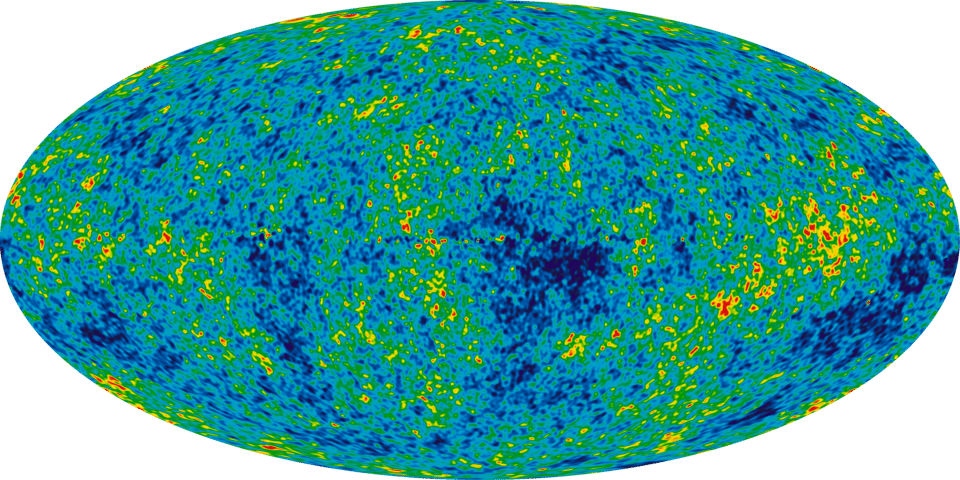

The angular power spectrum of these anisotropies — a statistical decomposition of the temperature fluctuation pattern into its component angular scales — is widely regarded as the single most informative dataset in all of cosmology. Its characteristic series of peaks and troughs constrains the age, geometry, composition, and expansion history of the universe, all within a model described by just six free parameters. The study of CMB anisotropies transformed cosmology from a data-starved discipline of order-of-magnitude estimates into a precision science with parameter uncertainties at the percent level.14, 13
Origin of the anisotropies
The CMB anisotropies trace their origin to the earliest moments of the universe. In the standard cosmological model, the universe underwent a brief epoch of exponential expansion called cosmic inflation within the first fraction of a second after the Big Bang.4 During inflation, quantum-mechanical fluctuations in the energy density of the inflaton field — the scalar field hypothesised to drive this rapid expansion — were stretched from subatomic scales to macroscopic and eventually cosmological sizes. These quantum fluctuations became the primordial density perturbations: regions of slightly higher or lower density seeded throughout the expanding universe.4, 6
After inflation ended and the universe settled into the hot, dense state described by the standard Big Bang model, these density perturbations persisted as slight variations in the temperature, pressure, and gravitational potential of the primordial plasma. The universe at this stage consisted of a tightly coupled fluid of photons, electrons, and baryons (protons and neutrons), suffused with dark matter that interacted gravitationally but not electromagnetically. Regions of slightly higher density were hotter due to adiabatic compression and the release of gravitational potential energy, while regions of lower density were correspondingly cooler.6, 5
The relationship between density perturbations and temperature anisotropies on the largest angular scales is governed by the Sachs-Wolfe effect, first derived by Rainer Sachs and Arthur Wolfe in 1967. Photons climbing out of gravitational potential wells associated with overdense regions lose energy through gravitational redshift, appearing cooler to a distant observer, while photons emerging from underdense regions gain a relative blueshift.5 On large angular scales (greater than about 2 degrees), where the perturbations had not had time to evolve significantly before recombination, this gravitational redshift effect dominates the observed temperature pattern. The Sachs-Wolfe effect produces a characteristic relationship: the temperature fluctuation at a given point on the sky is approximately one-third of the gravitational potential fluctuation at the corresponding location on the last-scattering surface.5, 6
Acoustic oscillations in the primordial plasma
On angular scales smaller than about 2 degrees, the CMB anisotropies are shaped not merely by the initial density perturbations but by the dynamic evolution of those perturbations in the hot plasma before recombination. The tightly coupled photon-baryon fluid behaved as a single medium through which density perturbations propagated as sound waves — compressions and rarefactions travelling at a characteristic sound speed of approximately 57 percent of the speed of light.6 The physics governing these oscillations is a competition between two forces: gravity, which pulled matter toward overdense regions and amplified perturbations, and radiation pressure from the photons, which resisted compression and pushed material back outward.6, 8
This interplay produced baryon acoustic oscillations (BAOs) — standing wave patterns in the photon-baryon fluid. A perturbation of a given wavelength would begin to collapse under gravity, compress until radiation pressure halted and reversed the infall, expand until gravity once again dominated, and then compress again in a repeating cycle. The oscillation frequency depended on the wavelength of the perturbation: shorter-wavelength modes oscillated faster than longer-wavelength modes. At the moment of recombination, approximately 380,000 years after the Big Bang, neutral hydrogen atoms formed for the first time, the photons decoupled from the baryonic matter, and the oscillations were frozen in place.6, 8 The pattern of compressions and rarefactions that happened to exist at that instant was imprinted permanently on the CMB.
The most prominent feature in the CMB power spectrum is the first acoustic peak, which corresponds to the perturbation mode that had time to compress exactly once — reaching maximum compression — before recombination halted the oscillation. The angular scale of this mode depends on the sound horizon at recombination (the maximum distance a sound wave could have travelled since the Big Bang) and the angular diameter distance to the last-scattering surface, which in turn depends on the geometry of the universe.6, 9 Successive peaks in the power spectrum correspond to modes that had completed additional half-cycles of oscillation: the second peak represents a mode that compressed and then fully rarefied, the third peak a mode that compressed, rarefied, and compressed again, and so forth.6
On very small angular scales, the acoustic oscillations are progressively erased by a process called Silk damping (or photon diffusion damping). Because the photon-baryon coupling was not perfectly tight, photons could diffuse out of small-scale density perturbations, carrying energy and smoothing out the temperature contrast. Joseph Silk showed in 1968 that perturbations below a characteristic mass scale — corresponding to structures of roughly galactic mass — would be exponentially damped by this radiative diffusion.7 In the power spectrum, Silk damping manifests as an exponential decline in the amplitude of the peaks at high multipole moments (small angular scales), producing the so-called damping tail.6, 7
The angular power spectrum
The fundamental tool for analysing CMB anisotropies is the angular power spectrum, obtained by decomposing the temperature map of the sky into spherical harmonics — the natural basis functions on the surface of a sphere. Each spherical harmonic mode is characterised by a multipole number ℓ, which is inversely related to the angular scale on the sky: ℓ = 1 corresponds to a dipole (the entire sky split into two hemispheres), ℓ = 2 to a quadrupole, and higher values of ℓ to progressively finer angular features. An angular scale of θ degrees corresponds approximately to ℓ ≈ 180/θ.6 The power spectrum, conventionally written as Cℓ or as ℓ(ℓ+1)Cℓ/2π, gives the variance of the temperature fluctuations at each angular scale.
The measured CMB power spectrum displays a series of peaks and troughs that encode a wealth of cosmological information. The position of the first acoustic peak at ℓ ≈ 220 (corresponding to an angular scale of approximately 1 degree) was one of the most eagerly anticipated measurements in cosmology. Its location is exquisitely sensitive to the spatial curvature of the universe: in a spatially flat universe, the first peak appears near ℓ ≈ 220, whereas in a positively curved (closed) universe it would shift to lower ℓ (larger angular scales) and in a negatively curved (open) universe it would shift to higher ℓ (smaller angular scales). The detection of the first peak at precisely the position predicted for a flat universe, first accomplished by the BOOMERanG and MAXIMA balloon experiments in 2000, provided compelling evidence that the total energy density of the universe is equal to the critical density.9, 6
The relative heights of the odd-numbered peaks (first, third, fifth) compared to the even-numbered peaks (second, fourth, sixth) encode the baryon density of the universe. Odd peaks correspond to compression phases and are enhanced by the gravitational effect of baryons, which add inertia to the oscillating fluid and deepen the potential wells into which the plasma falls. Even peaks correspond to rarefaction phases and are relatively suppressed when the baryon density is higher. The measured ratio between odd and even peak heights yields a baryon density of Ωbh2 ≈ 0.0224, corresponding to approximately 4.9 percent of the total energy density of the universe.14, 6
The overall envelope of peak heights at higher multipoles constrains the total matter density, including dark matter. Dark matter does not participate in the acoustic oscillations because it does not interact with photons, but its gravitational influence deepens the potential wells and alters the driving force that powers the oscillations. A higher ratio of matter to radiation suppresses the amplitude of higher-order peaks in a distinctive way that allows the dark matter density to be separated from the baryon density.6, 14 The damping tail at very high ℓ, shaped by Silk damping, constrains the physics of recombination and the detailed thermal history of the universe during the transition from an ionised plasma to neutral atoms.7, 15
COBE, WMAP, and Planck
The observational history of CMB anisotropies is a story of steadily improving angular resolution and sensitivity, each generation of instruments revealing new details in the temperature pattern that earlier experiments could not access.
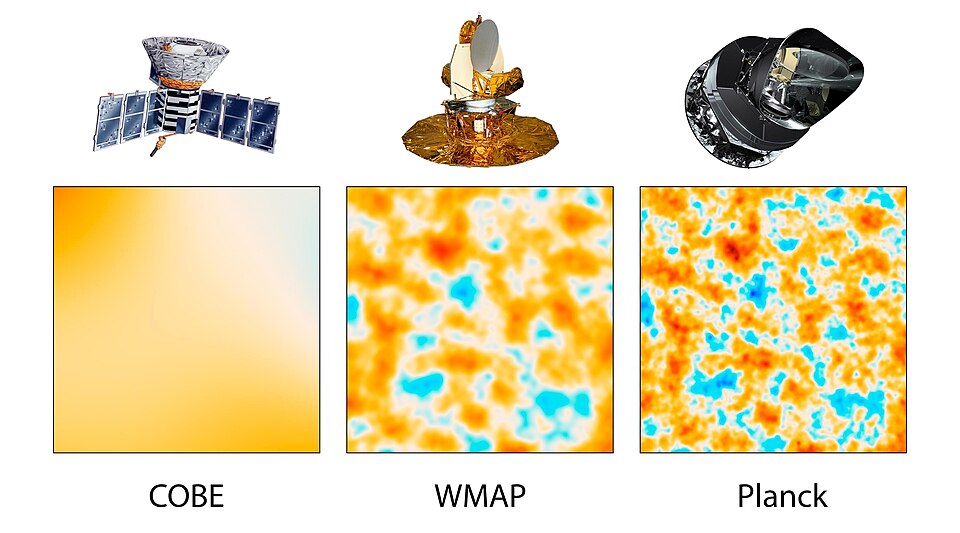

The Cosmic Background Explorer (COBE), launched by NASA in 1989, carried two instruments that fundamentally advanced CMB science. The Far Infrared Absolute Spectrophotometer (FIRAS) measured the CMB spectrum and confirmed it to be a nearly perfect blackbody at a temperature of 2.735 ± 0.06 K, with deviations of less than one part in 10,000 — the most precise blackbody spectrum ever measured in nature.22 The Differential Microwave Radiometer (DMR) detected temperature anisotropies for the first time in 1992, finding fluctuations with a root-mean-square amplitude of approximately 30 microkelvin at angular scales larger than 7 degrees, consistent with a nearly scale-invariant (Harrison-Zeldovich) spectrum of primordial perturbations as predicted by inflationary models.2 COBE confirmed that the seeds of all large-scale structure in the universe were present in the CMB, but its angular resolution of approximately 7 degrees was far too coarse to resolve the acoustic peaks.
The Wilkinson Microwave Anisotropy Probe (WMAP), launched by NASA in 2001 and operational through 2010, transformed CMB cosmology with full-sky temperature maps at an angular resolution of approximately 0.2 degrees across five frequency bands. The first-year WMAP data, published in 2003, clearly resolved the first three acoustic peaks in the power spectrum and constrained the basic cosmological parameters to a precision of a few percent, confirming the spatially flat, dark-energy-dominated concordance model.10 Over nine years of observations, WMAP progressively improved these constraints, ultimately determining the age of the universe to be 13.772 ± 0.059 billion years and the Hubble constant to be 69.32 ± 0.80 km/s/Mpc, and reducing the allowed volume of the six-parameter cosmological parameter space by a factor of 68,000 relative to pre-WMAP measurements.11, 12
The Planck satellite, launched by the European Space Agency in 2009, represented another order-of-magnitude advance in angular resolution (approximately 5 arcminutes at its highest-frequency channels) and sensitivity. Operating across nine frequency bands from 30 to 857 GHz, Planck produced full-sky maps of the CMB temperature and polarisation with unprecedented fidelity, resolving at least seven acoustic peaks in the temperature power spectrum and detecting the gravitational lensing of the CMB at 40 standard deviations.13, 15, 16 The final Planck 2018 data release established the current gold standard for cosmological parameter estimation, fitting the six-parameter ΛCDM model to the data with remarkable precision. The six-parameter model fits the observed power spectrum over more than three decades in multipole moment, describing the cosmological information contained in over a billion sky pixels with just six numbers.14, 13
Cosmological parameters from the power spectrum
The Planck 2018 results represent the most precise determination of the fundamental cosmological parameters from CMB data alone. The six-parameter ΛCDM model assumes a spatially flat universe containing baryonic matter, cold dark matter, and a cosmological constant (dark energy), with primordial perturbations described by a power-law spectrum of adiabatic, Gaussian fluctuations. The six free parameters are the baryon density Ωbh2, the cold dark matter density Ωch2, the angular size of the sound horizon at recombination θ*, the optical depth to reionisation τ, the amplitude of the primordial power spectrum As, and the scalar spectral index ns. All other quantities — the Hubble constant, the age of the universe, the dark energy density — are derived from these six.14
The Hubble constant derived from Planck is H0 = 67.4 ± 0.5 km/s/Mpc, corresponding to an age of the universe of 13.80 ± 0.02 billion years.14 The baryon density Ωbh2 = 0.0224 ± 0.0001 implies that ordinary matter constitutes approximately 4.9 percent of the total energy density, in excellent agreement with independent constraints from Big Bang nucleosynthesis. The cold dark matter density Ωch2 = 0.120 ± 0.001 corresponds to approximately 26.4 percent, while the cosmological constant accounts for the remaining 68.7 percent.14 The scalar spectral index ns = 0.9649 ± 0.0042 is less than unity at more than 8 standard deviations, a result consistent with the simplest inflationary models which predict a slight tilt toward more power on larger scales.17 The optical depth to reionisation τ = 0.054 ± 0.007, measured primarily from the large-scale polarisation of the CMB, indicates that the intergalactic medium was substantially reionised by the ultraviolet radiation from the first stars and galaxies at a redshift of approximately 7.7.14
The concordance between the CMB-derived parameters and those obtained from entirely independent probes — Type Ia supernovae, baryon acoustic oscillations in the galaxy distribution, galaxy cluster counts, and gravitational lensing surveys — constitutes one of the most powerful confirmations of the standard cosmological model. The baryon acoustic peak detected in the galaxy correlation function by the Sloan Digital Sky Survey at a comoving separation of approximately 150 megaparsecs is the same feature, seen at a later cosmic epoch, as the acoustic oscillations imprinted on the CMB at recombination.18
Cosmological parameters from Planck 201814
| Parameter | Symbol | Planck 2018 value | Physical meaning |
|---|---|---|---|
| Baryon density | Ωbh2 | 0.0224 ± 0.0001 | Ordinary matter: ~4.9% of total |
| Dark matter density | Ωch2 | 0.120 ± 0.001 | Cold dark matter: ~26.4% of total |
| Hubble constant | H0 | 67.4 ± 0.5 km/s/Mpc | Present expansion rate |
| Spectral index | ns | 0.9649 ± 0.0042 | Tilt of primordial power spectrum |
| Optical depth | τ | 0.054 ± 0.007 | Reionisation at z ≈ 7.7 |
| Dark energy density | ΩΛ | 0.6847 ± 0.0073 | Cosmological constant: ~68.7% of total |
| Age of the universe | t0 | 13.80 ± 0.02 Gyr | Time since the Big Bang |
The remarkable precision of these measurements is a testament to both the quality of the Planck data and the predictive power of the ΛCDM model. The fact that a model with only six free parameters can simultaneously fit the CMB temperature power spectrum across more than 2,500 independently measured multipole bins, the polarisation power spectra, and the lensing reconstruction is one of the great achievements of modern physics.14, 13
Polarisation of the CMB
In addition to temperature anisotropies, the CMB exhibits a faint polarisation pattern that provides independent and complementary information about the early universe. CMB polarisation arises from Thomson scattering of photons by free electrons in the presence of a local temperature quadrupole: if the radiation incident on an electron is not isotropic but has a quadrupolar pattern of hotter and cooler directions, the scattered radiation will be linearly polarised.6 This process occurred primarily at two epochs: during the initial decoupling of photons from matter around redshift 1,100, and during the reionisation of the intergalactic medium at much later times (redshift 7 to 10), when the first stars and quasars generated enough ultraviolet radiation to re-ionise the neutral hydrogen and create a new population of free electrons.14
The polarisation field on the sky can be decomposed into two geometrically distinct patterns. E-mode polarisation has a pattern that is symmetric under reflection — radial or tangential around hot and cold spots — and is generated by the same scalar (density) perturbations that produce the temperature anisotropies. E-mode polarisation was first detected in 2002 by the Degree Angular Scale Interferometer (DASI) at the South Pole, confirming a fundamental prediction of the standard model of CMB physics.19 The Planck satellite subsequently measured the E-mode power spectrum with high precision, and it is now used alongside the temperature spectrum to tighten constraints on cosmological parameters, most notably the optical depth to reionisation.14, 15
B-mode polarisation, by contrast, has a handedness — a curl-like pattern that is antisymmetric under reflection — and cannot be produced by scalar density perturbations alone. B-modes can be generated by two distinct physical mechanisms. The first is gravitational lensing of the E-mode pattern by the large-scale distribution of matter between the last-scattering surface and the observer, which distorts the polarisation field and converts a fraction of E-mode power into B-mode power. This lensing B-mode signal has been detected by multiple experiments including Planck, which measured the CMB lensing potential at a significance of 40 standard deviations.16 The second, and far more consequential for fundamental physics, is the generation of B-modes by primordial gravitational waves — tensor perturbations produced during cosmic inflation. Detection of this inflationary B-mode signal would constitute direct evidence for the quantum-gravitational origin of the primordial perturbations and would measure the energy scale of inflation. Despite intensive searches by ground-based experiments, most notably the BICEP/Keck Array programme at the South Pole, primordial B-modes have not yet been detected. The current best upper limit on the tensor-to-scalar ratio is r < 0.036 at 95 percent confidence, which already rules out several classes of inflationary models.20
Secondary anisotropies
The temperature pattern observed in the CMB today is not entirely determined at the moment of recombination. As CMB photons travel across billions of light-years of intervening space to reach our detectors, they interact with the matter and gravitational fields encountered along the way, acquiring additional anisotropies that are superimposed on the primordial signal. These secondary anisotropies are fainter than the primary signal on most angular scales but carry valuable information about the low-redshift universe, including the distribution of galaxy clusters, the growth of large-scale structure, and the properties of dark energy.6
The Sunyaev-Zeldovich (SZ) effect, predicted by Rashid Sunyaev and Yakov Zeldovich in 1970, arises when CMB photons pass through the hot, ionised gas that pervades galaxy clusters. Inverse Compton scattering by the energetic electrons in the intracluster medium boosts the energy of a fraction of the CMB photons, producing a characteristic spectral distortion: a decrease in the CMB brightness at frequencies below approximately 217 GHz and an increase above that frequency.8 This thermal SZ effect is independent of the redshift of the cluster, making it a uniquely powerful tool for detecting galaxy clusters at any distance. Planck used the SZ effect to compile a catalogue of over a thousand galaxy clusters, including many previously unknown systems at high redshift.13
The integrated Sachs-Wolfe (ISW) effect is a secondary anisotropy that arises because the gravitational potentials associated with large-scale structures in the universe are not static but evolve over time. In a matter-dominated universe, gravitational potentials remain constant and photons gain exactly as much energy falling into a potential well as they lose climbing out, producing no net temperature change. However, when dark energy begins to dominate the expansion — as occurred approximately five billion years ago — the expansion accelerates and gravitational potentials decay. A CMB photon traversing a decaying potential well emerges with slightly more energy than it had upon entry, producing a net blueshift. The cumulative effect of many such encounters along the photon's path generates a large-scale temperature anisotropy that is correlated with the distribution of galaxies and galaxy clusters in the foreground.5, 21 Crittenden and Turok proposed in 1996 that cross-correlating CMB temperature maps with surveys of large-scale structure could detect this ISW signal and thereby provide independent evidence for the existence of dark energy, and such detections have since been achieved.21
Gravitational lensing of the CMB by the intervening distribution of matter represents a third important class of secondary anisotropy. The gravitational fields of galaxy clusters, filaments, and other large-scale structures deflect the paths of CMB photons by small angles (typically a few arcminutes), slightly blurring and distorting the primordial anisotropy pattern. This lensing effect can be reconstructed statistically from the observed CMB maps, yielding a map of the projected gravitational potential of all matter — both luminous and dark — between the observer and the last-scattering surface. Planck's reconstruction of the lensing potential provided an independent measurement of the amplitude of matter clustering and the total matter density, in good agreement with the values derived from the primary CMB power spectrum alone.16
Significance and open questions
The study of CMB anisotropies has established the observational foundation for modern cosmology. The concordance ΛCDM model, with its six free parameters determined to percent-level precision by Planck, provides a consistent framework that accounts for the CMB power spectrum, the expansion history of the universe, the large-scale distribution of galaxies, and the abundances of the light elements produced in Big Bang nucleosynthesis.14, 13 The success of this model is all the more remarkable given the diversity and independence of these observational constraints.
.png)
.png)
Yet the CMB data also highlight several unresolved tensions and open questions. The Hubble constant derived from the CMB (H0 = 67.4 ± 0.5 km/s/Mpc) is discrepant at the 4 to 5 standard deviation level with the value obtained from local distance-ladder measurements using Cepheid-calibrated Type Ia supernovae, which yield H0 ≈ 73 km/s/Mpc.14 Whether this so-called Hubble tension reflects unrecognised systematic errors in one or both measurement techniques or genuine new physics beyond the ΛCDM model remains one of the most actively debated questions in cosmology.
The primordial B-mode polarisation signal from inflationary gravitational waves has not yet been detected despite increasingly sensitive searches. The current upper limit of r < 0.036 constrains but does not rule out all inflationary models, and next-generation experiments are being designed to push the sensitivity to tensor-to-scalar ratios below 0.001, a threshold that would probe a wide range of theoretically motivated inflation scenarios.20, 17 The detection or definitive non-detection of this signal would profoundly shape our understanding of the physics of the very early universe.
The CMB anisotropies, first glimpsed as barely detectable ripples in the COBE data of 1992, have proven to be among the most information-rich observations in the history of science. From these faint temperature fluctuations — smaller in amplitude than the thermal noise in a typical laboratory instrument — cosmologists have extracted the age, shape, composition, and evolutionary history of the entire observable universe.2, 14
References
Perturbations of a cosmological model and angular variations of the microwave background
A flat Universe from high-resolution maps of the cosmic microwave background radiation
First-year Wilkinson Microwave Anisotropy Probe (WMAP) observations: determination of cosmological parameters
Nine-year Wilkinson Microwave Anisotropy Probe (WMAP) observations: cosmological parameter results
Nine-year Wilkinson Microwave Anisotropy Probe (WMAP) observations: final maps and results
Detection of the baryon acoustic peak in the large-scale correlation function of SDSS luminous red galaxies
Improved constraints on primordial gravitational waves using Planck, WMAP, and BICEP/Keck observations through the 2018 observing season
A preliminary measurement of the cosmic microwave background spectrum by the Cosmic Background Explorer (COBE) satellite