Overview
- The Big Bang model, supported by three independent pillars of evidence—cosmic expansion, the cosmic microwave background, and primordial element abundances—describes a universe that originated 13.8 billion years ago from an extremely hot, dense initial state.
- The cosmic microwave background, mapped with extraordinary precision by the COBE, WMAP, and Planck satellites, encodes the composition, geometry, and age of the universe in its temperature fluctuations, revealing a cosmos that is 5% ordinary matter, 27% dark matter, and 68% dark energy.
- Dark matter provides the gravitational scaffolding for all large-scale structure, while dark energy drives the accelerating expansion of the universe—together they constitute 95% of the cosmos, yet neither has been directly detected in a laboratory.
The origin of the universe is the most fundamental question in all of science. Modern cosmology answers it with the Big Bang model: a comprehensive theoretical framework, rooted in Einstein's general theory of relativity and confirmed by multiple independent lines of observational evidence, which describes a universe that began approximately 13.8 billion years ago in an extremely hot, dense state and has been expanding and cooling ever since.1 The model does not claim to explain what caused the initial state or what, if anything, preceded it—those remain open questions at the frontier of physics—but it provides a remarkably precise and internally consistent account of everything that happened from the first fractions of a second onward.
The Big Bang model
The theoretical foundations of the Big Bang were laid in the 1920s, when the Belgian physicist and priest Georges Lemaître derived an expanding-universe solution from Einstein's field equations and proposed that the universe had originated from a "primeval atom" of extreme density.2 Observational confirmation came in 1929, when Edwin Hubble demonstrated that galaxies are receding from one another at velocities proportional to their distances, establishing that space itself is expanding. Running this expansion backward in time implies that the universe was once compressed into a state of immense density and temperature—the initial condition described by the Big Bang model.
Three independent pillars of evidence support this framework with quantitative precision. The first is the expansion itself, now measured with extraordinary accuracy using multiple distance indicators and confirmed to be accelerating rather than decelerating.4, 5 The second is the cosmic microwave background (CMB), the thermal afterglow of the early universe, discovered in 1965 and subsequently mapped by three generations of satellite missions with increasing precision.3, 1 The third is Big Bang nucleosynthesis (BBN), which predicts the primordial abundances of hydrogen, deuterium, helium-3, helium-4, and lithium-7 produced in the first three minutes—predictions that match observations of the most chemically primitive objects in the universe.6
These three lines of evidence were each predicted before they were fully confirmed, and each has been tested with increasing precision as instrumentation has improved. No competing cosmological model has simultaneously accounted for all three. The scientific community's acceptance of the Big Bang is essentially universal among professional cosmologists and astrophysicists.1
The cosmic microwave background
.jpeg)
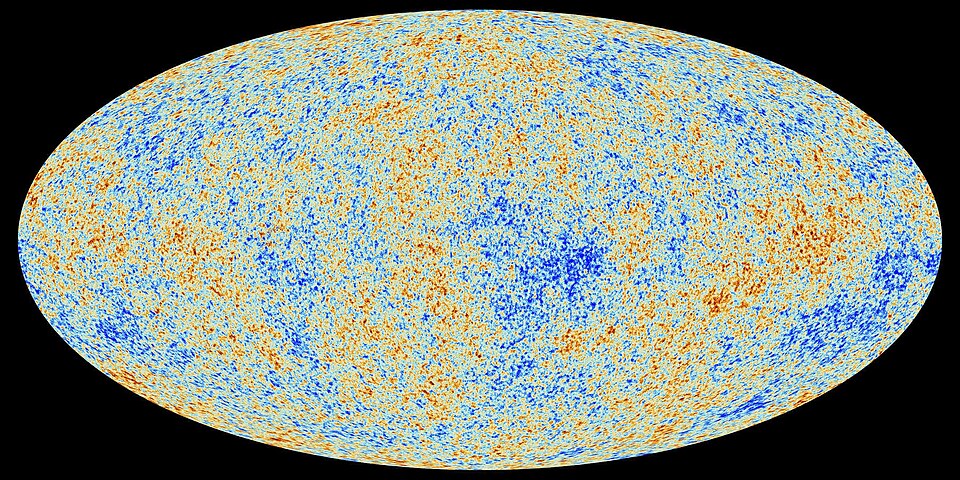
The CMB is the single most informative observation in cosmology. It originated roughly 380,000 years after the Big Bang, when the universe had cooled to approximately 3,000 kelvin—cool enough for electrons and protons to combine into neutral hydrogen atoms for the first time, a process called recombination. Before recombination, the universe was an opaque plasma in which photons scattered constantly off free electrons and could not travel freely. Recombination made the universe transparent, and the photons that had been trapped in the plasma were suddenly free to stream in all directions. Those photons have been traveling through expanding space ever since, stretched by the expansion to microwave wavelengths and cooled to a present temperature of 2.725 kelvin.1, 3
NASA's Cosmic Background Explorer (COBE), launched in 1989, confirmed that the CMB follows a near-perfect blackbody spectrum and detected tiny temperature fluctuations at the level of one part in 100,000. The Wilkinson Microwave Anisotropy Probe (WMAP) mapped these fluctuations with far greater resolution, and the European Space Agency's Planck satellite produced the most detailed CMB map ever assembled, pinning the age of the universe at 13.787 ± 0.020 billion years.1 The pattern of hot and cold spots in the CMB encodes the composition, geometry, and expansion history of the universe. Analysis of the CMB's angular power spectrum has independently confirmed the proportions of ordinary matter (approximately 5%), dark matter (approximately 27%), and dark energy (approximately 68%), as well as the geometric flatness of the universe and the nearly scale-invariant spectrum of primordial density fluctuations predicted by inflationary theory.1
Composition: ordinary matter, dark matter, and dark energy
One of the most striking results of precision cosmology is the discovery that the familiar matter composing stars, planets, and living organisms is a minor constituent of the universe. Ordinary baryonic matter accounts for only about 5 percent of the total energy density. The remaining 95 percent consists of two components whose physical nature remains unknown: dark matter and dark energy.1, 8
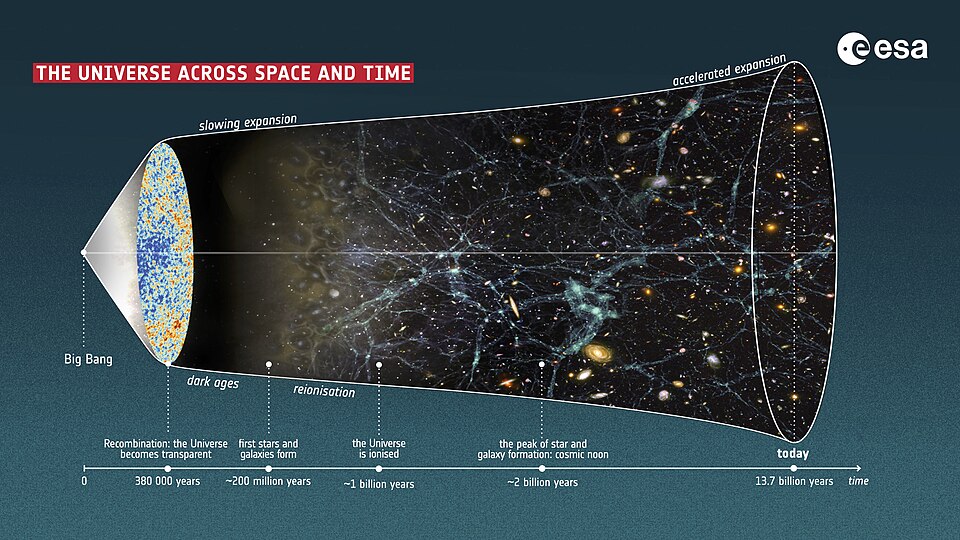

Dark matter, which accounts for approximately 27 percent of the total, neither emits nor absorbs electromagnetic radiation at any wavelength. Its existence is inferred from at least five independent lines of observational evidence: the rotation curves of galaxies, which remain flat far beyond the visible disk; gravitational lensing, in which the paths of light from distant galaxies are bent by the gravity of intervening mass that cannot be accounted for by visible matter; the temperature fluctuations of the CMB, which require a non-baryonic matter component to match observations; the formation and clustering of large-scale structure, which cannot be explained by ordinary matter alone; and the dynamics of galaxy cluster collisions, most dramatically the Bullet Cluster, where the gravitational mass and the luminous mass are clearly separated.7, 1, 8 Despite decades of experimental effort, no dark matter particle has been directly detected, and its identity remains one of the central questions in particle physics and cosmology.
Dark energy, comprising approximately 68 percent of the total energy density, was discovered in 1998 when two independent teams studying distant Type Ia supernovae found that the expansion of the universe is accelerating rather than decelerating under the influence of gravity.4, 5 The simplest theoretical explanation is Einstein's cosmological constant—a constant energy density inherent to empty space itself—but the observed value is roughly 120 orders of magnitude smaller than naive quantum field theory predictions, a discrepancy sometimes called the worst prediction in the history of physics.8 Whether dark energy is truly constant or evolves over cosmic time is an active area of observational investigation.
The large-scale structure of the cosmos
The distribution of matter in the universe is not uniform. Galaxy surveys mapping hundreds of millions of objects have revealed a vast cosmic web of filaments, walls, and voids stretching across hundreds of millions of light-years.7 Galaxy clusters, the most massive gravitationally bound structures in the universe, sit at the intersections of filaments, while immense voids—regions nearly devoid of galaxies—fill the spaces between. This large-scale structure is the direct descendant of the tiny primordial density fluctuations imprinted in the CMB: regions that were slightly denser than average 380,000 years after the Big Bang attracted more matter through gravity over billions of years, growing into the filaments and clusters observed today, while underdense regions emptied into voids.1, 7
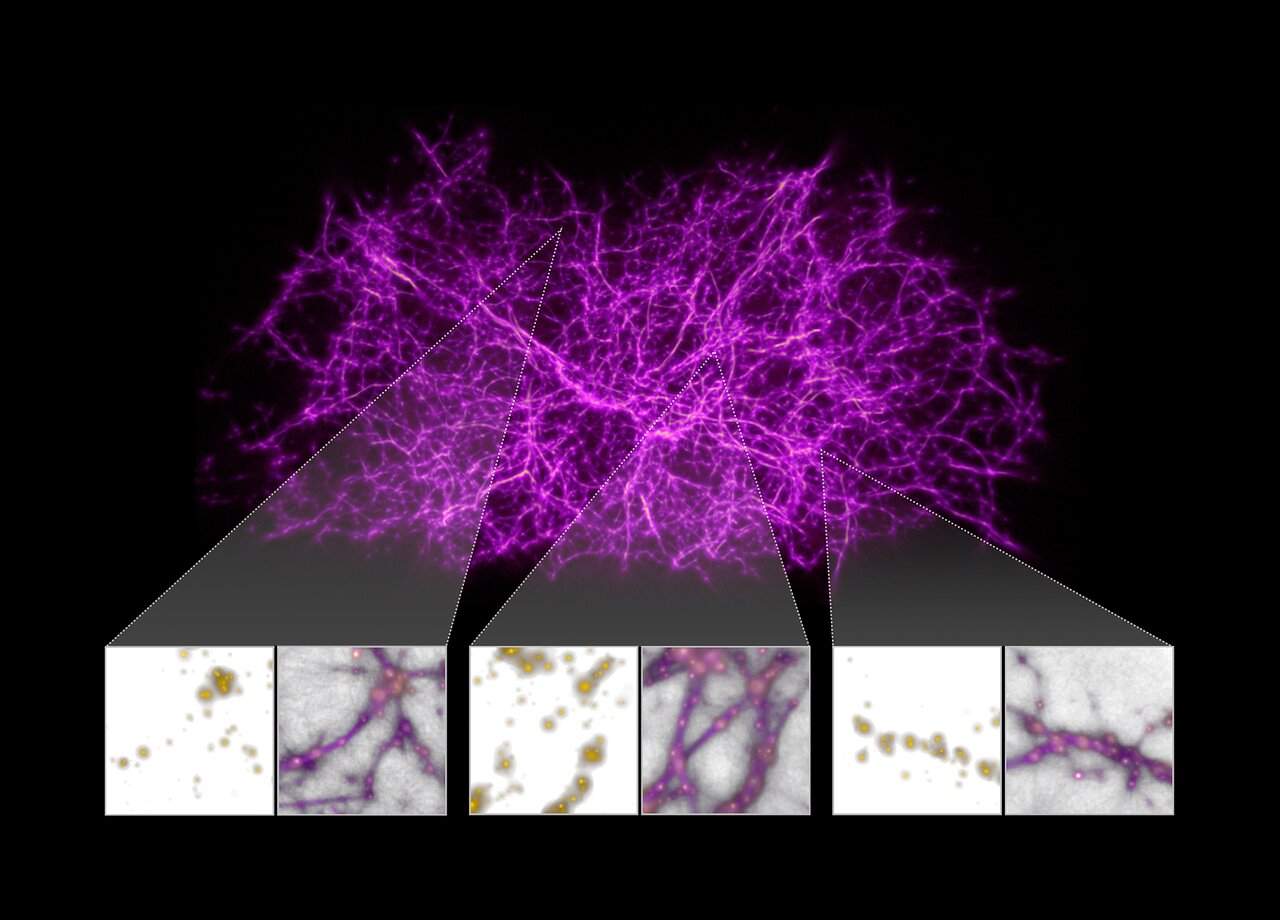

Dark matter played the decisive role in this process. Because it interacts only through gravity, dark matter began collapsing into halos earlier than ordinary matter, which was held back by radiation pressure until recombination. These dark matter halos provided the gravitational wells into which ordinary matter subsequently fell, cooled, and formed stars and galaxies. The observed pattern of large-scale structure matches the predictions of computer simulations that model the gravitational evolution of dark matter with extraordinary fidelity, providing some of the strongest evidence that dark matter exists and that it is "cold"—meaning its particles were moving slowly relative to the speed of light when structures began forming.7, 1
References
Un univers homogène de masse constante et de rayon croissant rendant compte de la vitesse radiale des nébuleuses extra-galactiques
Observational evidence from supernovae for an accelerating universe and a cosmological constant