Overview
- The observable universe has a comoving radius of approximately 46.5 billion light-years despite being only 13.8 billion years old, because the expansion of space has carried the sources of the oldest detectable light far beyond the distance that light alone could have traversed in that time.
- Three distinct horizons govern what we can see and what we will ever see: the particle horizon defines the boundary of the observable universe, the Hubble sphere marks where recession velocity equals the speed of light, and the cosmic event horizon sets the maximum distance from which light emitted today can ever reach us.
- Observations confirm that the universe is spatially flat to extraordinary precision, implying that the total universe may extend far beyond the observable volume, but cosmic variance and the finite speed of light impose a fundamental limit on what cosmology can directly measure.
The observable universe is not the entire universe. It is the spherical region centred on any observer from which light has had time to reach that observer since the Big Bang, approximately 13.8 billion years ago.1, 5 Because space itself has been expanding throughout cosmic history, the objects that emitted the oldest light we detect have been carried far beyond the naive light-travel distance of 13.8 billion light-years: the current comoving radius of the observable universe is approximately 46.5 billion light-years, giving it a diameter of roughly 93 billion light-years.1, 3 Understanding why the observable universe is so much larger than 13.8 billion light-years, and precisely what limits our cosmic view, requires a careful examination of the distance horizons that arise naturally in an expanding spacetime governed by general relativity.
The concept of a cosmological horizon was first rigorously formulated by Wolfgang Rindler in 1956, who distinguished between two fundamentally different kinds of horizon: the particle horizon, which bounds the region from which signals could have reached an observer by the present epoch, and the event horizon, which bounds the region from which signals emitted now will ever reach that observer in the infinite future.2 Together with a third surface called the Hubble sphere, these horizons define the causal structure of the universe and determine what we can observe, what we have already lost from view, and what we will never see.
Comoving and proper distance
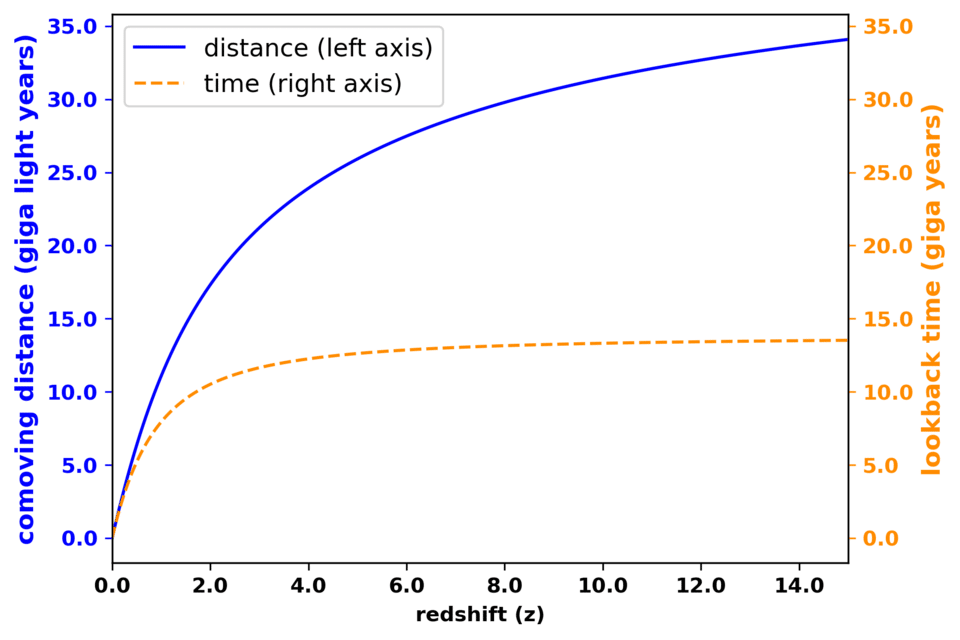
Before examining the horizons themselves, it is essential to understand the two distance measures that pervade cosmological discussion: comoving distance and proper distance. In the Friedmann-Lemaître-Robertson-Walker (FLRW) metric — the mathematical description of a homogeneous, isotropic, expanding spacetime derived from general relativity — the spatial separation between two objects can be expressed in coordinates that either expand with the universe or remain fixed.9, 4
.png)
Comoving distance uses coordinates that expand with the universal expansion, so that two galaxies at rest with respect to the cosmic flow maintain a constant comoving separation even as the physical space between them stretches. Comoving distance is the distance measure that factors out the expansion of space and remains unchanged over time for objects participating in the Hubble flow.4, 15 Proper distance, by contrast, is the physical distance between two points at a specific instant of cosmic time — the distance one would measure if one could freeze the expansion and lay rulers end to end. The two are related by the scale factor a(t), a dimensionless function normalised to unity at the present epoch: proper distance equals the comoving distance multiplied by a(t).4 At the present time, when a = 1, the comoving and proper distances are identical. In the early universe, when a was much less than one, the proper distance between two objects at a fixed comoving separation was proportionally smaller.
The distinction matters enormously in cosmology. When we say the observable universe has a radius of 46.5 billion light-years, we mean the current proper distance to the particle horizon — the physical distance, measured today, to the most distant objects from which light has had time to reach us.1, 3 The light-travel distance to those same objects is only 13.8 billion light-years, reflecting the time the photons spent in transit. The difference arises because the space through which the photons were travelling was continuously expanding behind them, stretching the total distance the source has receded since the photons were emitted.3, 22
The particle horizon
The particle horizon is the most fundamental boundary in observational cosmology. It represents the maximum comoving distance from which a photon emitted at the beginning of the universe (strictly, at the earliest moment from which electromagnetic signals could propagate) could have reached an observer by the present day.2, 19 In mathematical terms, the particle horizon is defined as the integral of c/a(t) from the initial singularity to the present epoch, where c is the speed of light and a(t) is the scale factor. The resulting comoving distance, when converted to a present-day proper distance by multiplying by a = 1, yields the radius of the observable universe.
Using the cosmological parameters measured by the Planck satellite — a Hubble constant of approximately 67.4 km/s/Mpc, a matter density parameter of Ωm ≈ 0.315, and a dark energy density parameter of ΩΛ ≈ 0.685 — the comoving radius of the particle horizon evaluates to approximately 46.5 billion light-years, or equivalently about 14.3 gigaparsecs.1 This is the edge of the observable universe. Every galaxy, every photon, every gravitational wave we have ever detected originated within this sphere. Nothing beyond it has had time to communicate with us.
The particle horizon grows with time, because as the universe ages, light from ever more distant regions has the opportunity to reach us for the first time. In a matter-dominated universe without dark energy, the particle horizon would grow without limit, eventually encompassing the entire universe. In the current dark-energy-dominated cosmos, however, the accelerating expansion imposes a ceiling: there is a maximum comoving distance from which signals can ever arrive, and the particle horizon asymptotically approaches a finite limit.3, 21
It is important to note that the particle horizon is observer-dependent only in position, not in size. Every observer in the universe has a particle horizon of the same radius — 46.5 billion light-years — but centred on their own location. Two observers separated by a large distance will have particle horizons that overlap extensively but are not identical: each can see regions invisible to the other.22
The Hubble sphere
The Hubble sphere (also called the Hubble radius or Hubble horizon) is the surface at which the recession velocity of objects due to the expansion of space equals the speed of light. For a Hubble constant of approximately 67.4 km/s/Mpc, the current Hubble radius is c/H0 ≈ 14.4 billion light-years, or about 4.4 gigaparsecs.1, 3 Objects beyond this distance are receding from us faster than light; objects within it are receding more slowly.
A widespread misconception holds that the Hubble sphere is the boundary of the observable universe — that is, that objects receding faster than light cannot be observed because their photons could never reach us. This is incorrect. As Davis and Lineweaver demonstrated in a landmark 2004 paper, we routinely observe galaxies that are, and always have been, receding from us faster than the speed of light.3 The reason is that the Hubble sphere itself is not static. As the universe evolves, the Hubble parameter H(t) decreases, and the Hubble radius c/H(t) increases. Photons emitted by a galaxy outside the Hubble sphere are initially swept away from us by the expansion, but as the Hubble sphere expands, it can eventually engulf those photons. Once inside the Hubble sphere, the photons find themselves in a region where the local expansion rate is slower than light, and they begin to make progress toward us.3, 20
The Hubble sphere is therefore not a causal boundary. It is the surface at which recession velocity instantaneously equals c at the present moment, and its relationship to the observable universe is more nuanced than popular accounts suggest. The true causal boundary of the past is the particle horizon, and the true causal boundary of the future is the event horizon, neither of which coincides with the Hubble sphere.3, 20
The cosmic event horizon
The cosmic event horizon answers a different question from the particle horizon: not what we can see now, but what we will ever be able to see. It is defined as the maximum comoving distance from which a photon emitted at the present time can reach the observer at any point in the infinite future.2, 19 In a universe dominated by a cosmological constant, the accelerating expansion ensures that distant regions are being carried away at an ever-increasing rate. Light emitted beyond the event horizon will never bridge the gap, no matter how long one waits.
For the concordance ΛCDM cosmological model, the current proper distance to the cosmic event horizon is approximately 16 to 17 billion light-years, or about 5 gigaparsecs.3, 21 This is substantially smaller than the particle horizon of 46.5 billion light-years. The implication is sobering: most of the galaxies that are currently observable lie beyond the event horizon. Light emitted from those galaxies today will never reach us, and as the universe continues to accelerate, those galaxies will progressively redshift out of detectability. In the far future, a cosmological observer will see an increasingly dark and empty sky, with all galaxies except those in the local gravitationally bound group having faded beyond the event horizon.3, 11
The event horizon grows slowly with time but asymptotically approaches a finite maximum in a Λ-dominated universe. Unlike the particle horizon, which expands as new light arrives, the event horizon shrinks in comoving coordinates as the expansion accelerates, meaning that the pool of galaxies from which future signals can reach us is steadily contracting.21 The cosmic event horizon is conceptually analogous to the event horizon of a black hole — it is a one-way causal boundary — though its physical origin in the accelerating expansion of space is entirely different from the strong gravitational curvature near a black hole.19
Comparison of cosmological distance horizons (ΛCDM model, Planck 2018 parameters)1, 3, 21
| Horizon | Definition | Current proper distance |
|---|---|---|
| Particle horizon | Maximum distance from which light emitted at the Big Bang could have reached us by now | ~46.5 Gly (14.3 Gpc) |
| Hubble sphere | Distance at which recession velocity equals the speed of light | ~14.4 Gly (4.4 Gpc) |
| Cosmic event horizon | Maximum distance from which light emitted now can ever reach us in the future | ~16.5 Gly (5.1 Gpc) |
| Surface of last scattering | Source of the cosmic microwave background, emitted ~380,000 years after the Big Bang | ~45.5 Gly (13.9 Gpc) |
Superluminal recession and cosmological redshift
The fact that distant galaxies recede faster than light is one of the most counterintuitive consequences of cosmic expansion, and it frequently provokes the objection that faster-than-light recession should violate special relativity. It does not. Special relativity prohibits objects from moving through space faster than light, but it places no restriction on the rate at which space itself can expand between two objects. The recession velocity in Hubble's law is not a velocity through space but a rate of increase of the proper distance due to the metric expansion of the intervening spacetime.3, 15 No energy or information is transmitted faster than light by this process, and no local reference frame ever measures a superluminal velocity.
The cosmological redshift of distant galaxies is a direct consequence of this expansion. As a photon travels through expanding space, the wavelength of the photon is stretched by the same factor by which the scale factor of the universe has increased during the photon's journey. A galaxy observed at redshift z emitted its light when the scale factor was a = 1/(1 + z), and the photon's wavelength has been stretched by the factor (1 + z) during transit.4, 15 This stretching is most naturally understood not as a Doppler shift due to the source moving through space, but as the cumulative effect of the metric expansion of the space traversed by the photon.
The relationship between cosmological redshift and the Doppler effect has been a subject of pedagogical debate. Bunn and Hogg argued in 2009 that the cosmological redshift can be decomposed into a sequence of infinitesimal Doppler shifts between adjacent fundamental observers, making it kinematic in origin.6 Others have emphasised that the standard general-relativistic derivation, which attributes the redshift to the stretching of wavelengths by the expanding metric, is the more physically transparent interpretation.15, 19 Both frameworks are mathematically equivalent — they yield the same redshift-distance relation — but they offer different conceptual emphases. The metric-expansion interpretation has the pedagogical advantage of making clear why superluminal recession is permitted: in general relativity, the expansion of space is not a motion in the special-relativistic sense and is therefore not subject to the special-relativistic speed limit.3
Davis and Lineweaver provided an observational test that distinguishes the cosmological redshift from a simple special-relativistic Doppler effect. Using the apparent magnitudes of Type Ia supernovae, they showed that the special-relativistic Doppler interpretation of cosmological redshifts is ruled out at a confidence level of 23σ, conclusively demonstrating that the observed redshift-distance relation requires a general-relativistic treatment of expanding space.3
The cosmic inventory within the observable universe
The observable universe, bounded by the particle horizon, is an immense but finite volume containing a staggering quantity of matter and radiation. Within this sphere of approximately 46.5 billion light-years radius, observational surveys and theoretical extrapolations have produced progressively refined estimates of the total contents.
.png)
.png)
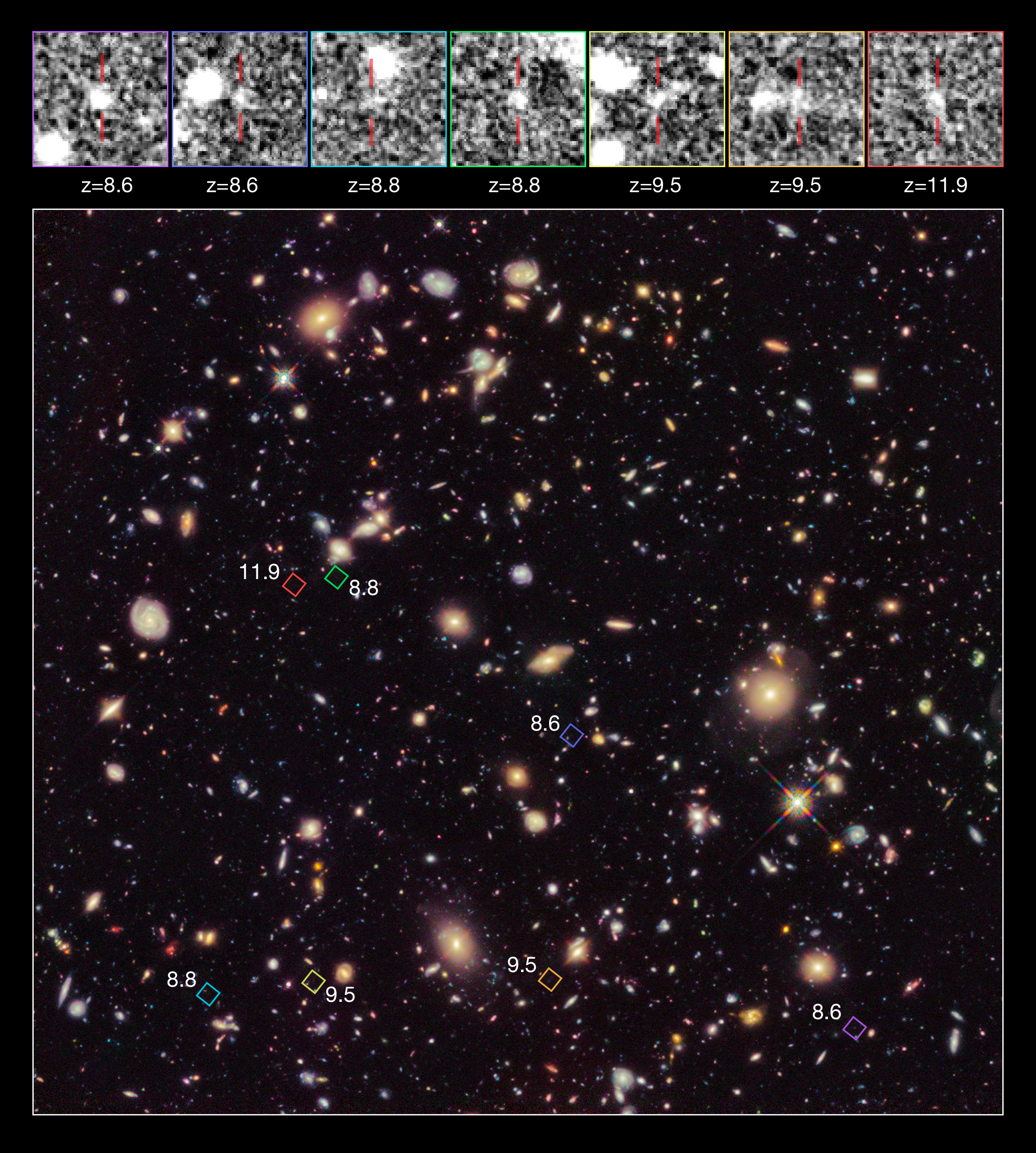
A 2016 analysis by Conselice and collaborators, using deep-field observations from the Hubble Space Telescope combined with mathematical models to account for galaxies too faint and too distant to detect, estimated that the observable universe contains approximately 2 × 10¹² (two trillion) galaxies.10 This figure is roughly ten times larger than previous estimates based on direct galaxy counts from the Hubble Deep Fields, which had placed the number at approximately 120 to 200 billion. The revised estimate includes a vast population of small, low-luminosity galaxies at high redshift that merged into larger systems over cosmic time, implying that the galaxy population was much more numerous in the early universe than it is today.10
The total number of stars in the observable universe is estimated at roughly 1022 to 1024, derived from multiplying the estimated number of galaxies by typical stellar populations per galaxy.16 The total ordinary (baryonic) matter content amounts to approximately 1.5 × 1053 kilograms, corresponding to approximately 1080 atoms (predominantly hydrogen and helium). Ordinary matter, however, constitutes only about 5 percent of the total energy density of the universe. The remaining 95 percent is composed of dark matter (approximately 27 percent) and dark energy (approximately 68 percent), as determined by the Planck measurements of the cosmic microwave background.1
The entropy of the observable universe provides another measure of its vast scale. Egan and Lineweaver calculated in 2010 that the total entropy within the observable universe is dominated by supermassive black holes and amounts to approximately 3.1 × 10104 k, where k is the Boltzmann constant. The entropy associated with the cosmic event horizon itself, computed from its area in analogy with the Bekenstein-Hawking entropy of a black hole, is vastly larger still: approximately 2.6 × 10122 k.11
Energy-density composition of the observable universe1
Spatial flatness and the size of the total universe
The geometry of space on cosmic scales is determined by the total energy density of the universe relative to the critical density — the density required for space to be geometrically flat. This ratio is parameterised by Ωk, the curvature density parameter: Ωk = 0 corresponds to a perfectly flat universe, Ωk > 0 to an open (hyperbolic) geometry, and Ωk < 0 to a closed (spherical) geometry.9, 15
The Planck 2018 analysis of the cosmic microwave background, combined with baryon acoustic oscillation (BAO) measurements, constrains the curvature parameter to Ωk = 0.0007 ± 0.0019, consistent with exact flatness to extraordinary precision.1 An independent analysis by Efstathiou and Gratton in 2020, using an improved Planck likelihood that incorporated polarisation and gravitational lensing data, found Ωk = 0.0004 ± 0.0018 when combined with BAO data, reinforcing the conclusion that the universe is spatially flat or extremely close to it.12 The Dark Energy Spectroscopic Instrument (DESI) has provided additional BAO measurements that confirm consistency with flat spatial geometry.18
The observed flatness has profound implications for the size of the total universe. A perfectly flat universe is spatially infinite: it extends without limit in all directions, and the observable universe is merely a tiny patch within it. Even if the universe has a very slight positive curvature (making it a closed, finite three-sphere), the precision of the Planck constraint implies that the radius of curvature must be at least several hundred times the radius of the observable universe, meaning the total volume of the universe is at minimum hundreds of times larger than the volume we can observe.1, 12 In either case, the observable universe represents a vanishingly small fraction of the whole.
The remarkable flatness of the universe is most naturally explained by cosmic inflation — a period of exponentially rapid expansion in the first fraction of a second after the Big Bang that would have stretched any initial curvature to undetectable levels, much as inflating a balloon makes a small region of its surface appear flat.13, 15
Cosmic variance and what lies beyond
The finite extent of the observable universe imposes a fundamental limitation on cosmological measurements known as cosmic variance. Because we can observe only one realisation of the universe from a single vantage point, statistical measurements of the largest-scale structures and fluctuations are limited by an irreducible sampling uncertainty.

For the lowest multipoles of the cosmic microwave background angular power spectrum, which correspond to fluctuations on scales comparable to the observable universe itself, the number of independent modes available for measurement is small, and the resulting cosmic variance dominates the error budget.1, 5 No improvement in instrument sensitivity or survey depth can overcome this limitation; it is a consequence of having access to only one observable volume.
What lies beyond the particle horizon is, by definition, inaccessible to direct observation. General relativity and the cosmological principle — the assumption that the universe is statistically homogeneous and isotropic on large scales — strongly suggest that the universe beyond the observable volume looks much like the universe within it, containing the same types of galaxies, the same large-scale structure, and the same physical laws.15, 19 The cosmic microwave background provides evidence for this extrapolation: its near-perfect isotropy, with temperature fluctuations of only one part in 100,000, indicates that the universe was remarkably uniform at early times and that conditions just beyond the current particle horizon were statistically identical to conditions just within it.1, 5
Inflationary cosmology provides a theoretical framework for this uniformity. During inflation, a microscopically small patch of space was stretched to vastly superhorizon scales, producing a region far larger than the current observable universe with nearly identical physical properties throughout.13 In many inflationary models, inflation is eternal — once started, it continues producing new inflating regions indefinitely, giving rise to an infinite or effectively infinite volume of space of which our observable universe is an infinitesimal part. In this picture, the particle horizon is not the edge of existence but merely the edge of our epistemic access, a boundary imposed by the finite speed of light and the finite age of the cosmos.13
Observational tests and ongoing research
The theoretical framework of cosmological horizons has been tested and refined through several independent lines of observational evidence. The discovery of the accelerating expansion of the universe in 1998, based on observations of distant Type Ia supernovae by the Supernova Cosmology Project and the High-z Supernova Search Team, established the existence of dark energy and confirmed that the universe possesses a cosmic event horizon, since the accelerating expansion ensures that sufficiently distant regions will be permanently beyond reach.7, 8
Baryon acoustic oscillations — the imprint of primordial sound waves in the distribution of galaxies — provide a standard ruler for measuring cosmic distances. The original detection by Eisenstein and collaborators in 2005, using luminous red galaxies from the Sloan Digital Sky Survey, confirmed the predicted scale of the BAO feature at approximately 490 million light-years (150 megaparsecs) and provided an independent geometric constraint on the expansion history, consistent with the flat ΛCDM model and its predicted horizons.23 The DESI collaboration has extended these measurements to higher precision across multiple redshift bins, yielding distance constraints that further validate the concordance model while providing tentative hints of time-varying dark energy that, if confirmed, could modify the future evolution of the cosmic event horizon.18
The Hubble tension — the persistent discrepancy between the value of the Hubble constant measured from the cosmic microwave background (approximately 67.4 km/s/Mpc) and the value measured from the local distance ladder using Cepheid variables and Type Ia supernovae (approximately 73.0 km/s/Mpc) — has direct implications for the sizes of all three horizons, since the Hubble constant enters directly into the calculation of the Hubble radius, the particle horizon, and the event horizon.1, 14 If the higher local value were adopted, the Hubble radius would be smaller (approximately 13.4 billion light-years instead of 14.4 billion), the particle horizon would shift, and the comoving volume of the observable universe would change accordingly. Resolving the Hubble tension remains one of the most pressing problems in cosmology and carries implications for our understanding of the fundamental geometry and causal structure of the universe.14
Large-scale cosmological simulations, such as the Millennium Simulation, have modelled the formation and evolution of structure within the observable volume, tracking the growth of dark matter halos, galaxies, and galaxy clusters under the concordance cosmological parameters.17 These simulations confirm that the large-scale statistical properties of the universe are consistent with the ΛCDM model out to the largest observable scales, lending further confidence to the extrapolation that the universe beyond the particle horizon is governed by the same physics and populated by the same kinds of structures as the universe within it.17, 15
References
Expanding confusion: common misconceptions of cosmological horizons and the superluminal expansion of the universe
Nine-year Wilkinson Microwave Anisotropy Probe (WMAP) observations: cosmological parameter results
Observational evidence from supernovae for an accelerating universe and a cosmological constant
A comprehensive measurement of the local value of the Hubble constant with 1 km/s/Mpc uncertainty from the Hubble Space Telescope and the SH0ES team
DESI 2024 VI: Cosmological constraints from the measurements of baryon acoustic oscillations
Detection of the baryon acoustic peak in the large-scale correlation function of SDSS luminous red galaxies