Overview
- Galaxy clusters are the largest gravitationally bound objects in the universe, containing hundreds to thousands of galaxies embedded in dark matter halos of 10⁹⁴ to 10⁹⁵ solar masses, with the majority of their baryonic mass residing not in stars but in a diffuse, X-ray-emitting intracluster medium heated to tens of millions of degrees.
- The distribution of galaxies on scales of hundreds of megaparsecs forms the cosmic web, a network of filaments, sheets, and voids first revealed by redshift surveys such as the CfA, 2dFGRS, and SDSS, and successfully predicted by cold dark matter simulations of gravitational structure formation.
- Observations of galaxy clusters and large-scale structure, including baryon acoustic oscillations, cluster mass functions, and the Sunyaev-Zel'dovich effect, provide independent and powerful constraints on cosmological parameters including the matter density, dark energy equation of state, and the amplitude of primordial density fluctuations.
The universe is not uniformly filled with galaxies. On scales of millions to hundreds of millions of light-years, matter is organized into a vast, web-like architecture of clusters, filaments, sheets, and voids — the large-scale structure of the universe. At the densest nodes of this cosmic web sit galaxy clusters, enormous gravitationally bound assemblies of hundreds to thousands of galaxies, vast reservoirs of hot gas, and even larger quantities of dark matter, with total masses reaching 1014 to 1015 solar masses.15, 17 The study of galaxy clusters and large-scale structure connects the physics of the very early universe — the primordial density fluctuations imprinted during cosmic inflation — to the observable distribution of matter today, providing some of the most powerful tests of cosmological models and the nature of dark matter and dark energy.16
Galaxy clusters were among the first structures to reveal the existence of dark matter, and the cosmic web they inhabit was among the first large-scale patterns to confirm the predictions of cold dark matter cosmology. From Fritz Zwicky's pioneering observations of the Coma Cluster in the 1930s to modern surveys mapping millions of galaxies across billions of light-years, the study of large-scale structure has transformed our understanding of cosmic evolution and continues to yield increasingly precise constraints on the fundamental parameters that govern the universe.1, 16
Galaxy clusters and their discovery
A galaxy cluster is a gravitationally bound system containing anywhere from a few dozen to several thousand galaxies, together with a pervasive hot gas called the intracluster medium and a dominant dark matter halo. Clusters typically span 2 to 10 megaparsecs (roughly 6 to 30 million light-years) in diameter and represent the most massive collapsed structures in the universe.15, 17 The recognition that galaxies are not scattered at random but congregate in clusters dates to the eighteenth century, when Charles Messier and William Herschel noted concentrations of nebulae in certain regions of the sky. However, the systematic study of galaxy clusters began in earnest in the twentieth century with the development of wide-field photographic surveys.
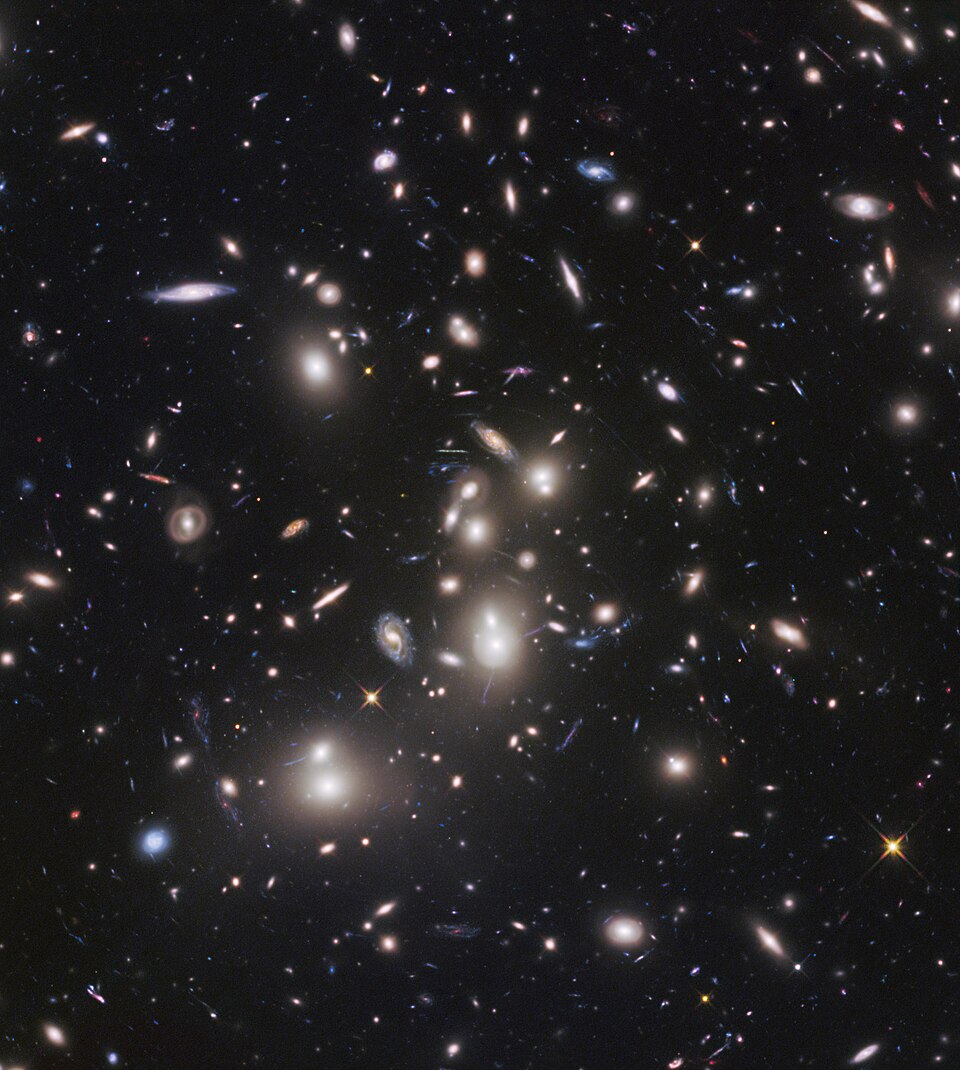

In 1933, the Swiss astronomer Fritz Zwicky applied the virial theorem to the Coma Cluster, a rich collection of galaxies approximately 100 megaparsecs from the Milky Way. By measuring the velocities of individual galaxies within the cluster, Zwicky calculated the total gravitational mass required to keep the system bound and found it to be roughly 400 times greater than the mass visible in the cluster's luminous galaxies. He termed the discrepancy dunkle Materie — dark matter — providing one of the earliest and most compelling pieces of evidence that the universe contains far more matter than can be accounted for by stars and gas.1
The first comprehensive catalog of galaxy clusters was compiled by George Abell in 1958, based on visual inspection of photographic plates from the Palomar Observatory Sky Survey. The Abell catalog identified 2,712 rich clusters in the northern sky, selected according to standardized criteria for galaxy count and angular extent. The catalog revealed that clusters themselves are not distributed uniformly but tend to congregate into larger associations — superclusters — separated by vast regions of relative emptiness.2 The Abell catalog and its subsequent extensions have remained foundational references in extragalactic astronomy for more than six decades.
Among the best-studied individual clusters are the Coma Cluster (Abell 1656), a massive, approximately spherical system dominated by two giant elliptical galaxies; the Virgo Cluster, the nearest major cluster to the Milky Way at a distance of approximately 16 megaparsecs and the dominant mass concentration of the Local Supercluster; and Abell 2029, one of the most luminous X-ray clusters known, containing a central galaxy with one of the largest stellar envelopes ever measured.2, 3
.jpg)
.jpg)
The intracluster medium and X-ray emission
Although galaxy clusters are named for their constituent galaxies, the majority of the baryonic (ordinary) matter in a cluster resides not in stars but in a vast, diffuse plasma that fills the space between galaxies: the intracluster medium (ICM). This gas, composed primarily of ionized hydrogen and helium with trace heavier elements, is heated to temperatures of 107 to 108 kelvin (approximately 10 to 100 million degrees) by the gravitational energy released during the collapse and virialization of the cluster. At these temperatures, the ICM emits copiously in X-rays, primarily through thermal bremsstrahlung (free-free emission) and line emission from highly ionized heavy elements such as iron.3
The discovery of extended X-ray emission from galaxy clusters in the late 1960s and 1970s, first with sounding rockets and then with the Uhuru satellite, fundamentally changed the study of clusters. X-ray observations revealed that the ICM typically constitutes 10 to 15 percent of the total cluster mass — several times more mass than is contained in all the cluster's galaxies combined. The remaining 80 to 90 percent of the cluster mass is in the form of dark matter, detectable only through its gravitational effects.3, 15 Subsequent X-ray observatories, including the Einstein Observatory, ROSAT, Chandra, and XMM-Newton, have mapped the ICM in hundreds of clusters with progressively finer spatial and spectral resolution, revealing substructure from mergers, cold fronts, cavities inflated by jets from central active galactic nuclei, and the chemical enrichment history of the intracluster gas.3, 17
The temperature and luminosity of the ICM are tightly correlated with the total mass of the cluster, a relationship that makes X-ray observations one of the primary methods for estimating cluster masses. For a cluster in approximate hydrostatic equilibrium — where the outward gas pressure balances the inward pull of gravity — the temperature and density profiles of the ICM can be used to infer the total gravitating mass as a function of radius. This hydrostatic mass estimation technique has been applied to large samples of clusters observed by Chandra and XMM-Newton, yielding mass measurements that are essential for cosmological analyses.16, 18
The Sunyaev-Zel'dovich effect
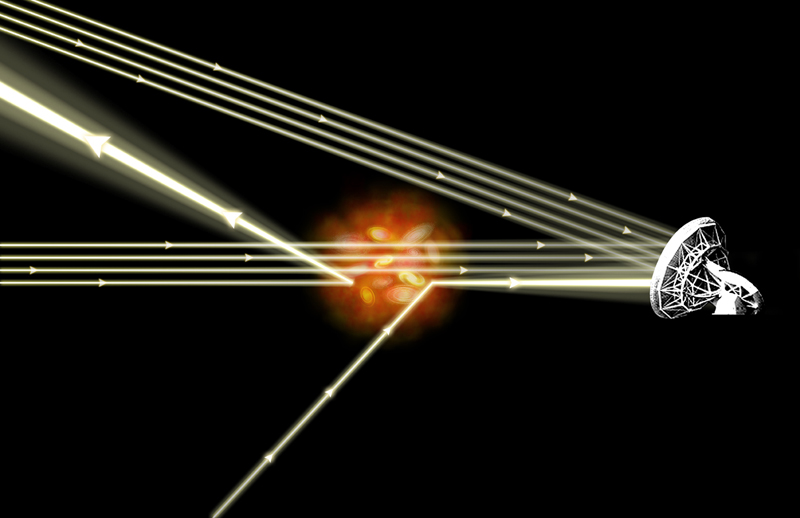
The hot electrons of the intracluster medium interact not only with X-ray photons but also with the photons of the cosmic microwave background (CMB) that permeate the universe. When CMB photons pass through a galaxy cluster, a small fraction of them undergo inverse Compton scattering off the high-energy ICM electrons, gaining energy in the process. This spectral distortion of the CMB in the direction of a galaxy cluster is known as the thermal Sunyaev-Zel'dovich (tSZ) effect, first predicted theoretically by Rashid Sunyaev and Yakov Zeldovich in 1972.4
.jpg)
The tSZ effect produces a characteristic signature: a decrement in the CMB intensity at frequencies below approximately 218 gigahertz and an increment at higher frequencies. The magnitude of the effect is proportional to the integrated electron pressure along the line of sight through the cluster, a quantity known as the Compton y-parameter. Crucially, because the SZ effect is a scattering phenomenon rather than an emission process, its surface brightness is independent of the cluster's redshift. A cluster at redshift 1 produces the same SZ signal as an identical cluster at redshift 0.1, making the SZ effect uniquely powerful for detecting clusters at high redshifts where X-ray emission becomes progressively fainter.4, 5
A second form, the kinetic Sunyaev-Zel'dovich (kSZ) effect, arises from the bulk motion of the cluster relative to the CMB rest frame. The kSZ effect produces a pure intensity shift without the frequency-dependent signature of the thermal effect, making it more difficult to detect but providing a direct measurement of the cluster's peculiar velocity along the line of sight.5 Surveys with the South Pole Telescope, the Atacama Cosmology Telescope, and the Planck satellite have exploited the SZ effect to discover hundreds of previously unknown galaxy clusters and to construct cluster catalogs that are approximately mass-limited and nearly redshift-independent — properties that make SZ-selected cluster samples invaluable for cosmology.5, 16
Dark matter halos and mass estimation
Galaxy clusters are embedded within massive halos of dark matter that dominate their gravitational potential. Cosmological N-body simulations have shown that dark matter halos formed through hierarchical merging follow a characteristic density profile, described by the Navarro-Frenk-White (NFW) profile. The NFW profile is a two-parameter function in which the density decreases as the inverse of the radius in the inner regions and as the inverse cube of the radius in the outer regions, with a smooth transition at a characteristic scale radius. This universal profile has been confirmed observationally through gravitational lensing analyses of numerous galaxy clusters.6
Determining the mass of a galaxy cluster is central to both astrophysics and cosmology, and several independent methods have been developed. The virial theorem method, pioneered by Zwicky, uses the measured velocities of cluster galaxies as tracers of the gravitational potential: the velocity dispersion of the galaxies, combined with the spatial extent of the cluster, yields an estimate of the total enclosed mass.1, 15 The X-ray hydrostatic method assumes that the ICM is in approximate pressure equilibrium within the cluster potential, allowing the mass profile to be derived from the observed gas temperature and density gradients.3, 16
Gravitational lensing provides a third, entirely independent approach. The mass of a galaxy cluster deflects light from more distant background galaxies, distorting their images in a pattern that depends on the projected mass distribution of the cluster. Strong lensing, which produces dramatic arcs and multiple images of background galaxies, constrains the mass in the dense central regions. Weak lensing, which induces subtle, statistically detectable shape distortions (shear) in large numbers of background galaxies, maps the mass distribution out to the cluster outskirts and beyond. Because gravitational lensing responds to all mass regardless of its physical state or composition, it provides a direct measurement of the total mass including dark matter, without assumptions about hydrostatic equilibrium or dynamical relaxation.23
The Bullet Cluster (1E 0657-558) provided one of the most striking demonstrations of the power of gravitational lensing and the reality of dark matter. In this system, two galaxy clusters have recently undergone a high-velocity collision. Chandra X-ray observations show that the ICM of the two clusters has been decelerated and separated from the galaxies by ram-pressure stripping, creating a bow-shock morphology. However, weak-lensing mass maps reveal that the dominant mass component — the dark matter — has passed through the collision largely unimpeded, remaining coincident with the collisionless galaxies rather than with the gas. The spatial offset between the baryonic mass peak (the X-ray gas) and the total mass peak (the dark matter) was detected at 8-sigma significance, providing direct empirical evidence that the majority of cluster mass consists of a weakly interacting, non-baryonic component.7
Galaxy cluster mass estimation methods15, 16, 23
| Method | Observable | Key assumption | Mass range probed |
|---|---|---|---|
| Virial theorem | Galaxy velocity dispersion | Dynamical equilibrium | Within virial radius |
| X-ray hydrostatic | ICM temperature & density | Hydrostatic equilibrium | Core to ~r500 |
| Strong lensing | Arcs, multiple images | Lens model geometry | Central ~200 kpc |
| Weak lensing | Background galaxy shear | Source redshift distribution | Core to several Mpc |
| Sunyaev-Zel'dovich | CMB spectral distortion | ICM pressure model | Integrated along line of sight |
The cosmic web: filaments, sheets, and voids
On scales far larger than individual clusters, the distribution of matter in the universe forms a pattern known as the cosmic web. Galaxy clusters sit at the densest nodes of this web, connected by elongated filaments of galaxies and dark matter that can stretch for tens to hundreds of megaparsecs. Between the filaments lie vast, approximately spherical voids — regions tens of megaparsecs across that are largely devoid of luminous galaxies and contain significantly less matter than the cosmic average.9, 22
The cosmic web was first revealed observationally by the CfA Redshift Survey. In 1986, Valérie de Lapparent, Margaret Geller, and John Huchra published a map of galaxy positions derived from spectroscopic redshifts of approximately 1,100 galaxies in a thin slice of the sky. The resulting image — known informally as the "slice of the universe" — revealed a striking pattern of galaxies distributed along thin walls and filaments surrounding large, roughly circular voids, a structure compared by the authors to a network of soap bubbles. The subsequent detection of the Great Wall, a sheet-like concentration of galaxies extending over 170 megaparsecs, confirmed that coherent structures exist on scales far larger than individual clusters.8
The theoretical framework for understanding the cosmic web was articulated by Bond, Kofman, and Pogosyan in 1996, who showed that the filamentary pattern of the galaxy distribution is encoded in the initial density field of the early universe. The gravitational tidal field associated with the primordial density fluctuations determines where matter will collapse into sheet-like pancakes (along the direction of greatest compression), elongated filaments (along the directions of the two greatest compressions), and compact nodes or clusters (where compression occurs along all three axes). The pattern of the cosmic web is thus set by the geometry of the initial conditions, with subsequent gravitational evolution sharpening the contrast between dense structures and underdense voids.9
This theoretical picture received spectacular confirmation from cosmological simulations. The Millennium Simulation, carried out by Volker Springel and collaborators in 2005, followed the gravitational evolution of more than 10 billion dark matter particles in a cubic volume 500 megaparsecs on a side, producing the most detailed model of cosmic structure formation at the time. The simulation reproduced the observed cosmic web with remarkable fidelity, predicting the statistical properties of galaxy clustering, the abundance of clusters as a function of mass and redshift, and the topology of filaments and voids in close agreement with observations from large redshift surveys.12
Superclusters and the largest structures
Superclusters are assemblies of galaxy clusters and groups that span scales of 50 to 200 megaparsecs or more. Unlike individual clusters, superclusters are generally not gravitationally bound: the expansion of the universe carries their constituent parts apart faster than gravity can draw them together. They are therefore best understood as transient overdensities in the cosmic web rather than as stable, virialized objects. Nevertheless, superclusters represent the largest coherent structures in the observable universe and provide essential context for understanding the flow of matter on cosmic scales.20, 22
The Milky Way belongs to the Laniakea supercluster, identified in 2014 by R. Brent Tully and collaborators using a novel analysis of galaxy peculiar velocities — the departures of galaxy motions from the smooth expansion of the universe caused by local gravitational attractions. By mapping the three-dimensional velocity field derived from a catalog of approximately 8,000 galaxies, Tully's team identified the surface along which the velocity flow diverges, analogous to a watershed divide in hydrology. The volume enclosed within this surface defines Laniakea, a supercluster approximately 160 megaparsecs (520 million light-years) in diameter, containing roughly 100,000 galaxies with a total mass of approximately 1017 solar masses. The gravitational attractor at its center — the Great Attractor — is a region of anomalously high mass concentration toward which the Milky Way and thousands of other galaxies are moving at several hundred kilometres per second.20
Redshift surveys have revealed numerous other large structures. The Sloan Great Wall, discovered in SDSS data by Gott and collaborators in 2005, is a filamentary concentration of galaxies stretching approximately 450 megaparsecs in comoving length at a redshift of approximately 0.08, making it 80 percent longer than the earlier CfA Great Wall and one of the largest identified structures in the nearby universe.21 The Shapley Supercluster, located at a distance of approximately 200 megaparsecs, is the most massive supercluster in the local universe and a major contributor to the peculiar velocity of the Local Group.22
Redshift surveys and mapping the universe
The three-dimensional structure of the universe can only be revealed by measuring the distances to large numbers of galaxies, and the most efficient way to do this is through spectroscopic redshift surveys that use the cosmological redshift of a galaxy's spectral lines as a proxy for its distance. The history of large-scale structure research is therefore inseparable from the history of progressively larger and more complete galaxy redshift surveys.22
The CfA surveys of the 1980s and early 1990s mapped tens of thousands of galaxies and revealed the basic topology of the cosmic web. A revolution in survey scale came at the turn of the millennium with two programs that each mapped more than 200,000 galaxies. The Two-degree-Field Galaxy Redshift Survey (2dFGRS), conducted with the Anglo-Australian Telescope, obtained spectra and redshifts for approximately 230,000 galaxies to a median redshift of about 0.11, covering two large strips of sky. The 2dFGRS measured the galaxy power spectrum — the Fourier transform of the two-point correlation function — with sufficient precision to detect the imprint of baryon acoustic oscillations and to constrain the matter density parameter to Omegam ≈ 0.23, in excellent agreement with CMB measurements.10, 24
The Sloan Digital Sky Survey (SDSS), begun in 2000, has grown into the most extensive astronomical survey ever conducted, imaging more than a quarter of the sky in five photometric bands and obtaining spectra for millions of galaxies, quasars, and stars over its successive phases. The SDSS spectroscopic galaxy sample has mapped the three-dimensional distribution of galaxies to redshifts beyond 0.7, revealing the cosmic web in unprecedented detail and enabling precise measurements of galaxy clustering, baryon acoustic oscillations, and the growth of structure.11, 13 Together with the 2dFGRS, the SDSS has established the statistical properties of the cosmic web — the correlation function, the power spectrum, the void size distribution, and the topology of the galaxy distribution — as quantitative benchmarks against which cosmological models must be tested.13, 24
Baryon acoustic oscillations
One of the most important discoveries to emerge from large galaxy redshift surveys is the detection of baryon acoustic oscillations (BAO) in the distribution of galaxies. BAO are a relic of the same acoustic oscillations in the primordial plasma that produced the temperature fluctuations observed in the cosmic microwave background. Before the universe became transparent approximately 380,000 years after the Big Bang, sound waves propagated through the coupled photon-baryon fluid, driven outward from initial overdensities at roughly half the speed of light. When the universe cooled enough for hydrogen atoms to form (recombination) and photons decoupled from baryons, the sound waves froze in place, leaving a characteristic excess of matter at a radius of approximately 150 megaparsecs (comoving) from each initial overdensity.13, 19
This preferred scale is imprinted on the distribution of galaxies as a slight enhancement in the probability of finding two galaxies separated by approximately 150 megaparsecs compared to slightly smaller or larger separations. The first unambiguous detection of the BAO signal in the galaxy distribution was reported by Daniel Eisenstein and collaborators in 2005, using a sample of 46,748 luminous red galaxies from the SDSS. The measured correlation function showed a clear peak at a separation of approximately 100 h−1 megaparsecs (where h is the reduced Hubble constant), matching the predicted scale from CMB observations with excellent precision.13
Because the physical size of the BAO scale is precisely known from CMB physics and the well-understood physics of the early universe, it serves as a standard ruler — a fixed length scale that can be measured at different redshifts to trace the expansion history of the universe. By measuring the BAO scale in the galaxy distribution at multiple redshifts, astronomers can determine the angular diameter distance and the Hubble parameter as functions of cosmic time, directly constraining the geometry and expansion rate of the universe and providing independent evidence for the accelerating expansion driven by dark energy.13, 19 BAO measurements from the SDSS, 2dFGRS, and their successors have become one of the three principal pillars of observational cosmology, alongside the CMB and Type Ia supernovae.16
Approximate baryonic composition of a massive galaxy cluster3, 15
Gravitational structure formation
The large-scale structure of the universe grew from tiny density fluctuations in the nearly homogeneous matter distribution of the early cosmos. In the standard cold dark matter (CDM) framework, dark matter particles, which do not interact electromagnetically and therefore were not affected by the radiation pressure that prevented baryonic matter from collapsing before recombination, began to gravitationally clump shortly after the universe became matter-dominated. Regions of slightly above-average density attracted additional matter from their surroundings, while underdense regions were progressively emptied. This process of gravitational instability, first analyzed in the cosmological context by James Jeans and later developed extensively by Peebles and others, is the fundamental mechanism responsible for all the structure observed in the universe today.14, 22
The growth of structure is hierarchical: small objects collapse first and merge to form progressively larger ones. Dark matter halos of galactic mass formed first, merging over billions of years to build the group-scale and cluster-scale halos observed today. The mass function of collapsed halos — the number density of halos as a function of mass — was first estimated analytically by William Press and Paul Schechter in 1974 using a simple model based on the statistics of Gaussian random density fields. Despite its simplicity, the Press-Schechter formalism captures the qualitative features of the halo mass function remarkably well: an exponential cutoff at high masses (because the largest overdensities are exponentially rare in a Gaussian field) and a power-law behavior at low masses.14 Modern refinements, calibrated against N-body simulations, have improved the accuracy of the predicted mass function to the few-percent level, making it a precision tool for cosmological parameter estimation.17
The evolution of the cluster mass function with redshift is particularly sensitive to cosmological parameters. In a universe with a higher matter density, structure grows more rapidly and massive clusters form earlier, whereas in a low-density universe dominated by dark energy, the growth of structure is suppressed at late times and the abundance of very massive clusters declines relative to the high-density case. Observations of the cluster mass function at both low and high redshifts therefore constrain the combination of the matter density parameter Omegam, the amplitude of density fluctuations sigma8, and the dark energy equation of state. Vikhlinin and collaborators used Chandra X-ray observations of a carefully selected sample of galaxy clusters at low and high redshifts to measure the evolution of the mass function, finding evidence for dark energy at approximately 5-sigma significance and constraining the equation-of-state parameter to w0 = −1.14 ± 0.21, consistent with a cosmological constant.18
Cosmological implications
Galaxy clusters and large-scale structure provide constraints on cosmological parameters that are complementary to and independent of those derived from the cosmic microwave background and Type Ia supernovae. The cluster mass function, the power spectrum of galaxy clustering, the BAO scale, and the SZ effect each probe different aspects of cosmic geometry and the growth of structure, and their combination with CMB data has been instrumental in establishing the concordance Lambda-CDM cosmological model.16, 19
The matter density parameter (Omegam) is one of the quantities most tightly constrained by cluster studies. The abundance of clusters at the present epoch, combined with their mass-to-light ratios and the baryon fraction measured from X-ray observations, independently yields Omegam ≈ 0.3, in agreement with the value derived from the CMB power spectrum by the Planck satellite (Omegam = 0.315 ± 0.007).16, 19 The baryon fraction of clusters — the ratio of baryonic mass (ICM gas plus stars) to total mass — provides an additional constraint, because it should approximately equal the cosmic baryon-to-total-matter ratio. X-ray measurements of the baryon fraction in relaxed clusters, combined with the cosmic baryon density measured from the CMB and Big Bang nucleosynthesis, yield consistent and precise estimates of Omegam.16, 18
The amplitude of primordial density fluctuations, parameterized by sigma8 (the root-mean-square amplitude of mass fluctuations within spheres of 8 h−1 megaparsec radius), is constrained by the present-day abundance of massive clusters. Because the most massive clusters correspond to the extreme tail of the Gaussian density field, their abundance is exponentially sensitive to sigma8: a modest increase in the amplitude of fluctuations produces a dramatic increase in the number of massive clusters. Current cluster counts combined with CMB data yield sigma8 ≈ 0.81, consistent with the Planck value of 0.811 ± 0.006.18, 19
BAO measurements from galaxy surveys provide geometric constraints on the expansion history that are among the most robust in cosmology, because the BAO signal is a large-scale feature that is minimally affected by the astrophysical complexities of galaxy formation. Combined with CMB measurements, BAO data tightly constrain the Hubble constant, the spatial curvature of the universe, and the properties of dark energy, contributing to the overall concordance of the Lambda-CDM model.13, 19 The consistency of cosmological parameters derived from such fundamentally different physical processes — the primordial acoustic oscillations in the CMB, the gravitational growth of clusters, the geometrical BAO standard ruler, and the redshift-distance relation of supernovae — represents one of the most compelling achievements of modern observational cosmology.16
References
The observations of relic radiation as a test of the nature of X-ray radiation from the clusters of galaxies
Detection of the baryon acoustic peak in the large-scale correlation function of SDSS luminous red galaxies
Formation of galaxies and clusters of galaxies by self-similar gravitational condensation
A measurement of the cosmological mass density from clustering in the 2dF Galaxy Redshift Survey