Overview
- After recombination at redshift z ~ 1100, the universe entered the cosmic dark ages -- a period of hundreds of millions of years during which no luminous sources existed -- until the first metal-free Population III stars ignited inside dark matter minihalos, cooling their gas through molecular hydrogen and reaching masses of tens to hundreds of solar masses.
- These first stars, together with the earliest galaxies, produced ultraviolet photons that gradually ionized the surrounding neutral hydrogen in a process called reionization, which began around z ~ 15-20 and was essentially complete by z ~ 5.5-6, as evidenced by the Gunn-Peterson trough in high-redshift quasar spectra and the CMB optical depth measured by Planck.
- JWST has revealed unexpectedly luminous galaxies at redshifts z > 10-14, suggesting that star formation in the early universe was more efficient than pre-launch models predicted, while upcoming 21-cm experiments such as HERA and SKA promise to map the three-dimensional structure of reionization in unprecedented detail.
Approximately 380,000 years after the Big Bang, the universe cooled sufficiently for electrons and protons to combine into neutral hydrogen atoms in a process known as recombination. The resulting gas was transparent to the cosmic microwave background radiation but opaque to ultraviolet light, and with no luminous objects yet in existence, the cosmos entered a period of profound darkness. This era, spanning roughly from redshift z ~ 1100 to z ~ 20–30, is known as the cosmic dark ages.1 The dark ages ended when the first generation of stars and galaxies ignited, flooding the intergalactic medium with ultraviolet photons that gradually stripped electrons from the surrounding neutral hydrogen. This transformation of the intergalactic medium from a neutral to an ionized state is called reionization, and it represents one of the most significant phase transitions in the history of the universe.1, 7
Understanding reionization requires tracing the formation of the very first luminous objects — the metal-free Population III stars that formed inside dark matter minihalos — through the assembly of the first galaxies and the progressive ionization of the intergalactic medium over hundreds of millions of years. Observational evidence from quasar absorption spectra, the cosmic microwave background, Lyman-alpha emitting galaxies, and the revolutionary discoveries of the James Webb Space Telescope (JWST) have together established a coherent picture of this epoch, while the promise of 21-cm radio observations holds the potential to map the three-dimensional structure of reionization in unprecedented detail.7, 20
The cosmic dark ages
The cosmic dark ages began at the epoch of recombination, when the universe was approximately 380,000 years old and had cooled to a temperature of about 3,000 kelvin. At this point, nearly all free electrons were captured into neutral hydrogen and helium atoms, rendering the universe electrically neutral and transparent to the photons that would eventually be observed as the cosmic microwave background.1, 10 With no stars, galaxies, or other luminous sources yet in existence, the universe was filled only with a nearly uniform sea of neutral gas and the invisible scaffolding of dark matter, whose small density perturbations had been imprinted during cosmic inflation.
During the dark ages, the matter content of the universe consisted almost entirely of hydrogen (roughly 76 percent by mass) and helium (roughly 24 percent), with negligible traces of lithium and deuterium produced during Big Bang nucleosynthesis.1 No heavier elements existed anywhere in the cosmos. The small gravitational overdensities seeded during inflation grew gradually through gravitational instability, with dark matter collapsing first into progressively larger structures known as halos. Ordinary baryonic matter followed, falling into the gravitational potential wells of these dark matter halos. The first halos massive enough to trap and cool gas — known as minihalos, with masses of roughly 105 to 106 solar masses — are predicted to have formed at redshifts of z ~ 20–30, approximately 100 to 200 million years after the Big Bang.1, 4
A critical bottleneck in the formation of the first luminous objects was the problem of gas cooling. For gas to collapse and fragment into stars, it must be able to radiate away its gravitational energy. In the absence of heavy elements (which provide the atomic and molecular line transitions that cool gas efficiently in the present-day universe), the only significant coolant available in primordial gas was molecular hydrogen (H2). Molecular hydrogen forms through a two-step gas-phase process involving the intermediary H− ion and can cool gas to temperatures of roughly 200 kelvin through rotational and vibrational line emission, allowing it to condense to densities sufficient for star formation.4, 2 The minimum halo mass required to initiate H2 cooling and support gravitational collapse was calculated to be approximately 105 to 106 solar masses at redshifts z ~ 20–30, setting the mass scale for the very first star-forming structures in the universe.4
Population III stars
The first generation of stars to form in the universe, known as Population III (Pop III) stars, emerged from gas of purely primordial composition — entirely devoid of carbon, oxygen, and other elements heavier than lithium. The absence of metals had profound consequences for their formation and properties. Without the efficient cooling channels provided by metal lines and dust grains, the primordial gas within minihalos could cool only through H2 rotational-vibrational transitions, which limited the minimum temperature achievable in collapsing gas clouds to approximately 200 kelvin. This relatively high temperature floor resulted in characteristic masses for the collapsing gas clumps that were substantially higher than those typical of present-day star formation.2, 3
.png)
.png)
The first detailed three-dimensional hydrodynamical simulation of Pop III star formation, performed by Abel, Bryan, and Norman in 2002, followed the gravitational collapse of primordial gas within a dark matter minihalo from cosmological initial conditions down to the formation of a protostellar core. The simulation showed that the gas fragmented into a single dense core of approximately 100 solar masses that underwent rapid contraction, with a protostellar seed of roughly one solar mass forming at the centre. The high accretion rates predicted by these and subsequent simulations — of order 10−3 solar masses per year, compared to 10−6 to 10−5 solar masses per year for present-day low-mass star formation — suggested that Population III stars grew to masses of tens to hundreds of solar masses before feedback processes halted further accretion.3, 2
The resulting initial mass function (IMF) of Population III stars is predicted to have been top-heavy, meaning that the characteristic stellar mass was much higher than the approximately 0.5 solar masses that characterises the present-day IMF. Although the precise form of the Pop III IMF remains uncertain, recent simulations incorporating magnetic fields, turbulence, and radiative feedback suggest a broad mass distribution spanning from roughly 10 to several hundred solar masses, with a characteristic mass of approximately 10 to 50 solar masses.6 Some simulations have also identified the possibility of fragmentation within the accretion disc surrounding the protostar, producing small multiples or clusters of moderately massive stars rather than a single extremely massive object, but the top-heavy character of the mass function remains a robust prediction.6, 2
Because of their extreme masses and the absence of metals in their outer layers, Pop III stars would have had surface temperatures exceeding 100,000 kelvin and luminosities of 105 to 107 solar luminosities, making them extraordinarily efficient producers of ultraviolet and ionizing radiation.2 A single Pop III star of 100 solar masses could have ionized a region of intergalactic hydrogen several kiloparsecs in radius, creating the first localised bubbles of ionized gas in the otherwise neutral universe. These stars burned through their hydrogen fuel in only a few million years, ending their lives as core-collapse supernovae or, for the most massive examples above approximately 260 solar masses, collapsing directly into black holes. The supernovae dispersed the first heavy elements into the surrounding gas, seeding subsequent generations of star formation with the metals that would eventually enable the formation of lower-mass, longer-lived stars.2, 6
The first galaxies
While individual Pop III stars formed in isolated minihalos, the assembly of the first true galaxies required the gravitational coalescence of many such halos into larger structures. In the hierarchical model of structure formation, dark matter halos grow through mergers and smooth accretion, and when a halo reaches a virial temperature of approximately 104 kelvin — corresponding to a halo mass of roughly 108 solar masses — the infalling gas can cool through atomic hydrogen line emission (Lyman-alpha cooling), independent of the fragile H2 molecule. These atomic-cooling halos are considered the sites of the first galaxies, capable of sustaining more vigorous and sustained star formation than their minihalo predecessors.5, 1
The transition from Pop III to Population II (metal-enriched) star formation occurred as the first supernovae polluted the surrounding gas with heavy elements. Once the metallicity of the gas exceeded a critical threshold of approximately 10−4 to 10−3 solar metallicities, fine-structure line cooling from species such as carbon and oxygen became effective, enabling the gas to cool to much lower temperatures and fragment into lower-mass stars.5, 6 This chemical enrichment was inhomogeneous and patchy, proceeding outward from the sites of the first supernovae, so that Pop III and Pop II star formation likely coexisted over an extended period. Simulations suggest that Pop III star formation may have continued in pockets of pristine gas in the intergalactic medium or in low-mass minihalos far from early enrichment sites, potentially persisting until the end of reionization itself.6
The first galaxies were small, irregular systems with stellar masses of perhaps 105 to 107 solar masses — far less massive than the Milky Way but collectively far more numerous. Through hierarchical merging, these protogalactic fragments assembled into progressively larger systems, building up the galaxy population that would eventually dominate the ionizing photon budget during the main epoch of reionization.5, 14 The ultraviolet radiation from star formation in these early galaxies also exerted powerful feedback on the intergalactic medium, heating the gas and suppressing further star formation in the smallest halos through the photoevaporation of their gas reservoirs — a process that regulated the pace of reionization itself.14
The process of reionization
Reionization was not an instantaneous event but an extended and spatially inhomogeneous process that unfolded over hundreds of millions of years. As the first stars and galaxies formed, their ultraviolet photons ionized the surrounding neutral hydrogen, creating expanding bubbles of ionized gas (H II regions) around each source. Initially, these bubbles were small and isolated, each centred on an individual galaxy or cluster of galaxies. Over time, as more sources formed and the existing sources grew in luminosity, the bubbles expanded and began to overlap, progressively permeating the intergalactic medium with ionized gas.1, 15
The topology of reionization is often described as proceeding in three overlapping phases. In the pre-overlap phase, individual ionized bubbles grow around the first luminous sources but remain separated by vast regions of neutral gas. In the overlap phase, the bubbles merge into increasingly large ionized regions, creating a complex patchwork of ionized and neutral zones. In the post-overlap phase, the remaining neutral gas is confined to small, dense pockets — primarily within self-shielding systems such as Lyman-limit systems and damped Lyman-alpha absorbers — while the bulk of the intergalactic medium is highly ionized.7, 15
The reionization of hydrogen was accompanied, with a substantial time delay, by the reionization of helium. Hydrogen reionization required photons with energies above 13.6 electron volts (eV), which could be provided by hot stars in early galaxies. The first ionization of helium (He I to He II) has a comparable ionization potential of 24.6 eV and occurred roughly in concert with hydrogen reionization. However, the second ionization of helium (He II to He III) required photons with energies above 54.4 eV — hard ultraviolet radiation that stellar sources could not efficiently produce. Quasars and active galactic nuclei, with their harder radiation spectra, are thought to have been the primary drivers of He II reionization, which observations of the He II Lyman-alpha forest indicate was completed substantially later, at approximately z ~ 2.7, more than a billion years after hydrogen reionization ended.22, 15
Observational evidence
The primary observational constraints on the timing and duration of reionization come from three complementary probes: the absorption spectra of high-redshift quasars, the large-scale polarization of the cosmic microwave background, and the statistical properties of Lyman-alpha emission from early galaxies.
The most direct evidence for the end of reionization comes from the Gunn-Peterson effect. In 1965, James Gunn and Bruce Peterson predicted that even a tiny fraction of neutral hydrogen in the intergalactic medium would produce complete absorption of a quasar's light at wavelengths shortward of the Lyman-alpha transition (121.6 nanometres in the rest frame), creating a characteristic spectral feature called a Gunn-Peterson trough.8 For decades, the absence of such a trough in observed quasar spectra indicated that the intergalactic medium was highly ionized out to the highest redshifts probed. In 2001, however, the Sloan Digital Sky Survey discovered a quasar at redshift z = 6.28 whose spectrum showed essentially complete Gunn-Peterson absorption — transmitted flux consistent with zero — in a region of the Lyman-alpha forest, providing the first direct evidence that the intergalactic medium had a substantially higher neutral fraction at z ~ 6 than at lower redshifts.9 Subsequent observations of additional quasars at z > 6 confirmed a rapid increase in the effective Lyman-alpha optical depth, consistent with the tail end of reionization occurring near z ~ 5.5–6.7, 9
Independent constraints on the integrated history of reionization come from the optical depth to Thomson scattering measured from the cosmic microwave background. CMB photons traversing the reionized intergalactic medium have a finite probability of scattering off free electrons, producing a measurable suppression of the CMB temperature anisotropies and a characteristic large-scale polarization signal. The Planck satellite's final measurement of the Thomson optical depth, τ = 0.054 ± 0.007, implies an instantaneous reionization redshift of z ~ 7.7 ± 0.7, though the true reionization history was of course extended rather than instantaneous.10 The relatively low value of τ measured by Planck, revised downward from earlier estimates by the Wilkinson Microwave Anisotropy Probe (WMAP), indicates that reionization occurred later and more rapidly than initially thought, with the bulk of the process taking place between z ~ 10 and z ~ 6.10, 11
The visibility of Lyman-alpha emission from high-redshift galaxies provides a third probe of the neutral fraction of the intergalactic medium. Because Lyman-alpha photons are resonantly scattered by neutral hydrogen, the fraction of galaxies showing strong Lyman-alpha emission should decline with increasing redshift as the neutral fraction increases during the epoch of reionization. Observations have confirmed this trend, with a marked decrease in Lyman-alpha emitter fractions beyond z ~ 6.7, 23 In a striking recent result, the JWST Advanced Deep Extragalactic Survey (JADES) detected strong Lyman-alpha emission from a galaxy at z = 13.0, an unexpectedly early detection suggesting that this galaxy had created a large local ionized bubble capable of transmitting the emission through an otherwise substantially neutral intergalactic medium.19
Timeline of reionization
Combining constraints from quasar absorption spectra, the CMB optical depth, Lyman-alpha emitter statistics, and damping wing measurements from the spectra of high-redshift quasars and gamma-ray bursts, a coherent timeline of hydrogen reionization has emerged. The process is now understood to have begun at z ~ 15–20, when the first Pop III stars and protogalaxies produced the earliest ionized bubbles in the intergalactic medium. By z ~ 10, these bubbles had begun to grow and merge, though the volume-averaged neutral hydrogen fraction remained high, likely above 50 percent.11, 14
The midpoint of reionization — when approximately half the volume of the intergalactic medium had been ionized — is now placed at approximately z ~ 7–8, consistent with the Planck optical depth measurement and with damping wing analyses of quasars at z ~ 7.10, 7 The final stages of reionization proceeded rapidly, driven by the accelerating growth in the number and luminosity of star-forming galaxies. By z ~ 5.5–6, reionization of hydrogen was essentially complete, as evidenced by the sharp transition in the Gunn-Peterson optical depth observed in quasar spectra at these redshifts.9, 7
Observational constraints on the reionization timeline7, 10, 11
| Redshift (z) | Cosmic age | Event / constraint | Observable |
|---|---|---|---|
| ~1100 | ~380,000 yr | Recombination; universe becomes neutral | CMB last-scattering surface |
| ~20–30 | ~100–200 Myr | First Pop III stars form in minihalos | Predicted 21-cm absorption signal |
| ~13–15 | ~300 Myr | First galaxies; early ionized bubbles | JWST Lyman-alpha at z = 13 |
| ~10 | ~470 Myr | Reionization well underway; neutral fraction > 50% | HERA 21-cm upper limits |
| ~7–8 | ~650–750 Myr | Midpoint of reionization; ~50% ionized | Planck τ; quasar damping wings |
| ~5.5–6 | ~0.9–1.0 Gyr | Hydrogen reionization complete | Gunn-Peterson trough disappears |
| ~2.7 | ~2.4 Gyr | Helium II reionization complete | He II Lyman-alpha forest |
The total duration of reionization — from the first significant ionized bubbles to the final overlap of ionized regions — is thus estimated at roughly 500 to 700 million years, a remarkably brief interval in the 13.8-billion-year history of the universe but one that fundamentally transformed the state and thermal properties of the intergalactic medium.11, 15
Sources of ionizing photons
A central question in reionization research is identifying which objects provided the ultraviolet photons responsible for ionizing the intergalactic medium. The two primary candidates are star-forming galaxies and quasars (active galactic nuclei powered by accretion onto supermassive black holes). The relative contribution of each has been debated for decades, but the emerging consensus assigns the dominant role to star-forming galaxies, particularly the numerous faint dwarf galaxies that populated the early universe.12, 14
The case for galaxies as the primary drivers rests on the observed ultraviolet luminosity function at high redshifts. Deep surveys with the Hubble Space Telescope and, more recently, JWST have measured the number density of galaxies as a function of ultraviolet luminosity at redshifts z ~ 4–10, revealing a steep faint-end slope that implies a large population of intrinsically faint galaxies.12, 23 When integrated down to sufficiently faint magnitudes, the total ultraviolet luminosity density produced by these galaxies is sufficient to maintain an ionized intergalactic medium, provided that a fraction of the Lyman-continuum photons produced within galaxies — the escape fraction, fesc — can reach the intergalactic medium without being absorbed by dust or neutral gas within the galaxy itself. Estimates of the escape fraction remain uncertain but are typically placed in the range of 5 to 20 percent at z ~ 6–8, values that are broadly consistent with the requirements for galaxy-driven reionization.11, 14
Quasars, by contrast, are powerful individual sources of ionizing radiation with hard spectra capable of producing photons above 54.4 eV, making them the likely drivers of He II reionization at z ~ 2–3. However, their observed number density declines steeply at redshifts above z ~ 3, and they are extremely rare at z > 6. While some models have explored whether a larger-than-expected population of faint active galactic nuclei could contribute significantly to hydrogen reionization, the current observational evidence suggests that quasars contributed no more than approximately 5 to 10 percent of the ionizing photon budget at z ~ 6, with star-forming galaxies providing the remainder.13, 7
Estimated contribution to the ionizing photon budget at z ~ 613, 14
JWST and unexpectedly luminous early galaxies
The launch of the James Webb Space Telescope in December 2021 opened an entirely new window on the epoch of reionization, and its earliest observations produced results that surprised the astronomical community. Within months of JWST's first science operations, multiple teams reported the discovery of galaxy candidates at redshifts z ~ 10–16 that were substantially more luminous and more numerous than predicted by most pre-launch theoretical models of galaxy formation.16, 18
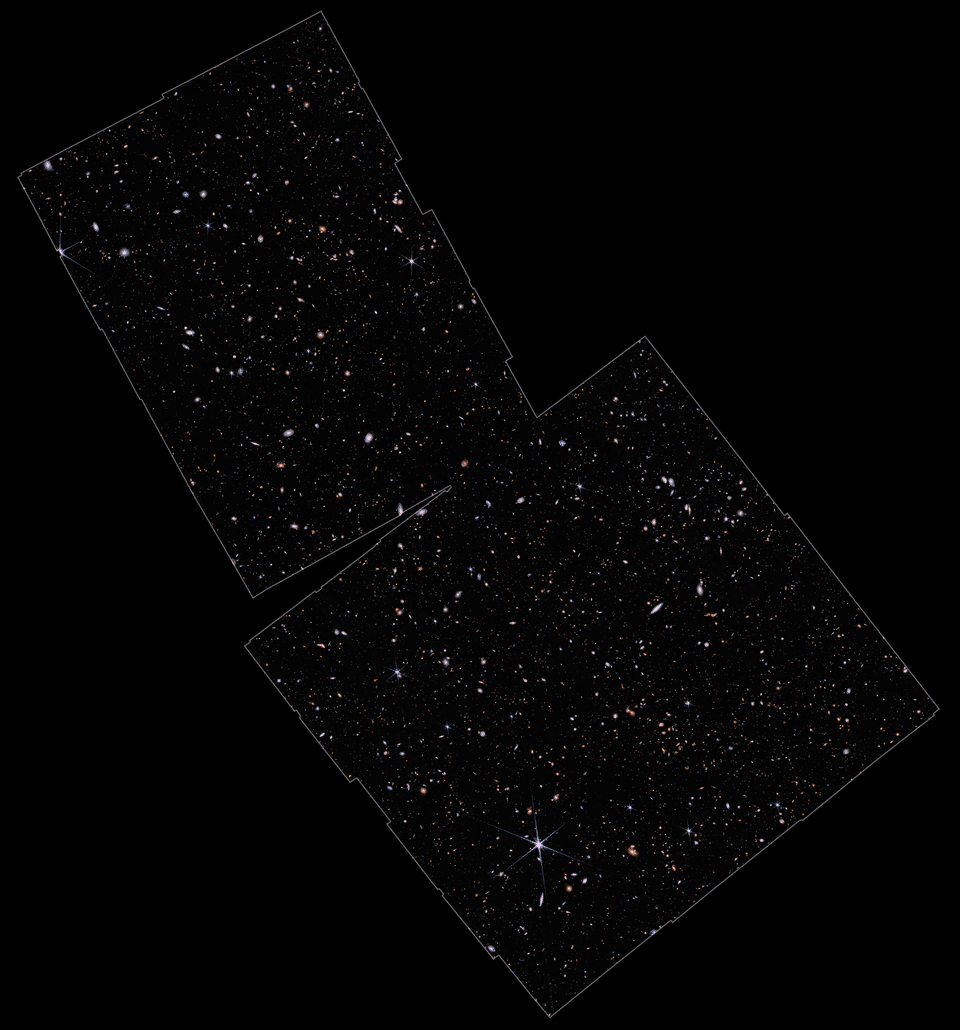

Among the first discoveries were two remarkably luminous galaxy candidates at z ~ 10 and z ~ 12, identified through the Lyman-break technique in JWST's near-infrared imaging. These objects had absolute ultraviolet magnitudes of approximately −21, comparable to moderately luminous present-day galaxies despite existing less than 400 million years after the Big Bang.16 Subsequent spectroscopic follow-up confirmed many of these photometric candidates while refuting others, establishing that the overabundance of bright galaxies at z > 10 is genuine rather than an artefact of photometric uncertainties.24 In 2024, JWST spectroscopy confirmed two luminous galaxies at z = 14.32 and z = 13.90, placing them at a cosmic age of only approximately 290 million years — the most distant spectroscopically confirmed galaxies known.17
The observed number density of bright galaxies at z > 10 exceeds the predictions of most theoretical models published before the JWST era. A comprehensive analysis of galaxies at z ~ 9–16 from the first year of JWST data revealed cosmic star-formation rate densities at z ~ 12–16 that are higher than predicted by models assuming a constant star-formation efficiency.18 Several explanations have been proposed for this apparent excess, including more efficient star formation in the early universe than previously assumed, bursty star-formation histories that produce temporarily elevated ultraviolet luminosities, reduced dust attenuation in metal-poor galaxies, a top-heavy initial mass function at high redshifts, or contributions from faint active galactic nuclei.18, 14 The resolution of this puzzle has significant implications for reionization, because a higher-than-expected abundance of luminous galaxies at very high redshifts would mean that the photon budget for reionization was satisfied earlier and more comfortably than older models suggested.
In an even more remarkable observation, JADES spectroscopy of a galaxy at z = 13.0 detected strong Lyman-alpha emission with an equivalent width exceeding 40 angstroms, a signal strength previously observed only at z < 9.19 Because Lyman-alpha photons are efficiently scattered by neutral hydrogen, the detection implies that this galaxy had created a substantial ionized bubble in its local intergalactic medium only 330 million years after the Big Bang, providing direct evidence that reionization had already begun in localised regions at very early times.19
The 21-cm signal and future observations
Perhaps the most transformative future probe of the epoch of reionization is the 21-cm hyperfine transition of neutral hydrogen.
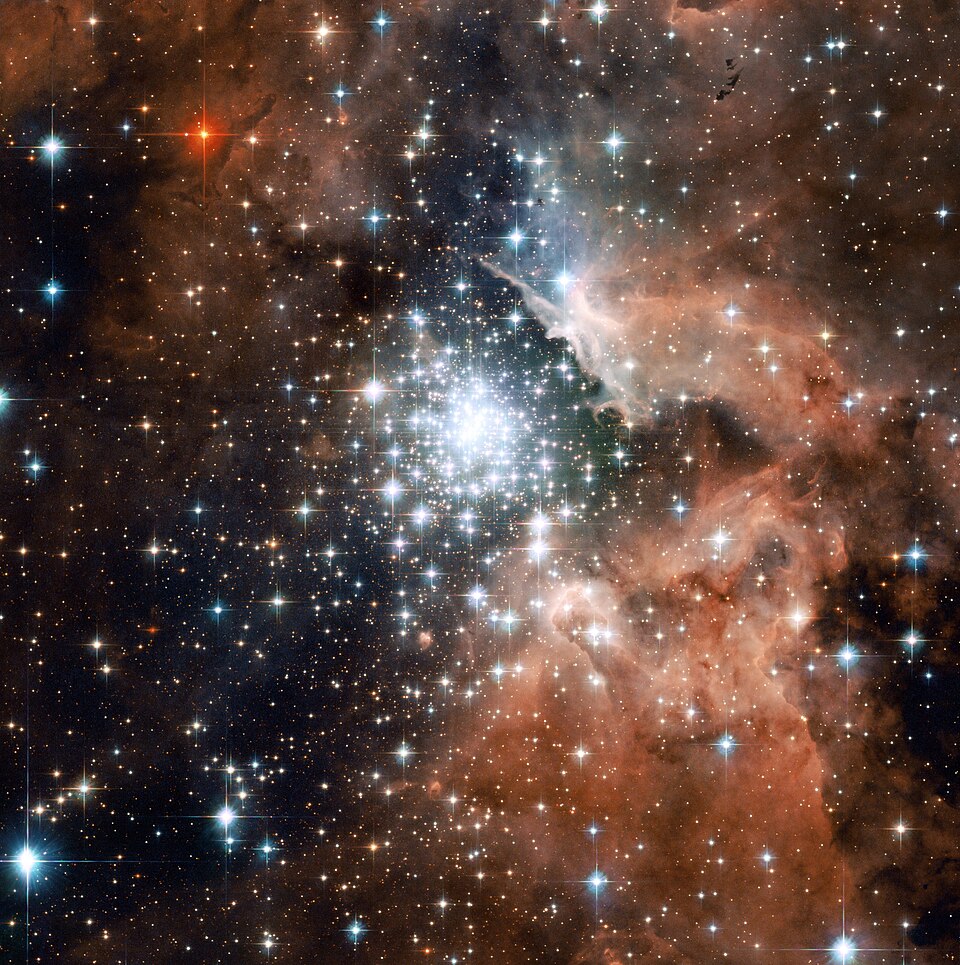

A hydrogen atom in its ground state can exist with the spins of its electron and proton either aligned (parallel) or anti-aligned (antiparallel), and the transition between these states produces or absorbs a photon at a rest-frame wavelength of 21.1 centimetres (1420.4 MHz). Because the intergalactic medium during the dark ages and the epoch of reionization was filled with neutral hydrogen, this transition offers a direct probe of the neutral gas — its density, temperature, and ionization state — as a function of both redshift and position on the sky.20
The 21-cm signal from the epoch of reionization is expected to appear as a complex, three-dimensional map of the contrast between neutral and ionized regions against the CMB. Before the first luminous sources formed, the neutral hydrogen would have produced a 21-cm signal determined by the competition between the spin temperature of the gas and the CMB temperature. As the first stars and X-ray sources heated the intergalactic medium and ionized bubbles grew, the 21-cm signal would have evolved in a characteristic sequence: initial absorption against the CMB during the cosmic dawn, followed by emission as X-ray heating raised the gas temperature above the CMB, and finally the disappearance of the signal as reionization erased the neutral hydrogen entirely.20, 1
Detecting this signal is extremely challenging because it is faint — of order millikelvins in brightness temperature — and buried beneath astrophysical foregrounds from our own galaxy and extragalactic radio sources that are four to five orders of magnitude brighter. The Hydrogen Epoch of Reionization Array (HERA), a dedicated radio interferometer in the Karoo Desert of South Africa, has produced the most sensitive upper limits to date on the 21-cm power spectrum during reionization. HERA Phase I observations using 94 nights of data established upper limits of 457 mK2 at z = 7.9 and 3,496 mK2 at z = 10.4, ruling out a broad class of "cold reionization" models in which the intergalactic medium was not heated above the adiabatic cooling threshold by z ~ 8.21 While these limits have not yet reached the sensitivity required for a direct detection of the cosmological signal, they have already begun to constrain the astrophysics of the early universe.
The next generation of radio facilities promises dramatically improved sensitivity. The Square Kilometre Array (SKA), currently under construction in Australia and South Africa, will deploy thousands of low-frequency antennas and is expected to achieve a direct, high-significance detection of the 21-cm power spectrum from the epoch of reionization and potentially produce tomographic maps of the ionized bubble structure. Together with HERA Phase II (the full 350-element array), these instruments will open a new era in which the spatial and temporal evolution of reionization can be directly imaged, providing constraints on the nature, abundance, and clustering of the first luminous sources that no other observational technique can match.20, 21
Connection to galaxy formation
Reionization was not merely a passive consequence of galaxy formation; it actively shaped the subsequent evolution of galaxies and the intergalactic medium. The ultraviolet radiation field established during reionization heated the intergalactic gas to temperatures of approximately 10,000 to 20,000 kelvin, dramatically raising the Jeans mass — the minimum mass of a gas cloud that can collapse under its own gravity — and suppressing the accretion of gas onto low-mass dark matter halos. Halos with virial temperatures below the temperature of the photoheated intergalactic medium could no longer accrete gas efficiently, effectively quenching star formation in the smallest galaxies.14, 5
This reionization feedback is thought to be partly responsible for the observed scarcity of satellite galaxies around the Milky Way and other large galaxies relative to the predictions of dark-matter-only simulations — the so-called "missing satellites problem." Many of the dark matter subhalos predicted by simulations may have had their gas supplies removed or suppressed by the reionization ultraviolet background, preventing them from forming observable numbers of stars.14 The timing and patchiness of reionization would have introduced spatial variations in this suppression, with regions that were ionized earlier experiencing earlier and more severe quenching of dwarf galaxy formation.
Reionization also established the large-scale thermal and ionization state of the intergalactic medium that persists to the present day. The Lyman-alpha forest observed in quasar spectra at redshifts z ~ 2–5 — a series of absorption lines produced by fluctuations in the density of the intergalactic gas — reflects a highly ionized medium maintained by the integrated ultraviolet background from galaxies and quasars, a state that was initiated during the epoch of reionization.15 The thermal state of this gas retains a memory of the heating that accompanied reionization, with temperature-density relations that encode information about when and how different regions of the intergalactic medium were first ionized.15, 7
The study of reionization thus sits at the intersection of cosmology and galaxy formation, linking the earliest phases of structure formation in the universe to the properties of the galaxies and intergalactic medium observed today. With JWST continuing to push the frontier of galaxy detection to ever higher redshifts, and with 21-cm experiments approaching the sensitivity needed for a direct detection of the reionization signal, the coming decade promises to transform our understanding of how the first light in the universe brought the cosmic dark ages to an end.17, 20, 21
References
Evidence for reionization at z ~ 6: detection of a Gunn-Peterson trough in a z = 6.28 quasar
Cosmic reionization and early star-forming galaxies: a joint analysis of new constraints from Planck and the Hubble Space Telescope
UV luminosity functions at redshifts z ~ 4 to z ~ 10: 10,000 galaxies from HST legacy fields
A comprehensive study of galaxies at z ~ 9-16 found in the early JWST data: ultraviolet luminosity functions and cosmic star formation history at the pre-reionization epoch
Improved constraints on the 21 cm EoR power spectrum and the X-ray heating of the IGM with HERA Phase I observations
The end of helium reionization at z ~ 2.7 inferred from cosmic variance in HST/COS He II Lyman-alpha absorption spectra