Overview
- Stars are born when gravity compresses hydrogen gas clouds until nuclear fusion ignites; their subsequent lives are governed almost entirely by mass, which determines temperature, luminosity, lifespan, and ultimate fate.
- Every element heavier than hydrogen and helium—including the carbon in our cells and the iron in our blood—was forged inside stars or in the violent explosions and neutron-star mergers that end stellar lives.
- The Hertzsprung-Russell diagram organizes stars by temperature and luminosity into a coherent pattern that encodes the full story of stellar evolution, from hydrogen-burning main-sequence stars to the exotic remnants they leave behind.
Every atom of carbon in a human body, every oxygen molecule in the air, and every iron atom at the center of a hemoglobin molecule was forged inside a star. The study of how stars are born, live, and die—and how that process manufactures the periodic table of elements—is one of the most consequential achievements of twentieth-century astrophysics. It connects the physics of nuclear reactions at the cores of stellar furnaces to the chemistry of life on Earth, binding astronomy, nuclear physics, and biology into a single coherent story.14, 26
The field rests on two complementary pillars. Stellar evolution describes the physical changes a star undergoes across its lifetime, driven by the continuous competition between gravity pulling inward and thermal pressure pushing outward. Nucleosynthesis describes the nuclear reactions that power those stars and, as a byproduct, build up every element heavier than the primordial hydrogen and helium that emerged from the Big Bang.1, 13, 23 Together, they explain why the universe is chemically rich rather than a featureless sea of the two lightest elements.
Birth in molecular clouds
Stars form inside vast, cold structures of gas and dust called molecular clouds. These objects, which pervade the spiral arms of galaxies like the Milky Way, are primarily composed of molecular hydrogen (H2) along with carbon monoxide, ammonia, water ice, and complex organic molecules. Temperatures within their densest cores fall as low as 10 kelvins, and densities can reach 105 molecules per cubic centimeter—conditions that make them the coldest and densest naturally occurring environments in the universe outside of stellar interiors.3

For a cloud or a region within a cloud to collapse under its own gravity, a condition known as the Jeans criterion must be satisfied. Named after the British physicist James Jeans, this criterion states that collapse begins when the gravitational potential energy of the cloud exceeds its thermal kinetic energy. Mathematically, this defines a minimum mass—the Jeans mass—below which thermal pressure can support the cloud against collapse, and above which gravity wins.2 In practice, the interstellar medium is turbulent, and shocks from nearby supernovae, collisions between gas streams in spiral arms, or the radiation pressure from massive young stars can all trigger collapse by compressing a region past this threshold.3
Once a region begins to collapse, it does not fall as a single body. Turbulent fragmentation causes the cloud to break into many smaller clumps, each of which collapses independently, which is why stars almost always form in clusters rather than in isolation.3 As each fragment contracts, it converts gravitational potential energy into heat. Initially the cloud is transparent to its own infrared radiation and can cool efficiently, allowing collapse to accelerate. But as density increases, the gas becomes opaque, trapping heat and causing pressure to rise. A central condensation called a protostar forms at the core of the infalling envelope, surrounded by a rotating disk of gas and dust from which planets may eventually coalesce.4
The protostellar phase is characterized by vigorous accretion of material from the surrounding disk and envelope, typically lasting several hundred thousand years for a solar-mass object. During this period, young stars often drive powerful bipolar jets and outflows perpendicular to the disk plane, which both regulate the accretion rate and inject energy and momentum back into the parent molecular cloud.4
T Tauri stars and the approach to the main sequence
When the surrounding envelope of gas and dust has been mostly accreted or dispersed, the young star enters the T Tauri phase, named after the prototype star T Tauri in the constellation Taurus. T Tauri stars are pre-main-sequence objects—they are fully visible at optical wavelengths but have not yet begun stable hydrogen fusion in their cores. They are powered instead by the continuing gravitational contraction described by the Kelvin-Helmholtz mechanism: as the star shrinks, the release of gravitational energy heats the interior and powers the luminosity at the surface.5
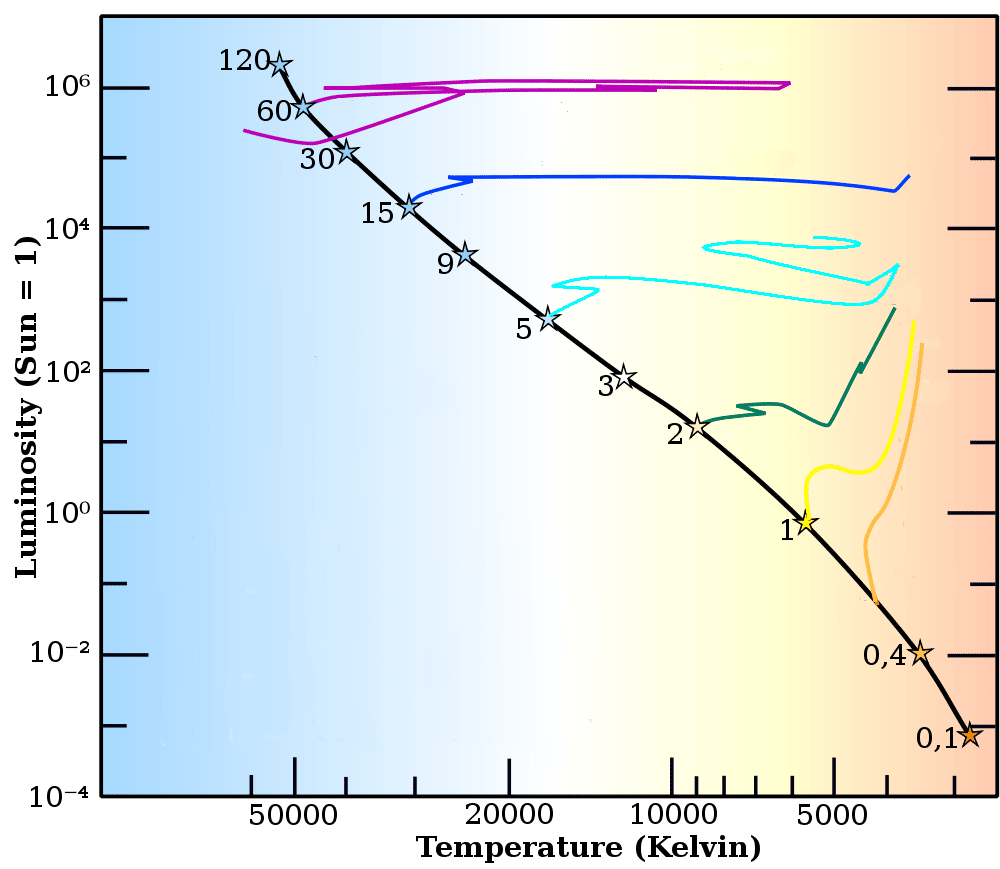
On the Hertzsprung-Russell diagram (discussed in the next section), a contracting pre-main-sequence star moves along a nearly vertical track called the Hayashi track toward higher temperatures and lower luminosities until it intersects the main sequence. For a one-solar-mass star, this pre-main-sequence contraction phase lasts roughly 30 to 50 million years before core temperatures reach the approximately 10 million kelvins needed to ignite sustained hydrogen fusion.5 More massive stars reach this threshold in thousands to hundreds of thousands of years; very low-mass stars take hundreds of millions of years.
The Hertzsprung-Russell diagram
In the early twentieth century, Danish astronomer Ejnar Hertzsprung and American astronomer Henry Norris Russell independently discovered that when stars are plotted with surface temperature (or spectral type) on the horizontal axis and intrinsic luminosity on the vertical axis, they do not scatter randomly. Instead they cluster into recognizable patterns that encode their evolutionary state.6 The resulting plot, the Hertzsprung-Russell (HR) diagram, remains the central organizing tool of stellar astronomy.
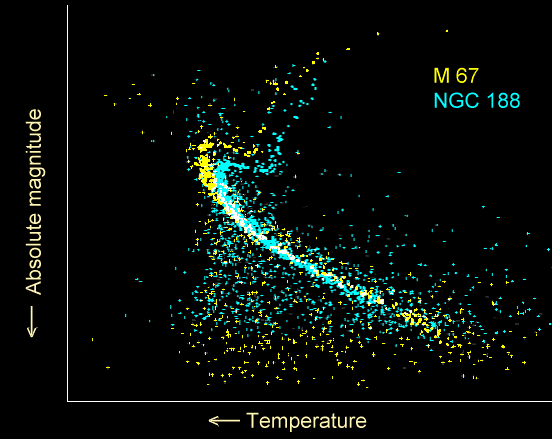

The most prominent feature of the HR diagram is the main sequence, a diagonal band running from hot, luminous blue stars in the upper left to cool, dim red stars in the lower right. Approximately 90 percent of all stars, including the Sun, reside on the main sequence because that is where they spend the great majority of their lives burning hydrogen in their cores.1 The upper right corner of the diagram is occupied by large, cool, luminous giant and supergiant stars, representing later evolutionary stages. The lower left contains small, hot, faint white dwarfs, which are the cooled remnants of stars that have exhausted their nuclear fuel.
Stellar spectral classification provides the horizontal axis of the HR diagram. The standard OBAFGKM sequence (extended to include L, T, and Y for brown dwarfs in modern usage) runs from hottest to coolest. O stars have surface temperatures exceeding 30,000 kelvins and burn blue-white; G stars like the Sun have temperatures around 5,800 kelvins; M stars are red and cool, with surface temperatures below 3,500 kelvins.7 Each spectral type displays characteristic absorption lines in its spectrum produced by different atoms and ions at the relevant temperatures, allowing astronomers to classify a star's type from a simple measurement of its light.
Main sequence stellar properties by spectral class1, 7, 9
| Spectral class | Surface temperature (K) | Mass (solar masses) | Luminosity (solar) | Main sequence lifetime | Fate |
|---|---|---|---|---|---|
| O | >30,000 | 16–100+ | 30,000–1,000,000 | 3–10 Myr | Neutron star or black hole |
| B | 10,000–30,000 | 2–16 | 25–30,000 | 10–500 Myr | Neutron star or white dwarf |
| A | 7,500–10,000 | 1.5–2.5 | 5–25 | 1–3 Gyr | White dwarf |
| F | 6,000–7,500 | 1.0–1.5 | 1.5–5 | 3–7 Gyr | White dwarf |
| G (Sun) | 5,200–6,000 | 0.8–1.0 | 0.6–1.5 | 7–15 Gyr | White dwarf |
| K | 3,700–5,200 | 0.45–0.8 | 0.08–0.6 | 15–50 Gyr | White dwarf |
| M | <3,700 | 0.08–0.45 | 0.001–0.08 | >50 Gyr | White dwarf |
Hydrogen burning and the main sequence lifetime
A star spends the great majority of its life on the main sequence, where it is powered by the fusion of hydrogen into helium in its core. The specific mechanism by which this occurs depends critically on the core temperature, which is itself determined by the stellar mass. In lower-mass stars like the Sun, hydrogen fusion proceeds via the proton-proton (pp) chain. In this sequence of reactions, two protons fuse to form a deuterium nucleus, releasing a positron and a neutrino; the deuterium then captures another proton to form helium-3; and finally two helium-3 nuclei combine to form helium-4, releasing two protons back into the plasma.8 The net result of the full chain is the conversion of four hydrogen nuclei into one helium-4 nucleus, with the mass deficit released as energy according to Einstein's E = mc2.
In more massive stars, whose cores exceed approximately 17 million kelvins, the dominant mechanism shifts to the CNO cycle (carbon-nitrogen-oxygen cycle). In this catalytic process, carbon, nitrogen, and oxygen nuclei act as intermediaries, shuttling protons onto the carbon nucleus step by step until a helium-4 nucleus is ejected and the original carbon is regenerated. The CNO cycle produces the same net result as the pp chain—four protons become one helium-4 nucleus—but it is far more temperature-sensitive and dominates the energy output of stars more massive than about 1.3 solar masses.8
The fundamental relationship governing main sequence lifetimes is the inverse dependence of lifetime on mass. More luminous stars burn their fuel at a prodigious rate relative to their total supply. The main sequence lifetime scales roughly as mass divided by luminosity; since luminosity scales approximately as mass to the fourth power, lifetime scales roughly as mass to the negative third power.9 This means that a star ten times more massive than the Sun is roughly a thousand times more luminous but lives only about a hundredth as long. An O-type star of 25 solar masses may exhaust its core hydrogen in as little as 3 to 7 million years, while a cool, dim M-dwarf of 0.1 solar masses could in principle remain on the main sequence for trillions of years—far longer than the current age of the universe.9
Post-main-sequence evolution
When a star exhausts the hydrogen in its core, the energy-generating region can no longer support itself against gravitational pressure. The core contracts and heats up, while hydrogen in a shell surrounding the inert helium core begins to fuse. The energy released by this shell burning causes the outer layers of the star to expand dramatically. The star grows in radius by factors of tens to hundreds while its surface cools, transforming it into a red giant.1 The Sun, for instance, will expand to roughly 200 times its current radius when it reaches the red giant phase in approximately 5 billion years, engulfing Mercury and Venus and potentially the Earth.
For stars in the solar mass range (roughly 0.5 to 2 solar masses), the helium core continues to grow as hydrogen shell burning adds to it. Because the core is electron-degenerate—meaning electrons occupy all available quantum states and the pressure is independent of temperature—it does not expand to relieve the pressure as it heats. The temperature rises until helium ignites abruptly throughout the entire core in an event called the helium flash. This is not a visible explosion; the energy released goes into lifting the degeneracy of the core gas rather than into observable luminosity. Afterward, the star settles into a stable phase of core helium burning on the horizontal branch of the HR diagram.1
Core helium burning converts helium into carbon and oxygen via the triple-alpha process (discussed in the next section). When core helium is exhausted, the star again forms shells and expands onto the asymptotic giant branch (AGB). AGB stars are very luminous, very extended, and highly variable, driven by thermal pulses in the helium-burning shell. They are also the primary sites of s-process nucleosynthesis and are responsible for enriching the interstellar medium with carbon and nitrogen. The AGB phase ends when stellar winds, enhanced by radiation pressure on dust grains, expel most of the star's outer envelope into space.24 This expelled material forms a glowing planetary nebula—a misnomer coined by William Herschel because of their resemblance through early telescopes to planetary disks—while the hot, exposed core remains as a nascent white dwarf.24, 25
Stars more massive than approximately 8 solar masses follow a fundamentally different evolutionary track. Because their cores are not electron-degenerate, each successive nuclear fuel—helium, then carbon, then neon, oxygen, and finally silicon—ignites in an orderly fashion as the previous fuel is exhausted. This produces an onion-shell structure of nested burning layers surrounding an iron-nickel core. Iron represents the end of the line for nuclear fusion as a source of energy, because iron nuclei are the most tightly bound in nature; fusing iron requires the input of energy rather than releasing it.15
Nucleosynthesis: forging the elements
The theoretical framework for understanding how stars build the elements was laid out in landmark detail in 1957 by E. Margaret Burbidge, Geoffrey Burbidge, William Fowler, and Fred Hoyle in a paper now universally abbreviated as B2FH. This paper identified eight distinct nucleosynthetic processes responsible for the origin of every naturally occurring element, and its core conclusions have been confirmed and refined by decades of subsequent observation and laboratory nuclear physics.14
The triple-alpha process is the mechanism by which helium is converted to carbon, and it is one of the most remarkable coincidences—or fine-tunings—in all of physics. Two helium-4 nuclei (alpha particles) fuse to form beryllium-8, which is extraordinarily unstable and decays back into two alpha particles in 10-16 seconds. For carbon to accumulate, a third alpha particle must collide with this fleeting beryllium-8 nucleus before it decays. The rate at which this three-body collision produces carbon is enormously enhanced by a resonance in the carbon-12 nucleus at an energy level of 7.65 MeV, which Fred Hoyle predicted must exist before it was found experimentally in 1953 on the grounds that carbon exists in abundance in the universe.10, 11 This resonance makes the triple-alpha process hundreds of millions of times more efficient than it would otherwise be, allowing stars to build up significant quantities of carbon during their helium-burning phases.
Elements heavier than iron cannot be produced by fusion in stellar cores. Instead, they are synthesized by neutron capture, a process in which free neutrons are absorbed by existing atomic nuclei, incrementally increasing their mass. Two distinct neutron-capture processes operate in different astrophysical environments. The s-process (slow neutron capture) operates in the interiors of AGB stars over thousands of years, allowing unstable isotopes time to undergo radioactive beta decay before capturing the next neutron. This process preferentially builds elements along the valley of nuclear stability up to bismuth (element 83), including barium, strontium, and the rare earth elements.12
The r-process (rapid neutron capture) requires extreme neutron densities far beyond anything achievable in the interior of an ordinary star. In the r-process, nuclei capture neutrons so rapidly that they are driven far from the valley of stability before decaying. This process is responsible for roughly half of all elements heavier than iron, including gold, platinum, uranium, and thorium.14, 26 For decades, the astrophysical site of the r-process was debated; core-collapse supernovae were the leading candidate, but detailed models struggled to reproduce the required neutron flux. The 2017 detection of gravitational waves from a binary neutron star merger (GW170817) and its electromagnetic counterpart, which displayed clear spectroscopic signatures of freshly synthesized heavy elements including lanthanides, provided the most direct evidence to date that neutron star mergers are a primary, if not the dominant, site of r-process nucleosynthesis.20, 21, 22
Supernovae as element factories
When the iron-nickel core of a massive star reaches the Chandrasekhar mass of approximately 1.4 solar masses, electron degeneracy pressure can no longer support it.


The core collapses in less than a second, reaching nuclear densities and then rebounding in a shockwave that, with the assistance of a flood of neutrinos produced in the collapse, tears the star apart in a Type II (core-collapse) supernova.17 The explosion briefly outshines entire galaxies. In the process, the shock wave drives oxygen, neon, magnesium, silicon, sulfur, and calcium—built up in the star's onion-shell interior over millions of years of nuclear burning—into the surrounding interstellar medium. The conditions in the innermost ejecta and just outside the proto-neutron star are also implicated in r-process synthesis, though the precise contribution remains an active area of research.17, 15
A second class of supernovae, Type Ia, occurs in binary star systems. When a white dwarf accretes matter from a companion star until it approaches the Chandrasekhar mass limit, or when two white dwarfs merge, carbon fusion ignites throughout the white dwarf in a thermonuclear runaway. The star is completely disrupted, leaving no remnant. Type Ia supernovae produce large quantities of iron-peak elements, particularly nickel-56, which decays to cobalt-56 and then to stable iron-56. These events are the primary source of iron in the universe, including the iron in terrestrial rocks and in the hemoglobin of human blood.16 The uniformity of Type Ia peak luminosities has made them invaluable as standard candles for measuring cosmic distances—it was observations of Type Ia supernovae in distant galaxies that led to the discovery of the accelerating expansion of the universe in 1998.
Core-collapse supernovae leave behind the most exotic objects in the universe: neutron stars and black holes. If the remaining core mass is between approximately 1.4 and 3 solar masses, neutron degeneracy pressure and repulsive nuclear forces halt the collapse, producing a neutron star with a density comparable to that of atomic nuclei—roughly 1014 to 1015 grams per cubic centimeter.18 A sugar-cube-sized volume of neutron star material would weigh approximately 100 million metric tons on Earth. If the core mass exceeds this threshold, no known force can halt the collapse, and a stellar-mass black hole forms.19
What stars did not make: Big Bang nucleosynthesis
Not every element in the universe was forged in stars. The lightest elements—hydrogen, most of the helium, and a trace quantity of lithium—were produced in the first three minutes after the Big Bang during a process called Big Bang nucleosynthesis (BBN). As the universe cooled from its initial fireball, protons and neutrons combined to form deuterium, which was rapidly processed into helium-4. The predicted primordial abundance of helium-4 is approximately 24 percent by mass, and this matches the observed helium content of the oldest, least chemically evolved stars with remarkable precision.23
Stars are therefore responsible for everything beyond this primordial baseline. Every carbon, nitrogen, and oxygen atom in organic molecules; every silicon and magnesium atom in the silicate rocks of terrestrial planets; every gold and uranium atom in the Earth's crust was synthesized by stellar nucleosynthesis and dispersed into the interstellar medium by stellar winds and supernova explosions. Successive generations of stars progressively enriched the galaxy with these heavy elements. The Sun and its planetary system formed from gas and dust that had already been processed through earlier stellar generations, which is why the rocky planets exist and why life based on carbon chemistry became possible.27
The cosmic origin of life's chemistry
The observation that human beings are composed of stellar material is not merely poetic. It is a precise and well-established claim of nuclear astrophysics. The oxygen that makes up roughly 65 percent of a human body by mass was synthesized in the helium-burning shells of intermediate-mass stars and expelled in planetary nebula ejecta and supernova explosions. The carbon, which comprises about 18 percent by mass and forms the structural backbone of every organic molecule, was produced primarily in the triple-alpha process in low- and intermediate-mass AGB stars. The nitrogen, calcium, phosphorus, and iron that are essential to biological function each have distinct nucleosynthetic origins tracing back to specific stellar processes and environments.27, 26
The iron at the center of hemoglobin molecules in human red blood cells was produced almost entirely by Type Ia supernovae and dispersed across the galaxy over billions of years before being incorporated into the molecular cloud from which the Sun formed 4.6 billion years ago. The gold in terrestrial ores, including any gold worn as jewelry, was produced in neutron star mergers—some of the most violent events in the universe—and rained down onto the early Earth during the heavy bombardment phase of the solar system's formation.22 The calcium in human bones traces its origin to silicon-burning in the cores of massive stars in the final days before their supernova deaths.15
This chain of causation from nuclear physics in stellar interiors to the biochemistry of living organisms is one of the most intellectually satisfying narratives in all of science. Stars do not merely illuminate the night sky; they are the fundamental engines of chemical complexity in the universe. Their births, lives, and deaths over cosmic time have progressively transformed a hydrogen-helium universe into one rich enough in heavy elements to support planets, chemistry, and ultimately, life.13, 27
References
Origin of the heavy elements in binary neutron-star mergers from a gravitational-wave event