Overview
- Sedimentary rocks form through the weathering, erosion, transport, deposition, and lithification of pre-existing material, and are classified into three major groups — clastic, chemical, and biochemical — based on the origin of their constituent particles.
- The internal structures preserved in sedimentary rocks, including cross-bedding, ripple marks, graded bedding, and mudcracks, record the physical conditions of ancient depositional environments ranging from rivers and deltas to deep ocean basins and wind-swept deserts.
- Sedimentary rocks cover approximately 73 percent of Earth's land surface and serve as the principal repository of the fossil record, making them indispensable for reconstructing the history of life and past environmental conditions over more than three billion years.
Sedimentary rocks are rocks formed at or near Earth's surface through the accumulation and consolidation of mineral grains, rock fragments, chemical precipitates, or organic material. They are the most visible rock type on the planet's surface, covering approximately 73 percent of Earth's continental landmass, yet they constitute only about 8 percent of the total volume of the crust.17 Sedimentary rocks are the product of a cycle that begins with the breakdown of pre-existing rocks through weathering and erosion, continues with the transport and deposition of the resulting particles, and concludes with the transformation of loose sediment into solid rock through a set of physical and chemical processes collectively termed lithification.2, 4
The significance of sedimentary rocks extends far beyond their abundance at the surface. They are the principal repository of the fossil record, preserving the remains and traces of organisms that document the history of life on Earth over more than three billion years.4 They record past climates, ocean chemistry, atmospheric composition, and tectonic configurations in their mineralogy, chemistry, and internal structures. They also host the majority of the world's petroleum, natural gas, coal, groundwater, and many metallic ore deposits, making them central to both Earth science and human resource extraction.1, 2
The sedimentary cycle
The formation of sedimentary rocks is governed by a cycle of interconnected processes that operate continuously at and near Earth's surface. The cycle begins with weathering, the in-place breakdown of pre-existing rocks (igneous, metamorphic, or older sedimentary) through physical disintegration and chemical decomposition. Physical weathering fragments rocks through mechanisms such as frost wedging, thermal expansion and contraction, and biological activity, while chemical weathering dissolves or alters minerals through reactions with water, dissolved carbon dioxide, and organic acids.19 The relative importance of physical and chemical weathering varies with climate, with chemical weathering dominating in warm, humid environments and physical weathering prevailing in cold or arid settings.19
Erosion is the removal of weathered material from its source by agents such as flowing water, wind, glacial ice, and gravity. Once mobilised, sediment enters the transport phase, during which it may be carried by rivers, ocean currents, wind, or glaciers over distances ranging from metres to thousands of kilometres. During transport, grains are sorted by size and density, and their shapes are progressively modified by abrasion and rounding.2 Deposition occurs when the transporting agent loses sufficient energy to carry its sediment load, causing particles to settle out. The specific conditions under which deposition takes place — the depth and chemistry of the water, the velocity of the current, the biological activity in the environment — determine the character of the resulting sediment and, ultimately, the type of sedimentary rock that forms.15
The final stage of the cycle is lithification, the conversion of unconsolidated sediment into solid rock. This transformation occurs through burial, compaction, and cementation during a suite of post-depositional processes collectively known as diagenesis, discussed in detail below.5
Classification of sedimentary rocks
Sedimentary rocks are divided into three broad categories based on the origin of their constituent material: clastic (also called detrital), chemical, and biochemical (also called biogenic or organic).4
Clastic sedimentary rocks are composed of fragments, or clasts, derived from the weathering and erosion of pre-existing rocks. These fragments are transported by water, wind, or ice, deposited in layers, and eventually lithified. Clastic rocks are classified primarily by the size of their constituent grains, following the Wentworth grain-size scale established in 1922, which remains the standard classification in sedimentology.3 The principal clastic rock types, in order of decreasing grain size, are conglomerate and breccia (gravel-sized clasts, greater than 2 mm), sandstone (sand-sized grains, 0.0625 to 2 mm), siltstone (silt-sized grains, 0.004 to 0.0625 mm), and shale or mudstone (clay-sized particles, less than 0.004 mm).3, 4
Chemical sedimentary rocks form by the precipitation of minerals directly from solution, typically in bodies of water where evaporation or changes in temperature, pressure, or chemistry cause dissolved ions to exceed their solubility limits. Evaporites such as halite (rock salt) and gypsum, chert (microcrystalline silica), and banded iron formations are the principal examples.8, 10
Biochemical sedimentary rocks are produced through the biological activity of organisms that extract dissolved minerals from water to build shells, skeletons, or other hard parts, which accumulate as sediment after the organisms die. Limestone composed of shell fragments, chalk formed from the microscopic calcite plates of coccolithophores, and coal derived from the accumulation and compaction of plant material are the most important biochemical sedimentary rocks.11, 12
Wentworth grain-size scale for clastic sediments3
| Size class | Grain diameter | Sediment name | Rock name |
|---|---|---|---|
| Boulder | > 256 mm | Boulder gravel | Conglomerate / Breccia |
| Cobble | 64–256 mm | Cobble gravel | Conglomerate / Breccia |
| Pebble | 2–64 mm | Pebble gravel | Conglomerate / Breccia |
| Sand | 0.0625–2 mm | Sand | Sandstone |
| Silt | 0.004–0.0625 mm | Silt | Siltstone |
| Clay | < 0.004 mm | Clay | Shale / Mudstone |
Clastic sedimentary rocks
Conglomerate is a coarse-grained clastic rock composed of rounded gravel-sized clasts (greater than 2 mm in diameter) set in a finer-grained matrix of sand, silt, or clay, and bound together by a mineral cement. When the coarse clasts are angular rather than rounded, the rock is termed breccia, indicating that the fragments were not transported far enough to be abraded into smooth shapes. Conglomerates typically form in high-energy environments such as river channels, alluvial fans, and rocky shorelines where currents are powerful enough to transport large particles.2, 4
Sandstone is among the most studied and economically important sedimentary rocks. Composed of sand-sized grains (0.0625 to 2 mm), sandstones are classified not only by grain size but also by mineral composition. Quartz arenite contains more than 90 percent quartz grains and indicates extensive weathering and prolonged transport that removed less stable minerals. Arkose is rich in feldspar (more than 25 percent), suggesting rapid erosion of granitic source rocks with minimal chemical weathering. Lithic sandstone (or greywacke in older terminology) contains abundant rock fragments and typically forms in tectonically active settings where erosion is rapid and sediment is deposited close to its source.4, 7 Sandstones are important reservoir rocks for petroleum and groundwater because of their typically high porosity and permeability.7
Siltstone is composed predominantly of silt-sized particles (0.004 to 0.0625 mm) and represents deposition in environments with lower energy than those that produce sandstone, such as floodplains, shallow marine shelves, and lake margins. Shale, the most abundant sedimentary rock on Earth, is composed of clay-sized particles (less than 0.004 mm) and characteristically displays fissility — the tendency to split along thin, closely spaced planes parallel to bedding. This property results from the alignment of platy clay minerals during compaction. Where clay-rich rocks lack fissility, they are more properly termed mudstone.1, 4 Shale is deposited in the quietest water conditions, including deep ocean floors, lake bottoms, and protected lagoons, and its fine grain size and high organic content make it the principal source rock for petroleum generation.4
Chemical sedimentary rocks
Evaporites form when bodies of water such as inland seas, saline lakes, or restricted marine basins undergo extensive evaporation, causing dissolved minerals to precipitate in a predictable sequence governed by their solubility. As water evaporates, the least soluble minerals precipitate first: calcium carbonate (calcite and aragonite), followed by calcium sulfate (gypsum and anhydrite), and finally the highly soluble sodium chloride (halite) and potassium-magnesium salts such as sylvite and carnallite.8 Enormous evaporite deposits have formed repeatedly throughout Earth history during periods when tectonic configurations created restricted marine basins in arid climates. The Messinian Salinity Crisis of the late Miocene, approximately 5.96 to 5.33 million years ago, produced a thick sequence of evaporites across the Mediterranean basin when the connection to the Atlantic Ocean was intermittently severed.8
Chert is a hard, dense, microcrystalline rock composed almost entirely of silica (SiO2). It occurs as nodules within limestone and chalk, as bedded sequences interlayered with other marine sediments, and as replacements of pre-existing carbonate rocks. The silica in chert may derive from the dissolution of siliceous microfossils such as radiolarians and diatoms, from volcanic ash, or from direct inorganic precipitation from silica-saturated waters.10 Bedded cherts associated with deep-ocean sediments are particularly important in the Precambrian rock record, where they preserve some of the earliest evidence of microbial life in the form of silicified stromatolites and microfossils.10
Banded iron formations (BIFs) are chemically precipitated sedimentary rocks consisting of alternating layers of iron-rich minerals (typically hematite, magnetite, or siderite) and silica-rich chert. They were deposited almost exclusively between 3.8 and 1.8 billion years ago, during the Archean and early Proterozoic eons, and represent one of the most distinctive rock types in Earth's geological record.9 The formation of BIFs is linked to the chemistry of the early ocean, which contained abundant dissolved ferrous iron (Fe2+) under the anoxic conditions that prevailed before the Great Oxidation Event approximately 2.4 billion years ago. As cyanobacteria began to produce free oxygen through photosynthesis, the oxygen reacted with dissolved iron to precipitate insoluble ferric iron (Fe3+) minerals, creating the characteristic banded deposits.9, 22 Banded iron formations are the world's primary source of iron ore, accounting for the vast majority of mined iron globally.9
Biochemical and organic sedimentary rocks
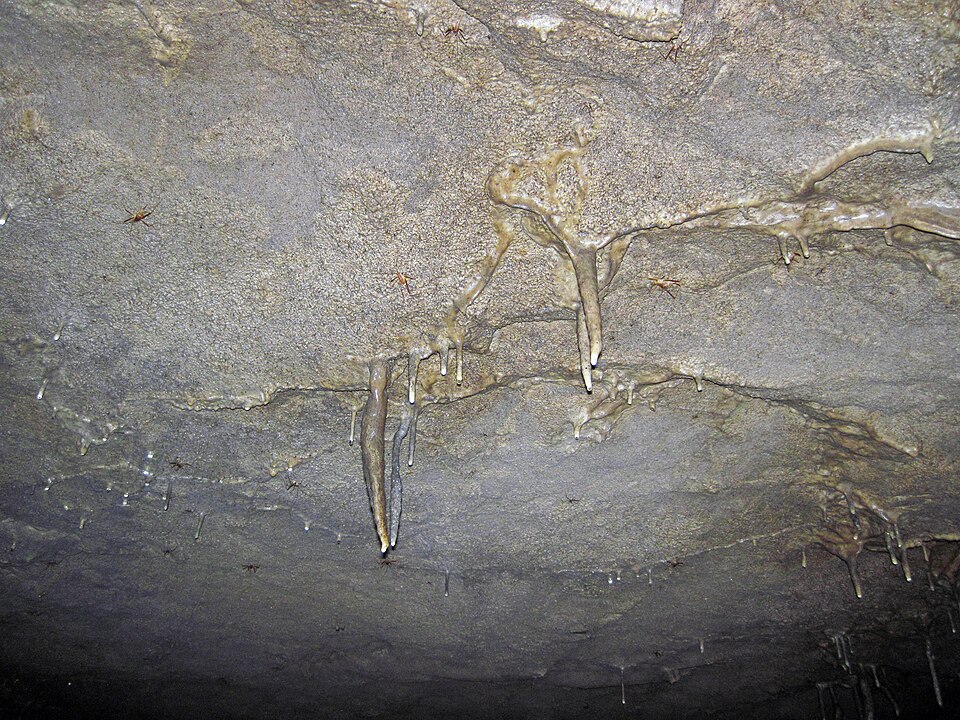
Limestone is a carbonate rock composed primarily of the mineral calcite (CaCO3), and it is the most abundant biochemical sedimentary rock. Most limestone originates from the accumulation of calcareous skeletal fragments produced by marine organisms, including corals, foraminifera, brachiopods, molluscs, echinoderms, and calcareous algae. In warm, shallow, tropical seas, biological carbonate production can be extraordinarily prolific, building extensive carbonate platforms and reef complexes such as the modern Great Barrier Reef and the ancient reef systems preserved in the Permian of west Texas and the Devonian of western Canada.11 Some limestones also form through the direct precipitation of calcite from supersaturated waters, as occurs in travertine deposits around hot springs and in certain restricted marine environments.11
_1.jpg)
Chalk is a particular variety of limestone composed almost entirely of the microscopic calcite plates, called coccoliths, shed by single-celled marine algae known as coccolithophores. The famous White Cliffs of Dover in southeastern England are composed of Upper Cretaceous chalk, a testament to the enormous biological productivity of coccolithophores in the warm Cretaceous seas that covered much of Europe approximately 100 to 66 million years ago.11
Coal is an organic sedimentary rock formed from the accumulation, burial, and thermal alteration of plant material in swampy, oxygen-poor environments where decomposition is incomplete. The process begins with the deposition of peat — a spongy mass of partially decayed vegetation — which is progressively converted through increasing burial, temperature, and pressure into a sequence of coal ranks: lignite (brown coal), sub-bituminous coal, bituminous coal, and ultimately anthracite. Each successive rank represents greater carbon content, lower moisture and volatile matter, and higher energy density.12 The great Carboniferous coal deposits of Europe and North America formed in vast tropical swamp forests approximately 359 to 299 million years ago, during a period when the luxuriant growth of early vascular plants, particularly lycopsids and ferns, produced enormous volumes of organic matter in extensive low-lying wetlands.12
Diagenesis and lithification
The transformation of loose, unconsolidated sediment into solid sedimentary rock occurs through a suite of physical, chemical, and biological processes collectively termed diagenesis. Diagenesis encompasses all changes that occur in sediment after deposition and before the onset of metamorphism, and it operates over timescales ranging from days to hundreds of millions of years at temperatures generally below 200°C and pressures below several hundred megapascals.5
Compaction is the first and most straightforward diagenetic process. As sediment is buried beneath successive layers, the weight of the overlying material squeezes out pore water and forces grains into closer contact. Compaction is most significant in fine-grained sediments: muds may lose 50 to 80 percent of their original volume during burial, as platy clay minerals are reoriented into parallel alignment and excess water is expelled.6 Sand-sized grains, being more rigid, undergo less compaction, though at great burial depths the grains may begin to deform at their contact points through a process called pressure solution.5, 6
Cementation is the precipitation of minerals in the pore spaces between grains, binding them together into a rigid framework. The most common cements are silica (quartz overgrowths), calcite, and iron oxides, though clay minerals, dolomite, and other phases may also serve as cements. The cement is deposited from pore fluids — groundwater or connate water that percolates through the sediment during burial. The composition of the cement depends on the chemistry of the pore fluid, which is in turn influenced by the composition of the surrounding grains, the temperature and pressure of the burial environment, and the hydrological connectivity of the sedimentary basin.5, 7 In sandstones, quartz cementation typically begins at burial depths of approximately 2 to 3 kilometres and temperatures of 70 to 80°C, and it is the dominant process by which deeply buried sandstones lose their porosity and permeability.7
Other diagenetic processes include recrystallisation, in which existing minerals dissolve and reprecipitate in more stable forms (as when aragonite in shells is replaced by calcite); replacement, in which one mineral is substituted for another while preserving the original texture (as in the silicification of wood or the dolomitisation of limestone); and authigenesis, the formation of entirely new minerals within the sediment, such as the growth of clay minerals, zeolites, or pyrite.5
Sedimentary structures
Sedimentary rocks preserve a rich archive of physical structures that record the conditions under which the sediment was deposited. These structures are among the most powerful tools available to geologists for interpreting ancient environments, because they reflect the behaviour of the fluids — water or air — that transported and deposited the sediment.13
_1.jpg)
Cross-bedding (also called cross-stratification) consists of inclined layers within a sedimentary bed, formed by the migration of bedforms such as ripples and dunes. As a current moves sand grains along the bed surface, they accumulate on the downstream (lee) face of dunes, producing sets of inclined laminae that dip in the direction of current flow. Cross-bedding is common in sandstones deposited by rivers, in tidal environments, and in aeolian (wind-blown) dune fields. In aeolian settings, cross-bed sets may be exceptionally large, reaching heights of 10 metres or more in ancient dune deposits such as the Jurassic Navajo Sandstone of the Colorado Plateau.14
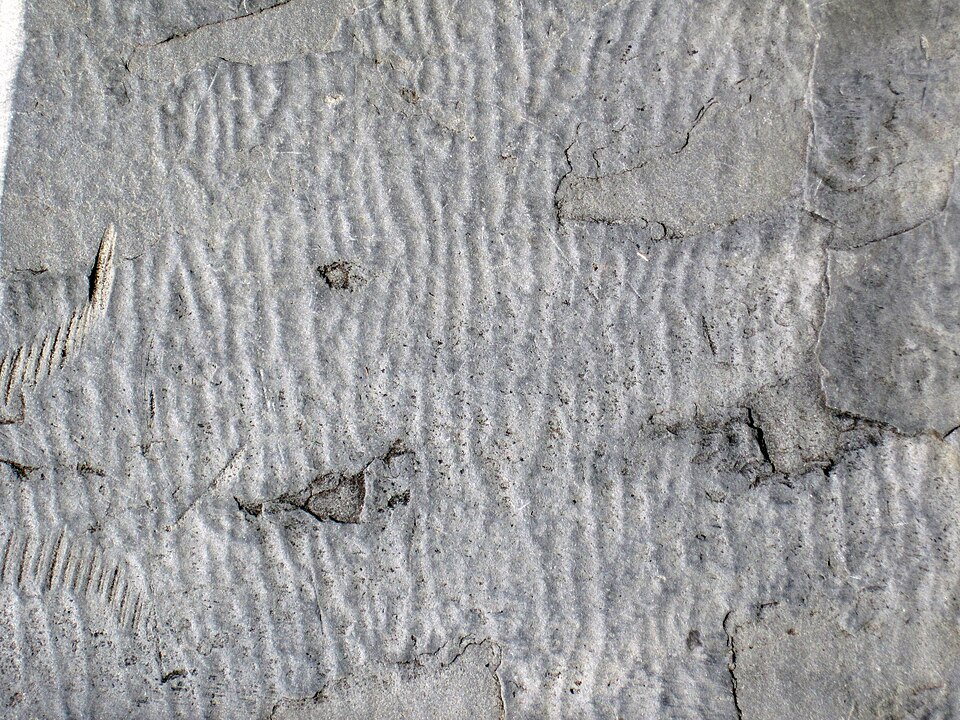
Ripple marks are small-scale undulations on a bedding surface, typically with wavelengths of a few centimetres to tens of centimetres. Asymmetric ripples, with a gentle upstream (stoss) side and a steep downstream (lee) side, are produced by unidirectional currents in rivers or by wind. Symmetric ripples, with roughly equal slopes on both sides, are generated by the oscillatory motion of waves and are characteristic of shallow marine and lacustrine environments.13
Graded bedding is a systematic change in grain size within a single bed, most commonly a gradual fining upward from coarse grains at the base to fine grains at the top. This structure is the hallmark of turbidites, deposits laid down by turbidity currents — dense, sediment-laden flows that rush down submarine slopes under the influence of gravity. As a turbidity current decelerates on reaching the flat ocean floor, the largest and heaviest grains settle first, followed by progressively finer material, producing the characteristic graded sequence described by Bouma in his classic 1962 model.21
Mudcracks (also called desiccation cracks) are polygonal fracture patterns formed when fine-grained sediment, typically mud or clay, shrinks upon drying. They indicate subaerial exposure and are diagnostic of environments that experience periodic wetting and drying, such as tidal flats, playa lakes, and river floodplains. When preserved in the rock record, mudcracks are filled by sediment from the overlying layer and appear as casts on the base of the succeeding bed.1, 13
Sedimentary environments
Sedimentary rocks are intimately linked to the environments in which their constituent sediments were deposited.

.jpg)
The concept of depositional environment encompasses the physical, chemical, and biological conditions that prevail at a site of sedimentation, and geologists use the term facies to describe the distinctive set of rock characteristics — lithology, sedimentary structures, fossil content, and geometry — produced by a particular environment.15, 16
Fluvial (river) environments produce a characteristic assemblage of channel sandstones and conglomerates, overbank siltstones and mudstones, and floodplain deposits. River channels typically contain cross-bedded sandstones with an erosional base, while the adjacent floodplains accumulate finer-grained sediment deposited during floods. The overall geometry of a fluvial deposit depends on whether the river is braided (multiple shifting channels) or meandering (a single sinuous channel), each producing a distinctive architectural pattern in the rock record.2, 15
Deltaic environments form where rivers enter standing bodies of water and deposit their sediment load. Deltas are dynamic, progradational systems that build outward over time, producing a predictable vertical succession of bottomset (prodelta muds), foreset (delta-front sands and silts), and topset (distributary channel and marsh) deposits. The morphology and facies of a delta are controlled by the relative importance of river discharge, wave action, and tidal currents, yielding river-dominated deltas (such as the Mississippi), wave-dominated deltas (such as the Nile), and tide-dominated deltas (such as the Ganges-Brahmaputra).15, 16
Marine environments span the full range from shallow continental shelves to the abyssal plains of the deep ocean. Shallow marine settings produce well-sorted sandstones, limestones, and mixed carbonate-siliciclastic deposits, often rich in fossils and displaying wave-generated sedimentary structures. Deep marine environments are dominated by fine-grained pelagic sediments (clays and biogenic oozes that settle slowly from the water column) punctuated by turbidites — the graded beds deposited by gravity-driven turbidity currents descending submarine slopes and canyons.15, 21
Lacustrine (lake) environments share many features with marine settings but at a smaller scale and with greater sensitivity to climatic fluctuations. Lake sediments commonly display fine laminations reflecting seasonal variations in sediment supply and biological productivity, and they are among the most valuable archives of continental climate change, preserving records of temperature, precipitation, and vegetation in their sediment chemistry, pollen assemblages, and varved (annually laminated) layers.20
Aeolian (wind-driven) environments are characterised by well-sorted, well-rounded sand grains and large-scale cross-bedding produced by the migration of sand dunes. Aeolian sandstones are typically composed of mature quartz arenite because wind transport is an efficient agent of mineralogical and textural sorting. The sand grains in aeolian deposits often display a distinctive frosted surface texture produced by grain-to-grain impacts during saltation. Ancient aeolian deposits, such as the Permian Coconino Sandstone and the Jurassic Navajo Sandstone of the American Southwest, record the existence of vast desert environments in Earth's past.14, 18
Approximate coverage of major sedimentary environments on Earth's surface15, 17
Sedimentary rocks and Earth history
Sedimentary rocks are the primary medium through which geologists read the history of the Earth. The principle of superposition — that in an undisturbed sequence of strata, the oldest layers lie at the bottom and the youngest at the top — provides the fundamental framework for stratigraphy, the branch of geology devoted to interpreting the layered rock record.4 By studying the vertical succession of sedimentary facies, geologists can reconstruct the changing environments of a region through time: a transition from marine limestone to coastal sandstone to fluvial conglomerate, for example, records the regression of the sea and the advance of a river system across the landscape.15, 16
The fossils preserved within sedimentary rocks are the cornerstone of biostratigraphy, allowing the correlation and relative dating of rock units across continents and ocean basins. The successive appearance and disappearance of fossil species in the stratigraphic record underpins the geological timescale and provides the primary evidence for the history of biological evolution, from the earliest Archean microfossils preserved in chert to the rich assemblages of the Phanerozoic eon.4, 10 The process by which organisms become preserved as fossils — fossil formation and taphonomy — is itself controlled by the sedimentary environment, because rapid burial in fine-grained sediment provides the oxygen-poor conditions most conducive to fossilisation.4
Beyond individual fossils, sedimentary rocks preserve geochemical signatures that record the composition of ancient atmospheres and oceans. The oxygen isotope ratios in marine carbonate sediments serve as proxies for past ocean temperatures and ice volumes. Carbon isotope excursions in the sedimentary record mark episodes of massive carbon cycle disruption, including the end-Permian mass extinction and the Paleocene-Eocene Thermal Maximum. The sulfur isotope composition of sedimentary pyrite and sulfate minerals tracks the redox state of ancient oceans. And the very existence of banded iron formations in the Precambrian record, followed by their abrupt disappearance around 1.8 billion years ago, provides compelling evidence for the progressive oxygenation of the atmosphere during the Great Oxidation Event.9, 22
Sedimentary rocks thus serve as both the archive and the interpreter of deep time. Every stratum is a page in Earth's history, recording in its mineralogy, fossil content, chemistry, and physical structures the conditions that prevailed at a particular place and time on the planet's surface. The study of sedimentary rocks lies at the heart of our understanding of how the Earth has changed over the 4.5-billion-year span of its existence.1, 4