Overview
- Quasars are the most luminous persistent objects in the universe, powered by accretion of matter onto supermassive black holes of 106 to 1010 solar masses at the centres of galaxies; first identified in 1963 when Maarten Schmidt measured the redshift of 3C 273 at z = 0.158, they can outshine their entire host galaxy by factors of 100 or more.
- Under the unified model of active galactic nuclei, quasars, Seyfert galaxies, blazars, and radio galaxies are the same physical phenomenon—an accreting supermassive black hole surrounded by a dusty torus—viewed from different angles, with quasars representing the most luminous end of the AGN population seen at moderate inclinations.
- JWST has detected luminous quasars at redshifts beyond z = 7, revealing supermassive black holes of over 109 solar masses already in place when the universe was less than 700 million years old, posing fundamental challenges to standard models of black hole seed formation and growth.
Quasars—short for quasi-stellar objects—are the most luminous persistent sources of electromagnetic radiation in the universe, capable of outshining their entire host galaxy by factors of 100 or more.4, 10 They are powered by the accretion of matter onto supermassive black holes with masses ranging from roughly 106 to 1010 solar masses at the centres of galaxies, converting gravitational potential energy into radiation with an efficiency of 5 to 40 percent—far exceeding the 0.7 percent efficiency of nuclear fusion in stars.2, 3, 4 First recognised as a class of objects in 1963 when Maarten Schmidt identified the optical counterpart of the radio source 3C 273 and measured its cosmological redshift, quasars have become indispensable tools for studying the growth of supermassive black holes, the evolution of galaxies, and the properties of the intergalactic medium across cosmic time.1, 20
Quasars represent the most luminous manifestation of the broader class of active galactic nuclei (AGN), which includes Seyfert galaxies, blazars, and radio galaxies.5, 6 Under the unified model of AGN, these apparently diverse phenomena arise from the same physical engine—an accreting supermassive black hole surrounded by a geometrically thick torus of dust and gas—viewed at different orientations relative to the observer’s line of sight.5, 6 The discovery of quasars at ever higher redshifts, now reaching beyond z = 7 with black hole masses exceeding 109 solar masses when the universe was less than 700 million years old, poses fundamental questions about how such massive objects could have formed and grown so rapidly after the Big Bang.11, 16, 19
Discovery and early history
The story of quasars begins with radio astronomy. During the 1950s, radio surveys catalogued hundreds of discrete celestial radio sources, some of which could not be identified with any known star or galaxy at their positions.20 The Third Cambridge Catalogue (3C), completed in 1959, contained several such “radio stars”—point-like radio sources with no obvious optical counterpart.20 Lunar occultation measurements by Cyril Hazard in 1962 refined the position of the radio source 3C 273 to arcsecond precision, revealing that it coincided with a seemingly ordinary 13th-magnitude star in the constellation Virgo.1, 20
.jpg)
.jpg)
On 5 February 1963, Maarten Schmidt at the Palomar Observatory obtained a spectrum of 3C 273 using the 200-inch Hale Telescope and identified a series of broad emission lines that did not correspond to any familiar pattern of laboratory wavelengths.1 After weeks of analysis, Schmidt realised that the lines were the hydrogen Balmer series redshifted by 15.8 percent (z = 0.158), implying a recession velocity of approximately 47,000 kilometres per second and, by Hubble’s law, a distance of roughly 750 megaparsecs.1 At that distance, the optical luminosity of 3C 273 was approximately 1013 times the luminosity of the Sun—roughly 100 times the total light output of the Milky Way concentrated in a region no larger than the Solar System.1, 20 Within months, Jesse Greenstein and Thomas Matthews identified 3C 48 at a redshift of z = 0.367, and the new class of “quasi-stellar radio sources”—soon shortened to quasars—was established.20
The enormous energy output of quasars immediately posed a theoretical crisis. No known stellar process could explain such luminosity from such a compact volume.2, 20 In 1964, Edwin Salpeter and, independently, Yakov Zel’dovich proposed that the energy source was gravitational: matter falling into the deep potential well of a massive compact object could radiate with far greater efficiency than nuclear fusion.2 Donald Lynden-Bell extended this idea in 1969, arguing that quasars are powered by accretion onto supermassive black holes and that the nuclei of nearby galaxies harbour the dormant remnants of former quasars—a prediction spectacularly confirmed by later observations.3 By the mid-1980s, Martin Rees and others had consolidated the theoretical framework: a quasar is the visible manifestation of an actively accreting supermassive black hole surrounded by an accretion disc that heats infalling gas to temperatures exceeding 105 kelvin, producing thermal radiation peaking in the ultraviolet.4
The accretion engine
The central engine of a quasar consists of a supermassive black hole surrounded by a geometrically thin, optically thick accretion disc in which gas spirals inward under the influence of gravity while angular momentum is transported outward by viscous and magnetohydrodynamic processes.4, 2 As gas descends into the gravitational potential well, frictional heating within the disc raises temperatures from roughly 104 kelvin at the outer edge to more than 105 kelvin near the innermost stable circular orbit, producing a characteristic thermal spectrum that peaks in the ultraviolet—the so-called “big blue bump” observed in quasar spectral energy distributions.4 The radiative efficiency of this process depends on the black hole’s spin: a non-rotating (Schwarzschild) black hole converts approximately 5.7 percent of the rest-mass energy of accreted material into radiation, while a maximally spinning (Kerr) black hole can achieve efficiencies of up to 42 percent.4, 16
The maximum luminosity a quasar can sustain through steady accretion is set by the Eddington limit, the luminosity at which outward radiation pressure on ionised gas balances the inward pull of gravity.4, 16 For a black hole of mass M, the Eddington luminosity is approximately 1.3 × 1038 (M / M⊙) erg per second; a 109 solar-mass black hole accreting at the Eddington rate thus radiates at roughly 1047 erg per second, consistent with the most luminous observed quasars.4 Super-Eddington accretion is theoretically possible through photon trapping in geometrically thick, radiation-dominated flows, and has been invoked to explain the rapid growth of the most massive black holes in the early universe.16
In addition to the accretion disc, quasars display a corona of hot electrons (with temperatures of approximately 109 kelvin) above the disc that inverse-Compton scatters disc photons to X-ray energies, producing the observed power-law X-ray continuum.4, 10 Approximately 10 percent of quasars are “radio-loud,” launching powerful relativistic jets of magnetised plasma along the black hole’s rotation axis at speeds approaching that of light, while the remaining 90 percent are “radio-quiet” and lack prominent jets.6, 10 The physical mechanism responsible for jet formation is thought to involve the extraction of rotational energy from the spinning black hole via the Blandford–Znajek process, in which magnetic field lines threading the event horizon generate an outward Poynting flux.4
The unified model of active galactic nuclei
The diversity of observed AGN types—Seyfert 1 and 2 galaxies, broad-line and narrow-line radio galaxies, quasars, and blazars—can be largely explained as a single physical phenomenon viewed from different angles, a framework known as the unified model.5, 6 Robert Antonucci’s landmark 1993 review synthesised a decade of evidence supporting this picture, centred on the discovery that the Seyfert 2 galaxy NGC 1068, which lacks broad emission lines in direct light, reveals a hidden broad-line region when observed in polarised (scattered) light—demonstrating that the broad-line region exists but is obscured from the observer’s direct view by a dusty, geometrically thick torus surrounding the central engine.5
In the unified model, the key geometric components are the accretion disc and its corona, a broad-line region (BLR) of dense gas clouds orbiting at velocities of thousands of kilometres per second within roughly 0.01 to 1 parsec of the black hole, a dusty molecular torus at scales of 1 to 10 parsecs, and a narrow-line region (NLR) of lower-density gas extending to hundreds or thousands of parsecs.5, 6 When the observer’s line of sight is relatively unobscured (face-on or moderately inclined), both broad and narrow emission lines are visible and the source appears as a type 1 AGN—a Seyfert 1 galaxy at lower luminosities or a quasar at higher luminosities.5 When the torus intercepts the line of sight (edge-on), the broad-line region and accretion disc are hidden, and the source appears as a type 2 AGN.5 When a relativistic jet points nearly directly at the observer, Doppler boosting amplifies the jet emission enormously, and the source appears as a blazar.6
Urry and Padovani extended the unified scheme specifically to radio-loud AGN in 1995, demonstrating that radio galaxies of Fanaroff–Riley classes I and II are the misaligned counterparts of BL Lac objects and flat-spectrum radio quasars, respectively.6 While the orientation-dependent unified model explains much of the observed diversity, it is now understood that additional physical parameters beyond viewing angle also play important roles, including black hole mass, accretion rate relative to the Eddington limit, black hole spin, and the evolutionary state of the host galaxy.10
Active galactic nuclei classification by viewing angle5, 6
Quasar populations and cosmic evolution
Quasars are not uniformly distributed across cosmic time. Large-area surveys, most notably the Sloan Digital Sky Survey (SDSS), which has catalogued over 750,000 spectroscopically confirmed quasars, have established that the space density of luminous quasars rises steeply from the local universe to a broad peak at redshifts z ≈ 2–3—an epoch sometimes called “cosmic noon”—and then declines sharply toward both lower and higher redshifts.9, 10 This evolution of the quasar luminosity function traces the history of supermassive black hole accretion across the universe: the peak at z ≈ 2–3 coincides with the era of maximum star formation and galaxy assembly, suggesting a deep connection between black hole growth and galaxy evolution.10, 12
The quasar luminosity function also exhibits “downsizing”—the most luminous quasars, powered by the most massive black holes, peak in abundance at higher redshifts, while lower-luminosity AGN peak later.10 This pattern implies that the most massive black holes completed the bulk of their growth earlier in cosmic history, a finding that challenges simple models in which all black holes grow at the same rate and instead favours scenarios in which early, rapid accretion episodes—possibly triggered by major galaxy mergers—are responsible for building the most massive black holes.10, 16
At the highest redshifts, dedicated surveys have now identified quasars at z > 7, with the current record holder being the quasar J0313–1806 at z = 7.642, observed when the universe was only 670 million years old.11 This quasar harbours a black hole of approximately 1.6 × 10⁹ solar masses, presenting a severe challenge to models of black hole formation: even continuous Eddington-limited accretion from a stellar-mass seed black hole cannot produce such a massive object in the time available.11, 16 Proposed solutions include the formation of “heavy seeds” of 104 to 106 solar masses through the direct collapse of primordial gas clouds, episodes of super-Eddington accretion, and mergers of multiple seed black holes.16 The Subaru Hyper Suprime-Cam survey has further constrained the quasar luminosity function at z = 7, finding a steep decline relative to z = 6 and implying that luminous quasars were exceedingly rare in the first billion years of cosmic history.21
Co-evolution with host galaxies
One of the most important discoveries in extragalactic astronomy is the tight correlation between the mass of a galaxy’s central supermassive black hole and the velocity dispersion of stars in its bulge—the M–σ relation—independently reported by Ferrarese and Merritt and by Gebhardt and colleagues in 2000.7, 8 The relationship follows a steep power law, MBH ∝ σ4–5, with remarkably small scatter, implying that the growth of the black hole and the stellar bulge are fundamentally coupled despite the black hole’s gravitational sphere of influence being negligibly small compared to the galaxy as a whole.7, 8
.jpg)
.jpg)
The leading explanation for this coupling is AGN feedback: energy and momentum released by the accreting black hole during its quasar phase regulate the gas supply available for both further black hole accretion and star formation in the host galaxy.12 Feedback operates in two principal modes. In the “quasar mode” (also called radiative or wind mode), which dominates during periods of high accretion, radiation-driven winds and outflows with velocities of thousands of kilometres per second sweep gas out of the nuclear region, suppressing star formation and self-regulating the black hole’s own growth.12 In the “radio mode” (or kinetic or maintenance mode), which operates at lower accretion rates, relativistic jets inject mechanical energy into the surrounding gas, preventing it from cooling and forming stars—a process directly observed in galaxy clusters where jets from the central AGN inflate large cavities in the hot X-ray-emitting intracluster medium.12
AGN feedback is now a standard ingredient in cosmological simulations of galaxy formation and evolution, where it is required to reproduce the observed galaxy luminosity function, the bimodal colour distribution of galaxies (red-and-dead ellipticals versus blue star-forming spirals), and the observed M–σ relation.12 Without feedback, simulations produce galaxies that are far too massive and luminous at the high-mass end, with black holes that grow far beyond observed masses.12 JWST observations of quasar host galaxies at z > 6 have revealed that the M–σ relation may already be in place at these early epochs, though some high-redshift systems appear to have overmassive black holes relative to their host galaxies, suggesting that black hole growth may precede bulge assembly in the early universe.19
Quasars as probes of the intergalactic medium
Because quasars are extraordinarily luminous and observable at great distances, their spectra serve as backlights that illuminate the properties of intervening gas along the line of sight.13, 14 The most prominent signature of this intervening gas is the Lyman-alpha forest: a dense thicket of narrow absorption lines in the blue wing of the quasar’s Lyman-alpha emission line, each produced by a discrete cloud of neutral hydrogen at a different redshift along the sightline.14 The forest was first recognised in the spectra of high-redshift quasars in the 1970s and has since become one of the primary observational probes of the intergalactic medium (IGM), providing constraints on the density, temperature, ionisation state, and chemical enrichment of diffuse gas throughout cosmic history.14
James Gunn and Bruce Peterson predicted in 1965 that if the intergalactic medium contained a significant fraction of neutral hydrogen, it would produce complete absorption—a “trough”—blueward of the Lyman-alpha line in the spectra of sufficiently distant quasars.13 The absence of such a trough in quasars at z < 6 demonstrated that the IGM is highly ionised, with a neutral fraction of less than 10−4, maintained by the ultraviolet background radiation produced in large part by quasars themselves.13, 14 The first detection of a complete Gunn–Peterson trough came in 2001 with the discovery of a quasar at z = 6.28 in the Sloan Digital Sky Survey, indicating a rapid increase in the neutral hydrogen fraction at z > 6 and providing direct evidence that the epoch of reionization—when the first stars and quasars ionised the intergalactic hydrogen—was ending around that time.15
Beyond neutral hydrogen, quasar absorption spectroscopy reveals metal absorption systems produced by intervening galaxies and their circumgalactic media, including damped Lyman-alpha systems (with column densities exceeding 2 × 10²⁰ atoms per square centimetre) that trace the neutral gas reservoirs from which stars form.14 These observations have established that metals were present in the intergalactic medium as early as z ≈ 6, implying that an earlier generation of stars had already enriched the universe with heavy elements within the first billion years.14, 15
Quasars in cosmography
The extreme luminosity of quasars makes them visible across cosmological distances, and several techniques exploit quasar properties to measure cosmological parameters independently of the cosmic distance ladder.17, 18 In time-delay cosmography, strong gravitational lensing by an intervening galaxy splits a background quasar into multiple images, each arriving with a different time delay determined by the geometry of the lens system and the expansion rate of the universe.17
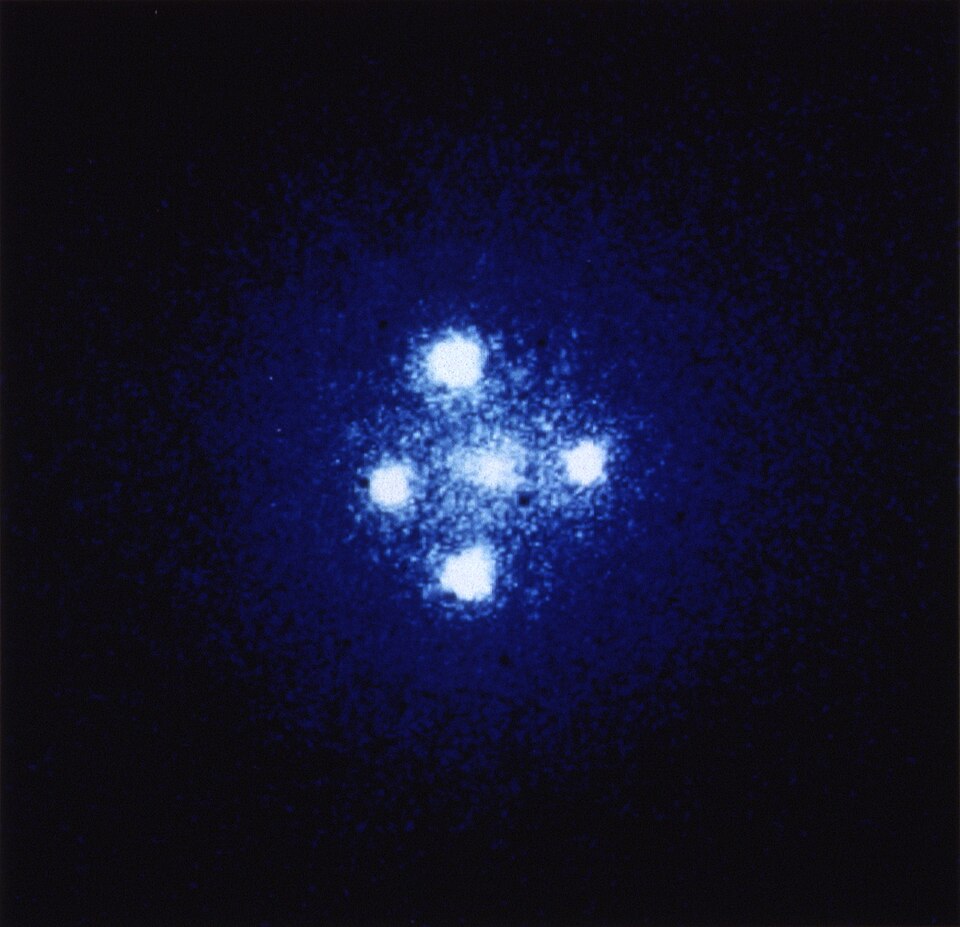

By monitoring the intrinsic variability of the quasar and measuring the time delays between the lensed images, the Hubble constant can be inferred. The H0LiCOW and TDCOSMO collaborations have measured the Hubble constant using this method, obtaining values of approximately 73 km s−1 Mpc−1—consistent with other late-universe measurements but in tension with the value of 67.4 km s−1 Mpc−1 inferred from the cosmic microwave background, contributing to the ongoing Hubble tension.17
A separate approach exploits the observed non-linear relationship between the ultraviolet and X-ray luminosities of quasars, which appears to hold across a wide range of redshifts and luminosities.18 Risaliti and Lusso demonstrated in 2019 that this relation can be calibrated to turn quasars into standardisable candles, extending the Hubble diagram to z ≈ 7—far beyond the reach of Type Ia supernovae, which are limited to z ≈ 2.18 Their initial analysis suggested possible deviations from the standard ΛCDM model at high redshifts, though the interpretation remains debated owing to systematic uncertainties in the calibration and potential evolution of the UV–X-ray relation with redshift.18
Approximate redshift reach of cosmological distance probes17, 18
JWST and the frontier of quasar science
The James Webb Space Telescope, operational since mid-2022, has opened a transformative new window on quasar science by providing rest-frame optical and near-infrared spectroscopy of quasars at redshifts where ground-based telescopes are limited to rest-frame ultraviolet observations.19 JWST observations of the quasar J1120+0641 at z = 7.08 have revealed a mature quasar spectrum with prominent broad emission lines of hydrogen, carbon, magnesium, and iron, along with a well-developed accretion disc continuum indistinguishable from those of quasars at much lower redshifts.19 The detection of strong iron emission, which requires multiple generations of prior star formation to produce, indicates that significant chemical enrichment had already occurred in the quasar’s host galaxy within the first 700 million years of cosmic history.19
JWST has also enabled the first detailed studies of quasar host galaxies at z > 6, separating the galaxy’s starlight from the overwhelmingly bright central point source with unprecedented sensitivity.19 These observations have detected companion galaxies and extended nebular emission around high-redshift quasars, providing evidence for the gas-rich, merger-driven environments thought to fuel rapid black hole growth.19 At the same time, JWST spectroscopic surveys have uncovered a new population of faint, previously undetected AGN at z = 4–7, identified by their broad hydrogen emission lines despite being 100 to 1,000 times less luminous than classical quasars.21 These “little red dots” may represent an early phase of black hole growth that contributes significantly to the total AGN population at high redshift, potentially resolving the tension between the observed abundance of massive black holes and the predictions of standard growth models.21, 16
The combination of JWST with ground-based extremely large telescopes under construction—the European Extremely Large Telescope, the Thirty Meter Telescope, and the Giant Magellan Telescope—promises to push quasar science into the epoch of the very first black hole seeds, mapping the assembly of supermassive black holes from their origins to the present day and testing whether the co-evolutionary relationship between black holes and galaxies was already established at the earliest cosmic times.11, 19, 16
References
Evidence for reionization at z ∼ 6: Detection of a Gunn–Peterson trough in a z = 6.28 quasar
Time-delay cosmography: measuring the Hubble constant and other cosmological parameters with strong gravitational lensing