Overview
- The universe has transformed dramatically over 13.8 billion years—from an opaque plasma of hydrogen and helium to a cosmos filled with hundreds of billions of galaxies, each containing billions of stars, many orbited by planets.
- Stellar nucleosynthesis is the process by which stars forge every element heavier than hydrogen and helium, from the carbon in organic molecules to the iron in planetary cores, through nuclear fusion in their interiors and explosive dispersal in supernovae and neutron star mergers.
- Measuring cosmic distances requires a chain of overlapping techniques called the cosmic distance ladder, and a persistent disagreement between two high-precision measurements of the expansion rate—the Hubble tension—may point to new physics beyond the standard model.
The universe that exists today—a cosmos of hundreds of billions of galaxies, each containing billions of stars, many orbited by planets—is profoundly different from the universe that existed in its first moments. Thirteen point eight billion years of cosmic evolution have transformed an opaque, nearly uniform plasma of hydrogen and helium into a richly structured cosmos of galaxies, clusters, and cosmic filaments, populated by stars that forge heavy elements in their interiors and disperse them into the interstellar medium when they die.4, 2 Understanding how this transformation occurred—from the ignition of the first stars through the assembly of galaxies to the origin of the chemical elements that make planets and life possible—is the subject of cosmic evolution.
The first stars and cosmic dawn
After the release of the cosmic microwave background roughly 380,000 years after the Big Bang, the universe entered the cosmic dark ages: a period of several hundred million years during which no luminous sources existed. Matter was distributed nearly uniformly, with only the tiny density fluctuations imprinted during cosmic inflation to break the symmetry. Over this immense span of time, gravity slowly amplified these fluctuations. Regions that were slightly denser than average attracted additional matter, grew denser still, and eventually collapsed under their own weight.1
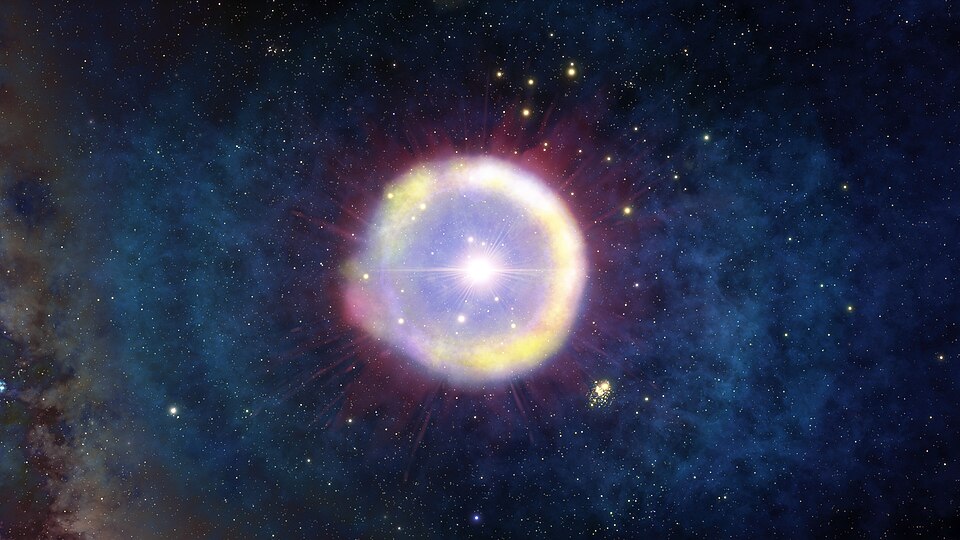

The first stars, known as Population III stars, are estimated to have ignited roughly 100 to 500 million years after the Big Bang.1 Formed from nearly pure hydrogen and helium—the only elements that existed in significant quantities at the time—these objects are thought to have been extraordinarily massive, perhaps tens to hundreds of solar masses, because the absence of heavy elements deprived the collapsing gas clouds of efficient cooling channels, favoring the formation of larger fragments. Their surfaces blazed with intense ultraviolet radiation, and their lifetimes were correspondingly short—a few million years at most.1
The ultraviolet radiation from these first stars began the process of reionization, stripping electrons from the neutral hydrogen atoms that had filled the universe since recombination. As more stars and eventually the first galaxies formed, the ionizing radiation field intensified, and by approximately one billion years after the Big Bang, reionization was largely complete—the intergalactic medium was once again ionized, and it has remained so ever since.6 The deaths of the first stars in supernova explosions were equally consequential: they produced the first heavy elements—carbon, oxygen, silicon, iron—and dispersed them into the surrounding gas, enriching the raw material from which subsequent generations of stars and planets would form.1, 2
Galaxy formation and the growth of structure
Galaxies did not appear fully formed. They grew hierarchically over billions of years through the merging of smaller protogalaxies within dark matter halos that had collapsed from the primordial density field.3 Dark matter, which constitutes approximately 27 percent of the universe's energy content and interacts only through gravity, collapsed into halos earlier than ordinary matter, providing the gravitational scaffolding within which baryonic gas subsequently accumulated. The gas cooled by radiating energy, sank to the centres of dark matter halos, and formed rotating disks of neutral hydrogen from which stars condensed.3
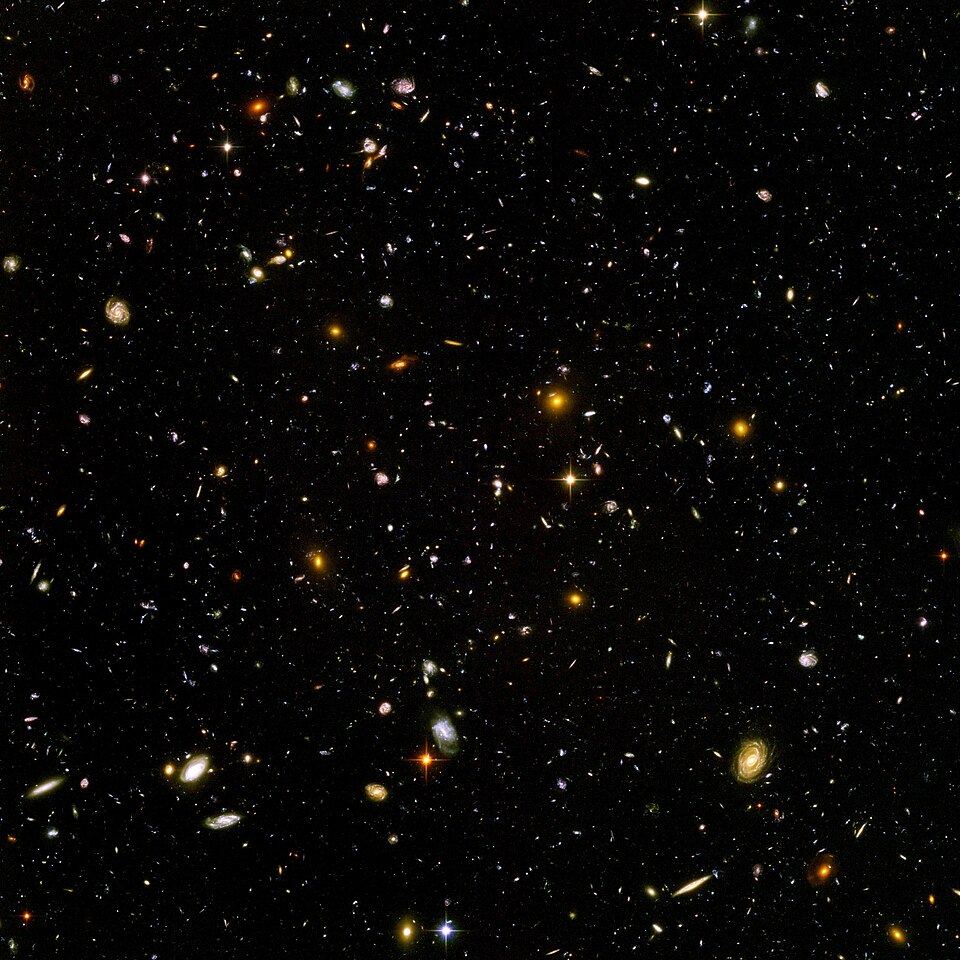

The diversity of galaxy morphologies observed today—spirals, ellipticals, and irregulars, organized into Edwin Hubble's tuning-fork classification scheme—reflects different evolutionary histories. Spiral galaxies like the Milky Way have maintained relatively ordered disk structures, sustained by ongoing gas accretion and steady star formation. Elliptical galaxies, by contrast, are the products of major mergers between comparably sized galaxies, events that scramble the ordered rotation of the progenitor disks into the random stellar orbits characteristic of elliptical morphology.3 Galaxy clusters, the most massive gravitationally bound structures in the universe, formed at the intersections of the cosmic web's filaments, assembling over billions of years as smaller groups fell into the deepest gravitational potential wells.3
Every large galaxy is now understood to harbour a supermassive black hole at its centre, with masses ranging from millions to billions of solar masses. The tight correlations between the mass of a galaxy's central black hole and the properties of its host—the stellar velocity dispersion, the luminosity, and the mass of the central bulge—imply a deep co-evolutionary relationship, mediated by energetic feedback from active galactic nuclei that can heat or expel gas and regulate star formation across the entire galaxy.3
Stellar nucleosynthesis: forging the elements
The chemical complexity of the universe is almost entirely the product of stellar nucleosynthesis—the nuclear reactions that power stars and, as a byproduct, build up every element heavier than the primordial hydrogen and helium that emerged from the Big Bang. The foundational theoretical framework was laid out in 1957 by E. Margaret Burbidge, Geoffrey Burbidge, William Fowler, and Fred Hoyle, who identified the distinct nucleosynthetic processes responsible for the origin of every naturally occurring element.2
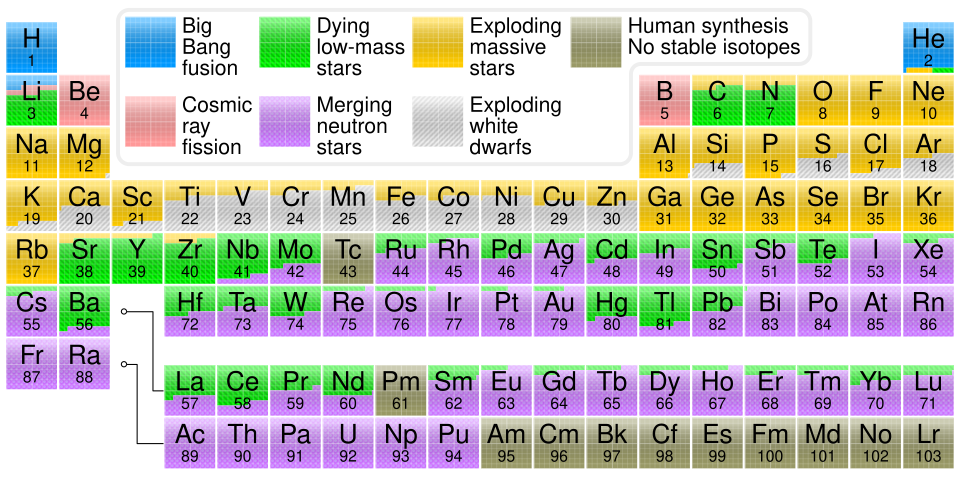

Stars on the main sequence convert hydrogen into helium through nuclear fusion—via the proton-proton chain in lower-mass stars like the Sun, and via the CNO cycle in more massive stars. When core hydrogen is exhausted, the star evolves off the main sequence, and subsequent burning stages fuse helium into carbon and oxygen, then carbon into neon and magnesium, and so on through silicon to iron in the most massive stars.8 Iron represents the end of energy-releasing fusion: it is the most tightly bound nucleus, and fusing it requires the input of energy rather than releasing it. When an iron core exceeds the Chandrasekhar mass limit of approximately 1.4 solar masses, it collapses in less than a second, and the resulting rebound drives a core-collapse supernova that disperses the star's accumulated layers of heavy elements into the interstellar medium.8
Elements heavier than iron—including gold, platinum, and uranium—are synthesized by neutron capture processes. The slow process (s-process) operates in asymptotic giant branch stars, while the rapid process (r-process) requires the extreme neutron densities found in neutron star mergers and possibly in certain core-collapse supernovae. The 2017 detection of gravitational waves from a binary neutron star merger (GW170817), accompanied by electromagnetic observations showing the clear spectroscopic signatures of freshly synthesized heavy elements, provided the most direct evidence that neutron star mergers are a primary site of r-process nucleosynthesis.7, 2 Successive generations of stars have progressively enriched the galaxy with heavy elements, and the Sun and its planetary system formed approximately 4.6 billion years ago from gas and dust already processed through multiple prior stellar generations.
Measuring the cosmos
Determining the distances, ages, and scales of cosmic objects requires a chain of overlapping measurement techniques called the cosmic distance ladder. No single method works at all distances: each technique is calibrated by the one below it, extending the reach of measurement from the solar system to the edge of the observable universe.5 In the nearest rung, parallax—the apparent shift of nearby stars against the background of more distant ones as Earth orbits the Sun—provides direct geometric distances to stars within a few thousand light-years. Beyond that, Cepheid variable stars, whose pulsation periods correlate with their intrinsic luminosities, serve as "standard candles" calibrated by parallax measurements to reach distances of tens of millions of light-years. At the greatest distances, Type Ia supernovae extend the ladder to billions of light-years, reaching deep enough into cosmic history to detect the accelerating expansion of the universe.5
The age of the universe—13.787 ± 0.020 billion years—is determined primarily from the Planck satellite's analysis of the cosmic microwave background, but it is independently corroborated by the ages of the oldest globular clusters, the cooling times of ancient white dwarfs, and the decay of radioactive heavy elements forged in stellar explosions.4 The observable universe is approximately 93 billion light-years in diameter, far larger than 13.8 billion light-years, because the expansion of space has carried the most distant objects far beyond the distance their light has traveled.4
A persistent discrepancy, known as the Hubble tension, has emerged between two high-precision measurements of the current expansion rate. The Planck satellite, analyzing the CMB, infers a Hubble constant of approximately 67.4 km/s/Mpc, while the SH0ES team, using Cepheids and Type Ia supernovae in the local universe, measures approximately 73.0 km/s/Mpc—a disagreement exceeding five standard deviations and unlikely to be explained by measurement error alone.4, 5 Whether this tension reflects unknown systematic errors or points to new physics beyond the standard cosmological model is one of the most actively studied questions in modern cosmology.
References
A comprehensive measurement of the local value of the Hubble constant with 1 km/s/Mpc uncertainty from the Hubble Space Telescope and the SH0ES team