Overview
- Earth's interior is divided into concentric shells—crust, mantle, outer core, and inner core—mapped by the behavior of seismic waves from earthquakes, which bend, reflect, or stop entirely at boundaries between materials of different density and composition.
- Plate tectonics, the unifying theory of geology, explains how the slow convective flow of the mantle drives the movement of rigid lithospheric plates, generating virtually all of Earth's major geological features: mid-ocean ridges, subduction zones, volcanic arcs, and mountain belts.
- Volcanism and mountain building are the most visible surface consequences of Earth's internal heat engine, producing everything from gently effusive basaltic eruptions at mid-ocean ridges to catastrophic explosive volcanism at convergent margins and the compressive orogeny that raises the Himalayas and the Andes.
The Earth is a dynamic, layered planet whose surface geology—its mountains, volcanoes, ocean basins, and earthquake belts—is ultimately driven by processes originating deep within its interior. Understanding how the Earth is structured internally, and how energy and material move through that structure, is the foundation upon which the rest of geology rests. Seismology has revealed a planet organized into concentric shells of markedly different composition and physical state; plate tectonics has shown how slow convective flow in the mantle translates into the horizontal movement of rigid surface plates; and the study of volcanism and mountain building documents the surface consequences of that internal activity in extraordinary detail.1, 2
A layered interior
Earth's internal structure is known almost entirely from seismology—the analysis of how vibrations generated by earthquakes propagate through the planet's interior.
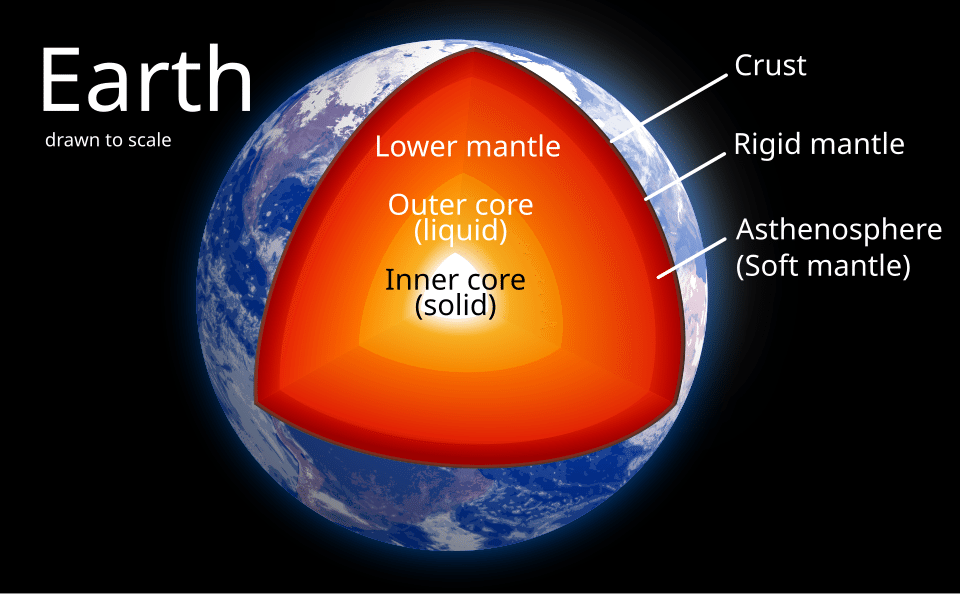

Seismic body waves travel at velocities determined by the density and elasticity of the material through which they pass, and they bend, reflect, or are absorbed at boundaries between materials of fundamentally different character. By recording these signals at seismometer networks around the globe and working backward through wave-propagation physics, geologists have constructed a detailed model of the planet's interior without ever directly sampling it below a depth of about 12 kilometres.7
The outermost layer, the crust, is the thin skin of silicate rock on which all surface geology occurs. Oceanic crust, composed predominantly of dense basalt and gabbro, averages only 5 to 10 kilometres in thickness and is continuously created at mid-ocean ridges and recycled back into the mantle at subduction zones. Continental crust is thicker—averaging 35 to 40 kilometres and reaching over 70 kilometres beneath major mountain ranges—and is composed of less dense granitic rocks that resist subduction and therefore accumulate over geological time, with some fragments exceeding 4 billion years in age.1, 8
Beneath the crust lies the mantle, extending to a depth of 2,891 kilometres and constituting roughly 84 percent of Earth's volume. The mantle is composed of silicate minerals—principally olivine, pyroxene, and their high-pressure polymorphs—and is solid in the conventional sense, transmitting both compressional and shear seismic waves. Yet on geological timescales of millions of years, the mantle behaves as an extremely viscous fluid and flows by solid-state convection, driven by the escape of heat from the planet's interior. This convective circulation is the engine that drives plate tectonics.3 At the centre of the planet lies the core: a liquid outer core of iron-nickel alloy whose convective motions generate Earth's protective magnetic field, and a solid inner core where pressures exceed 3.5 million atmospheres and temperatures approach 5,000 to 6,000 degrees Celsius.1
Plate tectonics: the unifying framework
The theory of plate tectonics, assembled in the 1960s from converging lines of evidence—seafloor magnetic anomaly stripes, global earthquake distribution, the age progression of oceanic crust away from ridge axes, and direct geodetic measurements of plate motion—holds that Earth's lithosphere is divided into a mosaic of rigid plates that move relative to one another atop the weaker asthenosphere beneath.2 Three types of plate boundary define the fundamental interactions. At divergent boundaries, plates move apart and new lithosphere forms from upwelling mantle melt, as along the Mid-Atlantic Ridge. At convergent boundaries, one plate descends beneath another in the process of subduction, generating deep ocean trenches, explosive volcanism, and seismic activity. At transform boundaries, plates slide horizontally past each other, producing strike-slip earthquakes such as those along the San Andreas Fault.2, 6
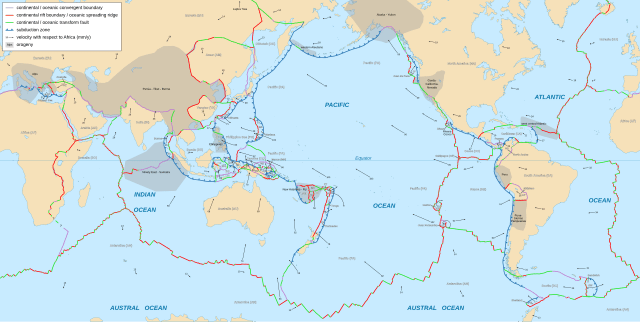

The forces driving plate motion are now well understood. Slab pull—the gravitational descent of cold, dense oceanic lithosphere at subduction zones—is regarded as the dominant mechanism, supported by the observation that plates attached to large subducting slabs move substantially faster than those without. Ridge push, the gravitational sliding of elevated lithosphere away from mid-ocean ridges, provides an additional driving force. Mantle convection, driven by the planet's internal heat, is deeply coupled to plate motion rather than simply causing it: the plates are themselves the upper thermal boundary layer of the mantle convection system.3, 4
Plate tectonics operates on timescales both human and geological. Modern GPS networks measure plate velocities of one to seventeen centimetres per year with millimetre precision, confirming rates derived independently from seafloor magnetic anomaly analysis.6 Over hundreds of millions of years, the cumulative effect of these motions has assembled and fragmented supercontinents in a recurring cycle: the most recent, Pangaea, assembled roughly 320 million years ago and began breaking apart approximately 200 million years ago, producing the present configuration of continents and oceans.6
Volcanism and igneous processes
Volcanism is the surface expression of magma—molten or partially molten rock generated by partial melting in the mantle or lower crust—rising through the lithosphere and erupting at the surface. The vast majority of Earth's volcanism occurs at plate boundaries: at divergent margins, where decompression melting of upwelling mantle produces basaltic magma along the global mid-ocean ridge system, and at convergent margins, where water released from subducting slabs lowers the melting point of the overlying mantle wedge, generating the andesitic and dacitic magmas that feed explosive volcanic arcs.8 A smaller but significant fraction of volcanism occurs at intraplate hotspots, where deep mantle plumes impinge on the base of the lithosphere and produce ocean island chains such as Hawaii.8
The character of a volcanic eruption depends principally on the composition and gas content of the magma. Low-viscosity basaltic magma, poor in silica and dissolved volatiles, produces relatively gentle effusive eruptions that build broad shield volcanoes. High-viscosity silicic magma, rich in dissolved gases that expand explosively as pressure drops during ascent, produces the violent Plinian eruptions characteristic of convergent-margin stratovolcanoes—eruptions capable of injecting ash and sulfur aerosols into the stratosphere with global climatic consequences.8 The same processes that produce volcanic rocks at the surface also form plutonic igneous rocks—granites, gabbros, diorites—when magma solidifies slowly at depth. These plutonic bodies constitute the deep structural foundations of the continents.8
Mountain building


Mountain building, or orogeny, results from the compressive forces generated at convergent plate boundaries. When oceanic lithosphere subducts beneath a continental margin, the associated volcanism, sediment accretion, and crustal shortening produce cordilleran-type mountain belts such as the Andes. When two continental plates collide—neither being dense enough to subduct efficiently—the result is the most dramatic form of orogeny: the wholesale thickening and elevation of the crust along the collision zone, as exemplified by the Himalayas and the Tibetan Plateau, produced by the ongoing collision of the Indian and Eurasian plates that began approximately 50 million years ago.6
The elevation of mountain ranges is not permanent. From the moment tectonic forces begin raising rock above its surroundings, gravity, water, ice, and wind begin tearing it down. Weathering disaggregates rock, rivers incise valleys and transport sediment to basins and the sea, and glaciers carve cirques and U-shaped valleys. The balance between tectonic uplift and erosion determines the height and form of a mountain range at any given time.8 This interplay between construction and destruction operates on timescales of tens of millions of years and connects the deep Earth processes studied by structural geologists and geophysicists to the surface processes studied by geomorphologists and sedimentologists.
The total heat flow from Earth's interior—approximately 47 terawatts, sourced roughly equally from residual primordial heat and the ongoing decay of radioactive isotopes in the mantle and crust—sustains all of these processes.5 Without this internal heat engine, mantle convection would cease, plate motion would stop, volcanism would end, and the Earth would become a geologically dead body, its surface shaped only by impact cratering, weathering, and gravitational settling.