Overview
- The fossil record documents a continuous narrative of life's history spanning 3.7 billion years, from the earliest microbial communities through the Cambrian explosion of animal body plans, the colonization of land, the age of dinosaurs, and the rise of mammals.
- Major transitions—the origin of photosynthesis, the evolution of multicellularity, the fish-to-tetrapod transition, the origin of flight, and the mammalian radiation—are each documented by sequences of transitional fossils that show the stepwise acquisition of new anatomical features.
- The temporal ordering of the fossil record is absolute: simpler organisms consistently precede more complex ones, and no fossil has ever been found in the wrong geological stratum—a pattern confirmed independently by molecular phylogenetics and radiometric dating.
The fossil record preserves a continuous, cross-validated narrative of life's history on Earth that stretches from the earliest microbial communities more than 3.7 billion years ago to the complex ecosystems of the present day. This narrative is not a single thread of evidence but a convergence of independent lines of inquiry—paleontology, molecular phylogenetics, radiometric geochronology, and comparative anatomy—all pointing to the same sequence of events.1, 10 The pages that follow trace the broad arc of that history, from the first cells to the modern biosphere, through the major transitions that define the story of life on our planet.
The earliest life
The oldest putative evidence of life on Earth comes from rocks in northern Quebec, Canada, where Dodd and colleagues reported microbial fossils and chemical biosignatures in hydrothermal vent precipitates dating to approximately 3.77 to 4.28 billion years ago.2 The oldest widely accepted microfossils—filamentous structures interpreted as cyanobacteria or their relatives—are found in rocks of the Pilbara Craton in Western Australia and the Barberton Greenstone Belt in South Africa, both roughly 3.5 billion years old.1 For approximately the first three billion years of Earth history, life was exclusively microbial: single-celled organisms that left their mark in the geological record primarily through stromatolites, the laminated carbonate structures built by successive layers of photosynthetic microbial mats.1
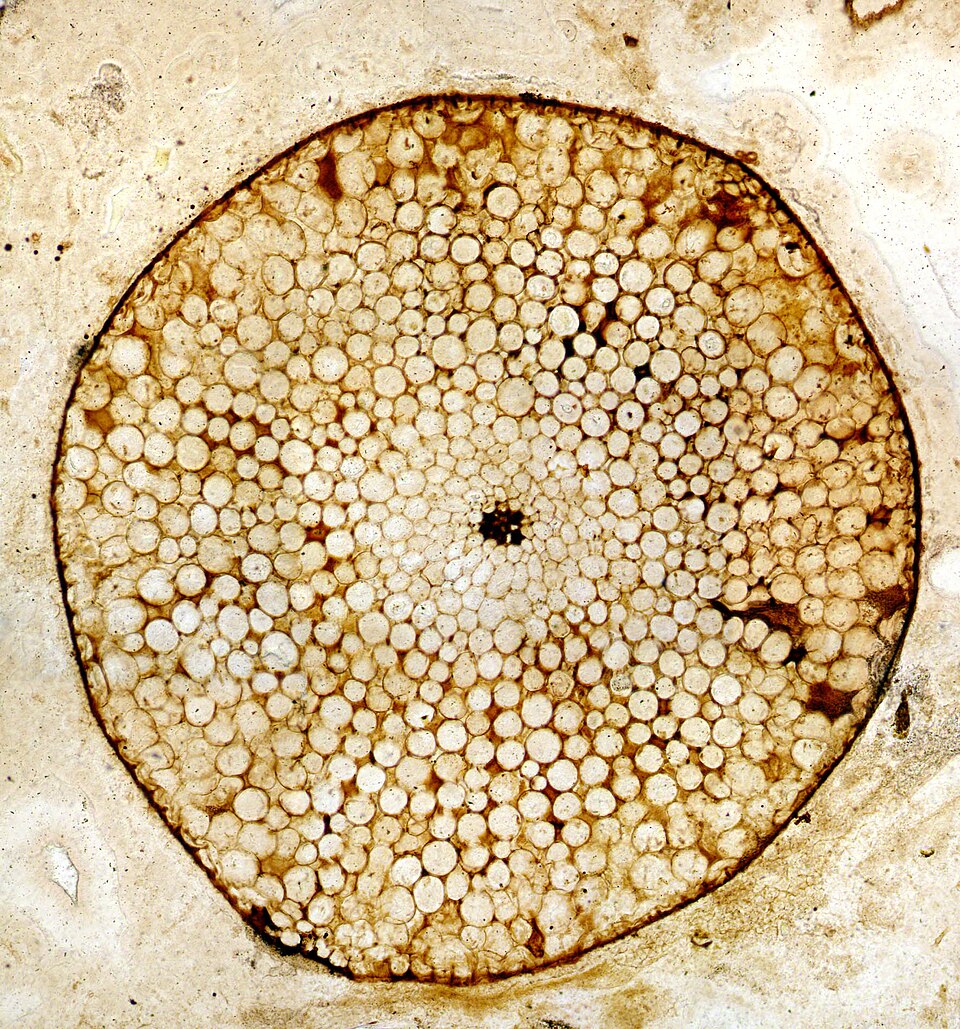

The evolution of oxygenic photosynthesis by cyanobacteria was among the most consequential events in the history of life. By splitting water molecules and releasing molecular oxygen as a waste product, cyanobacteria gradually transformed the atmosphere from anoxic to oxygen-rich over the course of hundreds of millions of years. The Great Oxidation Event, approximately 2.4 billion years ago, marks the point at which atmospheric oxygen first rose to geologically detectable levels, permanently altering the chemistry of the oceans and atmosphere and setting the stage for the later evolution of complex aerobic organisms.7 A second, more dramatic rise in atmospheric oxygen during the Neoproterozoic, roughly 800 to 540 million years ago, may have been a prerequisite for the evolution of large-bodied animals.7
The Cambrian explosion and early animal life
The Cambrian explosion, beginning approximately 538 million years ago and spanning roughly 20 million years, represents the most dramatic diversification event in the history of animal life. Within this geologically brief interval, nearly all major animal body plans (phyla) appeared in the fossil record, including arthropods, mollusks, echinoderms, annelids, chordates, and numerous groups with no surviving descendants.3 Exceptional fossil deposits—Lagerstatten such as the Burgess Shale in British Columbia and the Chengjiang biota in Yunnan, China—preserve the soft tissues of these early animals in extraordinary detail, revealing an astonishing menagerie that includes the meter-long predator Anomalocaris, the five-eyed Opabinia, and the earliest known chordates.3
The causes of the Cambrian explosion remain an active area of research. Rising oceanic oxygen levels may have removed a physiological barrier to large body size; the evolution of predation likely triggered evolutionary arms races that drove the rapid elaboration of defensive shells, spines, and burrowing behavior; and developmental genetic changes—particularly in the toolkit genes that control body plan organization—may have increased the morphological evolvability of animal lineages.3 Molecular clock analyses consistently push the origin of animal lineages tens of millions of years before their first abundant fossil appearance, suggesting that the explosion reflects both a genuine ecological revolution and the sudden acquisition of preservable mineralized skeletons.3
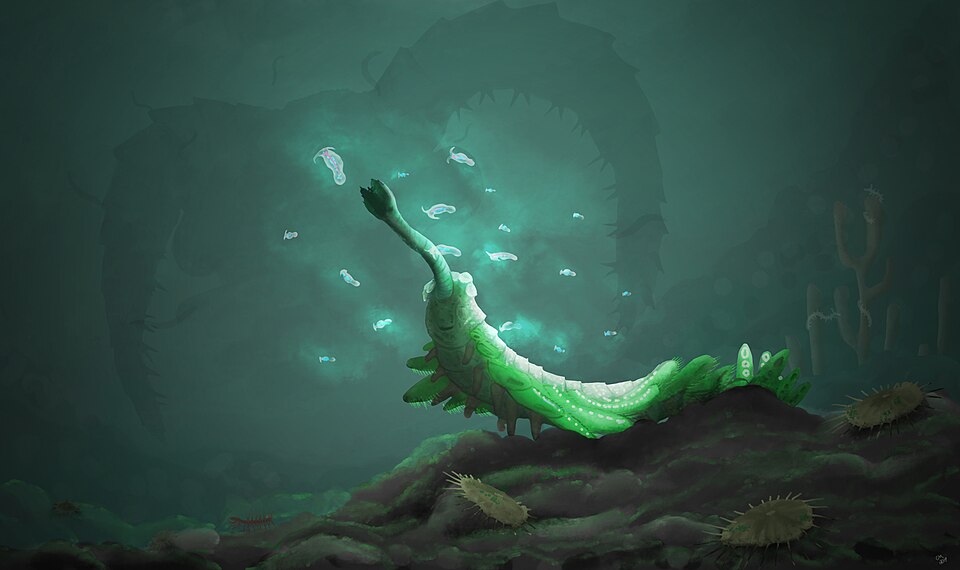

Following the Cambrian explosion, the Great Ordovician Biodiversification Event (approximately 485 to 450 million years ago) produced a second major pulse of marine diversification, roughly tripling the number of marine invertebrate genera. Unlike the Cambrian explosion, which primarily produced novel body plans, the Ordovician radiation filled ecological space within already-established phyla, generating high diversity of genera and species among brachiopods, crinoids, bryozoans, corals, and graptolites.8
The colonization of land
Life's transition from water to land was not a single event but a series of independent colonizations by different lineages over more than 100 million years. The earliest land plants—simple, non-vascular organisms related to modern liverworts—appear in the fossil record during the Ordovician, approximately 470 million years ago. Vascular plants, with internal plumbing for transporting water and nutrients, diversified through the Silurian and Devonian, and by the Late Devonian vast forests of tree-sized plants covered the continents, fundamentally altering terrestrial weathering, atmospheric carbon dioxide levels, and global climate.1
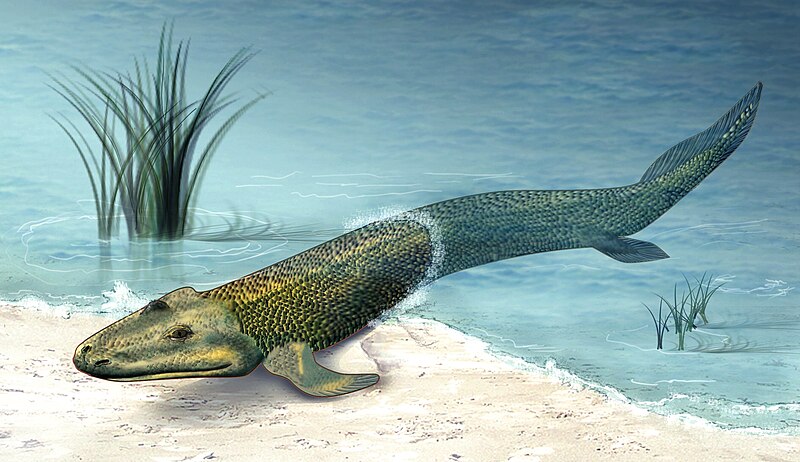

The colonization of land by vertebrates is among the best-documented major transitions in the fossil record. The fish-to-tetrapod transition, occurring in the Late Devonian approximately 375 million years ago, is recorded by a series of fossils that show the stepwise acquisition of limb-like fins, necks, ribs, and lungs appropriate for life in shallow water and on land. The most celebrated of these transitional forms is Tiktaalik roseae, described in 2006 from the Canadian Arctic, which possesses a mosaic of fish-like features (scales, fin rays) and tetrapod-like features (a mobile neck, robust ribs, a wrist joint capable of bearing weight) that places it precisely at the predicted intermediate stage between lobe-finned fish and the earliest limbed vertebrates.4 Subsequent work on Tiktaalik's pelvic anatomy confirmed that its hind fins were also becoming load-bearing, documenting the transition from fin-driven to limb-driven locomotion in anatomical detail.9
The age of reptiles
The Mesozoic Era—comprising the Triassic, Jurassic, and Cretaceous periods from 252 to 66 million years ago—is often called the Age of Reptiles for the dominance of dinosaurs and their relatives across terrestrial, marine, and aerial ecosystems. Dinosaurs first appeared in the Late Triassic, roughly 231 to 243 million years ago, as small, bipedal animals in the wake of the End-Permian extinction that had devastated earlier reptile groups. Following the End-Triassic extinction approximately 201 million years ago, which eliminated many competing archosaur lineages, dinosaurs diversified rapidly and achieved ecological dominance across every continent.5
The two major dinosaur lineages—Saurischia (lizard-hipped, including theropods and sauropods) and Ornithischia (bird-hipped, including hadrosaurs, ceratopsians, and ankylosaurs)—collectively filled virtually every large-body ecological niche on land for approximately 165 million years. Sauropods such as Argentinosaurus reached masses exceeding 70 tonnes, making them the largest land animals ever to have lived. Theropod predators ranged from the iconic Tyrannosaurus rex to small, feathered maniraptorans that would eventually give rise to birds.5 Meanwhile, pterosaurs dominated the skies and marine reptiles—ichthyosaurs, plesiosaurs, and mosasaurs—occupied the top predator niches in the oceans. The End-Cretaceous extinction 66 million years ago terminated all non-avian dinosaurs, all pterosaurs, and all marine reptiles, but one lineage of small, feathered theropods survived: the birds, which are living dinosaurs by phylogenetic definition.5
The rise of mammals
The evolutionary history of mammals extends far deeper than the post-dinosaur radiation for which they are best known. The synapsid lineage that gave rise to mammals diverged from other amniotes more than 300 million years ago, during the Carboniferous Period. The fossil record preserves a remarkably complete sequence of transitional forms documenting the gradual transformation from reptile-grade synapsids to true mammals over roughly 100 million years, including progressive changes in skull architecture, jaw mechanics, and the migration of jaw bones into the middle ear—one of the most thoroughly documented evolutionary transitions in vertebrate paleontology.6
Throughout the Mesozoic, mammals coexisted with dinosaurs for over 160 million years but remained mostly small-bodied, with the majority weighing less than one kilogram. Recent fossil discoveries have revealed, however, that Mesozoic mammals were far more ecologically diverse than previously appreciated: gliding forms, swimming forms, burrowing forms, and even a badger-sized predator capable of feeding on small dinosaurs have been described from Jurassic and Cretaceous deposits in China and elsewhere.6
The End-Cretaceous extinction 66 million years ago removed the non-avian dinosaurs and cleared virtually every large-body ecological niche on land. Mammals exploited this opportunity with an explosive Paleocene and Eocene radiation that produced every major living order within roughly 10 to 15 million years. By the Eocene, the ancestors of whales had returned to the sea, bats had taken to the air, and large-bodied herbivores and predators were well established on every continent.6 The subsequent Cenozoic Era—the last 66 million years—has been called the Age of Mammals, during which placental and marsupial mammals diversified into the tens of thousands of species that dominate terrestrial ecosystems today.
The consistency of the record
One of the most compelling features of the fossil record is its absolute temporal ordering. Simpler organisms consistently precede more complex ones in the geological column: bacterial microfossils appear in rocks over 3.5 billion years old, multicellular algae in rocks approximately 1.2 billion years old, and animals with mineralized skeletons only in the latest Precambrian and Cambrian. No mammal has ever been found in Cambrian rocks; no trilobite has ever been found in Cenozoic strata. This consistent ordering, maintained across hundreds of thousands of fossil localities on every continent, is a direct consequence of evolutionary succession and is incompatible with any alternative framework.1
Independent lines of evidence confirm and cross-validate the fossil narrative. Molecular phylogenetics, which reconstructs evolutionary relationships from DNA and protein sequences without reference to the fossil record, consistently produces branching patterns and divergence time estimates that agree with the fossil evidence about when major groups first appeared and how they are related.10 Radiometric dating provides absolute numerical ages that confirm the relative ordering established by biostratigraphy. The convergence of these independent methods—each with different assumptions, different sources of error, and different investigators—provides powerful confirmation that the narrative reconstructed from fossils faithfully represents the actual history of life on Earth.1, 10